Those small steps matter, and there’s always a first one.
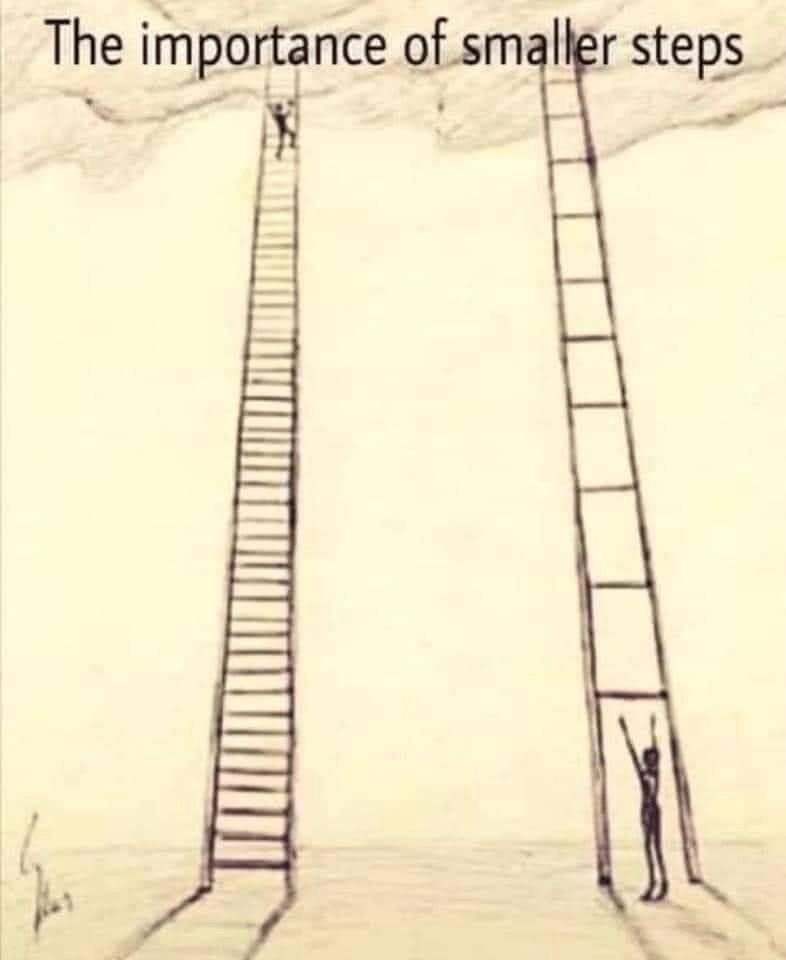

Those small steps matter, and there’s always a first one.

Drum Major Instinct– a sermon by Dr. Martin Luther King, Jr. [abridged]
This morning I would like to use as a subject from which to preach: “The Drum Major Instinct.” “The Drum Major Instinct.” And our text for the morning is taken from a very familiar passage in the tenth chapter as recorded by Saint Mark. Beginning with the thirty-fifth verse of that chapter, we read these words:
“And James and John, the sons of Zebedee, came unto him saying, ‘Master, we would that thou shouldest do for us whatsoever we shall desire.’ And he said unto them, ‘What would ye that I should do for you?’ And they said unto him, ‘Grant unto us that we may sit, one on thy right hand, and the other on thy left hand, in thy glory.’ But Jesus said unto them, ‘Ye know not what ye ask: Can ye drink of the cup that I drink of? and be baptized with the baptism that I am baptized with?’ And they said unto him, ‘We can.’ And Jesus said unto them, ‘Ye shall indeed drink of the cup that I drink of, and with the baptism that I am baptized withal shall ye be baptized: but to sit on my right hand and on my left hand is not mine to give; but it shall be given to them for whom it is prepared.’” And then Jesus goes on toward the end of that passage to say, “But so shall it not be among you: but whosoever will be great among you, shall be your servant: and whosoever of you will be the chiefest, shall be servant of all.”
The setting is clear. James and John are making a specific request of the master. They had dreamed, as most of the Hebrews dreamed, of a coming king of Israel who would set Jerusalem free and establish his kingdom on Mount Zion, and in righteousness rule the world. And they thought of Jesus as this kind of king. And they were thinking of that day when Jesus would reign supreme as this new king of Israel. And they were saying, “Now when you establish your kingdom, let one of us sit on the right hand and the other on the left hand of your throne.”
Now very quickly, we would automatically condemn James and John, and we would say they were selfish. Why would they make such a selfish request? But before we condemn them too quickly, let us look calmly and honestly at ourselves, and we will discover that we too have those same basic desires for recognition, for importance. That same desire for attention, that same desire to be first. Of course, the other disciples got mad with James and John, and you could understand why, but we must understand that we have some of the same James and John qualities. And there is deep down within all of us an instinct. It’s a kind of drum major instinct—a desire to be out front, a desire to lead the parade, a desire to be first. And it is something that runs the whole gamut of life.
And so before we condemn them, let us see that we all have the drum major instinct. We all want to be important, to surpass others, to achieve distinction, to lead the parade. Alfred Adler, the great psychoanalyst, contends that this is the dominant impulse. Sigmund Freud used to contend that sex was the dominant impulse, and Adler came with a new argument saying that this quest for recognition, this desire for attention, this desire for distinction is the basic impulse, the basic drive of human life, this drum major instinct.
And you know, we begin early to ask life to put us first. Our first cry as a baby was a bid for attention. And all through childhood the drum major impulse or instinct is a major obsession. Children ask life to grant them first place. They are a little bundle of ego. And they have innately the drum major instinct.
Now in adult life, we still have it, and we really never get by it. We like to do something good. And you know, we like to be praised for it. Now if you don’t believe that, you just go on living life, and you will discover very soon that you like to be praised. Everybody likes it, as a matter of fact. And somehow this warm glow we feel when we are praised or when our name is in print is something of the vitamin A to our ego. Nobody is unhappy when they are praised, even if they know they don’t deserve it and even if they don’t believe it. The only unhappy people about praise is when that praise is going too much toward somebody else. But everybody likes to be praised because of this real drum major instinct.
…Do you know that a lot of the race problem grows out of the drum major instinct? A need that some people have to feel superior. A need that some people have to feel that they are first, and to feel that their white skin ordained them to be first. And they have said over and over again in ways that we see with our own eyes. In fact, not too long ago, a man down in Mississippi said that God was a charter member of the White Citizens Council. And so God being the charter member means that everybody who’s in that has a kind of divinity, a kind of superiority. And think of what has happened in history as a result of this perverted use of the drum major instinct. It has led to the most tragic prejudice, the most tragic expressions of man’s inhumanity to man.
….And not only does this thing go into the racial struggle, it goes into the struggle between nations. And I would submit to you this morning that what is wrong in the world today is that the nations of the world are engaged in a bitter, colossal contest for supremacy. And if something doesn’t happen to stop this trend, I’m sorely afraid that we won’t be here to talk about Jesus Christ and about God and about brotherhood too many more years. If somebody doesn’t bring an end to this suicidal thrust that we see in the world today, none of us are going to be around, because somebody’s going to make the mistake through our senseless blunderings of dropping a nuclear bomb somewhere. And then another one is going to drop. And don’t let anybody fool you, this can happen within a matter of seconds. They have twenty-megaton bombs in Russia right now that can destroy a city as big as New York in three seconds, with everybody wiped away, and every building. And we can do the same thing to Russia and China.
But this is why we are drifting. And we are drifting there because nations are caught up with the drum major instinct. “I must be first.” “I must be supreme.” “Our nation must rule the world.” And I am sad to say that the nation in which we live is the supreme culprit. And I’m going to continue to say it to America, because I love this country too much to see the drift that it has taken.
God didn’t call America to do what she’s doing in the world now. God didn’t call America to engage in a senseless, unjust war as the war in Vietnam. And we are criminals in that war. We’ve committed more war crimes almost than any nation in the world, and I’m going to continue to say it. And we won’t stop it because of our pride and our arrogance as a nation.
But God has a way of even putting nations in their place. The God that I worship has a way of saying, “Don’t play with me.” He has a way of saying, as the God of the Old Testament used to say to the Hebrews, “Don’t play with me, Israel. Don’t play with me, Babylon. Be still and know that I’m God. And if you don’t stop your reckless course, I’ll rise up and break the backbone of your power.” And that can happen to America. Every now and then I go back and read Gibbons’ Decline and Fall of the Roman Empire. And when I come and look at America, I say to myself, the parallels are frightening. And we have perverted the drum major instinct.
But let me rush on to my conclusion, because I want you to see what Jesus was really saying. What was the answer that Jesus gave these men? It’s very interesting. One would have thought that Jesus would have condemned them. One would have thought that Jesus would have said, “You are out of your place. You are selfish. Why would you raise such a question?”
But that isn’t what Jesus did; he did something altogether different. He said in substance, “Oh, I see, you want to be first. You want to be great. You want to be important. You want to be significant. Well, you ought to be. If you’re going to be my disciple, you must be.” But he reordered priorities. And he said, “Yes, don’t give up this instinct. It’s a good instinct if you use it right. It’s a good instinct if you don’t distort it and pervert it. Don’t give it up. Keep feeling the need for being important. Keep feeling the need for being first. But I want you to be first in love. I want you to be first in moral excellence. I want you to be first in generosity. That is what I want you to do.”
And he transformed the situation by giving a new definition of greatness. And you know how he said it? He said, “Now brethren, I can’t give you greatness. And really, I can’t make you first.” This is what Jesus said to James and John. “You must earn it. True greatness comes not by favoritism, but by fitness. And the right hand and the left are not mine to give, they belong to those who are prepared.”
And so Jesus gave us a new norm of greatness. If you want to be important—wonderful. If you want to be recognized—wonderful. If you want to be great—wonderful. But recognize that he who is greatest among you shall be your servant. That’s a new definition of greatness.
And this morning, the thing that I like about it: by giving that definition of greatness, it means that everybody can be great, because everybody can serve.
……Every now and then I guess we all think realistically about that day when we will be victimized with what is life’s final common denominator—that something that we call death. We all think about it. And every now and then I think about my own death and I think about my own funeral. And I don’t think of it in a morbid sense. And every now and then I ask myself, “What is it that I would want said?” And I leave the word to you this morning.
If any of you are around when I have to meet my day, I don’t want a long funeral. And if you get somebody to deliver the eulogy, tell them not to talk too long. (Yes) And every now and then I wonder what I want them to say. Tell them not to mention that I have a Nobel Peace Prize—that isn’t important. Tell them not to mention that I have three or four hundred other awards—that’s not important. Tell them not to mention where I went to school.
I’d like somebody to mention that day that Martin Luther King, Jr., tried to give his life serving others.
I’d like for somebody to say that day that Martin Luther King, Jr., tried to love somebody.
I want you to say that day that I tried to be right on the war question.
I want you to be able to say that day that I did try to feed the hungry.
And I want you to be able to say that day that I did try in my life to clothe those who were naked.
I want you to say on that day that I did try in my life to visit those who were in prison.
I want you to say that I tried to love and serve humanity.
Yes, if you want to say that I was a drum major, say that I was a drum major for justice. Say that I was a drum major for peace. I was a drum major for righteousness. And all of the other shallow things will not matter. I won’t have any money to leave behind. I won’t have the fine and luxurious things of life to leave behind. But I just want to leave a committed life behind. And that’s all I want to say.
If I can help somebody as I pass along,
If I can cheer somebody with a word or song,
If I can show somebody he’s traveling wrong,
Then my living will not be in vain.
If I can do my duty as a Christian ought,
If I can bring salvation to a world once wrought,
If I can spread the message as the master taught,
Then my living will not be in vain.
Yes, Jesus, I want to be on your right or your left side, not for any selfish reason. I want to be on your right or your left side, not in terms of some political kingdom or ambition. But I just want to be there in love and in justice and in truth……
[and in commitment to others, so that we can make of this old world a new world.]
Did you know that there’s a fish with a silly name that looks like a Demogorgon?

I must confess something… I’m kind of over cold weather. At the very least, I desire a longer break from it. But as we hit Halloween last evening, we had the first snowflakes. This is life in the Upper Midwest.
I’m sure we’ll get some bizarre pockets of warmer weather throughout the upcoming season, and I’ll take advantage of those for sure. I also plan to get myself to some warmer locations here and there over the next six months. Anyway, that’s my honest confession. I’m not excited about this change this year.
But here’s another thing that’s also true for me: I like when we hit a new month. I’m a believer in the fresh start effect, and sometimes, I like to choose themes or rhythms for a particular month, kind of like a new year’s resolution that lasts only for that month (unless I like it so much that it sticks around).
So I’m declaring this month to be Novelty November. I want to try something new every day. It can be a very small, new experience rather than a big ordeal. I might drive or bike on a new road, eat a new food, or attend a new-to-me community event. I might learn something new. (I already do that most days, but I’ll be more intentional and grateful for it). I might shift up some of my daily routines. This will make the shift into this month a little more exciting.
If you want to join me for Novelty November, let me know!

I like to pair these two quotes together:
Howard Thurman says,
“Don’t ask what the world needs. Ask what makes you come alive, and go do it. Because what the world needs is people who have come alive.”
Frederick Buechner says,
You are called to the place “where your deep gladness meets the world’s deep hunger.”
How do these connect to you?
—Renee Roederer
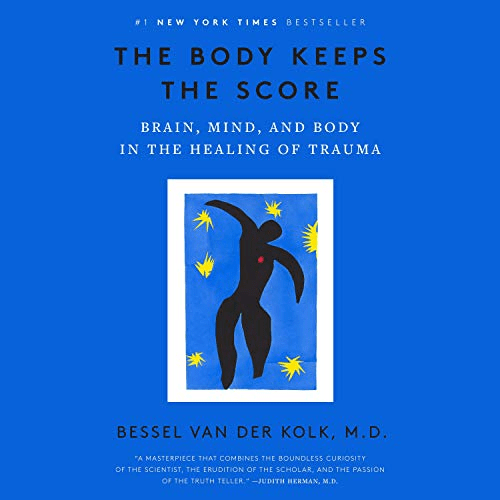
Slowly and intentionally,, I’ve been listening to Bessel Van Der Kolk’s pivotal work, The Body Keeps the Score: Brain, Mind, and Body in the Healing of Trauma on audiobook. Truly, I’d place it in the top five books I’ve ever read. I recommend it frequently to others.
The book is remarkably insightful and impactful in addressing how traumatic experiences are carried in the body. In addition to explaining the physiology of post-traumatic symptoms in detail, he uplifts a number of somatic approaches to healing trauma in our bodies and relationships.
Today, I’d like to uplift a quote that really spoke to me. Bessel Van Der Kolk says,
“Study after study shows that having a good support network constitutes the single most powerful protection against becoming traumatized. Safety and terror are incompatible. When we are terrified, nothing calms us down like a reassuring voice or the firm embrace of someone we trust.”
After hearing him talk about so many other protective factors, studies, and forms of therapy, I thought it was really significant for him to say that support networks and forms of community are the single most powerful protection against becoming traumatized.
When you reach out to someone…
When you share how you’re really doing…
When you introduce people to each other…
When you learn about community organizations…
When you suggest community resources…
You are participating in the protection of the body, mind, and spirit. You are building networks that protect yourself and your neighbors from becoming traumatized.

While on a Zoom with a group of teenagers, one of them quoted the 1988 movie Heathers, well before her time: “If you were happy every day of your life, you wouldn’t be a human being. You’d be a game-show host.”
Thanks, kiddo, for that gem. I’ll share that one from time to time. And I’ll tell myself too.
—Renee Roederer

We welcome the new moon.
Cheshvan,
month to turn inward.
Inward, to review and reflect
a time to dive deep
a place of quiet stillness.
But the New Year festivities
Music and rejoicing
were interrupted.
Marred by violence.
Murder of innocents
in their beds, homes, fields.
How can we witness such brutality
while our aching hearts
yearn for peace?
We cry out for an end to
Smoldering hatred
Continual violence
Danger for our children.
Do we not learn anything
traveling this human path
In these mortal bodies?
Must history repeat itself?
We cycle in circles
with cries of revenge
leading us to despair.
Oh, Shechinah, Holy One of Blessing,
Teach us to deepen in awareness
Lift ourselves from
desperate repetition.
Brother killing brother.
Release us from this bondage.
Help us find a place of balance
where darkness transmutes to light.
Let us return to the natural rhythms of
body and earth
Resonate with water and wind
Touch our inner well of wisdom
Come home to our unity
with all sentient beings
And find comfort in heart openings
connecting us to each other and the One.
–Lucinda Kurtz