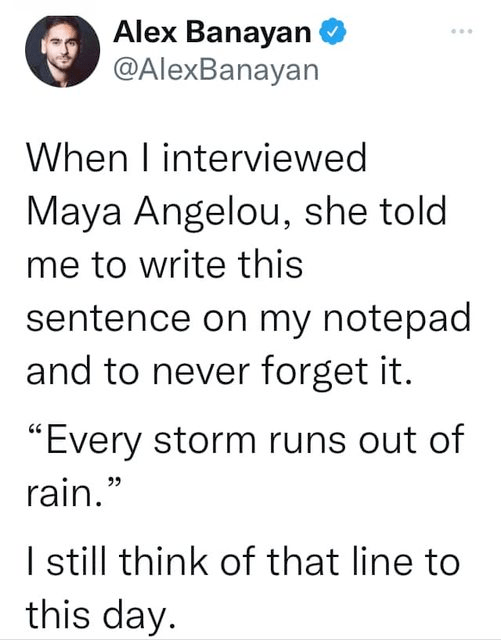
The image above is a tweet from @AlexBanayan, and I really love it. It reads,
“When I interviewed Maya Angelou, she told me to write this sentence on my notepad and to never forget it. ‘Every storm runs out of rain.’ i still think of that line to this day.”
As I reflect on this, I think it can mean a number of things:
— Some storms aren’t worth our energy. — Sometimes, we’ve fought too long in a direction that’s not worth it. Just walk away.
But I think my favorite is this:
— Sometimes, with time, the clouds clear. The pain is clearer too, or healed or healing. And love, or possibility, or expansiveness, or growth is what remains.
Whether you have trauma in your childhood or have pains and griefs in adulthood, I think this video from Anna Runkle gives good advice, so I’d love to share it today. When you feel stuck emotionally or situationally, how do you move through it?
She shares that we need to imagine a better future and begin telling ourselves a more life-giving story.
Image Description: A brown mat with the word “Welcome” in black. It’s on the ground in front of a yellow door which is slightly ajar. Public domain image.
I woke up happy, hopeful, and uplifted, and I was grateful. On Saturday, I shared here about my sudden, unexpected back pain. But already by Sunday, it was gone, and I was feeling both lighter and delighted.
This caused me to reflect: Sometimes, we need to make space for our pain and feel our way through it, whether it is physical, emotional, or both. Though that is challenging, it may need our attention and our intention to tend to it. It many cases, it won’t persist in the same way forever. It may also clear us out for something different. I think about one of my favorite poems,
The Guesthouse
This being human is a guest house. Every morning a new arrival.
A joy, a depression, a meanness, some momentary awareness comes as an unexpected visitor.
Welcome and entertain them all! Even if they are a crowd of sorrows, who violently sweep your house empty of its furniture, still, treat each guest honorably. He may be clearing you out for some new delight.
The dark thought, the shame, the malice. meet them at the door laughing and invite them in.
Be grateful for whatever comes. because each has been sent as a guide from beyond.
— Jellaludin Rumi, translation by Coleman Barks
Whatever you’re feeling, may you be cleared out for some new delight.
My 40th birthday was more than a month ago, but this year, I asked my loved ones for something unique. I asked them to pick a random month of the year and surprise me with something. I said it doesn’t need to be big — no flash mobs needed. But I dearly love surprises, and I thought it would be fun to spread that energy throughout a whole year.
I’ve received boxes of goodies in the mail and a new coffee mug that I love. I’ve been surprise sledding and surprise roller skating. One person — and this is so generous — is making me a surprise meal once per month. Last weekend, she made me linguine from scratch. How lucky am I?
And then last night, I shared a text with a young adult I love to see if we wanted to pick up watching where we left off with Buffy the Vampire Slayer (My favorite show ever! We watching it all bit by bit, and we sync our screens over distance.) “How about 8:30?” she replied.
“Yep,” I replied simply.
8:30pm rolled around, and my doorbell rang. She drove from an hour away to watch it with me in person!
To my great surprise, I woke up this morning with a migraine and intense, lower back pain. (What is this? Is this 40? Just kidding. I think.) I have no idea why. I do get migraines a few times a year, but back pain is not common at all for me. It’s also gotten progressively better throughout the morning, thankfully.
Michigan Nones and Dones, one of the communities I help organize, meets on Saturday, and there are many people there who can also help to lead and welcome newcomers. By the time I got on the screen, I felt a bit better, but they all did this.
Part of leadership is nurturing the leadership of others and/or just getting out of the way and letting them do what they are already so good at doing.
Image Description: The expanding universe, Public domain.
One of my favorite, quirky-but-true things to think about is how we have never resided in the same physical space. It may feel like it, but that’s not true in a cosmic scale. By this time tomorrow, we will have collectively hurtled 10 million miles through space, as our planet revolves around a sun that is also revolving around the center of the Milky Way. And the universe itself is expanding, so every second, we hurtling and residing in a space we’ve never resided in before.
So when it comes to our own lives, why do we think we have to stay in the same rut we’ve been in for so long?
We’re supposed to get more snow today. I expect that it, too, will look pretty. Shoot, it may even feel magical in its own way. But I confess… I’m a bit over it.
So today, my best blessing is for people who are over it. Over the winter, Over the pandemic, Over difficult dynamics, Over unsustainable rhythms, Over the things that keep us up at night.
Blessings to everyone who is over it. Whatever the it-s may be.
Image Description: There are game pieces resembling people. Eight red ones are grouped together, and one black one is off by itself to the right.
Yesterday, during a Zoom call, one of my mentors said, “I never use the word ‘individual.’ We are unique people, and we have unique skills, talents, interests, and personalities. But I never use the word individual, because individualism is always ‘I will divide’-ism.”
Image Description: In green, a digital clock reads 5:55 PM.
Michigan Nones and Dones, one of the communities I help to organize, had a discussion last weekend about communal rhythms. During the pandemic, these have been much more infrequent, and we’ve been feeling this. We need a sense of shared experience.
As a result of this, we decided to create a communal rhythm of our own. Every day since then, we’ve all set an alarm on our phones for 5:55pm, and when that sounds, we take several minutes to think of each other and send hopes in each other’s direction. I have loved this every day. We are aware that we are holding each other gently, and we know we’re being thought about too.
It feels very meaningful to have awareness that all of this is happening at the same time.