Grace. It is with us and among us. Grace. It is love, gift, worth, and favor for us. Grace. It is above us, behind us, and around us. Grace. It is right here alongside us.
Grace. It precedes us. Grace. It surpasses us. Grace. It is apart from us, God’s Good Gift.
Yet remarkably, This Grace — This with, This among, This above, This behind, This around, This Grace, This Very Grace! God’s Good Gift, It passes through us.
Day by day, Minute by sacred minute, We breathe it, We carry it, We shoulder it. We smuggle it.
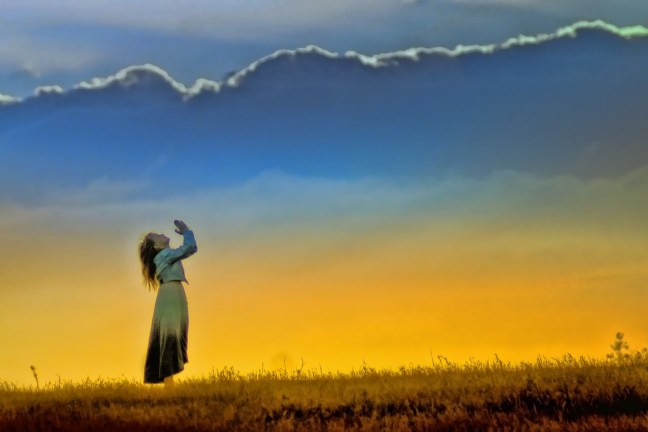
God, breathing life into the world, breathes through us. So with joy let’s smuggle grace this very instant — into ourselves, into each other, into this God-breathed world. . .
Suddenly, I heard my own prayer. As I was making my final rounds before sleep — turning off lights, putting dishes in the sink — I suddenly heard myself, my deeper self, reverberate words from a prayer nine years ago.
There it was, from a moment I had actually forgotten: The words rose up and found themselves inside me like a thought I didn’t think.
It was a mantra I prayed during a Taize service in a time of transition — a time for which I was not ready, yet for which I was being prepared.
Two phrases of prayer, uplifted over and over, anxiety lending itself toward trust, wondering if change can change us even if we would like to change its pathway.
Times like this can shape becoming, our own shaping, our own becoming. Times like this can shape our meaning-making, as we carry mantles we do not know to choose, yet for which we are lovingly chosen.
Despite what we hope for, Despite what we wish for, even our Deepest Despite can lend its way toward a world of meaning and becoming.
So I suppose if a prayer can return again, we can return to this truth, to this wondering, to this becoming.
Image Description: A large, orange-colored full moon is on the horizon in the center of the image, within a black sky. A dir road, down the center of the image, leads to the moon. Grass, trees, and a fence line both sides of the road.
If you close your eyes and awaken your awareness,
If you inhale deeply and let that breath fill every part of your being,
If you allow yourself to sit with the Question — really and truly, as if you were taking it out for tea, it will inhabit you, it will enliven you, it will call you by name, and you will know what I’m talking about.
You will be familiar with the Question, because it keeps making itself familiar to you.
It is that Question that keeps rising again inside your being, like an enormous, beckoning moon, and the mysterious tide She consistently summons.
Yes, listen. Stand on the shore of the horizon and welcome the Question revealed in the waves of longing lingering dreaming.
. . . that Idea that keeps returning, . . . that Love that keeps emerging, . . . that Path that keeps arriving,
Listen. . . In the swell of waves, Ah, there it is – Won’t you?
It sounds for you – Won’t you?
Hear it resound and expand – Won’t you choose that which is choosing you?
I first met her at a children’s hospital where I served as a chaplain.
I was called to the room of her 8 month old baby boy who had an autoimmune disease and had to remain in isolation. The nurse told me that his mother was a sweet girl who spent most of her days in the room alone with her baby and seemed kind of lonely. As the days added up and the case became more acute, Miguel and his mama Maria were transferred to the pediatric intensive care unit (PICU), still, our visits continued and I got to know Maria and sweet baby Miguel more deeply. For all of her natural beauty, Maria lacked any age appropriate self-searching, self conscious awareness of it. She was either oblivious to how strikingly beautiful she was or didn’t care because her energy and efforts were solely focused upon this baby. Maria shared with me that she and the baby’s father had intentionally become pregnant. I was surprised but she was clear and adamant. I felt as though I was speaking to a 30 something grown woman. She was gentle, calm and confident. I repeatedly had to remind myself that she was only 14 years old. She was completely unapologetic about her situation and wholly lacking in any perception of any potential societal-heaped shame! I loved that and admired her for it.
While I, as a much older sister-type, was concerned for her development emotionally, physically, mentally and spiritually I’d seen enough of these teenage pregnancies to know that it was often the girls, from families more wealthy than hers, who were faced with the pressure to give up their children before or after birth, one way or another and who later suffered from having to keep the secrets associated with an unexpected pregnancy. Even during this time, of the late 20th century, saving face for the sake of other family members or themselves seemed to rule the response and decision that weighed so heavily upon and into their young lives.
After baby Miguel had been moved to the PICU his young, 16 y.o. daddy, Joseph, (Maria and Joeseph, yes really!) began to visit during the shift that I covered also, so he would be in the room during my usual visit to Maria. Joseph was in energy and personality, a mirror to Maria! They were very attuned to one another, caring, responsive and gentle. He owned his role as a father, proud, encouraging, supportive, diaper-buying (and changing), a responsible parent. I often thought to myself, ‘these two outperformed most ‘grown-up’ parents with whom I often had contact in this place!’
Joe attended night school to work on his GED as well as working full-time during the day to adequately provide for his little family. He had started coming to the hospital for his lunch breaks, making quick visits to see if Maria or Miguel needed anything and he had just enough time to don the protective gown, mask, gloves, booties and head covering required for little Miguel’s isolation status. As soon as he entered the room, it was a kiss for Maria then he’d scoop up his baby boy, cover him with be-masked kisses, and stand rocking him in his arms.
He told me that when this hospitalization was over, that he and Maria were going to be married and wanted to have several children with this sweet, fat, baby Miguel being the eldest. They had the support of each of their large, extended families and looked very much forward to their future together.As more time passed I continued my visits with Maria and sometimes Joseph, and despite the increasingly grim prognosis for baby Miguel, Maria’s tone and gentle temperament never changed. I wondered at one point if she really understood what the doctors had told her during the progression of family care conferences. In ascertaining this I’d ask her what stood out to her from what the doctor had said this day or that. She was always clear in her response to me, repeating in her own words what she’d been told. At times tears would roll down her checks as she told me how much they’d looked forward to the birth of baby Miguel and how much they loved him. Her expectation of life seemed to me to be full and yet not entitled or privileged in any way. This was a thing that was a part of life to her- a dreaded part but she was more than aware that it happened sometimes and as the days rolled by, she began to be comforted by the fact that Miguel would have her grandmother ‘to meet and take care of him in heaven’. I was humbled, baffled and gifted with knowing this unusual pair of young parents. One day I received a call on my pager from the nurse caring for baby Miguel. She informed me that baby Miguel was probably only going to live a few more hours. I thanked God that my colleague Philipe was working that day also, paged him and told him I needed his musical talents, asking him to meet me in the PICU and to please bring his guitar.
Philipe and I gathered with Maria, Joseph and baby Miguel, now no longer required to wear protective garments and enjoying the freedom it offered them at last with their little baby.His parents held onto one another and took turns kissing his face while murmuring sweetnesses to him. I reviewed the time they’d spent here in the hospital thanking God for the gift of this little Miguel, asking that God would sustain them in their continued lovingkindness toward all they met and one another while continuing to hold them in comfort during their grief. When we finished this part I asked Philipe to play a lullaby Maria had sung to Miguel. Philipe played and sang that song and others- at one point Joseph joined in singing a Spanish song he also knew. It was a spontaneous and fulfilling time of blessing and farewell. I asked how else we might support them during this time? Joseph apologized then said, “if it’s okay I think we’d like to spend some time with Miguel, just Maria and me.” I said it was more than okay, drew the shades in the room and we went out into the main area of the PICU.
Within the hour their nurse came to me and said, “I can’t believe it, Maria will not let any of the staff help her with Miguel!’ I asked what she meant? She said, Maria had bathed and changed her baby, dressed him in a long, soft, white baby gown similar to a baptismal gown, then asked the nurse where he was supposed to go next? The nurse said the staff will take him there. Maria had replied, “No, but thank you. I will carry my baby to where he needs to go now”. The nurse then said to me, “Look” the doors to Miguel’s room opened and Maria held Miguel in her arms as Joseph reached for her free hand. Miguel’s dark hair curled around his fat little neck, still damp from the final bath his mother had given him. He eyes were closed with the long dark lashes resting on his round cheeks and the little full lips pursed as he looked to be sleeping peacefully. Every eye in the PICU was upon the little family as Maria exited the area and walked slowly, carrying her baby down the hall.No one had ever done such a thing and while I had not been aware of that fact, it was apparent that THIS was not the usual routine. There were procedures in place for the time following a death, each staffer had a role in the effort to minimize confusion and for the sake of supporting the family.
At 14 years of age, Maria was not aware of the hospital’s procedures and probably didn’t care. She simply deemed it her responsibility to see her baby safely onto the next stop of his journey, so she carried him in her arms to the reception door of the morgue. After pressing the bell, the door opened, with tears streaming down her cheeks, Maria reached out, gently placing her baby into the arms of the young, overwhelmed attendant who had evidently drawn the short straw, by the look of him in the face of the outrageous courage from this mama, Maria kissed her Miguel, whispered goodbye, thanked the attendant, turned and walked away.
Yes always, by far the most loving, self-sacrificing mama I’ve ever seen.
I have thought of this encounter over the years and have learned so much. The strength that self-acceptance offers a person, the richness that enters one’s life by refusing to bow under shaming or ill-treatment by others, the courage it takes to not yield to authority disguised in a lab coat, the value of not bending with the whims of one’s crowd or what is deemed the popular thing to do and that not taking the easy way out but facing what life hands one can be a wonderful, deep and fulfilling journey.
Wendy Terpstra is a daughter, sister, friend, writer, lover, advocate of the downhearted, chaplain and mama. She currently resides in Michigan and although a native considers herself more of a Californian than belonging to any other state.
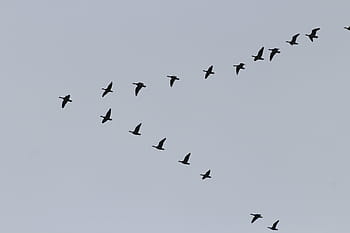
That moment when you awaken to the sound of geese flying over, and you think peacefully, ah, yes, Mary Oliver… That’s right… You don’t have to be good…
Then three minutes later, you hear giggidy jillion more fly over, and it sounds like an utter symphony of clown horns.
And you lose it with laughter.
Good morning, everyone. YOU DON’T HAVE TO BE GOOD.
Image Description: A white question mark, written in chalk, on a blackboard.
These days, I find myself thinking about this often:
Concern and worry are not quite the same. They’re different experiences, I think.
When we’re concerned about something, we take it seriously. And this feels proactive: We think ahead. We consider consequences. We galvanize our strength, our inner resources, and our community resources.
But…
When we’re worried about something, we just spin around our own anxiety. It can feel like a whirlwind.
It’s not easy, and sometimes, not possible to just snap our fingers and exit worry. Anxiety is very physical, and when it takes hold, we’re really in it. This deserves compassion and never shame or criticism.
I wonder, if we can practice moving our worry energy into concern energy, might we inhabit a different stance? Then we can be in a different relationship with what we face or fear.
Some relationships and some communities seem to feel timeless.
Some friendships can pick right back up, even if you haven’t spoken in a long time. Or you can recall memories so vividly that they begin to feel present to you, even if they happened a long time ago. Some people are just with you in a sense. You can bring their presence to you with a thought or a feeling. And some communities seem to be accompanying you in multiple chapters of your life even if they were primarily a part of one.
Maybe timeless isn’t the right word. Maybe this is timefulness.
Before I go any further, it’s important to say that this pandemic is far from over. That’s true in our country, and at this moment, it’s very true within my state. In particular, India is in serious crisis at the moment. So we’ll need to keep taking precautions in a variety of ways based on where we are within the vaccination process and based on the best scientific recommendations before us. My heart goes out to people who are suffering with COVID.
I want to honor this. I also recognize there’s a certain level of privilege in having access to vaccines. That’s so important to say.
For the purpose of this post, ever since I had my first vaccination on March 22, I’ve been calling May 3 my “Donezo Day.” It’s the arrival point two weeks after my second vaccination. According to the CDC, I am fully vaccinated as of today.
The pandemic isn’t done, and I’ll continue to wear my mask in public spaces. But a particular chapter is done for me as of today. And with so much gratitude, I am looking forward to doing some of the things I haven’t done in a long time.
Here’s a small one, and yet one I am thrilled about: I’m going back to Trader Joe’s today for the first time in more than a year. And big ones are coming up too — I can’t wait to spend more time with also-vaccianted-loved-ones.
Unless you have health conditions that cause serious reactions to them, please get vaccinated, friends. Most of all, this helps us collectively. This is how we defeat this coronavirus.
When we connect with a sense of Beyond — when we zoom out to see a larger field of view — we see ourselves in a different light. We encounter our finitude, our fragility, and our power.
In 1990, the space probe and explorer Voyager 1 was 13 years old and 3.7 billion miles away from the earth. On February 14 of that year, scientists commanded the probe to turn around and take a photo of the earth. That command resulted in this image. Astronomer Carl Sagan called it “the pale blue dot.”
He added poetic meaning and power when he added convicting words to this image. He said,
Look again at that dot. That’s here. That’s home. That’s us. On it everyone you love, everyone you know, everyone you ever heard of, every human being who ever was, lived out their lives. The aggregate of our joy and suffering, thousands of confident religions, ideologies, and economic doctrines, every hunter and forager, every hero and coward, every creator and destroyer of civilization, every king and peasant, every young couple in love, every mother and father, hopeful child, inventor and explorer, every teacher of morals, every corrupt politician, every “superstar,” every “supreme leader,” every saint and sinner in the history of our species lived there–on a mote of dust suspended in a sunbeam.
The Earth is a very small stage in a vast cosmic arena. Think of the rivers of blood spilled by all those generals and emperors so that, in glory and triumph, they could become the momentary masters of a fraction of a dot. Think of the endless cruelties visited by the inhabitants of one corner of this pixel on the scarcely distinguishable inhabitants of some other corner, how frequent their misunderstandings, how eager they are to kill one another, how fervent their hatreds.
Our posturings, our imagined self-importance, the delusion that we have some privileged position in the Universe, are challenged by this point of pale light. Our planet is a lonely speck in the great enveloping cosmic dark. In our obscurity, in all this vastness, there is no hint that help will come from elsewhere to save us from ourselves.
The Earth is the only world known so far to harbor life. There is nowhere else, at least in the near future, to which our species could migrate. Visit, yes. Settle, not yet. Like it or not, for the moment the Earth is where we make our stand.
It has been said that astronomy is a humbling and character-building experience. There is perhaps no better demonstration of the folly of human conceits than this distant image of our tiny world. To me, it underscores our responsibility to deal more kindly with one another, and to preserve and cherish the pale blue dot, the only home we’ve ever known.