Image Description: A microphone on a stand with shimmering lights in the background. Public domain image.
We internalize voices of people —
people near, people far,
people recent, people long past,
people who affirmed, people who criticized.
Sometimes, we carry these voices around for a long time.
Who is telling you about you recently? In your own mind, whose voices are chiming up? If we could see a pie chart, what percentage of time and space do those voices take up in our thinking? In our processing? In our feelings? In our beliefs about what is possible?
This may be something to consider, because I know that in many cases, we privilege the most cynical voices.
Maybe we need to turn this completely in the opposite direction. How can we privilege the voices of those who gave affirmation? Those who challenged us because they believed in us? Those who opened up our perspectives on the world? Those who helped us find a calling larger than ourselves? Those who loved us no matter what? Those who created space for us to be ourselves – including opportunities to try things and fail, and get back up again?
Though we are each one person, we are made of these many parts. As we negotiate these, in a real sense, we are in relationship with ourselves. So how do we integrate the best voices into our own internal voice?
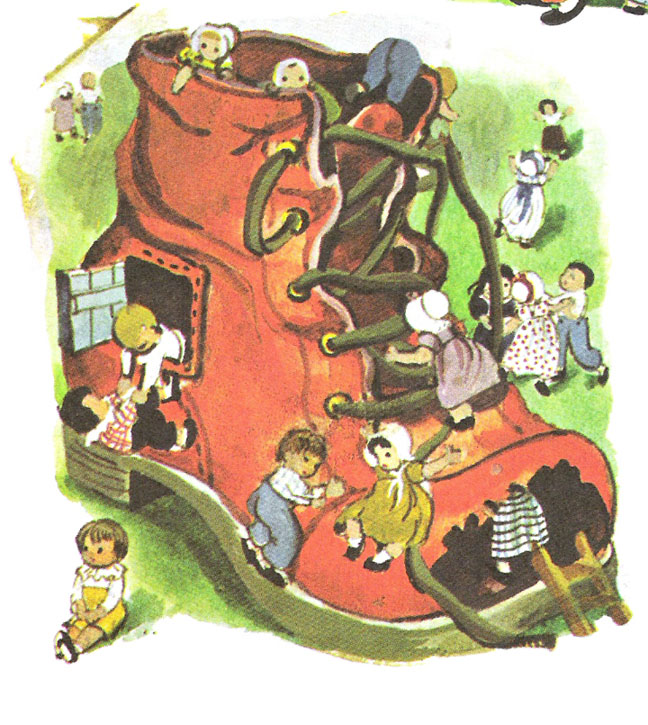
The Old Woman Who Lived in a Shoe, image from Artisan Landscape. Children are coming out of this shoe in all directions!
“What if you think of it this way?” she said.
Sometimes, we can shift a situation simply by reframing it.
Years ago, a friend of mine was feeling sad, frustrated, and angry. Then, as we sometimes do, she began to turn those feelings inward, feeling sad, frustrated, and angry with herself for having such feelings in the first place. In the midst of that, she had a conversation with someone pretty wise. That person said,
“Imagine you’re a grandmother, and you have so very many grandchildren. In fact, you have more grandchildren than you can count, and maybe they’re running around all over the place. It probably feels pretty disorienting. Frustrated though you are, you’re a loving grandmother, so rather than lashing out at all these grandchildren, you approach them one at a time, and you try to figure out why each one is acting up. These grandchildren are your feelings. Maybe they have some things to tell you. What if you approach them one by one and ask them they need?
“Maybe you say, ‘Honey, you can’t run around like this, and you can’t hit your sister feeling over the head. But come here. Can you tell me why you’re frustrated? Can you tell me why you’re feeling so sad? I’m listening to you.’
“Then listen to yourself. Really listen. Mirror back what you hear. ‘Oh, I hear that you’re scared. Yeah, that can feel scary.’ Then say, ‘I’m here.’ And give these grandchildren what they need — love, reassurance, and confidence that you’re going to be present and that you’ll protect them.”
This was a wise reframing.
Sometimes, we especially need to remember that we are in relationship with ourselves. Entering that recognition more deeply, we can have important insights and grow. None of us is uniform or monolithic. We have parts, and sometimes, some parts of ourselves need to be heard by other parts. We can have internal dialogue. No need for shame spirals. We can hear ourselves with loving intention.
So if it’s helpful, I offer this reframing: You too can be that grandmother.
Image Description: A toddler has her back to us with her arms crossed. She has brown hair in pigtails and is wearing a dress and red shoes. We will soon learn that these shoes are very squeaky.
Are you carrying stress today?
Perhaps,
you didn’t sleep well, or
you have a looming deadline, or
you’re juggling a heavy load of responsibilities, or
you’re troubled by the news, or
you’re at wits end with your teenager, or
you’re in a conflict with someone you love.
Whatever it may be,
you are worth
wellness,
space,
grace,
peace,
insight, and
connection.
And a moment of play serves as a reminder. Play reorients and grounds us in what is most true: We are loved and living in a world with lovely gifts, even as it contains real challenges.
Play changes our brains. It calms us and helps us feel more connected. It also shifts us away from our anxious reactivity, allowing us to use the higher levels of our brain functioning to solve problems.
So find a way to play a bit today, even if it’s just for a moment.
Today, I take my cue from a hilarious, adorable toddler. She has a really hard time continuing to sulk in that tantrum once she starts to delight in squeaky, red shoes. Enjoy this video:
Image Description: A black and white photo of Bob Youngblood, my AP English teacher from my senior year of high school. He’s looking to the left and smiling.
During my very last week of high school, every morning began with a creative conspiracy. It was implemented by giggling, teenage masterminds. Collectively, we struggled to stifle our laugher as we waited for our teacher to enter the room. Each stunt stranger than the last, we pranked Mr. Youngblood five days in a row. Our very last days of public education were filled with practical jokes.
And what sort of pranks do teenage masterminds create? Fire alarms, smoke bombs, or egg smeared chalkboards? Not these teenagers. We were way too nerdy for that.
Mr. Youngblood entered the room to find us all wearing. . . Ayn Rand masks.
Ayn Rand masks! A classmate had actually taken the time to find an Ayn Rand image, blow it up, print twenty-five some odd copies, and glue them to sticks so we could hold them to our faces and greet Mr. Youngblood as he walked through the door. Once he did, there we were, dressed to the nines in our Objectivism best. He loved it.
I could say that Mr. Youngblood introduced us to Ayn Rand, but it was, in fact, the other way around. Before we ever met him in the classroom, he assigned The Fountainhead as summer reading. We entered our senior year ready to discuss that large work, and we were introduced to one of our best teachers.
In his English class, we learned how to analyze classic works of literature. We learned how to hone our unique voices as we wrote with greater nuance. We had spirited discussions, and we challenged each other. And we laughed. Every day, we laughed.
This last aspect of our experience has been on my mind lately. Within it, I recognize that a larger lesson was present all along. It was never sketched out as a lesson plan, but Mr. Youngblood embodied it in the classroom. It was both simple and profound: He delighted in us as students. He thoroughly enjoyed us as people.
Sure, we occasionally annoyed him. But most often, he greeted us with a dry wit we also enjoyed. That wit accompanied our intentional learning and created spontaneous moments of playfulness. He believed in our voices. He delighted in us, and we knew it.
Bob Youngblood died almost four years ago. I have been reflecting on this kind of legacy, and pondering the gift of our educators who are certainly stressed during this odd pandemic era we’re living. Teachers impart great knowledge, but they are also in a position to teach a larger lesson of delight. When teachers delight in their students, their students come to know their own worth. From that awareness, they go on to learn in self-directed ways.
Since our Ayn Rand mask wearing days, my classmates and I have more than doubled in age. This astonishes me. Even more, I am amazed to consider who we have become. We have charted career pathways, formed families, and created meaning. Bob Youngblood would delight in all of this too, I am sure.
Robert Frost once wrote that poetry “begins with delight and ends in wisdom.” [1]
Good teachers spark delight and illumine human worth. From these gifts, a lifetime of learning continues.
Image Description: A single, tea light candle is burning. Public domain image.
I want to start a conversation today. If you’d like to chime in in the comments, I’d welcome hearing from you, and your responses could help others.
In this time of pandemic, what’s helping you cope?
It’s certainly not difficult to name what’s causing us challenge. But what coping skills, mindsets, and practices are you engaging for yourself and others?
Here’s one from me. I hold within myself a tension of timescale:
— I assume I’m going to be living like this for a long time.
(longscale timeline to manage expectations)
– and –
— Each day, I ask myself, what can I do to make this day a good one?
(shortscale timeline to take action on what I can choose and control)
And most days are genuinely good, or at least, I cultivate and receive a lot of good moments. I don’t mean they’re challenge-free. Hardly!Like for real… whew!
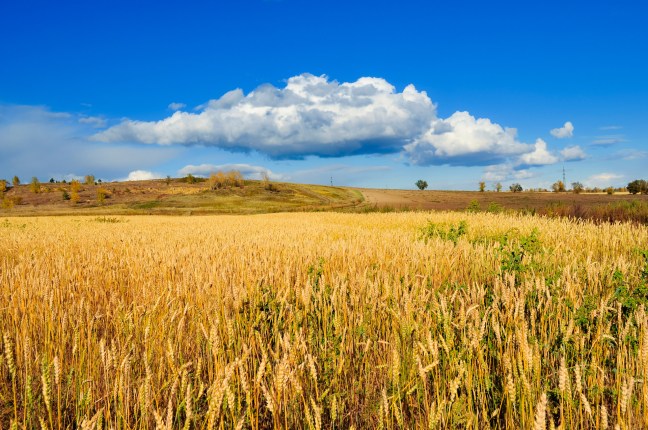
Image Description: A large field of golden wheat with a blue sky and clouds above. Public domain image.
This sermon was preached with Northside Presbyterian Church in Ann Arbor and was focused upon Matthew 13:1-9, 18-23. An audio recording is above and a written manuscript is below.
Matthew 13:1-9
‘Listen! A sower went out to sow. And as he sowed, some seeds fell on the path, and the birds came and ate them up. Other seeds fell on rocky ground, where they did not have much soil, and they sprang up quickly, since they had no depth of soil.But when the sun rose, they were scorched; and since they had no root, they withered away. Other seeds fell among thorns, and the thorns grew up and choked them. Other seeds fell on good soil and brought forth grain, some a hundredfold, some sixty, some thirty. Let anyone with ears listen!’ . . .
A sower went out to sow.
That’s simple enough. That’s how Jesus’ parable begins. A sower went out to sow. Plain and simple. A sower went out to do what a sower does: Sow seeds.
But is it simple? I mean, what kind of sower is this, really?
Now I confess that I know little to nothing about farming, but even if I were to plant a small garden, perhaps large enough for me with some extra vegetables thrown in to share with friends from time to time, I would till the ground in some way, and I would sowmy seeds in a methodical way. I would likely place my seeds in rows. I would certainly place the seeds in such a way as to know where to find them! And even with my limited knowledge, I would somehow take inventory of my yard. I would discover which area of the yard has the best soil, or at the very least, which area of the yard has the greatest access to the right level of sunlight, not too much, not too little. I would look into these things. I would sow methodically.
But not this sower. Not at all. This sower seems to throw seeds around willy-nilly. A little here, a little there. It’s as if this sower just throws seeds to the wind, letting them end up wherever they might go.
So what would make someone do this? It doesn’t really make logical sense, does it? I suppose we can’t really know the answers to those questions, but perhaps this sower really had hope and faith that something positive – something fruitful – would come from these actions. So instead of picturing an irresponsible or even an inept sower, perhaps we might begin to see an image of playfulness here. Perhaps we might begin to see a sower who throws seed in absolute delight, with great abandon, with the entirety of the sower’s being overflowing with abundance, with full confidence that the seeds are just the beginning, and that the fruitful increase of unexpected harvest is just around the corner. Maybe our sower is that kind a sower – mysterious to us in ways that we can’t fully understand, yet a sower we can picture with our limited imagination, one we can envision as seeds are thrown with imagination and playfulness and even conviction. This is the sower of our parable.
So as Jesus speaks these words, this sower emerges as one who throws seeds continuously, everywhere with belief – with trust – that fruit will emerge even in the most unlikely of places. This is good news for us.
But you might also say, “Now wait a minute! Don’t some difficulties emerge in this parable too?” There’s is a good deal of realism in Jesus’ words, isn’t there? Some seeds end up on the path, and before they can get into the ground at all, they’re gobbled up, right into the stomachs of birds. Other seeds fall into shallow soil. No fault of their own. But the conditions just aren’t right for them to thrive in the long term. And still other seeds, fall into places where danger lurks. There are thorns and weeds growing around them, choking off the possibility for them to blossom and grow in a healthy way. Even though the final word of this parable is abundance, Jesus’ parable is full of realism too. And since you and I live in the real world, maybe it’s helpful to see that Jesus gets it. Maybe this is good news for us too.
I’m sure that Jesus’ first hearers could relate to this realism because many of them were farmers themselves. And if they weren’t farmers, they knew people who were. This parable was certainly a lived parable. Jesus’ audience knew what it was like to start with good intentions and then be forced to deal with a less than perfect harvest. They knew what it was like to sow well – perhaps even methodically – only to discover that conditions beyond their control could throw the harvest out of balance, or worse, cause its destruction. Drought, floods, and pests could threaten more than the livelihood of profit for an individual farmer. They could ravage the food supply entirely, all there is to live on. This is a lived parable, one to which Jesus’ hearers could relate.
But we also learn in the latter half of this passage that this parable isn’t just about seeds. It isn’t ultimately about farming techniques. It’s about people. It’s about us. And when we move to the level of people and the word of the Kingdom, this ultimate good news that Jesus depicts as seeds, we also see some realism here. When we move to this level, we realize again that this parable is a lived parable.
Jesus and his disciples were itinerant preachers, moving about all the time. And like sowers scattering seed, Jesus and his disciples were scattering words about everywhere, scattering words of good news – the Kingdom of God is coming and is already here! These seeds – these words of the Kingdom – are about the Ultimate Good, but in Jesus’ experience, they didn’t always lead to perfect blossoming when they were spoken. In the Gospel of Matthew, people misunderstand, people follow Jesus only to turn away when he makes inconvenient demands of them, people receive the word and yet struggle intensely with temptations; in the case of the rich young man, you may remember, the pursuit of wealth and the desire to keep many possessions were true stumbling blocks. Jesus and his disciples lived this parable.
And this is a parable that we live. When we think about our own lives – when we think about our relationship with that mysterious, imaginative, abundant Sower – we know that we have lived this parable. In the different moments of our lives, we too have misunderstood, we too have followed Jesus only to turn away when he makes inconvenient demands of us, we too have received the Word and yet struggled intensely with temptations. We’ve lived this parable too. And we’re not just one category. We’re not one type of seed or one type of soil. We’re not destined to live this way or to get stuck in any of these places. We’ve simply experienced them in our lives. That’s realism.
But this reality is not the final word. In order to know the what is the final word, in order to know Who is the final word, we need only to look to the Sower once again. On one hand, this Sower is so unlike us – unmethodical and persistent in imaginative possibilities. Yet on the other hand, this Sower is so with us! This is the Sower who never gives up, who believes an abundant harvest is not only possible but is what we are destined for. This is the Sower who keeps throwing seeds our way – seeds of love, calling, nurture, vision – who keeps willing us and dreaming us into good soil. This is the Sower who looks at each one of us and at this community of us and says, “You are Beloved. And I have named you and claimed you to be endlessly and profoundly good in my sight.” This is the Sower who knows the soil. This is the Sower who throws seed with total abandon and reaps a harvest beyond all imagination. This is the Sower who makes a harvest out of us, one that is miraculous. Apart from that Sower’s vision and action, it seems almost unbelievable.
It is almost unbelievable, isn’t it? When we look back on this parable and see seeds thrown all over the place – upon the beaten, bird-filled path; upon the barren, shallow soil; upon the soil filled with stumbling blocks of weeds and thorns – it would be miraculous if even a normal harvest were to emerge. It would be miraculous if the typical harvest were to come through: five-fold or seven-fold. But that’s not what happens here. Despite difficulties and problems, this Sower produces harvests that are thirty-fold, sixty-fold, beyond all odds, one-hundred-fold! This is miraculous! This is astounding! This Sower who knows the soil dreams possibilities for harvest that come to fruition beyond our wildest imagination! Incredible.
When Jesus tells parables, he often issues a call. “Let anyone who has ears, listen!” Maybe Jesus is saying something similar to us in this moment, “Listen up! Notice what’s around you right now! Pay attention!” As God spoke to Moses in the wilderness, perhaps our Sower is telling us, “Pay attention! Look around you and see that you are on Holy Ground! Together, you are Holy Ground. Open your eyes and ears and recognize that you are on good, holy soil!”
You know, a healthy dose of realism that takes difficulties seriously and sees them for what they are is a gift. But those difficulties are not the final word. Realism: We’re living during a pandemic. We ourselves are scattered like seeds and more physically distant from the nurture of one another. Realism: We’re living in a world with systemic harms. Systemic racism persists. People are pushed into poverty. Some are maligned for their body’s needs. Some are discriminated against because of who they love or for daring to live precisely as the people they are.
It’s good that we’re paying attention to these needs. It’s crucial to note this realism. That’s part of our calling. It’s a call to action. And at the same time, we can open all our senses to the constant seed-throwing that’s coming our way, that’s happening around us, and among us, and in us, and even sometimes, in spite of us.
So here is a message for us today:
Notice.
Notice this love. Notice its possibilities and its actualities. Notice a Sower who weaves us together even though we’re physically distanced. Notice a Sower who doesn’t give up on us but still dreams a better world around us and through us. Notice a Sower who persists. Notice a Sower who is playful. Notice a Sower that does indeed bring about abundance, not in one area alone but broadly and fully in many directions.
And know this too: You are good, holy soil. We will keep that realism present. And we will keep our dreaming and our acting present. While we do that, God, our Sower, will keep calling us to live with joyful abandon and abundance. So go forth expecting an unimaginable harvest. Go forth expecting that we’ll see flourishing in truly surprising places. And in all of it, thanks be to God. Amen.
***This sermon was influenced and enriched by the insights of four authors who write on this passage in Feasting Upon the Word: Year A: Pentecost and Season After Pentecost. Those authors are Gary Peluso-Verdend, Talitha J. Arnold, J. David Waugh, and Theodore J. Wardlaw.
Disclaimer: You should really only watch this video if you’re willing to have a better day. Because it’s pretty challenging to avoid the joy here. The precious kiddo in the blue shirt just can’t keep it together. When you pair clapping with sudden bursts of silence, it’s . . . well, the best thing in the whole world.
We tend to juxtapose them,
Martha and Mary, in
their doing, and
their being,
as if these are two entirely different spheres of life.
We tend to juxtapose these parts of ourselves,
internally wrangling with
our doing, and
our being,
at times, feeling guilty for
rest
pleasure
relaxation
contemplation.
Our internal critic
(our voice?
internalized voices?
the voice of a productivity-obsessed culture?)
chimes in to say, Do you not care that there is so much yet to do?
So many needs?
Such a long list?
Yet
There is one thing,
a Better Part —
Knowing and Being Known,
Loving and Being Loved,
Listening and Learning,
Resting in the Renewal —
Belonging.
Now as they went on their way, he entered a certain village, where a woman named Martha welcomed him into her home. She had a sister named Mary, who sat at the Lord’s feet and listened to what he was saying. But Martha was distracted by her many tasks; so she came to him and asked, “Lord, do you not care that my sister has left me to do all the work by myself? Tell her then to help me.” But the Lord answered her, “Martha, Martha, you are worried and distracted by many things; there is need of only one thing. Mary has chosen the better part, which will not be taken away from her.” – Luke 10: 38-42
Image Description: Two hands come together to hold a red, heart-shaped object with two band aids on it, crossed like an x. The hands are in black-and-white, and the heart and band aids are in color.
This is a simple thought, but I think it’s beautiful and often true to the experience of life.
The verb ‘heal’ is both active and passive.
At times, we say,
“Heal,” i.e. “be healed.”
At other times, we say,
“Heal,” i.e. “act as a healer.”
Healing is –
Something we receive,
Something we take in,
Something we allow to sit with us,
Something we invite inside, and it makes a home with us.
Healing is –
Something we cultivate,
Something we enact alongside others,
Something we breathe into the world,
Something we work at, like kneading dough.
Frederick Buechner says that our calling is found in “the place where your deep gladness and the world’s deep hunger meet.”
It makes me wonder. . .
What needs are present in our own lives?
How can we receive healing?
What needs are present in the world?
How can we work as healers?
And. . .
. . . Are there any intersections where those could come together as a calling?
Image Description: Bright, yellow flowers with green stems and leaves on a brown table with two brown chairs behind them. The flowers are leaning over the container in many directions.
Before COVID-19 hit, I used to keep yellow alstroemeria flowers on the dining room table. I did this regularly because they’re beautiful, but I also loved that when I brought them home and put them in a vase, they would typically last for about three weeks.
Around this time last year, I bought a bouquet. I kept them in their sleeve on a table for just a couple of hours, and… they wilted completely. Way more than the first photo above. They seemed destroyed. This was such a quick transformation that I assumed I needed to put them immediately in the compost.
“Well, I guess I’ll try,” I thought. I put these extremely wilted flowers in a vase with water and plant food. They looked like a sad cartoon. Then I ran an errand, and when I came back, they had perked right up. This too was completely surprising to me. And a couple of days later, they were even stronger and more vibrant.
This had me thinking…
Sometimes, nourishment is the work.
Nourishment is what we need. We can give this gift to ourselves in self-care. And community-care can be even more transformative, when with consent and empowerment, we are nourishing each other.
Sometimes, nourishment is the work. And when we choose it and help cultivate these nourishing conditions collectively, more is possible than we tend to think. Sometimes the seemingly impossible becomes possible.
Image Description: Bright, yellow flowers with green stems and leaves on a brown table with two brown chairs behind them. Now the flowers are tall and straight.