We’ve hit September, and we’re in the last few months of the year. We’re not in the last quarter quite yet (sorry to sound so corporate) but we’ll be there soon.
Maybe it’s a good time to ask: What did we hope for in 2025?
I can already hear some of us us scoffing at the question, and I can’t blame anyone for doing that. I think many of us entered this year with genuine fear and trembling, expecting hardship especially as politics impacts our collective life. We weren’t wrong, and that is, of course, devastating.
But when we think about hope for the year, was there something deeper than a simple resolution? Something less cynical? Some kind of vision or values that we wanted?
I wonder if this might be a good time to take stock of that. We still have some time to return to these and act on them.
We have more wrinkles now. Some of our own kids have even joined the marching band. Some of us have moved away, while others have lived here the whole time. As the decades moved on, some of us have started businesses. Some of us joyfully came out of the closet. Some of us are caring for parents. Some of us are teaching. Lots of us can talk about physical changes, and lots of us can talk about the ubiquity of Teams Meetings.
Over the weekend, I went to my High School Reunion, and it was a great time. We set up space in a pool bar, while talking, laughing and yes, occasionally, watching our own senior yearbook photos scroll across a screen.
I admit that I don’t know exactly where all the fault lines used to lie — that is, who could hang out with whom, and who could easily gossip about whom — but undoubtedly, those used to be there, and now, they are totally gone. None of my closest friends from that time in my life came to this particular reunion. But if we recognized someone, the primary response wasn’t hesitation or distance, but an easy, ‘Hey! How are you doing?’—as if time had folded in on itself and we’d been old pals all along. I had engaging conversation all night long.
Sometimes, time itself erodes those lines. They’re just gone. No cliques. Friends who can start as friends again, at least for this night and maybe longer, too. We are certainly people who take an interest in wanting each other to be well and do well.
No doubt, there are bigger, more significant conflicts in this country and in our personal lives than the divisions of our high school days. But if time itself can erase those, what might be possible with real intentions to do the work in good faith — healing what can be healed?
A series of black dominos with quite dots; the ones in the back have fallen, and the ones in the front are about to fall. Public domain image.Public domain.
Many years ago, I worked in a context where everyone worked with their office doors closed. There may be many reasons for this — needing quiet, having a place to focus, or other kinds of needs entirely. That context was filled with lovely, supportive people, but this happened to be a very stressful period of time in our collective history. Some part of me wonders if we all kept our doors closed because stress pheromones were constantly floating through the air in that space.
Anxiety can function like a contagion. We can pick up on the anxious energy of others through body language and yes, even pheromones. We may also be anxious about similar concerns, and someone’s anxiety may evoke our own. That same anxiety in a person or community may also trigger older, stressful storylines from our lives. The anxiety can grow.
Sometimes, we need space alone or in small groups of non-anxious (at the moment) people so we can ground ourselves again and regulate or co-regulate our nervous systems.
In a remarkably anxious period of time, it is okay and helpful to take that space, both for ourselves and for the collective circles of people we love.
495.3 miles later, I’ve finished the Es! 3024.8 Miles Total
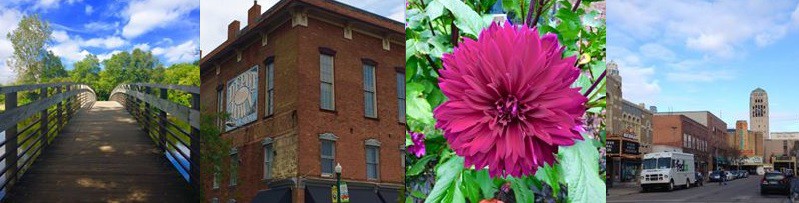
Since September 2023 (whenever it’s warm) I’ve been riding my e-bike successively to and through every street in Ann Arbor in alphabetical order. Yesterday, I finished the E Streets. Whenever I finish a letter, I write a reflection on place. Today, I’d like to talk about my summer as a whole.
This summer, three of my closest local friends went on sabbatical. I live in a university town, but none of these friends are professors. Each of them had unique circumstances, but they each took a substantial amount of time to get outside of their typical rhythms and travel. I admired them for doing this.
I wasn’t doing this in any official way, either formally or informally, but I thought, “How can my summer have the same kind of vibe?”
“How about… a… staybatical?”
I didn’t set out to stay exclusively in town, though mostly I did. I only made one larger trip. I’ve barely done any day trips either — something that is pretty standard for me in the summer.
Though minimal travel wasn’t my intent, I started calling this ‘my staybatical’ right at the very beginning. It was a framework. How might I relate to this place differently one summer later if I treated this as a special, set-aside time? How could I make space for memories right here?
It turns out, I could do that daily. I’ve kept a running list on my phone since Memorial Day, the informal beginning of summer. Today is Day 92. Every day, I’ve sought to do something memorable. It doesn’t have to be monumental — just something that might lead to me thinking or saying,
“Remember that time when we…?”
Or
“Remember that time when I…?”
Something that will stay with me.
My list is filled with things like,
“Dinner at ____ with ____”
“Walk and photography at ____ Metropark.”
There’s also,
“Mein erstes Mal am Stammtisch” (i.e. the time that I went to a German-speaking Meetup and discovered I’m an extrovert auf Deutsch, too.)
There were so many community events. (Thank you, Ann Arbor Observer Magazine). There were so many outdoor spaces. There were times with neighbors, including the literal ones on my actual street, and the ones that surround my life in this town where I live.
And here is where it led me:
I’m not trying to be overly schmaltzy, but I absolutely re-fell in love with Ann Arbor this summer.
It’s not that I had fallen out of love, though I confess, I have truly gotten to a place where I am over winter. But sometimes you need an experience and feeling of novelty. Sometimes you need to know that if you let a place hold you, it starts to form you.
And this staybatical gave me a framework and an experience of knowing I can shape and be shaped by seasons. Hopefully, this means I can be intentional in winter in unique ways rather than letting it be a blasé, throwaway, cabin fever time.
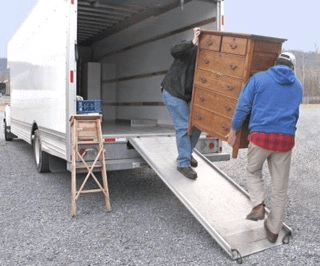
Two people carrying a chest of drawers into a moving truck.Public domain.
Every single day, there are real, raw, human stories of suffering in the news cycle. And likely, some of those harms are impacting real people we know and love. There are times when we feel helpless to prevent suffering and powerless to change it.
It’s incredibly understandable to fall into those feelings. In such times, we need the solidarity of one another – that is,
. . . the sense that we are in each other’s view, that we encounter each other’s pain with empathy,
. . . the sense that we have each other’s commitment, that we are in each other’s corner for the long haul,
. . . the sense that we have each other’s action, that we covenant to act on behalf of one another, especially and most readily for those who are made vulnerable by harms and barriers.
In some spiritual traditions, we hear language of bearing each other’s burdens. Lately, within that vision, I find myself thinking about what it means to shift each other’s burdens.
We can easily become incapacitated once we realize we cannot instantly fix the systems that are causing burdens. But our empathy, and most importantly, our committed action can change these systems and these burdens. Do not underestimate what these can do.
When we see pain for what it is, we add our validation, and it shifts burdens.
When we add our resources of money, time, or skills, it shifts burdens.
When we use our voices to name wrongs for what they are, it shifts burdens.
When we use our minds to create solutions, it shifts burdens.
When we honor the humanity of people who are being dehumanized, it shifts burdens.
When we take direct action and demand justice for the oppressed and vulnerable, it shifts burdens.
If we want to change the large-scale systems that cause harm, we have to disrupt them. But alongside that commitment, we have to live and model our lives with a different rhythm altogether – with different commitments and ways of relating to one another.
We practice solidarity. Frankly, we practice love.
And within that way of living, we share and lighten the loads that people are carrying. We assign energy and responsibility to where they really belong.
While leading a congregational service this weekend, someone read these words:
After this I looked, and there was a great multitude that no one could count, from every nation, from all tribes and peoples and languages, standing before the throne and before the Lamb, robed in white, with palm branches in their hands.(Revelation 7:9)
Alligator Alcatraz is no more.
Bombs no longer fall on Gaza hospitals.
The colonized are free.
ICE is vanquished.
The gulags are closed forever.
The impoverished stand liberated.
All people — every nation, tribe, and language — serve as beloved witnesses.
And if all of these things are no longer — in this vision, or another vision you hold dear — why not work for them now?
Frieda is an opportunist. But if you think about it, isn’t any spider? The right criteria for a web placement seem to involve maximum opportunity for stability and the ability to catch bugs for dinner.
I visited Cedar Point for the first time over the weekend. My favorite activity was riding the gigantic Ferris wheel. A sizable spider had taken up residence on the wheel, spinning her web in the triangle of red-colored steel bars. I named her Frieda. All day long, she rode the same wheel, round and round, and at night her masterful web glowed pink in the shimmer of colored lights. I have hardly ever seen so many bugs attracted to one web. There were already plenty, and as we stopped suspended at the top, I watched more fly in, even as new riders loaded below.
Right place, right time.
Years ago, I was gifted some purple basil seedlings. One day, to my sadness, I noticed they were wilting in their planter container. It was almost time to replant them in a proper pot, but now their stems were completely wilted, lying flat on the dirt.
So I moved the soil into small clear bowls and added water. Those little plants drank it right up, and in short order, they sprang back into growth. It was astonishing to see how resilient they were.
Right place, right time. Right boost, too.
If we want to see human beings flourish, maybe it’s worth thinking about where and how we can be part of that. Sometimes it means being opportunists — casting our nets (or webs) wide. Sometimes it involves being someone’s boost. Growth happens when the right place, the right time, and the right help come together.










 Smuggling Grace