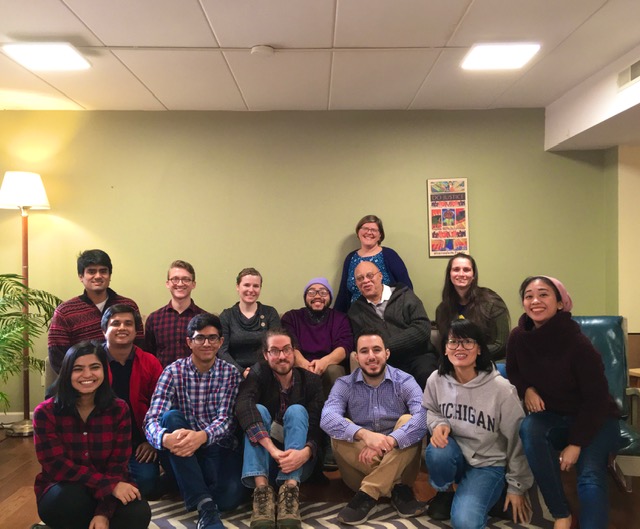
I find that questions and stories are some of the most transformative aspects of interfaith and multicultural dialogue. Earlier this month, the Interfaith Round Table of Washtenaw County met at International House Ann Arbor to share a meal and hold a conversation between international students and scholars and young adults who grew up in the United States.
Together, we explored these questions:
Where did you grow up, and how did that place and culture shape who you have become? How did it influence what you care about?
The stories were so rich and meaningful.
When we receive each other’s questions and stories, we build relationships, expand our understanding, and come to know ourselves more deeply.
When have you received a transformative question? When have you heard a transformative story? When did you experience a transformative invitation to tell your own story?
I wonder if we might open ourselves to even more opportunities like these.
Last summer, my good friend Suzanne died after living with cancer for nearly a decade.
Many words could be used to describe Suzanne… welcoming, boisterous, joy-filled, passionate, compassionate, feisty, devoted, heartfelt, hilarious, loyal, and free-spirited. And in many ways, the words keep on coming. . . After Suzanne died, people began to speak and write about her. In a celebration of her life, Suzanne’s large, loving community gathered to honor her, not at a traditional funeral or memorial service, but at a party. Her eulogy was collective; some were invited ahead of time to speak, and others were given the occasion to join them. Before, during, and after that party, people have shared stories of Suzanne’s love and influence in their lives. Her impact was both personal and expansive. She touched each person individually and a lot of people collectively.
Last spring, Suzanne traveled to Chicago in the hopes of participating in a medical trial. It was all about to move forward until some of the measurements of the cells in her blood fell outside of the parameters of the study. She stayed in and out of the hospital in Chicago for more than a month, waiting and hoping to get those numbers in the right range. That was a challenging waiting period, especially knowing that beyond this, her treatment options were becoming limited.
While she waited in Chicago, a large number of people cared for her. Some drove her there and back; many visited and stayed with her in the hospital. Some opened their homes to her. It was touching to see this happen. I always felt that Suzanne was an example of someone who loved deeply and a model of a person who allowed herself to receive love deeply. People don’t always know how to do this. It can be a rare gift.
In one my most memorable moments with Suzanne, I called her during her time in Chicago. The occasion for this call was painful. Suzanne had just learned with finality that she was not going to be able to participate in the study. That was devastating news.
Over the phone, Suzanne expressed her sadness. But then, she began to talk about the many people who were caring for her through visits, meals, phone calls, emails, texts, and above all, presence. People truly gathered around Suzanne and for Suzanne. She invited this collective giving and receiving of care.
In recognition of that, here is what was most memorable to me in that phone call:
With love for all these people, with tears of gratitude, Suzanne said, “It makes you feel like you did something right.”
In response, it was so easy for me to affirm that statement because it was abundantly true. She had done this right. Suzanne cultivated so many relationships, each particularly valued, and all, collectively cherished. She invited all of this with her living.
Suzanne is deeply missed, and she will be missed as long as these beloved people in her life keep on living. Yet in the midst of this, after the painful loss of Suzanne, she continues to do something right, and we join her in it. These relationships keep on living. Her memory is honored. Her love is remembered and re-experienced, not only in memory, but in all the ways her many people now also care for each other. We get to turn that care toward each other as well.
And with our own living, both in the ways we remember her, and in the ways we cultivate and deepen additional relationships in our lives, we can affirm,
You did something right, Suze!
And we’re going to keep on joining you.
Image Description: Two cupped hands meet together to form the shape of a heart. The person is wearing a sweater with blue sleeves. In the foreground at the bottom left, there are large rocks, forming a cliff. In the distance are blue water and mountains.
💜 Every body is a good body. 💜
Every body is a worthy-of-love body.
Every body is a worthy-of-care body.
Every body is a worthy-of-resources body.
Every body is a worthy-of-taking-up-space body.
Every body is a worthy-of-dignity body.
Every body is a worthy-of-connection body.
Every body is a worthy-of-self-expression body.
Every body is a worthy-of-advocacy body.
Every body is a worthy-of-self-determination body.
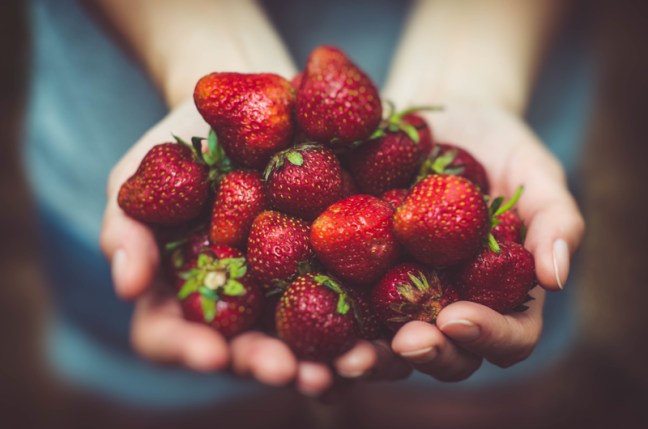
Image Description: A close-up of two hands cupped together, holding a large number of strawberries. Public domain image.
A story from Zen Buddhism:
A man was walking across a field when he saw a tiger. Fearing for his life, the man fled, but the tiger gave chase. The man reached the edge of a cliff, and just as he thought the tiger would get him, he spotted a vine growing over the edge of the cliff. Grabbing on to it, he swung himself over the edge to safety.
The tiger came to the edge and snarled at him from above. While precariously perched like this, the man saw another tiger growling at him from below. Trembling, he held on to the thin vine that was keeping him from being dinner for the tigers. What could be worse than this, he wondered.
Just then, two mice scampered out and began gnawing at the vine. As they chewed and the man pondered over his fate, he saw a juicy, red strawberry on a ledge next to him. Grasping the vine with one hand, he plucked the strawberry with the other. Ah, how sweet it tasted!
If you Google information about this story, you will quickly learn that there is debate about its meaning. Some hold the interpretation that this story is about living in the present moment and enjoying pleasure right in front of us, even in times of trial. Others, however, say that this a misunderstanding; the story is about the foolishness of getting distracted by pleasure when we have the occasion to remove ourselves from a perilous situation.
With both interpretations, we choose our life.
I will leave the interpretations to communities of Zen Buddhists, as it is their story, and they know it best.
But lately, here is something I’ve been thinking about…
There are times when loss is so great or stress is so high that we are plunged into present moment living because that feels like only way to make it — one day at a time, one moment at a time, one feeling at a time. But as we do this… we discover that present moment living is also the best way to live. It’s freeing and filling.
And
There are times when loss is so great or stress is so high that we are plunged into choosing our life in order to survive — our bodies, our in-the-moment daily needs, our rhythms, our memories, our values, our loves, and our communities. And as we do this… we often discover that there are still so many gifts in our lives. There are times when we say yes to the broad fullness of it.
With both of these, we choose our life.
And that invitation is always there.
This sermon was preached at White Lake Presbyterian Church in White Lake, Michigan and was focused upon Luke 3:1-6. An audio recording is above and a written manuscript is below.
Luke 3:1-6
In the fifteenth year of the reign of Emperor Tiberius, when Pontius Pilate was governor of Judea, and Herod was ruler of Galilee, and his brother Philip ruler of the region of Ituraea and Trachonitis, and Lysanias ruler of Abilene, during the high priesthood of Annas and Caiaphas, the word of God came to John son of Zechariah in the wilderness. He went into all the region around the Jordan, proclaiming a baptism of repentance for the forgiveness of sins, as it is written in the book of the words of the prophet Isaiah, “The voice of one crying out in the wilderness: ‘Prepare the way of the Lord, make his paths straight. Every valley shall be filled, and every mountain and hill shall be made low, and the crooked shall be made straight, and the rough ways made smooth; and all flesh shall see the salvation of God.’”
This passage begins with words that don’t seem particularly significant to our 21st century context, so if you’re like me, as you read them, you might tend to tune them out. Luke initiates this section of his Gospel with a list of rulers from the 1st century — despots, kings, foreign occupiers, and the highest religious officials.
It takes a bit of time to move through these names, which adds to the probability that our brains might move elsewhere. But these words are absolutely significant to the message Luke intends for us to hear.
So let’s consider them again.
In the fifteenth year of the Emperor Tiberius. . .
Tiberius was the primary ruler and ultimate authority in the expansive Roman Empire.
When Pontius Pilate was governor of Judea. . .
Pilate was the Roman prefect who governed a large portion of the occupied land.
And Herod was ruler of Galilee, and his brother Philip ruler of the region of Ituraea and Trachonitis. . .
The Herod dynasty included kings who ruled harshly as a client state for Rome.
During the high priesthood of Annas and Caiaphas. . .
Annas and Caiaphas were the highest religious leaders put in place by Rome.
This is Luke’s list at the opening of this passage. But take notice of what happens after he lists all of these powerful leaders with high status. Luke says. . . During the time when all of these powerful people governed, “the Word of God came to John in the wilderness.”
The Word of God came to John and it came to him in the wilderness.
This is significant. At first, it may seem like Luke is simply setting the scene and establishing the time period as he mentions what was happening in the government, but it’s so much more than that.
Luke wants us to know that at the time these leaders ruled — some with corruption and all with wealth and influence– the Word of God came to one of society’s so-called nobodies in the wilderness, a remote spot entirely removed from society’s center.[1]
And this man named John went into many places in this wilderness. Luke says that he went into all the region around the Jordan River, and as he did that, he baptized people into the very waters of that river, proclaiming good news and a message of repentance. The word ‘repentance’ literally means to ‘turn around.’ John invited people to turn around toward a lifetime of good news, living toward God with worship, passion, and justice.
And John did this with power.
John the Baptist did not have the world’s power.
He wasn’t wealthy.
He wasn’t welcome in high society.
He didn’t have a position in the government.
He wasn’t the leader of an army.
But John was a prophet of God, a fiery prophet of power who did not mince words. Without question, John would have made us uncomfortable, and he might have made us angry too. Like so many of Luke’s characters, John preaches a radical Gospel: God is turning the world upside down. The powerful are becoming de-centered, and the people on the margins are empowered to lead the way toward new life.
With this message in the wilderness, John cries aloud the very words that the prophet Isaiah proclaimed centuries before him. “Prepare the way of the Lord, make God’s paths straight. Every valley shall be filled, and every mountain and hill shall be made low, and the crooked shall be made straight and the rough ways smooth; and all flesh shall see the salvation of God.”
God is turning the world upside down. The mountains and hills and bastions of power will be made low! And the valleys of those who are humbled, despised, and marginalized shall be filled so that all people will see and know the salvation of God.
As John proclaims this message, he serves as a messenger, preparing the way for Jesus who will indeed turn this world upside down. When John cries words aloud in the wilderness, Jesus is about thirty years old and on the verge of his public ministry. John is the herald, inviting people to prepare their anticipation, because once Jesus comes into the fullness of this ministry,
He will speak truth to power,
He will uplift the downtrodden,
He will eat in full communion with the ‘outsiders,’
And he will empower these very people to take his message of worship, passion, and justice to the ends of the earth.
All people, All people,
will see the salvation of God.
This world-turning intention is central to the character of God. It is a vital part of Who God Is. So it makes me wonder. . .
How is God moving now? How is God proclaiming a message of salvation now? How is that happening in our own time and in our own modern forms of wilderness?
After all, isn’t that just the kind of thing this God would do? Arrive in the middle of wilderness places that some label insignificant?
This is one of the primary messages of Advent —
God is always coming,
Always arriving in this Jesus,
Always initiating movements of power and good news through the Holy Spirit, often in the least likely of places.
So it makes me wonder how God is showing up in the wilderness.
We certainly have many places of wilderness in the landscape of our lives. These places seem rough and are perhaps on the outside of anyone’s knowledge or notice.
Our losses,
Our addictions,
Our health crises,
Our disappointments,
Our broken relationships. . .
They can feel like places of wilderness.
But we can take heart,
And we can remember,
God shows up even there and can turn the world upside down.
Your life is not insignificant in God’s vision. It is immensely significant.
Even in these places of wilderness,
God turns our lives upside down,
so we can turn toward the direction of new life.
It makes me wonder how God is showing up in the wilderness.
We also know that there are many in our neighborhoods and many around our world who experience burdens that are heavier than we can easily imagine —
People struggle through poverty,
Children fall through the cracks of failing schools,
Some are despised and disenfranchised through racism,
Some are stigmatized and treated as less than because of disability,
Men, women, and children are caught in the trauma of wars,
Refugees escape those wars but have nowhere to go,
And victims die and are wounded by the senseless and seemingly continuous gun violence in our country. These are wilderness places, These are painful wilderness places.
And these lives are not insignificant in God’s vision. They are immensely significant.
Even in these places of wilderness,
God turns our lives upside down,
so we can turn toward the direction of new life.
It makes me wonder how God is showing up in the wilderness.
I know this. . . God often shows up in the presence of other people, and God can arrive in these realities of wilderness through our very presence.
In the midst of heartache, God brings comfort and good news through our presence.
In the midst of challenges, God turns the world upside down through our presence.
In the midst of wilderness, God provides a way in the desert and makes all things new through our presence.
How will we add our presence?
How will we be a part of the very prayers we make?
How will we act on that small thing or that large thing that keeps arriving in our minds and hearts?
How will we reach out to that person or community that keeps showing up in our thinking and praying?
How will we follow John into the wilderness to proclaim good news? How will we also turn the world upside down?
I was deeply honored by the question but also concerned about dropping it or making ignorant missteps, so I declined. I did smile though, and the Torah scroll was handed over to another person for additional whirling and merriment.
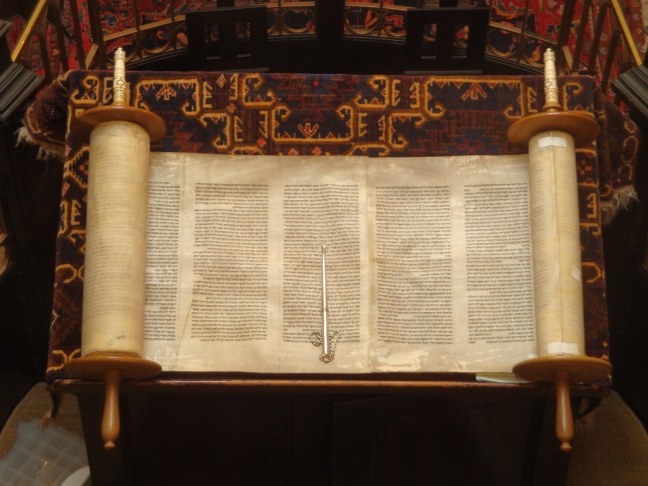
As a Presbyterian seminary student, I was grateful to visit a Conservative Jewish synagogue with members of my class. We were present for Simchat Torah, a Jewish holiday that marks the end of a cycle of public Torah readings and a new beginning for the next cycle. On this night, the Torah scrolls of the ark are removed, and the community dances with them.
I knew I was going to experience a meaningful interfaith encounter; I had no idea I was going to cut a rug with Torah scrolls. And cut a rug we did!
This celebration was joyous and gleeful, and it lasted for a couple of hours. It was an meaningful experience, and along with my classmates, I was grateful to be welcomed into the community holiday. It was the kind experience you cannot quite anticipate as a guest. You have to be present with it as it unfolds, finding yourself within a moment in the midst of community.
The dancing was meaningful and memorable, but right alongside it, there was an another moment when I suddenly found myself within a community experience I could not have anticipated. The Rabbi invited everyone to come close together, and members of the synagogue unrolled the Torah scroll so that it encircled the people. We were inside the text, in a sense. Then the Rabbi traveled around that circle of text and shared its stories as the larger, unfolding story of the people. He said things like,
“This is when we were created, along with the entire world.”
“This is when we were liberated from slavery in Egypt.”
“This is when we received the law.”
This is when we…
We stood there, peopled.
And I was so drawn to that sense of being gathered together, encircled by story, peopled together by a shared story.
It was the kind experience you cannot quite anticipate as a guest — the kind of experience when you find yourself suddenly peopled too.
Image Description: The word ‘language’ in a dictionary.
In the English language, we have one primary word for love. Just… Love. There are certainly synonyms and words that expand upon it, but we typically use one word while other languages are a bit more expansive.
I’ve decided that it would be wonderful if these kinds of experiences and feelings of love had names:
— There’s a wonderful feeling of discovering that you are known in your specificity and loved in your limitations, and that without saying anything, people anticipate and accommodate what you need, including barriers that might be challenging for you.
I’ve experienced that in the last two weeks. That’s love. I wish it had its own name.
— There’s a wonderful feeling of discovering that people think about things and frame things in particular ways because they’ve internalized stories you have told, and when they reveal this to you, there’s a beautiful surprise of recognizing that they have internalized pieces of you, just as you have internalized pieces of them.
I’ve experienced that in the last two weeks. That’s love. I wish it had its own name.
— There’s a wonderful feeling of discovering you have commonality with a person, that simply being in their presence returns you to a part of yourself, a piece you didn’t even know was missing.
I’ve experienced that in the last two weeks. That’s love. I wish it had its own name.
–There’s a wonderful feeling of discovering that people now see you — really see you in some of your more challenging moments — not in an exposed way but in an expansive and affirming way, demonstrating a recognition that you have suffered and prevailed, and showing you a surprising amount of compassion, awe, and respect.
I’ve experienced that in the last two weeks. That’s love. I wish it had its own name.
Image Description: A blank and a question mark in black writing. The image has a gray background.
Chasidic masters told this story about Rabbi Zusya of Hanapoli:
Once, the Hassidic Rabbi Zusya came to his followers with tears in his eyes. They asked him:
“Zusya, what’s the matter?
And he told them about his vision; “I learned the question that the angels will one day ask me about my life.”
The followers were puzzled. “Zusya, you are pious. You are scholarly and humble. You have helped so many of us. What question about your life could be so terrifying that you would be frightened to answer it?”
Zusya replied; “I have learned that the angels will not ask me, ‘Why weren’t you a Moses, leading your people out of slavery?’ and that the angels will not ask me, ‘Why weren’t you a Joshua, leading your people into the promised land?”‘
Zusya sighed; “They will say to me, ‘Zusya, why weren’t you Zusya?’”
Zusya, why weren’t you Zusya?
[________], why weren’t you [________]?
We can easily place our names in those boxes. In lifting this story up today, my point is not to raise the possibility of judgment, either here or in some future afterlife. My point is to raise questions like,
[________], what has gifted you to be [________]?
[________], what could be possible if you lived as [________]?
[________], how might your neighbors connect meaningfully to [________]?
[________], what is possible if you are fully [________]?
After all, there are gifts and abilities that come quite easily specifically to you. What could be possible if you felt their joy — a joy that then extends well beyond yourself? What could be possible if those very qualities, traits, gifts, abilities, and passions were turned in the direction of some of the greatest needs we witness and experience? What is possible when we feel at home with ourselves?
Image Description: A sink of dirty dishes (not mine; a different set than I’m about to describe below!) One side of the sink has lots of bubbles from dish soap. Public Domain image.
For the last year, I’ve had the great privilege of hosting a group of young adults in my home. We are an interspiritual discussion community. Over that time, our conversations have been wonderfully enriching, and our relationships have grown very deep. As both have happened, we have become a family group for each other.
Young adults in their 20s experience a lot of transience, moving often. It’s a gift to have a sense of home with one another. I feel so fortunate that I get to host them in my house, providing home-space for these home-relationships to develop.
On Sunday, they all came over for a family meal. I made tortilla soup, and we gathered at the table, which we expanded with the typically-stored table leaves. We told stories, laughed hard, and had a discussion around this question:
What does it mean to home-build?
At the end of our time, we all took a photo on couch, something that has become a tradition. Then before they left, we cleaned up, organizing dishes into the dishwasher. But those dishes didn’t all fit, so after everyone left, I organized the stacks a bit more, cleaned the counters, and went to bed, leaving the rest for the morning.
When I woke up the next day, I encountered the mess of them in the sink, and instead of inwardly groaning, I beamed. I delighted that I had had all of these beloved people with me in one place the night before.
This is part of what it means to home-build.
Dirty dishes. A memory of a shared meal. Home-space. Home-relationships.
Image Description: A wall hanging in the shape of a heart reads, “Home Sweet Home.”
Today’s piece is re-post from March 21, 2018. It was written after I attended the “Why Christian?” conference in Durham, North Carolina. These themes have been with me in renewed ways over the last few days, and I intend to write in these directions for the rest of the week. I love this language of Radical Homemaking. I also love my own calling as a Radical Homemaker. How does this resonate with you?
What could be possible if we put joy at the center?
For me, this question is connected to Radical Homemaking, and it has been energizing me since I’ve returned home after spending much of last week in Durham, North Carolina. I visited very beloved folks there and then attended the Why Christian Conference.
Some context…
The name of the Why Christian conference is actually pretty apt. Organized by Nadia Bolz-Weber and Rachel Held Evans, the conference invited eight incredible women to give testimony, answering these questions:
“Why, in the wake of centuries of corruption, hypocrisy, crusades, televangelists, and puppet ministries do we continue to follow Jesus? Why, amidst all the challenges and disappointments, do we still have skin in the game? It’s a question that may take a lifetime to answer, but we hope the next two days inspire you to wrestle with it in some new and fresh ways.”
All of the stories were remarkably powerful and compelling. They weren’t crafted to convince people of anything, or move to some sort of ‘or else,’ grand conclusion, as many of us have experienced in fire-and-brimstone churches. These were life testimonies of experience, speaking to deep conviction, love, and joy, and that took place right alongside stories of honesty, confession, loss, trauma, and vulnerability.
The piece that impacted me the most was one of the breakout sessions. I attended a session with the Rev. Amy Campbell, pastor of the BeLoved Community in Asheville. This session was called, “The Radical Art of Making Home.” “What if our primary vocation as humans is to make home?” she asked. Over these last years, she has been making home together with people who are acquainted with the painful experiences of homelessness. The BeLoved Community is an intentional community in a house in Asheville. People worship, share meals, sleep, build friendships, and beautifully celebrate one another — especially making space for people who have no shelter or people who are estranged from a sense of home in one way or another.
Radical Homemaking. . . I can’t begin to tell you how much this spoke to me. In my own context, I feel like this framework names the calling that energizes me as well.
What does it mean to be at home. . .
. . . in our bodies?
. . . in our selves?
. . . in our relationships?
. . . in connection to the Sacred?
. . . in the ways we organize our communities?
. . . in the beautiful broadening of kinship-belonging?
. . . in the ways we shape family and choose family?
. . . in the cultivation of space (including literal homes) for hospitality and nurture?
. . . in the inclusion of people (or perhaps, parts of ourselves) that feel estranged from home in one way or another?
Radical Homemaking. . . Radical: meaning, of, relating to, proceeding from a root. . . Last week, I found myself pondering this so much. This is newer language for what I know has been calling me all along.
So that brings us back here: What could be possible if we put joy at the center?
Radical Homemaking is one of my deepest joys. And I have returned home with such deep awareness that I need to put this calling and joy right at the center. Giving and receiving from this framework, I wonder what is possible?