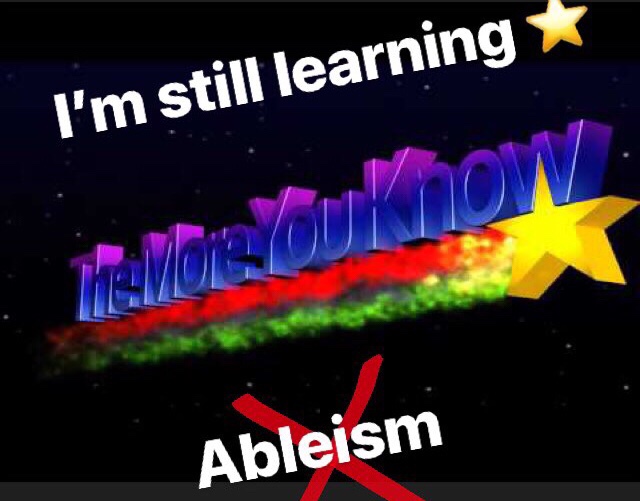
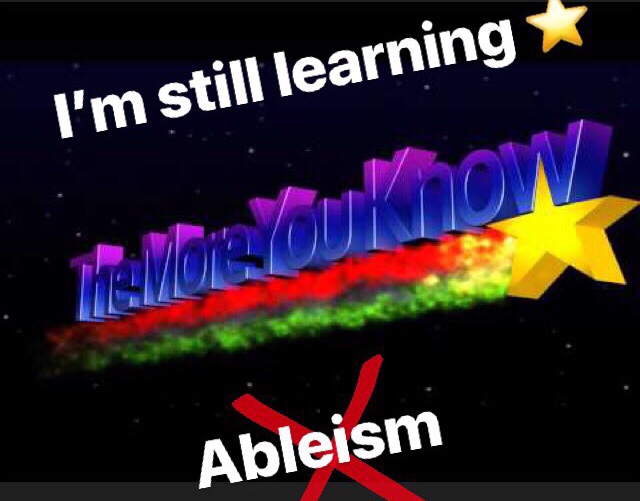
I’m still learning, indeed. And I need to take responsibility when I make mistakes. I made a big one yesterday when I wrote a piece called, Some Thoughts on Ableist Language.
I said some statements that were too broad in their generalizations which led to erasing communities and individuals that prefer identity-first language to person-first language. This is particularly true of the autism community.
Let me get a little more specific:
I started out by saying, “No one is *an* ‘ic'” and then listed a number of words like… an anorexic, a bulimic, an autistic, an arthritic, an asthmatic, a diabetic, an epileptic, a schizophrenic, etc.
It is true that many people in these communities bristle at that kind of language, but “No one is”? What if someone chooses that language?
But here’s where I made my biggest mistake:
I had originally posted these thoughts on Twitter the night before. I had made a tweet that followed this list, which said,
“It’s possible that someone might use this language as a self-descriptor, but it doesn’t mean everyone would want to be named/described in that way. It’s always good to use person-first language.”
Later, when searching for an image to place in the post here, my searching led me to the realization that many people in the autism community reject person-first language and prefer identity-first language.
In other words, many prefer “autistic person” to “person with autism.” The first frames autism as an identity, and the second frames autism as a condition.
So when I placed the language from that tweet in this post, I added,
“Some may also reject the adjective version too. They/she/he is _________(ic). Though some embrace the adjective version as an identity. That’s important to lift up. Others do not, however, and prefer to talk about these as conditions that they have.”
But see what I did there?
I added this, yes, but I had already said, “It’s always good to use person first language.” ‘Always’ is a strong, generalizing word. My second statement about identity language sounds like an afterthought and indicates that person-first language is normative.
Yesterday, an autistic person shared with me that this is ableist and that the autism community “overwhelmingly prefers identity-first language.”
I had used generalizations in ableist ways which erased communities and individuals. I am not in a position to speak for those communities, and I should not erase them with broad words like “always.”
People are not *an* ‘ic.’ I’ve been called one of these. (I bristle at it.) At times, I’ve caught myself using a couple of these.
But no one is
an anorexic
a bulimic
an autistic
an arthritic
an asthmatic
a diabetic
an epileptic
a schizophrenic
etc.
It’s possible that someone might use this language as a self-descriptor, but it doesn’t mean everyone would want to be named/described in that way. It’s always good to use person-first language.
No need to say they/she/he is a/an __________(ic). For some, this is reductive and offensive.
Some may also reject the adjective version too. They/she/he is _________(ic). Though some embrace the adjective version as an identity. That’s important to lift up. Others do not, however, and prefer to talk about these as conditions that they have.
They/she/he has __________.
Also, spastic and manic are medical terms. When applied to people or things outside of that context, this is ableist language too. These are not personality traits or feelings of able-bodied people. (Saw this happen yesterday!) No one is ‘spastic’ or ‘manic’ about such-and-such.
There’s lots more to learn. But today, lifting these up.
[Important Edit: I made a big mistake in this piece which is itself ableist, particularly in the way I said, “It’s always good to use person-first language.” I have learned that people in the autistic community overwhelmingly prefer identity-first language to person-first language. My generalization erased communities and individuals that prefer to use identity-first language. More about that in a follow-up piece called, My Piece About Ableist Language Was Ableist.]
In the midst of boarding a plane, I overheard the row of people behind me striking up a conversation. They were talking a bit loudly, but initially, it was kind of refreshing to hear them make so many connections to each other. They were each strangers to one another and were introducing themselves and finding some commonalities. At one point, the man sitting in the window seat said, “Now I don’t want to get too controversial, but there’s a lot of ignorance out there these days.” They were talking loudly enough that it was kind of hard to tune out their conversation, but I didn’t hear what he was referring to or why he made the statement.
It’s just kind of interesting because…
Once the flight took off, the woman in the middle seat asked that man in the window seat, “So are you a Jesus freak?”
“Oh yeah, I’m a Jesus freak!”
I wondered where this was going to go. I never heard the man in the aisle seat speak again. Maybe he wasn’t a “Jesus freak.”
At first, they talked about Christian music and bands that they liked, but quickly after asking this question, the woman in the middle seat said, “Once, I was in the airport, and this man wearing a turban approached me! This was right after 9/11, so I was really scared, you know?”
Keep in mind, they are talking really loudly. Do they consider that this might be hurtful or offensive to someone?
“I had a Jesus shirt on. He came straight up to me, and he asked, ‘Are you a Christian?’ And I was like, ‘Oh Lord, help me. What is this?’ I was really scared. Then I said yes, and he said, ‘I really love Christians!'” Then they started laughing.
Then they started talking about immigration. Lord, help me.
“Now I don’t want to get political,” he said, “but we need to do something at the southern border.”
“That’s right,” she chimed in.
“I have no problem with people coming here, if they do it the right way.” He gave an example of somebody coming here in what he determined to be the right way.
This is a pretty common statement from people, but I wondered, do they have any idea how hard it is to come into this country “the right way?” Do they know, or do they care, that this administration is refusing to renew the visas of people who are already here legally and entered the country that way? Do they know that it’s a completely legal process, and more importantly, a human right, to present at the border and seek asylum? Are they willing to consider or have empathy for the violence and poverty people are fleeing? Are they willing to consider the history that the United States has helped destabilize the nations they’ve left, creating some of the very dynamics that have plunged their lives into violence and poverty? Are they willing to have any sense of commonality and connection with immigrants, or is their identity as “Jesus freaks,” less overarching than their determination of who is a citizen (and deserving of it) and who is not? For them, where does the ultimate commonality lie?
All of these questions were swirling around in my mind as they continued to talk, and I admit I was getting angry at the “Jesus freaks” who had no qualms talking loudly with fear and anger about people with brown skin.
“I paid thousands of dollars in taxes last year,” he said, “And that should be going to pay for my Dad with a disability. But it goes to them. They don’t pay any taxes, but my taxes go to them.”
No, his taxes don’t go there. Undocumented immigrants are completely ineligible for government social services, by policy and because they don’t have a social security number. And what’s more, if they are employed, unless they’re being paid under the table, they’re all paying taxes. Undocumented immigrants paid hundreds of billions in taxes, no small number, in 2018. See here and here.
“Yes, it’s just so wrong,” she said, “They are just stealing. Stealing everywhere all the time.”
And that’s when I couldn’t take it anymore, not only because their information was wrong, and not only because they were talking loudly without any concern that their words might hit home or hurt someone else (though definitely that) but also because the “Jesus freaks” were completely willing to stereotype and accuse people different than themselves this whole flight so far.
I turned my head in their direction and said loudly (a bit more exasperated than I intended to sound, though I indeed was) “Immigrants pay taxes too!!!”
They said nothing. Then they said nothing for the rest of the flight. In fact, they soon fell asleep.
I didn’t regret saying that, which was only one tiny piece of a response. But I didn’t feel good about any of this either. The whole thing just felt so yucky.
Last week, I was walking down a busy street, and along one of the city blocks, a number of people without shelter stood or slept against the wall of a building. In this location, they were also positioned underneath an awning which kept them dry from the rain. Some of the people had created makeshift shelters with cardboard and tarps.
I had already seen this city block of people when I walked by a couple of hours before. This time, as I made my return, I noticed a person driving a vehicle which was cleaning the sidewalk. My assumption is that this happens at regularly scheduled times.
I might not have noticed this, except that the driver was trying to clean the section of the sidewalk that runs up against the wall, right where people were standing or sleeping. I couldn’t avoid noticing this because one of the people standing began to scream at a woman who was sleeping.
“WAKE THE ?!&* UP!!!” he yelled loudly.
She remained in her cardboard and tarp structure, still asleep.
I don’t know what eventually happened. I stood somewhat nearby for a just a bit, and I think that the driver of the vehicle gave up. That’s when I let myself imagine… how might people respond to hearing this story?
Might we say, “Well, that man nearby shouldn’t have been yelling at her like that. But she also can’t just stay right there. What are we supposed to do? Not have the street cleaned?”
Sure, it’s important to have clean streets. Not saying I would want the opposite, including for the woman who is sleeping there. But I found myself wondering if we would emphasize the situation about an uncleaned street — “We couldn’t possibly have this situation” — above any reaction to the fact that a woman (and many others) are living on the street. How can we possibly have that situation?
This made me wonder how often I assume and normalize the presence of poverty and homelessness as if this is just a natural part of the landscape, forgetting that this is devastating and does not have to be the case. I know I do this too often.
How can we possibly continue to have this situation?
Today is the 10th anniversary of the loss of David, one of the most significant people in my life. Over the last few years, I have shared some stories about him on this blog, like here, here, here,here, here, here, and here. (He’s a great person to spend time with, so you won’t regret re-reading any of those! And if it’s helpful to any of you, there are lots of reflections here from me about grief, loss, and an experience of continued love).
Over the last couple of weeks, there have been some days, and one in particular, where I felt great sadness as this larger date approached. Though this made complete sense (after all, I was reflecting very purposefully) the strength of the feeling took me by surprise a bit as well. But today, the 10th anniversary of the day he died, I’m not feeling particularly sad. I’m feeling grateful. I’m feeling connection. I find myself reflecting upon the impact of our relationship in the ten years that have followed this loss.
As I approached this anniversary, the date that hit me hardest this year was December 29. It’s a date I always mark in addition to this one. It’s the date of our last conversation together, one that was so lovely, and one that has sustained me for ten years now. These last words are on my mind and heart again as I begin this day, this time, not with sadness, but with gratitude. So I want to share them with you:
David had been in treatment for a rare, aggressive form of prostate cancer for nearly two years when he went into the hospital with pneumonia on December 29, 2008. Though we lived in Texas at that time, Ian and I happened to be in Southern Indiana on that date, where we both grew up and where David lived also. Sadly, this was also the date of Ian’s grandmother’s funeral. After finishing the funeral, we received a phone call that David had been admitted into the hospital. We were told that he needed treatment for pneumonia, but that after two weeks or so, he’d recover fully thanks to some heavy-duty medicine.
So Ian and I went over to the hospital. This was our last day in town; the next day, we would get in our trusty car and drive 22 hours all the way back to Texas. Unexpectedly, this was also the last day that David would be fully lucid. I’m so grateful we were able to be there.
When we arrived, he was still in the ER without a longer-term room, so we were told we could only have a few minutes with him and just two people at a time. Two people stepped out so that Ian and I could have that bit of time.
When we walked into the ER where he was lying in bed, David greeted us and then first made a funny, crude joke that I won’t even repeat here. His sense of humor was certainly intact! While I’m sure he wasn’t happy that he needed to be in the hospital, I think he was relatively hopeful and fully himself.
Then he began to take care of us. He asked about the funeral and took interest in how Ian’s family was doing. He also wanted to make sure we’d be okay for that long drive the next day. This was the bulk of our conversation in that makeshift hospital room.
But since we knew we couldn’t stay long, we also began to say goodbye. While I stood in that room, I assumed we’d make our drive back to Texas and that I’d talk to him the next day on the phone. But in that moment, we shared our last words together. This was such a sweet moment, and for years, I’ve felt grateful for it.
As we were ending our time together, I said, “Do you know how much I love you?”
“How much do you love me?” he asked in reply.
“I love you so much that I am going spend the rest of my life loving you by loving everyone I encounter.” I said this playfully but also sincerely, genuinely more sweet than sappy. And at that, he just kind of gathered me to himself and kissed me on the forehead.
We stepped out of the room and said goodbye to the others who were there, and once I walked out of the hospital, something in my gut told me very clearly that I had just talked to David for the last time.
I was right. While in the hospital with a weakened immune system, David developed an infection from sepsis. He was not often lucid, but he pushed on for many days until he died on January 11, ten years ago today.
As I experience this anniversary today, and I as I consider those playful but sincerely loving words we shared, I can’t help but think about all the love that has come into my life over the last decade. Or to put it another way, and with language I remember David using once in a sermon (he was a Presbyterian minister), I think about all the Loves who have come into my life over the last decade. “God’s extravagances,” he called such Loves.
People come to mind. People with names. The kinds of people with whom I am now in life-long relationships. Whole communities come to mind too, people and places to whom I belong. These are God’s extravagances to me.
They’re also connected to him.
I’ve done a lot of reflection over these ten years, and I always come to this: The best way I’ve known to honor David Nelson Roth is to incarnate pieces of our relationship into all my relationships. And this happens all the time. This is also how I experience him as present. He shows up all the time.
I tell stories about him and quote him to others here and there. So sometimes, this connection is obvious. But most of the time, his way of living shows up in the ways that the many people behind these relationships — God’s extravagances — keep choosing one another. If I could have one more conversation with him, I know I would speak to him about these many relationships by name, along with what it has been like to choose one another.
I miss David, and I wish he were still here. I waited a long time to have someone like him in my life, and I lost him when I was still pretty young, hoping for many more years with him. But he was such a catalyst in my life and in ways that make his influence so actively present. The course of my life was altered and deeply enriched because he chose me. He chose to make me family.
In response, I chose a pathway — one that is so human, rich, imperfect, messy, and loving — to experience community and build our own family entirely by choice. Because of him, I have chosen and been chosen many times over.
He chose me for a lifetime of choosing. I haven’t loved perfectly — far from it, in fact — but in a very real way, I have truly loved him in my love of others. And I hope that somehow, he knows it.
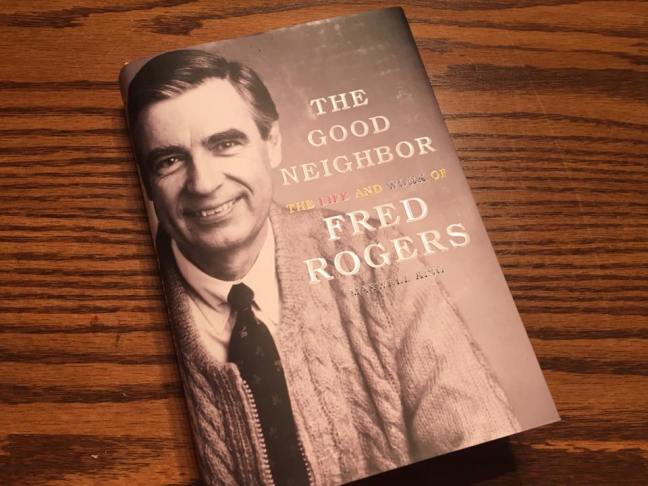
I’ve started reading this wonderful, new biography about Fred Rogers, entitled, The Good Neighbor: The Life and Work of Fred Rogers by Maxwell King. In particular, I love a story in this book which I’ve never heard before.
Once, an intern who was working on the Mister Rogers Neighborhood television show traveled with Fred Rogers to Boston. A very influential executive at the Boston public television station had invited them to dinner with the rest of his family. The executive arranged for a limousine to pick up Fred and the intern and bring them both to his home. Once the limousine arrived at the house, the driver asked what time he should return to pick them up again. But instead of sending him away until a later time, Fred Rogers just invited him to the dinner! And the wife of the television executive was completely caught off guard and bewildered by this.
Then after the dinner was over, Fred Rogers sat up front with the limo driver and spent time getting to know him. His name was Billy. After connecting so wonderfully, Billy invited Fred and the intern over to his parents’ house. While there, Fred played the piano and people from the neighborhood kept coming over and joining the spontaneous time together. And Fred and Billy stayed in touch. A few years later, Fred learned that Billy was in the hospital and dying, and he made a personal phone call to say goodbye.
Connection, friendship, and kinship can happen at any time. And I suppose if we want to live in a world where they transform us, we have to be willing to do the unexpected and upend the labels and class structures that divide us.
This story is found on page 39 of The Good Neighbor: The Life and Work of Fred Rogers. It comes from an interview with Elaine Rogers Crozier, Fred Rogers’ sister.
Today’s piece is a re-post, but I like visiting it again because it’s a good metaphor. It’s also an incredible medical breakthrough.
V.S. Ramachandran designed an experiment that was utterly brilliant in its creativity and its simplicity. Most importantly, it worked. It was life changing.
Ramachandran is a neuroscientist who is famous for a variety of discoveries about the human brain. In particular, his work has helped reveal the incredible qualities of its plasticity and malleability. Decades ago, he designed an experiment to alleviate phantom limb pain by using two simple mirrors.
Phantom limb pain is a kind of curious thing in and of itself. Documented in medical literature for more than 500 years, many physicians had written about the challenging phenomenon some patients had after losing limbs. For years, even decades, these patients continued to feel a painful sensation in the limb that was missing. Some felt as though their lost arm or leg was held permanently in an awkward or painful position. They remarked that they wished to move it back into a more typical, comfortable position. Of course, that was impossible.
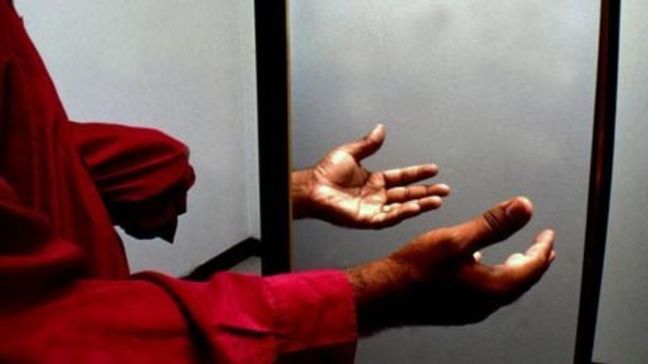
In a flash of curiosity, V.S. Ramachandran created a mirror box. He placed two mirrors together at a right angle and invited people to step inside the box. Suddenly, those who, say, lost their right arm, could see their left arm projected on the right side of their body. Inside the mirror box, it appeared that they had both arms. Then, they could “move” their missing limb into a better position by simply moving their remaining limb. And shockingly, this led to actual relief of the phantom pain! For many people, this was a permanent shift.
I love this experiment. I love that it worked. And if you’ll allow me, perhaps we can also enter this as a bit of a life analogy also:
There are times when we face one another too, and our human brains also have mirror neurons. When we see the emotions of the person standing in front of us, the neurons in our own brains begin to fire and sync with the other person. Isn’t that an incredible thing? (By the way, V.S. Ramachandran has done work on this too.)
At times,
we recognize each other and smile,
we demonstrate need to one another,
we marvel in the presence of one another,
and at times,
we present pain:
broken and insecure attachment,
grief and longing,
fear and anxiety.
In all of these, in ourselves and in others, we can choose the intention to see one another well. Certainly, with our vision, we can’t save anyone into wellness. But by choosing to mirror back what is true — love, belonging, acceptance, openness, our own humanity and vulnerability — we can create conditions that allow us to see each other and see ourselves with more clarity.
We can see each other with more truth, more safety, and more healing. And sometimes, we can reconnect or reconfigure our relationship with what we’ve lost. This too is brilliant in its creativity and in its simplicity.
Mother Teresa used to say, “If we have no peace, it is because we have forgotten we belong to one another.”
I certainly don’t need to remind anyone that we have many ways of forgetting that we belong to one another. At times, we neglect our shared belonging; at other times, we create barriers purposefully, excluding some people and labeling some people, marking them as ones who stand outside our community circle.
For this reason, perhaps we underestimate the power of an invitation and forget how transformative it can be. I’ve been thinking of this after hearing a meaningful story that I would like to pass along to you today. I extend my own invitation for you to listen. It is well worth the 8 minutes:
The Rev. Bill Golderer talks about the rhythms of invitation at Broad Street Ministry, where people regularly hold dinner parties, extending to everyone in their neighborhood and including people who are rarely invited to other community events. The story above talks about what happened when a couple decided to share their wedding day with the whole community at one of these spontaneous dinner parties and what it was like to be invited.
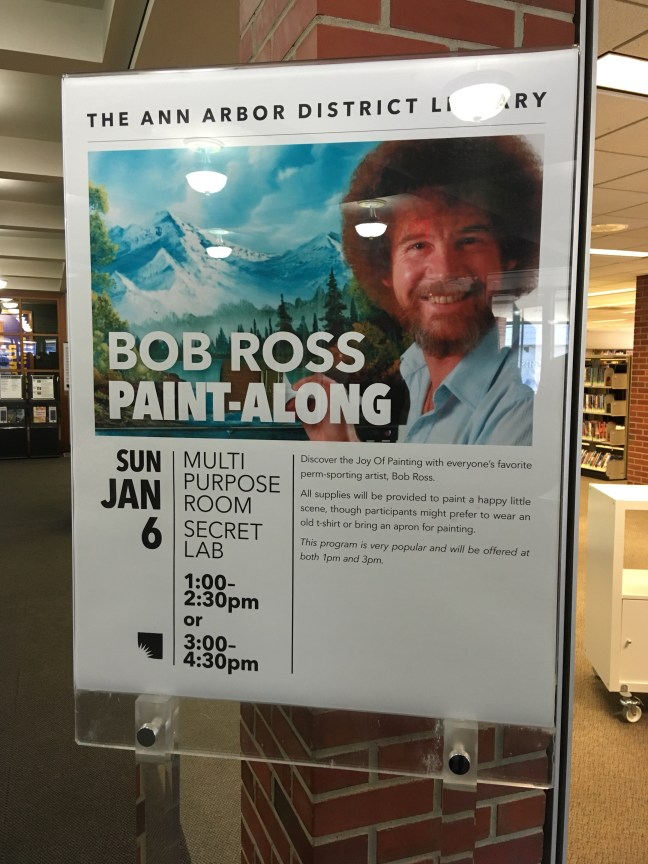
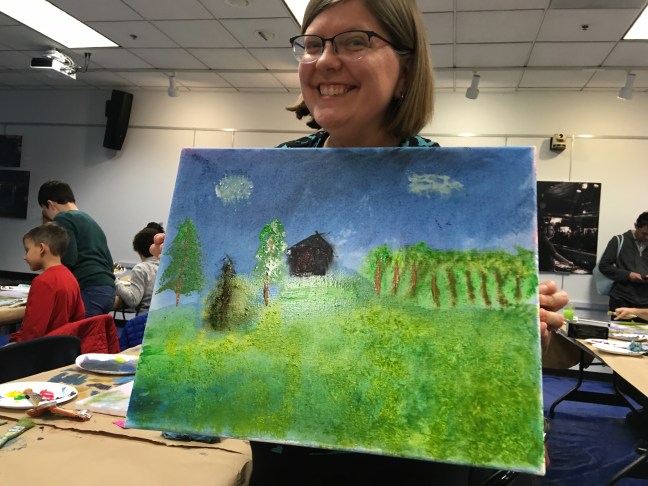
The photos above probably give it away: I went to a Bob Ross Paint-Along, and it was so much fun!
And… I’m terrible at painting. I mean, look at it…
Yet I enjoyed the attempt very much. I joined some student friends at the Ann Arbor Public Library to watch a half hour video of Bob Ross, who led us in the creation of a scenic view. Unfortunately, he never said the phrase, “happy little trees,” but we created them nevertheless.
Now don’t let Bob’s soothing voice fool you. He may be calming, but gracious, he moves fast!
My first mistake was that I put waaaaay too much water on my canvas at the beginning. Bob typically uses a clear, oil base across the canvas at the beginning. We were instructed to use brushstrokes of water instead. I was too generous with this, so once I started painting in earnest, my initial, happy little trees were remarkably waterlogged. They were more like a big blob of green, floating, meh, non-trees. And the rest “took shape” from there.
It’s possible that I painted in middle school art, though I don’t remember that. I never took an art class in high school or college. The last time I clearly remember painting was when I was using watercolors at preschool age. Does it show? As an adult, it’s also clear to me now that I’ve always had some sort of spacial reasoning deficit too (fun fact: I can’t do jigsaw puzzles… like literally cannot do them. It’s intriguing!) so these things do not set me up to paint well.
But I loved the experience.
And I just want to say that it can be wonderfully refreshing to simply play, thoroughly enjoying something you’re terrible at doing. I want to recommend this in whatever the equivalent may be for you.
Too often, we’re focused on results and outcomes for their own sake. We also get caught up in comparison and competition with others. But process matters. Play matters. Enjoyment for its own sake matters. And it can be especially fun to do it with others.
This sermon was preached at Lincoln Park Presbyterian Church in Lincoln Park, Michigan and was focused upon the story that is told in Matthew 2:1-12. An audio recording is above and a written manuscript is below.
The story begins with questions.
It’s a story that is familiar to many. Each year, the Magi make their way into our nativity scenes at Christmas. From our boxes stretched out in all directions, they arrive from the “East.” We pose them carefully in the hopes of setting up a holy scene of serenity, or perhaps, we simply desire a decorative display for our houses. Apart from our pristine nativity scenes, however, we might forget that the story begins with swirling, controversial questions:
In the time of King Herod, after Jesus was born in Bethlehem of Judea, wise men from the East came to Jerusalem, asking, “Where is the child who has been born king of the Jews? For we observed his star at its rising, and have come to pay him homage.”
These wise ones had come into the city of Jerusalem, and before they ever met with King Herod, it seems that they were asking these questions of everyone. “Where is this child? Where is this King?” They stirred up these questions among the people of Jerusalem.
And then, King Herod heard about it.
The questions stirred up fear in the king.
The story says,
When King Herod heard this, he was frightened and all Jerusalem with him.
Soon after, Herod begins asking questions of his own. He calls together all the chief priests and scribes he can find, and he inquires of them where this Messiah is to be born. This is the pressing question before him. They tell him,
In Bethlehem of Judea; for so it has been written by the prophet: ‘And you, Bethlehem, in the land of Judah, are by no means least among the rulers of Judah; for from you shall come a ruler who is to shepherd my people Israel.’
At these words, Herod must have been terrified and enraged. In the midst of his fear and anger, he puts a plan into place. He decides to use these Magi as pawns.
Herod secretly calls for them.
It is time to do his own questioning.
Herod asks them questions about the star that they have observed. The Magi were likely astrologers, and Herod wanted to know about the astronomical sign that initiated their journey. And after gaining enough information, Herod then sends the Magi directly into Bethlehem to find the very child who is stirring up fear in his heart. He gives a false story to cover up his motives, saying that he wants to find the child and honor him. But along with the fear, Herod has hatred and violence in his heart. How dare this child question his own rule?
And so, they go. The Magi from the East will not be deterred by these false motives, but instead, they let their questions lead them on. They follow the astronomical sign, and they follow the questions of their hearts. Then miraculously, they find the child Jesus. They enter the house and see Mary, his mother, also. This is when they fall to their knees to honor him.
And from that place of honor, they give him gifts of gold, frankincense, and myrrh. These are odd gifts to give a child. . . and yet, they set the scene for the life story that will unfold.
Gold is a gift fitting for a king.
Frankincense is a gift fitting for a priest.
Myrrh is a gift fitting for one who will die,
one whose body will be anointed.
These gifts raise hints about how the story will unfold, and perhaps we find ourselves curious with questions. Alongside these questions, the scene gives way to exclamations of joy.
This child… in a way we can barely begin to understand… is a King…
This child… in way can barely begin to understand… is the Prince of Peace…
This child… in a way we can barely begin to understand…
reigns over the entire cosmos — all that is, and through all that is — and
This child reigns within our very being.
This is the exclamation of this story.
It invites our own exclamations of joy and conviction.
Where is this child, the one who is born a King?
Where is this child, the one who is born the Prince of Peace?
Where is this child who reigns over this cosmos — all that is —
from whom and for whom all things have come into being?
These questions lead to responsive exclamations.
Of course, large questions like these lead to an array of exclamations. For some, questions like these can become exclamations of threat.
This was certainly true for Herod. The Magi were warned in a dream not to return to him, so they left for their own country by another road. They practiced a bit of civil disobedience. [1] Meanwhile Herod, in a fit of rage and violence, begins to massacre all children in Bethlehem under the age of two in an attempt to stop the reign of the child who threatens him. Joseph, Jesus’ father, also warned in a dream, then flees with Mary and Jesus to Egypt, a country where they never expected to live. The holy family lives there as refugees until Herod dies and is no longer a threat to their own lives.
That’s picture is quite different than our serene nativity scenes.
For those in positions of power, and especially for those who rule over others in oppressive ways, the birth of Jesus is not particularly good news.[2] because
God will always uplift those who are downtrodden.
God will always stand against uneven, oppressive manifestations of power.
God will always make holy space for the oppressed, marginalized, and suffering.
For some, this will not seem to be good news. Though it is.
The questions emerge again and again.
Where is this child, the one who is born a King?
Where is this child, the one who is born the Prince of Peace?
Where is this child who reigns over this cosmos,
from whom and for whom all things have come into being?
These questions lead to responsive exclamations.
For us, they don’t have to be exclamations of threat. For us, they can be questions of wonder and hope. These questions can guide our lives. Like that astronomical sign in the sky, these large questions can lead us to find the child who has been born. They can help us to follow him as he grows, as he serves the people of God with freedom, peace, justice, and love.
These questions can guide us to befound in him, for that is what he seeks. Jesus seeks to transform our lives so that we can live in the very same way, serving people with freedom, peace, justice and love.
If we let large questions guide us, we will soon discover that Jesus himself is light among us. He guides the questions. He clears the pathway so that we may find him and be found in him.
He is God among us in human form.
He is infinitely with us.
He is light leading the way.
He is with us. . .
He comes among us as one who is poor. He is born to a family in poverty, and he enters the world at a time when there is with no room at the inn. He is born into a world of violence, where his very being seems to threaten those in power. He lives as a refugee.
He walks alongside us.
He enters this world with us,
guiding us in our places of deepest heartache.
The light is among us because he is with us.
Where is this child, the one who is born a King?
Where is this child, the one who is born the Prince of Peace?
Where is this child who reigns over this cosmos,
from whom and for whom all things have come into being?
He is with us.
He is the light beside us, among us, beyond us, within us.
He is with us in our poverty,
He is with us in our heartbreak,
He is with us in our grief and losses,
He is with us in our cancer,
He is with us in our Alzheimer’s Disease,
He is with us in our mental illness,
He is with us in our experiences of bullying, racism, and discrimination,
He is with us in our loss of a homeland,
He is with us in our loss of immigration status,
He is with us in our experiences of violence,
He is with us in our experiences of abuse,
He is with us in all forms of suffering.
And no matter where we find ourselves today and no matter how we feel today, the light invites us forward. Jesus is leading the way toward hope, justice, wholeness, and peace.
So let us follow that light.
Let us find this one who seeks us.
Let us be found in him.
Amen.
[1] I appreciated this tweet from Dr. Serene Jones, which says, “Civil disobedience lies at the heart of the Epiphany story: The magi receive an unjust order from a vindictive tyrant. Instead, they defy him. May we do likewise.”
[2] The Epiphany C (Jan. 3, 2016) episode of the Pulpit Fiction Podcast influenced my thinking and language here.