Today, we conclude a series that has explored the central findings of the book Church Refugees: Sociologists Reveal Why People are DONE with Church But Not Their Faith by Joshua Packard and Ashleigh Hope. This book gave us the term “the Dones” as a descriptor for an increasing number of Christians who left have traditional, institutional churches yet continue to practice their faith.
Packard and Hope, both sociologists, conducted interviews with Christians to learn more about their departures from organized churches.
Interviewees revealed that,
They wanted community. . . and got judgment.
They wanted to affect the life of the church. . . and got bureaucracy.
They wanted conversation. . . and got doctrine.
They wanted meaningful engagement with the world. . . and got moral prescription.
In other posts this week (see below), we explored the first three themes. Today, let’s look at the last one.
Meaningful Ministry and Moral Prescription
As I mentioned earlier this week, Packard and Hope write that their interviewees are “doers.” They want to engage faith in an active way. They care about their neighbors, and they want the ministries of the church to have meaningful impacts in their larger contexts.
But so often, the interviewees reported that their congregations made very little impact beyond their own membership. These churches did not address crucial needs beyond their own sanctuary walls, even as they made all kinds of moral pronouncements. Interviewees believed that church leaders and members should teach about morality and ethics, but they wanted teachings to be paired with communal action. The Church Refugees interviewees perceived their congregations to be “hypocritical and unconcerned with the world” and “increasingly incongruent” with lives “outside of the church walls.”
And this cannot be overstated: Church pronouncements and debates around sexuality and gender — particularly, same-sex marriage and gender identity — added deep pain to the lives of interviewees. Christians from the Church Refugees study held a variety of theological and social perspectives in the midst of these debates, but many carried deep pain on behalf of LGBTQ+ loved ones. Church pronouncements often functioned to shame, judge, and scapegoat LGBTQ+ people. Interviewees believed such teachings were emphasized frequently and harshly.
Finally, Christians from the Church Refugees study voiced a correlation: The more their congregations discussed morality without action, the more likely it became that church offerings would stay within the confines of their own membership. Interviewees were frustrated by this.
For all of these reasons and for the reasons mentioned earlier in the week, these Christians stepped away from institutional church communities.
It makes me wonder,
How do we confess and apologize for the ways we’ve harmed transgender, bisexual, lesbian, gay, and queer people, including fellow Christians?
How do we broaden the ways we talk about morality, and how do we prioritize that with action?
How do we listen to the witness of those who have left our congregations?
How might we hear their convictions and follow their lead?
Packard and Hope conducted in-depth interviews with Christians who left organized, institutional churches yet continued to maintain their faith identity. Packard and Hope use the term Church Refugees to describe the experiences of their interviewees — not so much a comparison to the plight of actual refugees, but as a spiritual analogy. The people they interviewed still practice Christianity, but many feel that they do not have a larger, spiritual home in the way they once did.
Packard and Hope held interviews to discover why these Christians had departed from organized churches. As they did so, four primary themes emerged quite frequently.
Interviewees revealed that,
They wanted community. . . and got judgment.
They wanted to affect the life of the church. . . and got bureaucracy.
They wanted conversation. . . and got doctrine.
They wanted meaningful engagement with the world. . . and got moral prescription.
Earlier this week, we explored the first and second themes. Now, let’s turn to the third.
Conversation and Doctrine
The interviewees from the Church Refugees study uplifted the values of conversation and shared dialogue in relationships. In their interviews, many said that they learned, grew, and experienced God most readily in the context of community. In fact, they view conversation as a theological value itself. They expressed that they often deepened their faith and spirituality in shared conversation.
But so often in their churches, these Christians experienced tension when they wanted to think theologically in dialogue. This was particularly true if they wanted to raise challenging questions.
They didn’t expect all people in the church to agree theologically on all matters, nor were they looking for people to endorse all of their own viewpoints. They simply wanted to engage in conversation, expecting that all would grow in the process of learning from one another.
In many cases, however, dialogue was simply not tolerated in the cultures of their church communities. Most frequently, they received doctrinal lectures from clergy and church members, and ‘conversations’ moved in only one direction. In such contexts, these Christians encountered churches that could not accept any ambiguity. If they raised questions or were honest about doubts, they were treated with suspicion, judgment, or were even scapegoated.
Some of the Church Refugees interviewees were additionally disheartened to watch their communities build relationships primarily as a ‘technique’ for other goals — most frequently, to introduce or convert people to Christian faith. They viewed these forms of relationship-building as remarkably inauthentic and disingenuous, and they wondered if such processes were doing harm to others. Meanwhile, they held relationships as an intrinsic good, not as a means to some other end.
All of this makes me wonder,
How can church communities create greater opportunities for shared dialogue?
How might that impact the formats for teaching or preaching?
How can we honor the hurt and reasonable suspicion of our neighbors, who expect lectures or ulterior motives from us?
How can we come to embrace ambiguity and trust that our acceptance is rooted in something much greater than ‘certainty’?
Packard and Hope are sociologists who conducted a qualitative research study from January 2013 – July 2014. They held in-depth interviews with Christians who left traditional, institutional churches yet maintained their faith identity. After spending time with interviewees and hearing their personal stories and perspectives, Packard and Hope lifted up four themes they encountered most frequently in narratives.
Interviewees revealed that,
They wanted community. . . and got judgment.
They wanted to affect the life of the church. . . and got bureaucracy.
They wanted conversation. . . and got doctrine.
They wanted meaningful engagement with the world. . . and got moral prescription.
Yesterday, we explored the first theme of community and judgment. Today, let’s talk about the second.
Activity and Bureaucracy
As Packard and Hope interviewed Christians who left congregational communities, they discovered that these interviewees are “doers.” Perhaps surprising to some, most of the interviewees never existed on the fringe of church involvement. Instead, many were leaders who participated right at center of the church’s community life for years. As leaders, they longed for their congregations to be active in their wider communities. They desired to build friendships with their neighbors and work together to address social needs in their local neighborhoods.
Holding mission and justice as high theological values, these Christians prioritized the necessity of action in partnership and service. In fact, they viewed such priorities to be central to the ministry of Jesus.
But these interviewees became deeply discouraged and frustrated as they watched their congregations grow increasingly insular. At the very moment they wanted connect in vital partnerships, their churches were most interested in securing their own institutional survival. Their churches constantly discussed how to increase the numbers of people in the pews, in large part, to ensure higher offering numbers for building expenses and staff salaries. The interviewees from the Church Refugees study felt that these concerns were disproportionally prioritized, often at the expense of faithful action. Some expressed that they “felt they were basically working as entry-level employees for a large organization.” [page 59]
Additionally, interviewees expressed frustration that their ideas were consistently impeded from coming to fruition. When they expressed a new opportunity for vision or collective action, their ideas often entered processes that required approval from multiple layers of committee structures. Interviewees were realistic that institutions need processes for discernment and accountability, but they felt that these processes were too slow and worked ultimately to protect the church from necessary change.
Most of the interviewees from the Church Refugees study worked for a long time to try to affect the vision of their churches, but eventually, they became frustrated. In addition, some became convicted: They came to a personal conclusion that they could follow the vision and ministry of Jesus more actively beyond the congregational life their churches.
And there is deep loss in that conclusion.
Interviewees left churches where they would have preferred to stay. And of course, there are deep losses to Christian congregations as well. In such situations, Packard and Hope write that congregations lose leaders who have institutional knowledge and training, energy and talents, and many community and social connections that extend beyond the walls of the church. Congregations lose vital bridge-builders to their wider communities.
All of this makes me wonder,
How can we build cultures that are willing to take more risks toward life-giving action?
How do we empower the gifts and visions of ‘doers’?
How might we grieve the people and possibilities lost in these church departures?
How do we become reconciling churches – with neighbors and our fellow Christians?
A couple summers ago, I read a book that continues to shape a great deal of my thinking. It’s entitled, Church Refugees: Sociologists Reveal Why People are DONE with Church but Not Their Faith. It is authored by Joshua Packard and Ashleigh Hope, two sociologists who conducted a research study from January 2013-July 2014. Through in-depth, personal interviews, they sought to discover why some Christians have maintained their faith identity but left organized, institutional churches behind. In most cases, these Christians have left for good.
As you may intuit from the title, this is the book that gave us the term “the Dones.” A bit of a buzzword now, this term has begun to float around quite a bit, particularly in church circles. In response, some Christians have chosen to take on this precise title to describe themselves and their experiences. Others, however, use different frameworks entirely or reject this one.
For that reason, beyond a mere word or a label, it’s important to open ourselves to fuller stories – that is, self-reported, self-described narratives of experience. That is also what Packard and Hope lift up in their book.
From their interviews, Packard and Hope uncovered four themes that participants named quite frequently as they discussed their departure from Christian congregations. I know many of us have probably seen a plethora of internet article titles like, “[Number] Reasons People are Leaving Church!” ad nauseum (insert rolled eyes). But that being said, I think this list is an important one.
Interviewees revealed that,
They wanted community. . . and got judgment.
They wanted to affect the life of the church. . . and got bureaucracy.
They wanted conversation. . . and got doctrine.
They wanted meaningful engagement with the world. . . and got moral prescription.
For the rest of the week, I’d like to look at these themes one by one.
Community and Judgment
I’m going to venture to guess that this theme is not much of a shocker to anyone.
Whether one identifies as a Christian or not, it’s not much of a surprise to hear that many people perceive Christian churches to be remarkably judgmental. . . Deeply painful, this perception is rooted in a great deal of experience.
The participants in Packard and Hope’s interviews articulated community as a high value. In fact, for many, it may be their highest value. Inside their congregations, they appreciated support, friendship, and belonging. And as leaders, they sought to cultivate these experiences for others too. Alongside the connections of support, interviewees also named community as an important theological value in their lives. They shared that they experience God and a sense of the sacred most readily through relationships.
These interviewees wanted church community ties to be strong, and from that foundation, they wanted to experience spiritual connection and meaning in relationships with others. But inside their congregations, they were especially pained to see judgment, shame, stigmatization, and scapegoating taking hold in their communities. In some instances, they were targeted for such judgment themselves, and they bore that trauma personally. At other times, they watched in deep pain as church members and leaders tore into others with labeling and shaming. They could not stand for it.
They also struggled to reconcile their view of God and the ministry of Jesus with these patterns of harsh judgment. After trying to shift the direction of the church, many of these Christians concluded that they needed to leave the community. First and foremost, they could not support these dynamics. But also, they concluded that they needed to leave in order to preserve their spiritual lives.
And so, they did. They practiced their Christian faith by leaving. It came with a lot of pain and grief. Yet remarkably, many have chosen to continue in their faith, even if they now do so outside of traditional, church buildings.
It makes me wonder,
How many people have had such experiences?
How do we identify the patterns that make such dynamics possible?
How do we listen and express our remorse?
How do we practice, model, and embody a different way?
Years ago, I heard a podcast where someone lifted up some questions.
He was making a claim that as Americans come into adulthood, they ask different questions of Christianity, depending on the generation of which they are a part. He borrowed this idea without mentioning the source, so unfortunately, I don’t know where these thoughts originate. But these questions resonate with my experience, and I’d like to share them with you.
He says that Baby Boomers have asked this primary question: Is it true?
Does Christianity make sense? Is it logical? Is this something I can reasonably put my trust in? These are also questions of Modernism.
He says that people from Generation X have asked this primary question: Is it real?
Can Christianity make a real difference in our real lives? Is it concerned with things that matter? Can it be present to our real, authentic struggles?
And right now, he says that Millennials are asking this primary question: Is it good?
Is Christianity a force for good in the world, or is it mainly causing harm? Will I harm myself or my neighbors by engaging Christianity?
Certainly, none of these questions are limited internally to any one generation. Lots of people are asking them. Maybe you, the reader of this post, are asking them too.
And this last perspective — Is it even good? — is one that we Christians must ponder internally and confessionally without defensiveness. What has happened that so many people have experienced tangible harm in the wake of Christian communities?
How will we listen to that harm?
How will make amends for it?
How will we reconcile ourselves to these realities and then, if possible, to our neighbors?
I’m reminded that in its origin, Christianity is about the proclamation and the enactment of good news. Perhaps we can proclaim some of that good news with a listening posture, honoring the worth of people who have ample reason to ask such a question. And perhaps we can enact some of that good news by practicing a different way.
As you know, it’s hardly a news flash to say that patterns of religious affiliation and expressions of religious experience have changed quite a bit over the last 40-50 years. More and more in the news and on social media, we’re hearing about a variety of studies examining these shifts. But beyond the formal studies and news reports, many of us have witnessed these changes over time. Likely, some of us have experienced such shifts internally in our own religious expression as well.
As some of these changes are explored, I think it’s intriguing to ponder these two patterns together:
And at the very same time, an increasing number of people have reported experiencing mystical encounters with the Divine. Undoubtedly, people would define God or the Divine in an array of ways. People would also describe their mystical encounters in a variety of ways too. But reports of mystical experiences appear to be increasing. Or, at the very least, people are talking about them more.
Here are some thoughts from Diana Butler Bass in her book Christianity After Religion: The End of Church and the Birth of a New Spiritual Awakening:
“In 1962. . . pollsters found that 22 percent of Americans claimed to have had a ‘mystical experience’ of God. In 1976. . . that number had risen to 31 percent of the population. Back in those days, we thought we were in the middle of a revival. Apparently, however, it did not end. In 2009, 48 percent of Americans confessed that they had a mystical encounter with the divine. This was not merely some sort of short-lived emotional outburst of renewed faith. Instead the numbers indicate that, during the past thirty years, American faith has undergone a profound and extensive reorientation away from externalized religion toward internalized spiritual experience.” (pages 3-4)
– And –
“The 48 percent is, if nothing else, a theological motley crew, diverse and pluralistic in their spirituality, as ineffable as the divine itself. But whatever the differences between these people, it appears that a good many of them are traveling new paths of meaning, exploring new ways to live their lives, experiencing a new sense of authenticity and wonder, and practicing new forms of community that address global concerns of human flourishing.” (4)
More of that, please.
I wonder how this will continue to shape us collectively.
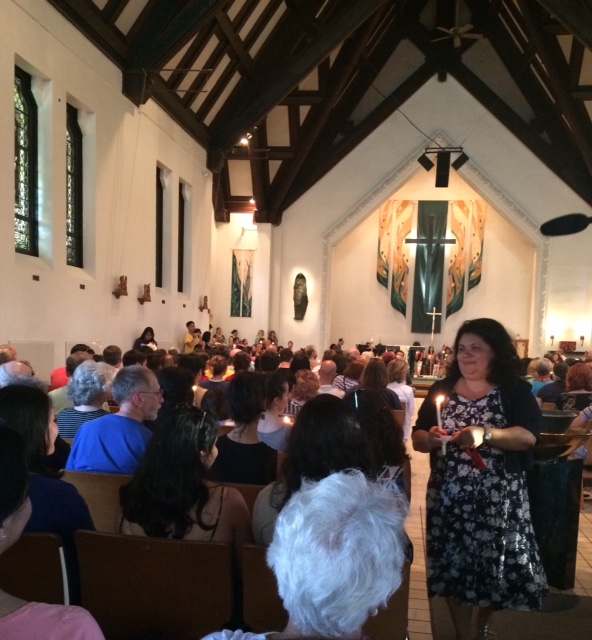
Hundreds of people in my town gathered together in advocacy of a woman named Lourdes Salazar Bautista. We pledged to support her, her three children, her wider family, and our wider community.
First, there was a vigil.
Then there was a march.
Lourdes Salazar Bautista faces immanent deportation by August 2.
Lourdes addressed us directly last night. It was one of the most powerful moments of the evening, and it was also heartbreaking. She spoke honestly about the struggles she and her family have faced since 2010.
Lourdes has lived in the United States for the last 20 years, and during most of that time, she’s lived in Ann Arbor. Her three children were born in the United States and are U.S. citizens. In 2010, after dropping off one of her children at school, she was detained by ICE and spent 23 days behind bars. It was terrifying.
ICE then made a ‘trade’ and deported her husband instead. He was sent back to Mexico, and their children lost regular contact with their father. As part of this ‘trade,’ she was granted a Stay of Deportation. Each year, it was renewed along with her work permit. But when she went in for her annual appointment in March, she was told that “this President has different priorities,” and her deportation would now be a priority. She was told that she would have to return to the ICE Field Office on July 19 (today) and present plane tickets back to Mexico. Without intervention, she has to leave the country by August 2. This means her children will have no legal guardianship. As the family considers their options, the children could leave everything and everyone they’ve ever known to move to a country where they’ve never lived, likely, with less opportunity. Or they could continue in the United States without the presence of their mother, while her oldest daughter, a college student at Michigan State University, assumes guardianship.
This is a traumatic set of options.
As we heard Lourdes speak last night, many of us were in tears. I kept longing that people could hear her voice and recognize that she is a mother who loves her children, a worker, a friend, and an advocate for our entire community. In her address, she called us to care for others who are experiencing all kinds of harm, including anti-immigrant sentiment, detainment, and deportation.
Without relationship and proximity to immigrants, so many people in the U.S. have spurred each other on to believe that people like Lourdes should not be here, and that she is even “the wrong kind of person to be here.” This belief is based on an internalized caste system of who gets to matter, who deserves protection, and who deserves opportunity.
Lourdes Salazar Bautista and her children are fellow human beings. We shouldn’t have to remind people of that. But this was so powerfully on display last night.
Last night, this family lit the candles.
At the vigil, we all held the light for them. But they were the ones who passed it to us. They initiated all those lights. I will forever remember that image. I felt remarkably humbled, called, and empowered in the presence of that action.
The fight is not over. For the last few weeks, there has been a large-scale campaign called #LuchaPorLourdes. People are trying to convince Rebecca Adducci in the Detroit ICE Field Office to grant a Stay of Deportation to Lourdes Salazar Bautista. People are calling and emailing. People are talking about this story on social media, along with stories of other families facing similar trials.
If you want to learn more, please visit Lucha Por Lourdes on Facebook.
And please consider joining in advocacy with immigrants wherever you live.
I recently had the opportunity to read some words that are going to stick with me for a long time. They’re from Brian McLaren (see below) and have encouraged me to ponder these questions:
What if Christianity moved from being an organized religion to an organizing religion?
Not just some organized effort to promote and protect propositional beliefs, but more — so very much more — an organizing religion for compassion, contemplation, spiritual connection, and human flourishing?
What if we could see this happen? What if folks could participate in it happening?
Here’s what Brian McLaren has to say:
“For centuries, Christianity has been presented as a system of beliefs. That system of beliefs has supported a wide range of unintended consequences, from colonialism to environmental destruction, subordination of women to stigmatization of LGBT people, anti-Semitism to Islamophobia, clergy pedophilia to white privilege. What would it mean for Christians to rediscover their faith not as a problematic system of beliefs, but as a just and generous way of life, rooted in contemplation and expressed in compassion, that makes amends for its mistakes and is dedicated to beloved community for all? Could Christians migrate from defining their faith as a system of beliefs to expressing it as a loving way of life?
“For centuries, Christians have presented God as a Supreme Being who showers blessings upon insiders who share certain beliefs and proper institutional affiliation, but who punishes outsiders with eternal conscious torment. Yet Jesus revealed God as one who ‘eats with sinners,’ welcomes outsiders in, and forgives even while being rejected, tortured, and killed. . . . He preached that God was to be found in self-giving service rather than self-asserting domination. . . . What would it mean for Christians to understand, experience, and embody God as the loving, healing, reconciling Spirit in whom all creatures live, move, and have their being?
“For centuries, Christianity has presented itself as an ‘organized religion’—a change-averse institution . . . that protects and promotes a timeless system of beliefs that were handed down fully formed in the past. Yet Christianity’s actual history is a story of change and adaptation. . . . What might happen if we understood the core Christian ethos as creative, constructive, and forward-leaning—as an ‘organizing religion’ that challenges all institutions (including its own) to learn, grow, and mature toward a deepening, enduring vision of reconciliation with God, self, neighbor, enemy, and creation?
“Many people today are leaving the belief systems of their parents and grandparents. This is a mass exodus from institutional faith that demographers are calling ‘the rise of the Nones.’ Nones comprise about twenty percent of all Americans, and one-third of Americans under thirty. Having little patience with (or appreciation for) mystery, as well as so little humility or basic love for groups other than our own, maybe Christianity in its present formulation has to die for a truly universal and love-centered spiritual path to be born. I sincerely wonder if this might be true.”
Last week, the staff at Chipotle was really kind to me.
I had a meeting at the University of Michigan campus, and when I finished, I realized I was really hungry. It was almost 10pm, close to Chipotle’s closing time. I walked in, and I was just about to order. Then, at the precise moment when the staff member asked me what I would like, I realized I had left my wallet in the car.
“Oh, you know what? Nevermind. Don’t start that. I just realized I left my wallet in the car.”
“That’s okay. We’ll make it for you anyway.”
“But I don’t –”
“Oh, no worries. Really, it’s okay. Glad to do it. We wouldn’t want you to go hungry.”
He said this in such a sincere way and seemed to take pleasure in offering this gift to me. I ended up with a free burrito bowl, and it was very kind.
When I left, I found myself reflecting upon those words of intention and action: “We wouldn’t want you to go hungry.”
He meant it.
It was kind.
But when I left, I began to reflect. . . wondering how often people are honest that they’re hungry without ever receiving such a statement from us, or most importantly, the food they need. I found myself thinking about times when we’ve encountered the needs of people but consciously or unconsciously, put them into the category of, “They’re always hungry. That’s a type of person who is hungry. And a person to avoid.” Racism and classism are certainly a part of this.