Flowing abstract patterns in pastel pinks, blues, and purples
Right now, it can feel like the world is shifting under our feet. Whether it’s changes to policies affecting our loved ones based on their immigration status, or attacks on gender identity, or the broader impact of shifts in workplace and societal norms, many of us are feeling the weight of this moment.
In times like these, it’s easy to become weighed down by the urgency and stress of everything happening around us. We may feel overwhelmed, unsure of where to turn, or simply exhausted by the never-ending news cycle. It’s in these moments that compassion, both for ourselves and for those around us, becomes crucial.
Self-compassion allows us to hold space for the complexities of our emotions without judgment. It’s okay to feel uncertain, angry, sad, or even numb. These feelings don’t need to be fixed, just acknowledged and accepted. Similarly, extending compassion to others means recognizing that everyone around us may be navigating their own struggles, often silently. A kind word, a listening ear, or a moment of solidarity can make all the difference.
As we face these shifts together, let’s remember that it’s crucial to care for our mental health as we take actions in response to the world’s changes. By nurturing compassion, we can create spaces of care, healing, and strength—not just for ourselves, but for each other.
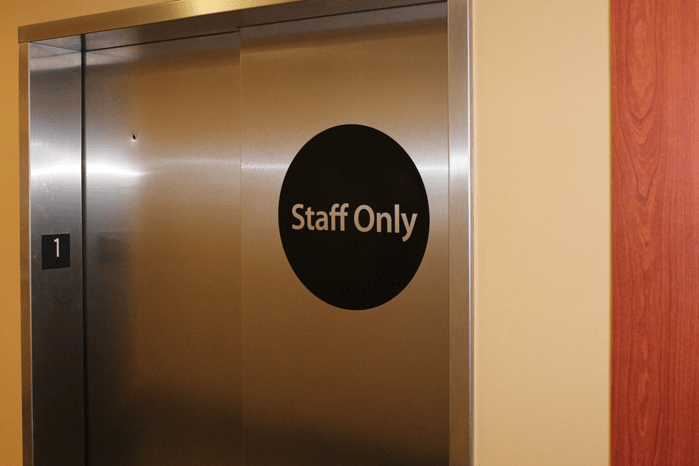
An elevator, with “staff only” written quite prominently!
Here is a re-post of a humorous story I shared in 2018 — remember those before times? — back when X was still Twitter and had the capacity to save the day. Enjoy.
Never Step Into a “Staff Only” Elevator
Have you ever left a City Council meeting, walked toward an elevator, read a sign that said “Staff Only,” pushed the button anyway, walked inside, watched the doors close, traveled down, then realized you’re completely stuck, then Tweeted your way out of it?
I have.
Move over, POTUS. I too can use Twitter for purposes for which it was never designed.
Yes, this really happened to me! Yes, it was embarrassing. And it has turned into a good story. (If you know me, surprise. I like that part).
Last month in Ann Arbor, I attended a very important City Council meeting. Despite some frustrating moments and comments, overall, the meeting moved in the direction we desired. This was certainly good news.
When that portion was over, I decided to leave. The meeting was still in session, and the City Council members had moved onto other business. So I decided to take the elevator down and walk back to my car. Now. . . which way did I come into the chambers. . .?
Here is a unique factoid about me: It’s mostly endearing, but on rare occasions, it can get in my way. That is, if I have things on my mind — especially if I’m anxious, but also, simply, if I’m pondering possibilities, as I was when I entered this City Council meeting — I don’t adequately pay attention to my surroundings.
In other words, when it was time to leave, I didn’t remember how I had come into the chambers. But never fear, here is an elevator! I remember coming up on an elevator!
It says, “Staff Only Elevator.”
“Surely, that means only during work hours,” I fatefully assume. “I mean, I came up on an elevator.”
I push the button, step inside, and choose the first floor.
I go down, and the doors swing open just as they should. But. . . I immediately recognize this isn’t where I’m supposed to be. Hmm. . . I suppose this was the wrong elevator after all. . . So I push the button, requesting that the doors close again so I can head back upstairs and try a different way.
The doors close.
And NOTHING.
That is, NOTHING HAPPENS. Because the doors are now irrevocably shut on the first floor, and no buttons are working. “Oh my goodness,” I realize, “This requires a badge.”
This just in: I have no badge.
I am the doof who stepped into a “Staff Only Elevator.”
I keep trying to push floor buttons to no avail. I see the red, EMERGENCY ONLY button, and with utter embarrassment, I begin to ponder what will happen if I push that. Will there be an alarm? Will I disrupt the City Council meeting that is still underway? Will emergency vehicles come? Will tomorrow’s news talk about this very important vote, then mention that the rest of the business was cut short when a firetruck arrived to save a person who took the wrong elevator?
I imagine people saying to me compassionately, “Oh, you must not have seen the sign that said ‘Staff only.’” And I ponder the truth, wondering if I would ever dare to say it aloud:
“Well, actually, I did see it, but due to my very poor spacial reasoning skills, I didn’t adequately remember the direction from which I entered the chamber. I only remembered coming up on an elevator, and here was an elevator, so. . .”
All of this felt mortifying to me.
But!
That’s when I remembered Twitter.
You see, friends, this very foolish error aside, I have a strong skill. I am an outside-the-box thinker! I remember, there is an entire community of people that uses a Twitter hashtag to hash out City Council meetings. #A2CityCouncil will be my saving day!
So I dare to craft an embarrassing, necessary tweet. I say,
“Okay, so this is verrrry embarrassing because I took an elevator that was for employees only, and now I’m on the first floor with an elevator door that won’t open. Can someone go push the elevator button on floor two so it sends me back up? #A2council”
And yes, to my further embarrassment, but even more to the necessity, people start retweeting this foolishness. And it works. The community makes a plan to collectively save me from my error (and just a little less dramatically than an emergency button) . In fact, a particular human was chosen by the community-at-large to push that button and send me back to the land of the living.
He was on his way when. . . oh, my goodness, I hear someone! An employee (you know, actual staff) was cleaning and talking on her phone right where I was. I started pounding on the elevator doors in an attempt to be just loud enough without scaring her. And that worked too.
She pushes the button to open the door, and as soon as I tell her what happened, she laughs and laughs.
I tweet again that I am free.
I walk out of that place, quite aware that I will never take a “Staff Only Elevator” again. And I tell you this tale, so that you will never follow in my not-able-to-go-anywhere footsteps.
We have a City Council meeting tonight. And God bless it it all, I’m going to pay attention to my entry point.
Great, courageous acts come from ordinary, every day people. This holds true for both individuals and communities, though I believe that individuals who act in such ways are likely shaped and supported by the communities around them.
Ordinary, every day communities shape individuals who can act in decisive moments:
Like the Rev. Mariann Edgar Budde, the Bishop who appealed to the newly inaugurated President, asking him to show mercy to immigrants and trans people. Have a watch of this powerful moment:
And like many more people who never make it into the news.
I’d like to re-share a Ted Talk I’ve shared in the past as well. David LaMotte; songwriter, author, and peace activist; talks about the danger of the hero myth. He shares that a network of communities usually build change in decisive moments.
May we, embedded in relationships, be enabled to act.
This is a time in our world when hope, despair, and determination are swirling around us and within us; at times, we feel one of these more than any of the others. Sometimes, we tend to the emotions and energy of others because they need our care, and sometimes, we need to borrow from the emotions and energy of others so we can receive care and keep going.
I am so grateful to see the ceasefire in Palestine and Israel come into effect. The hostages need to be home. They have experienced immense trauma and separation. There are Palestinian prisoners, including youth, who have not been charged. They need to come home. They have experienced immense trauma and separation.
It fills my heart to see these families reunited and people in Palestine celebrating when all they’ve known for more than 400 days is destruction and a will to survive.
And…
I also know that within the window of time when the ceasefire was announced (last Wednesday) and the moment it went into effect (last Sunday) the Israeli army continued to bomb Gaza, and more than 100 people were killed, including children. What is it like to survive more than 400 days in violence, debris, cold, and at times, a serious lack of food, only to die after a ceasefire was announced? More than 260 people were injured in the same window of time.
The people of Gaza continue to need our care and advocacy. And the Israeli hostages need to be released.
The work remains. Hope, despair, and determination are swirling around us and within us. We need each other. We need action.
Here we are. It is a precarious, chaotic week in many places and among many communities.
In the United States, many people are experiencing mental, physical, and emotional expressions of trauma, and/or dedicating themselves to personal practices of self-care and community-care to make sure those do not completely overwhelm us. Wherever we are, and whatever we feel, it’s all valid.
Trauma has a way of making time swirl together. What I mean is that experiences of trauma call up moments of difficulty from the past, and they become launching pads for anxieties about the future. It’s as if past and future (that is, an imagined and feared one) converge into the present. And when we have an inauguration and a flurry of painful executive orders, why wouldn’t that bring up memories and physical sensations from the initial presidency from 2016-2020, while also causing serious anxieties about what is ahead in 2025 and beyond? Those bookends of time can feel present — past and future — even when some of them haven’t happened yet.
So while these may absolutely be felt, and likely need to be processed, I want to invite us into an exercise so we may call in our deepest values and see how those might impact our present moments, too. These can also impact our mental processes, our physical bodies, and our emotions.
What are some of your deepest values, and some of the commitments you have that no matter what, you are determined to live and show forth in the world?
Think about these or write them down.
Think about a moment in the past when these values were really alive in your life or in the life of your community… Go ahead and get specific. You might want to think about a memory for each of the values, or a memory where they came together.
Think about these or write them down.
Rehearse those moments in your thinking and feeling. What was it like? Tell it like a story. Remember the sensations and what you saw and felt. Let your body feel that. You can come back to this any time. —– Now think about what it might look like to put these values into action and into relationship in the future — the near future or maybe slightly ahead of that. Visualize it. Who would be there? What would it sound like? What would it feel like for these values to be a much bigger force than our fears?What would it feel like for these to make a difference in our own lives and in the lives of others?
Think about these or write them down.
What if this form of the past and this form of the future can also converge in our present, allowing us to feel fortified mentally, physically, and emotionally? What if these can be our bigger and better bookends of time, alongside or even transcending the bookends of a presidency?
We can’t control everything that is happening. But no one can take these memories, values, forms of imagination, and action from us. No one.
I am grateful for spaces where we can bring all of ourselves — our joys, our fears, our connections, our concerns, and our hopes.
Once a month, I have the great pleasure of leading a Sunday morning service at a local church among a community called Parables. This community centers the needs of disabled and neurodivergent community members. I have loved building friendships with this community. This Sunday, I was touched as we made space to share community celebrations and deep concerns alike. Among them, we expressed worries for undocumented children in our school systems and beloved people who are waiting for travel visas. We surrounded each other in these concerns and honored the love that people feel.
I’m so glad we made space for this.
Later, after I gave the reflection, I moved into our time of communion. Two community members held the bread and the cup. I began, “On the night of his betrayal and arrest, Jesus gathered with his friends — his disciples — to share a meal, and –”
I paused.
“Oh my gosh, look at Fergus,” I continued. “Look at his tail wagging! Yes, Fergus, this meal is so wonderful,” I said, addressing him.
Fergus is one of the therapy dogs who comes on Sundays. He was in the very front row, looking directly at me, smiling in that way that golden retrievers can, and wagging up a storm as I continued to speak.
After we shared the bread and the cup together, we had some more time to name additional needs or upcoming events. “Yes, J,” my co-leader said, gesturing and calling on someone to speak next.
“Fergus is in a really kissy mood today!”
It’s true. He was. He had come over to these two adolescent boys and licked them enthusiastically for which they were overjoyed.
I turned off my news alert notifications. I want to do this for at least a week.
I will still engage news, even daily, but on my own terms. As we move into the next few days, I think we will see a slew of difficult executive orders that will come at us with a strategy of shock and awe. In the end, not all of them will stick, though some certainly will. They will feel troubling, and we may easily feel overwhelmed.
But we need not be inactive or feel entirely powerless. We’re not: We can care. We can act. We can reach out to one another.
I appreciated this paragraph from a lesson on Liven, a self-care app:
“… coping can be proactive and reactive.
“Proactive coping refers to the strategies we’re using to prevent the stress we experience from affecting us more than we’d like it to. Reactive coping is merely a response to the stress that’s already occurred, and its goal is to help us manage the impact.”
We need both of these, and this might be a good time to build up our strategies for each one.





















 Smuggling Grace