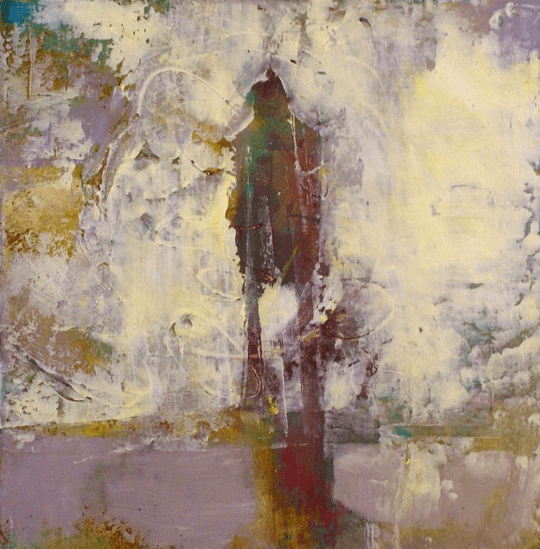
Light Walker | Grace Carol Bomer | oil and cold wax | 2013
I’m Giving Up for Lent,Lyndsay Rush What would it feel like to give up self-improvement for forty days? Would the tightness in our chests throat, shoulders, and hips ease as we contentedly took the easy way out? Would capitalism crumble if we deleted our wish lists and framed the before photo? Sounds holy, if you ask me, to be sold on life-as-is to just exist with only this, only us only what these two arms can hold
–Lyndsay Rush
Do any particular words or phrases resonate with you?
A person listening with headphones on. Public domain.
If you’re a choral singer, or if you’ve heard someone talk about conflict, you may have encountered the corny phrase,
“There’s a reason we have two ears but only one mouth!” (Har…)
Cheesy, indeed, but there are times when we are served well by listening more intentionally. When you’re singing in a choral setting, this is not only about how you sing, but about how you fit your singing into that of others. How do you blend? How do you practice dynamics? How do you keep the rhythms and cut offs precise and together? How do you make space for other vocal parts that should be primary in particular spots? This takes listening.
I’m just turning the corner on being sick for a week, but last night, I felt well enough to sit in the back of my choir rehearsal. I probably wasn’t contagious anymore, but just to be sure, I took some space, and instead of singing, I listened for the rehearsal.
And in listening intentionally, I perceived the music differently. I gained a larger view of the piece. I heard things that are working exceptionally well. I heard mistakes that needed more rehearsal.
This was a good exercise. And since I’ve already referenced an additional context for my corny, opening phrase, I do wonder where I need to listen more. If I listen intentionally, might I perceive conflicts differently? Might I hear needs more precisely? Might I consider community responses more frequently? Might I discern possibilities more readily?
Today, I’d like to offer two pieces of advice that I’ve heard over the years from loved ones. They can be helpful when you have goals but are less motivated than you’d like to be.
— A dear friend of mine is a therapist, and she often tells her clients,
“Don’t ask yourself, ‘Do I want to do this thing?’ Ask yourself, ‘Will I have wanted to do this thing?'”
In other words, are you aware that this will benefit you, and that once you’ve done it, you’ll be glad you did? How does that impact your motivation to do it?
— Another friend of mine says,
“If you’re in a place where you’re waiting for ideas, or you’re working on personal growth, and you’ve hit a plateau, ‘cultivate the soil.’ We don’t always have the energy to work at the precise goal at hand, and we can’t always expect immediate results, but we can work on the environment we’re in so that the goals and the growth are more likely to happen.”
Emotional flashbacks are a hallmark symptom of C-PTSD (C stands for complex, meaning that the trauma(s) involved have been encountered continually over a period of time, rather than existing as a single incident). They can also occur for anyone who is experiencing a response to high stress from the past.
Imagine that you enter a scenario in your everyday life, and in a way that is not easily explainable, you suddenly feel a need to flee, or you’re instantly irritable, or you’re overcome with a sense of guilt or shame, and you don’t know why you would want to run, or become angry, or feel badly about yourself. These are a few examples of what emotional flashbacks can feel like, and if you don’t know that that’s what’s happening — that is, you’re unaware that you’re being triggered in the present back to an experience from the past — you can easily look for clues in your present environment to make sense of such an experience. You might make up narratives to explain the present moment:
“She must be mad at me.”
“[Problem] is insurmountable.”
“I’ll never be good enough for this job.”
“I have to get away.”
“He hates my guts.”
“I’m so sorry for [tiny thing that happened.]”
But maybe this sudden rush of emotion isn’t primarily about the present moment or about any of these narratives. Maybe the rush of emotion is rooted in a past set of experiences.
The first step is recognizing this fact. It changes things greatly to be aware. “This is an emotional flashback.” Then we are in a position to care for it.
Here’s a great video from Heidi Priebe. Referencing Pete Walker, she helps us put language to emotional flashbacks so we can identify them and then care for them.
Why do we cry? And what is our relationship to crying?
It turns out that crying (at least, emotional crying) is a phenomenon that’s pretty unique to humans. If you’d like to learn more about that, I recommend listening to this episode of Vox’s Unexplainable podcast:
Image Description: Fallow land, rows of dirt without plants. Public domain.
One day this week, I woke up so sick. It took me by surprise, but I’m not entirely sure why it did. I had been going far too fast in a stretch of time that was also far too overscheduled. I hit a wall. My body quite literally found a way to make me stop.
So I did something I very rarely do. I canceled everything. And I mean everything. I canceled a long series of meetings for the rest of the week and my role in an Ash Wednesday Service. The last part made total sense because I wouldn’t want to get others sick, but usually, I would find ways to push through the virtual meetings. Not this time.
This is because I remembered something that a colleague of mine had posted recently on social media. Her message was,
We don’t need to be so central, because we are, actually, not truly pivotal to all things under way. We can do things collectively. We can slow things down. A variety of people can lead. It’s okay if the ground lies fallow for a while. It’s good to choose ease. It’s wise to trust and lean on others.
In my case, so many people picked up roles in those meetings and the service I was going to lead. And some of those meetings just didn’t need to happen.
I mention all of this, not because it’s some big, important story — it’s not; we all get sick, and we all need time — but if you need to slow down, for a similar reason or any reason at all, I want to play the same role my colleague did for me earlier in the week.
It’s okay to do so. In fact, it’s probably good to do so.
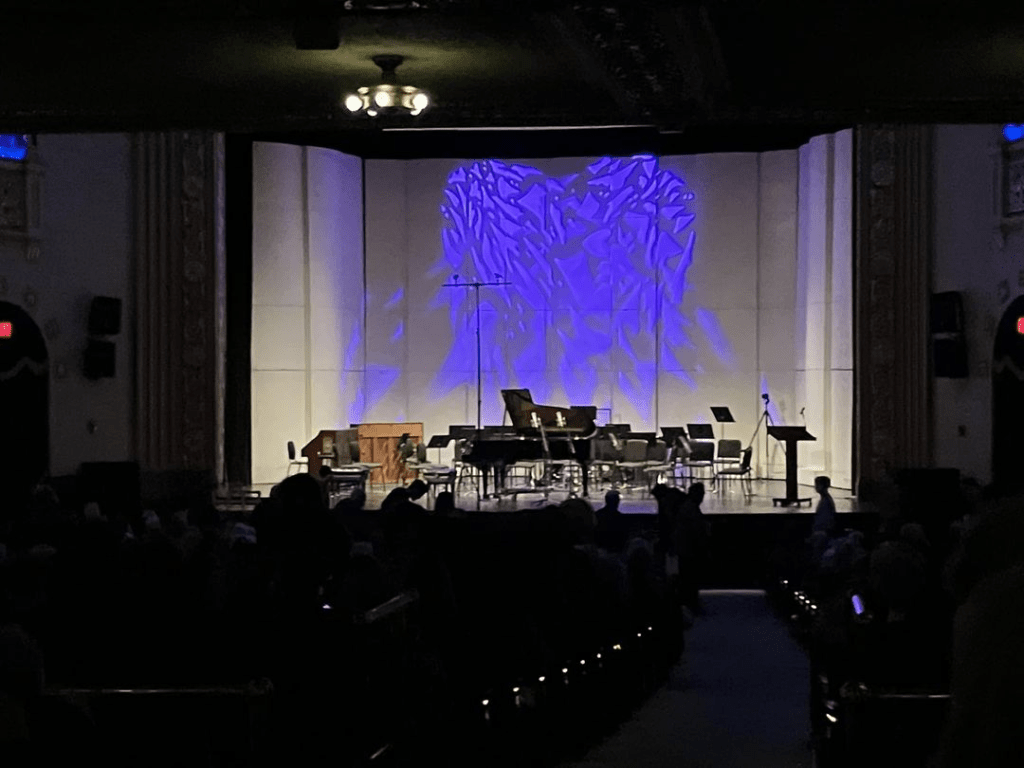
George Gershwin’s 1934 piano at the Michigan Theatre
Last week, I had the privilege of attending a remarkable event—a free performance commemorating the centennial anniversary of George Gershwin’s masterpiece, “Rhapsody in Blue.” The prospect of watching this live was already exciting, but I also received a serendipitous story that I’d like to share today.
The evening’s pianist, Kevin Cole, grew up in Bay City, Michigan. And when he was 15 years old, he learned that one of the premier experts of George Gershwin’s music also was from Bay City, Michigan, though he was living now in New York City. So he found a Manhattan phone book — I can’t imagine how big that was — and looked up this man’s name. There were twenty people with that same name, so he took his finger and just randomly let it land one one of the names. He dialed the number and said,
“Hello, my name is Kevin Cole, I’m 15 years old, from Bay City, Michigan, and I just wanted to tell you that I love George Gershwin too.”
He had called the right person!
The fortuitous encounter led Kevin Cole to receive an invitation to visit this man at his home in Manhattan, and only a couple of days later, there he was on the doorstep. They spent time connecting, and then he asked young Kevin Cole, “Do you want to play for me?” He then played some Gershwin classics, and while telling us this story, he shared, “Then this man said the one sentence that changed my life: ‘Do you know that you play like George Gershwin?'”
The man then introduced him to recordings of George Gershwin playing his own music. Fast forward fifty years, Kevin Cole, now 65, has emerged as the person who is widely considered to be the preeminent interpreter of Gershwin’s repertoire.
“I’ve been looking forward to this day for a long time,” he shared, “And I’m quite emotional, so let’s hope this goes well. It’s not every day that you get to play your hero’s piano.”
The piano on the stage was George Gershwin’s 1934 piano.
And gush he did, infusing the auditorium with an incredible sound and energy I’ll think about any time I hear this piece of music. It was an honor to watch him play this piece of music expertly, but also have one of the most joyful encounters in his life with this music — on his own hero’s piano. I love watching people come alive, and this was no exception.
I was on the phone with someone earlier this week who told me a strange fact: There is an ICD-10 code (i.e. medical billing) for “Bitten By an Orca: Initial Encounter.” I love every detail about this, because first of all, who has had this experience, really? It’s also so ominous. This is only the initial encounter. It sounds like there are more encounters to come. Will you survive? Will you have to bill insurance again?
And this made me curious about other strange ICD-10 codes. Here are some:
V0101XA: Pedestrian on Roller-Skates Injured in Collision with Pedal Cycle in Nontraffic Accident, Initial Encounter
V9431XA: Injury to Rider of (Inflatable) Recreational Watercraft Being Pulled Behind Other Watercraft, Initial Encounter
V9733XA: Sucked into Jet Engine, Initial Encounter
X52XXXA: Prolonged Stay in Weightless Environment, Initial Encounter









 Smuggling Grace