Samesie Sadie

Smiles from my bike. If I had thought to ask Sadie’s permission, I’d share our photo together.

I had a sad day.

There are no eventful or tragic happenings underway in my own life, but I’m finding myself aware of a number of deeply painful things happening in the lives of loved ones, plus deep losses and upheaval in our world. Sometimes, that sadness will get under your skin. I felt that throughout the day.

Feeling all of this, in the late afternoon on a warm day, I got on my bike, which tends to be one of my happiest undertakings. I love to feel free, zooming around town. I thought this might help me.

I was just a couple of blocks into my ride when an elder wheeled over to me. “We’re twins!” she said. Sure enough, we had the exact same bike in the exact same color. I asked her her name.

“Sadie,” she answered. (Not her real name) We smiled with each other and then we smiled again for a photo.

The light turned green, and we both took off. I was a bit ahead, but I noticed something. After I would pass people walking on the bike path, in the distance, I would sometimes hear a little, “Ding!” I knew that was Sadie just a bit behind me, passing the people as well. On a sad day, it was comforting to feel like someone was with me, taking a ride, feeling whatever we feel, noticing whatever we notice, and hoping to feel free on our bikes.

Thanks, Samesie Sadie. You made my heavy day lighter.

— Renee Roederer
Mental Health Monday: What Is Post-Traumatic Growth?

Today, I’d like to introduce us to some resources about a beautiful, strength-filled phenomenon called Post-Traumatic Growth.

Sometimes, people who experience the upheaval of trauma are able to remake their lives and live them more deeply, often with a greater sense of love and meaning than they might have had before. This is in no way to suggest that the trauma is somehow a good thing or a blessing in disguise. Certainly not. But Post-Traumatic Growth can happen alongside the pain of traumatic experiences.

Richard Tedeschi and Lawrence Calhoun, two psychologists and researchers, did a great deal of studies surrounding Post-Traumatic Growth, and they have identified five common themes in people who have experienced Post-Traumatic Growth. These include,

  1. Changes in how they relate to other people
  2. Recognition of new opportunities, priorities or pathways in life
  3. Greater appreciation for the value of one’s own life, and life in general
  4. Recognition of one’s own strength
  5. Spiritual or existential development

In light of these, here’s a video about Post-Traumatic Growth from Dr. Nicole LePera, also known as The Holistic Psychologist on social media:

In addition to sharing these, I’d like to close with a poem from Alice Walker. I wonder, does any part or resources of today’s blog resonate with you?

Hope to Sin Only in the Service of Waking Up 
by Alice Walker
Hope never to believe it is your duty or right to harm another simply because you mistakenly believe they are not you.
Hope to understand suffering as the hard assignment even in school you wished to avoid. But could not.
Hope to be imperfect in all the ways that keep you growing.
Hope never to see another not even a blade of grass that is beyond your joy.
Hope not to be a snob the very day Love shows up in love’s work clothes.
Hope to see your own skin in the wood grains of your house.
Hope to talk to trees & at last tell them everything you’ve always thought.
Hope at the end to enter the Unknown knowing yourself. Forgetting yourself also.
Hope to be consumed to disappear into your own Love.
Hope to know where you are –Paradise–if nobody else does.
Hope that every failure is an arrow pointing toward enlightenment.
Hope to sin only in the service of waking up.

A Voice Through the Door by Rumi

“A Voice Through the Door” by Rumi, Coleman Barks, Translator

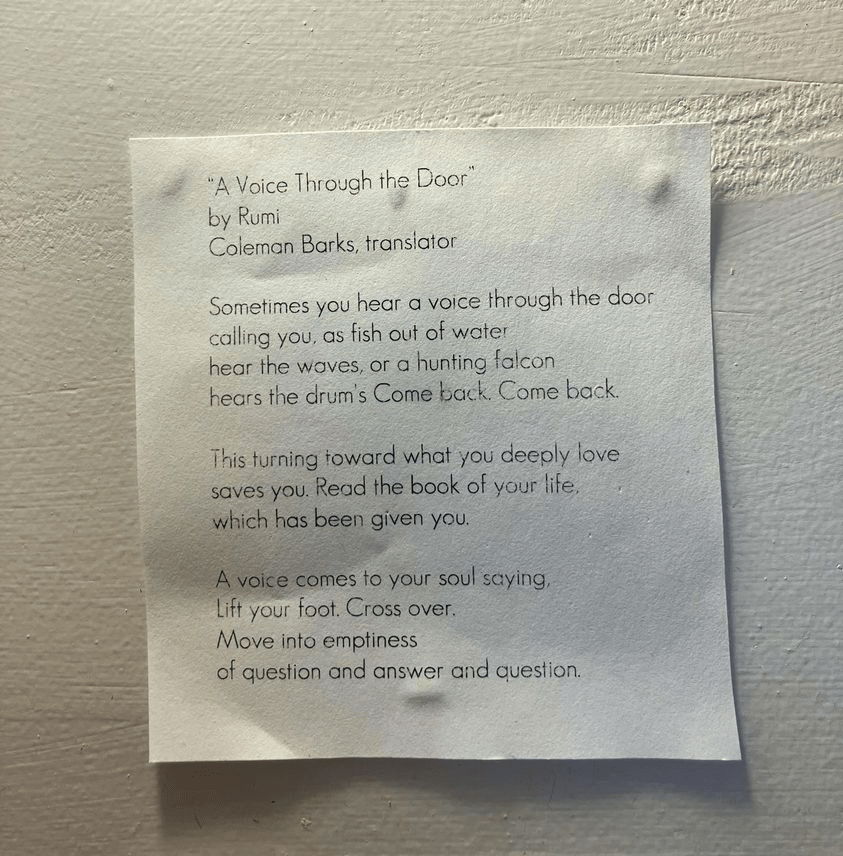
I recently found this poem hanging on a wall. I thought I’d share it today. May it speak to us in whatever way it needs to speak.

A Voice Through the Door
By Rumi

Sometimes you hear a voice through the door
calling you, as fish out of water
hear the waves, or a hunting falcon
hears the drum’s Come back. Come back.
This turning toward what you deeply love
saves you. Read the book of your life,
which has been given you.
A voice comes to your soul saying,
Lift your foot. Cross over.
Move into emptiness
of question and answer and question.

Mental Health Monday: Need Away, Friends

Two people clasping hands. Public domain.

All people in this world have needs that are particular to themselves.
Every person.

And

All people and all communities have unique and particular strengths to share.
Every person, every community.

I’m not sure if we can ever truly run from need, because human need is one of the most honest and real things about us all. But we definitely try. There may be a number of reasons for this. Among them, we’ve internalized lot of cultural narratives about individualism, self-sufficiency, and the belief that we must produce and earn love and belonging. (Psst, those are myths. Dangerous myths).

But those cultural narratives take form in our thoughts and feelings…

“I’m a burden.”

“I’m too much.”

“I don’t want to over-ask.”

“I don’t want to trouble.”

“They’re going to get tired of me.”

“I can’t voice this.”

Soon we’re speaking narratives about ourselves, and we run from our need and from one another. But again,

All people in this world have needs that are particular to themselves.
Every person.

And

All people and all communities have unique and particular strengths to share.
Every person, every community.

There is no shame in any of this. We can embrace these parts of ourselves. We can share these parts of ourselves. We can love these parts of ourselves.

Need away, friends. Welcome to humanity!

—Renee Roederer