Fractals — The Small Mirrors the Large; The Small Shapes Large

This partial view of the Mandelbrot set, possibly the world’s most famous fractal, shows step four of a zoom sequence: The central endpoint of the “seahorse tail” is also a Misiurewicz point. WOLFGANG BEYER/(CC BY-SA 3.0)

I greatly appreciate the book Emergent Strategy: Shaping Change, Changing Worlds by adrienne maree brown. The book opens up analogies to us through biomicry, inviting us to learn from nature-inspired innovation and organize our human living, loving, and changing through these patterns of nature.

Today, I’d like to share a quote about fractals. We often live in patterns: The small mirrors the large. Likewise, the small can shape and change the large. If we want to change big things, we can start small and let our largest values show up in our small, day-to-day interactions, especially through our relationships. If we want liberation, love, wholeness, and interdependence to be lived on the large scale, we must practice it as lived right where we are in the relationships we have and in our day to day living.

adrienne maree brown says,

“A fractal is a never-ending pattern. Fractals are infinitely complex patterns that are self-similar across different scales. They are created by repeating a simple process over and over in an ongoing feedback loop.

“How we are at the small scale is how we are at the large scale. The patterns of the universe repeat at scale. There is a structural echo that suggests two things: one, that there are shapes and patterns fundamental to our universe, and two, that what we practice at a small scale can reverberate to the largest scale…

“This awareness led me to look at organizations more critically. So many of our organizations working for social change are structured in ways that reflect the status quo. We have singular charismatic leaders, top down structures, money-driven programs, destructive methods of engaging conflict, unsustainable work cultures, and little to no impact on the issues at hand. This makes sense; it’s in the water we’re swimming in. But it creates patterns. Some of the patterns I’ve seen that start small and then become movement wide are:

— Burn out. Overwork, underpay, unrealistic expectations.
— Organizational and movement splitting.
— Personal drama disrupting movements.
— Mission drift, specifically in the direction of money.
— Stagnation — an inability to make decisions.

“These patterns emerge at the local, regional, state, national, and global level — basically wherever two or more social change agents are gathered. There’s so much awareness around it, and some beautiful work happening to shift organizational cultures. And this may be the most important element to understand — that what we practice at the small scale sets the patterns for the whole system.

“Grace [Lee Boggs] articulated it in what might be the most-used quote of my life: “Transform yourself to transform the world.” This doesn’t mean to get lost in the self, but rather to see our own lives and work and relationships as a front line, a first place where we can practice justice, liberation, and alignment with each other and the planet.”

-adrienne maree brown, Emergent Strategy: Shaping Change, Changing Worlds, pages 51-53

* If you’d like to read the book, you can find it here:
https://www.akpress.org/emergentstrategy.html

I Saw a Really Amazing, Terrible Butterfly Documentary

A Monarch Butterfly

I’ve watched many a documentary on Netflix, and while I tend to be a sentimental person overall, I don’t particularly like total cheeseball films. That is, unless I’m laughing at them. But even in those moments, I just chuckle a bit, close our eyes, and make a different selection.

But I watched a total cheeseball film in its entirety. I cannot overstate how exceedingly goofy it was in its presentation, but I watched all of it because it told an incredible story about dedicated scientists and innumerable monarch butterflies.

Flight of the Butterflies documents the lives of Fred and Nora Urquhart who spent 38 years working to discover the full migration patterns of monarch butterflies. From 1937 to 1975, they combined small-scale, detailed tracking with a large-scale movement of their own creation. They used self-adhesive stickers to tag the wings of individual monarch butterflies and recruited hundreds of citizen scientists to tag and record their sightings also. The Urquharts wanted to learn where these butterflies traveled over time, and many people in the U.S. joined them in these efforts.

Collectively, they all discovered several distinct migration routes, and for a long while, the Urquharts assumed that the butterflies converged somewhere in Texas. They took trips to Texas where they searched to no avail. Eventually, they began to wonder if Mexico was the destination.

In 1975, that became clearer. Kenneth Brugger and Catalina Trail, associates of the Urquharts, hiked to the winter sanctuary of monarch butterflies. This sanctuary exists on a mountain in Michoacán, Mexico. Mexicans had known about this location for years, but they did not know how far the butterflies had traveled. Adding their knowledge together, the migration patterns became known.[1]

When Brugger and Trail arrived in this location, they were stunned at what they saw. Somewhere between 60 million and 1 billion butterflies. . . on one particular mountain. At any time, this would be an incredible sight to see. But this discovery was additionally long awaited; it was long-hoped and long-dreamed.

In the next year, the Uruqharts traveled to the mountaintop and saw this incredible sight with their own eyes. I can hardly imagine what a culmination experience that would be. Day by day on the small-scale, they worked for an unseen conclusion that was decades in the making. Now they were seeing this massive winter sanctuary with their own eyes, knowing that along with others, their work had helped to map the full migration patterns of these butterflies .

It makes me wonder, do we carry any large-scale hopes? Are we captivated so deeply by anything that we would live and work in its direction daily for decades, even if we never saw the end result? Are will willing to work collectively with others? Will our lives have greater meaning if there is an ultimate goal or purpose before them?

Renee Roederer

[1] Though Mexicans knew about this incredible location, they were dismissed in the reporting on these events. For forty years, people have used language to say that Brugger, Trail, and the Urquharts “discovered” where these butterflies go. They certainly went on a journey to learn for themselves, and I admire that journey. But they could not have done so without the local citizens.

I Recommend Enjoying Something You’re Terrible at Doing

The photos above probably give it away: I went to a Bob Ross Paint-Along, and it was so much fun!

And… I’m terrible at painting. I mean, look at it…

Yet I enjoyed the attempt very much. I joined some student friends at the Ann Arbor Public Library to watch a half hour video of Bob Ross, who led us in the creation of a scenic view. Unfortunately, he never said the phrase, “happy little trees,” but we created them nevertheless.

Now don’t let Bob’s soothing voice fool you. He may be calming, but gracious, he moves fast!

My first mistake was that I put waaaaay too much water on my canvas at the beginning. Bob typically uses a clear, oil base across the canvas at the beginning. We were instructed to use brushstrokes of water instead. I was too generous with this, so once I started painting in earnest, my initial, happy little trees were remarkably waterlogged. They were more like a big blob of green, floating, meh, non-trees. And the rest “took shape” from there.

It’s possible that I painted in middle school art, though I don’t remember that. I never took an art class in high school or college. The last time I clearly remember painting was when I was using watercolors at preschool age. Does it show? As an adult, it’s also clear to me now that I’ve always had some sort of spacial reasoning deficit too (fun fact: I can’t do jigsaw puzzles… like literally cannot do them. It’s intriguing!) so these things do not set me up to paint well.

But I loved the experience.

And I just want to say that it can be wonderfully refreshing to simply play, thoroughly enjoying something you’re terrible at doing. I want to recommend this in whatever the equivalent may be for you.

Too often, we’re focused on results and outcomes for their own sake. We also get caught up in comparison and competition with others. But process matters. Play matters. Enjoyment for its own sake matters. And it can be especially fun to do it with others.

Do something terribly.

Enjoy it thoroughly.

Renee Roederer

Neighborly Donuts

A chocolate, glazed donut. Public domain image.

I was standing near the bus stop in the morning shade under a tree. I saw someone approaching with a white box. “She has donuts,” I thought. “A donut sounds so good.”

She sat on the bench, as I continued to stand under the tree. She opened the box, and curious, I looked over to see if they were, indeed, donuts — though I was careful not to stare. I was behind her, so she never saw me looking anyway.

But that’s when she turned to me and asked, “Would you like a donut?” With no way to know my curiosity, she was simply generous and neighborly. I smiled big.

“That’s so nice! How about half of one?”

“Which one would you like?”

“Ooh, how about this one!”

I savored it.

I introduced myself, and she told me her name too. She also shared that she works for the city. She told me a bit about her family as well. I know that none of our conversation solved gun violence, or climate disaster, or what’s happening in Ukraine. This person in city government didn’t suddenly solve what happens so regularly in Washington.

But this neighborliness matters too. It brightened my day. It led to connection. It bolstered us socially and physically — friendship and sugar in the warm weather.

Yes, this neighborliness matters too.

Renee Roederer

When Teachers Delight in Students, Students Learn Their Worth

 A black and white photo of Bob Youngblood, my AP English teacher from my senior year of high school. He’s looking to the left and smiling.

During my very last week of high school, every morning began with a creative conspiracy. It was implemented by giggling, teenage masterminds. Collectively, we struggled to stifle our laugher as we waited for our teacher to enter the room. Each stunt stranger than the last, we pranked Mr. Youngblood five days in a row. Our very last days of public education were filled with practical jokes.

And what sort of pranks do teenage masterminds create? Fire alarms, smoke bombs, or egg smeared chalkboards? Not these teenagers. We were way too nerdy for that.

Mr. Youngblood entered the room to find us all wearing. . . Ayn Rand masks.

Ayn Rand masks! A classmate had actually taken the time to find an Ayn Rand image, blow it up, print twenty-five some odd copies, and glue them to sticks so we could hold them to our faces and greet Mr. Youngblood as he walked through the door. Once he did, there we were, dressed to the nines in our Objectivism best. He loved it.

I could say that Mr. Youngblood introduced us to Ayn Rand, but it was, in fact, the other way around. Before we ever met him in the classroom, he assigned The Fountainhead as summer reading. We entered our senior year ready to discuss that large work, and we were introduced to one of our best teachers.

In his English class, we learned how to analyze classic works of literature. We learned how to hone our unique voices as we wrote with greater nuance. We had spirited discussions, and we challenged each other. And we laughed. Every day, we laughed.

This last aspect of our experience has been on my mind lately. Within it, I recognize that a larger lesson was present all along. It was never sketched out as a lesson plan, but Mr. Youngblood embodied it in the classroom. It was both simple and profound: He delighted in us as students. He thoroughly enjoyed us as people.

Sure, we occasionally annoyed him. But most often, he greeted us with a dry wit we also enjoyed. That wit accompanied our intentional learning and created spontaneous moments of playfulness. He believed in our voices. He delighted in us, and we knew it.

Bob Youngblood died almost seven years ago. I have been reflecting on this kind of legacy, and pondering the gift of our educators who are certainly stressed during this odd pandemic era we’re living. Teachers impart great knowledge, but they are also in a position to teach a larger lesson of delight. When teachers delight in their students, their students come to know their own worth. From that awareness, they go on to learn in self-directed ways.

Since our Ayn Rand mask wearing days, my classmates and I have more than doubled in age. This astonishes me. Even more, I am amazed to consider who we have become. We have charted career pathways, formed families, and created meaning. Bob Youngblood would delight in all of this too, I am sure.

Robert Frost once wrote that poetry “begins with delight and ends in wisdom.” [1]

Good teachers spark delight and illumine human worth. From these gifts, a lifetime of learning continues.

Renee Roederer

[1] Robert Frost wrote this in the foreword to his Collected Poems (1939).

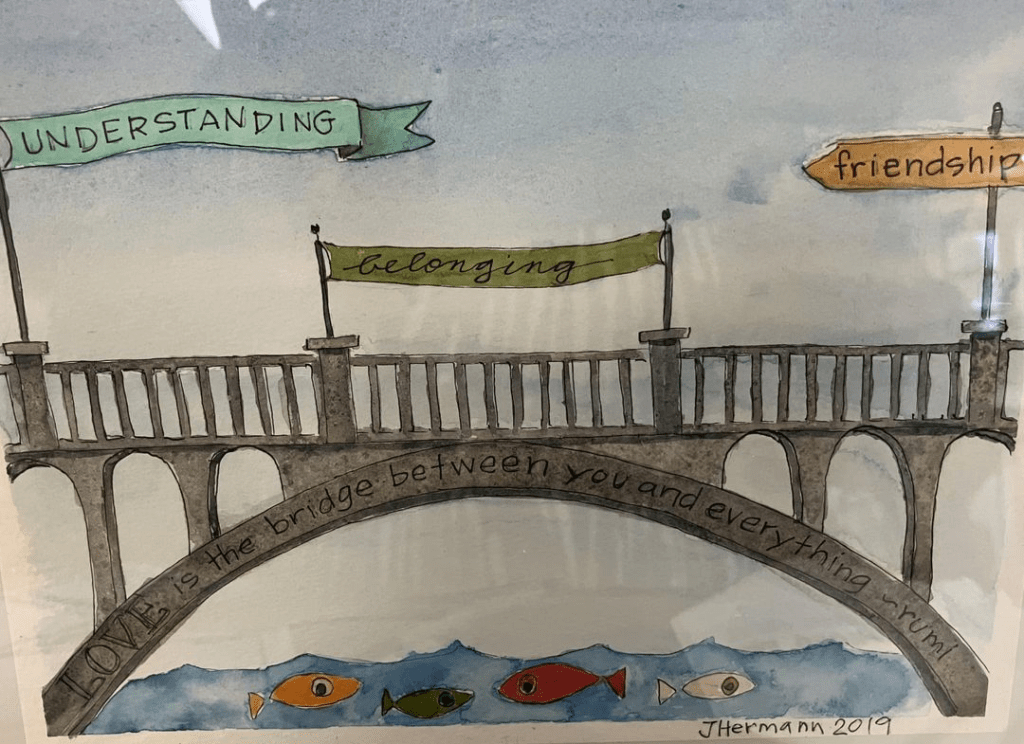
Home is Love with All Its Names

The word ‘language’ in a dictionary. Public domain.

In the English language, we have one primary word for love. Just… Love. There are certainly synonyms and words that expand upon it, but we typically use one word while other languages are a bit more expansive.

I’ve decided that it would be wonderful if these kinds of experiences and feelings of love had names:

— There’s a wonderful feeling of discovering that you are known in your specificity and loved in your limitations, and that without saying anything, people anticipate and accommodate what you need, including barriers that might be challenging for you.

I’ve experienced that. That’s love. I wish it had its own name.

— There’s a wonderful feeling of discovering that people think about things and frame things in particular ways because they’ve internalized stories you have told, and when they reveal this to you, there’s a beautiful surprise of recognizing that they have internalized pieces of you, just as you have internalized pieces of them.

I’ve experienced that. That’s love. I wish it had its own name.

— There’s a wonderful feeling of discovering you have commonality with a person, that simply being in their presence returns you to a part of yourself, a piece you didn’t even know was missing.

I’ve experienced that. That’s love. I wish it had its own name.

–There’s a wonderful feeling of discovering that people now see you — really see you in some of your more challenging moments — not in an exposed way but in an expansive and affirming way, demonstrating a recognition that you have struggled and prevailed, and showing you a surprising amount of compassion, awe, and respect.

I’ve experienced that. That’s love. I wish it had its own name.

Renee Roederer

Particular Love, Expansive Love

A tree with many visible roots. Wikimedia commons.

I was in a community setting when someone said this lovely sentence to everyone who was there:

“You make me fall in love with the world because you’re here.”

When we feel love particularly, we are enabled to feel love expansively.

To give another example, while officiating a wedding, I once heard someone say,

“May the love between you say yes to the Love beyond you.”

When we feel love particularly, we are enabled to feel love expansively.

When we’re rooted deeply, we’re connected broadly.

Renee Roederer