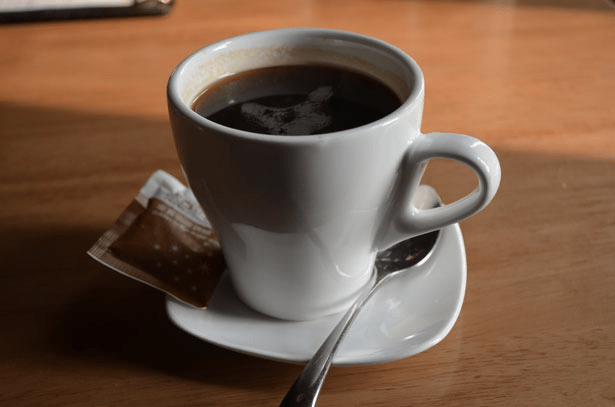
Image Description: A white mug of coffee on a white saucer. Public domain image.
When I visited some chosen family members this winter, one of them blurted out that I should feel energized because, “after all, don’t you drink like five cups of coffee a day?” I laughed and said that while staying with them, I had never had more than two. He came to his five-cups-per-day belief because I reheat my coffee in the microwave a lot. I guess I’m a slow coffee drinker.
When I was 7 and 8 years old, I would sometimes spend summer days with my Papaw Jim. He would take me to McDonalds, and I would order a Happy Meal while he would order a coffee. Sure enough, I would finish my meal way before he was finished with his coffee, and I would feel so bored.
“I’ve got just a little left,” he would say, with the cup half full.
“Just a little left.”
“Just a little left.”
This was such a marker of my summer. There was hardly ever just a little left.
I was reading and listening to a few news stories yesterday, and the themes felt so daunting. I have no need need to make any silver linings out of them. We know that painful, troubling stories of war, gun violence, financial difficulty, and climate emergency weigh heavy upon us, and they impact some directly in devastating ways.
I took in a deep breath and sighed. When we hear all of these things, particularly if they’re framed in a certain way, it can feel so daunting and dooming, as if there is nothing we can do to make this world better.
No silver linings, but I do know this last part isn’t true: We can do things to make this world better.
I sent a few texts to people I know who are connected to the themes of these stories. I told someone that I’m glad she’s working on an electoral campaign. I told someone that I’m glad he’s a peacemaker. I told someone that I’m glad he’s a doctor.
And these shoutouts of encouragement didn’t only benefit them. They benefitted me. They reminded me that we change things relationally, and I know some really stellar, committed people.
It reminds me of the poem, “Good Bones,” by Maggie Smith. (Have a read)
We can listen, sigh, and feel these stories in our own bones. And we can make this world better.
Imagination may involve thoughts, visualizations, and sensations that are internal to ourselves, but can it also take shape? Imagination becomes a lens that impacts what we notice, and thus, to a certain extent, it materializes into what we actually experience in the world.
There are very real ways to form relationships with ideas and even people internally inside our own imaginations, and this can impact how our bodies feel materially.
Image Description: Light shining through the trees of a forest.Public domain.
Father Greg Boyle is a person I really appreciate. He’s the founder and spiritual leader of Homeboy Industries in Los Angeles. Homeboy Industries provides jobs, training, tattoo removal, therapy, and a variety of classes for people who are leaving gangs and people who have been recently incarcerated. In the midst of these opportunities, Homeboy Industries has created a large, extended family of kinship — many meaningful relationships over time.
Father Greg was once a guest on Krista Tippett’s On Being. During that interview, he uses a beautiful phrase about the mutuality of relationship. He says that in kinship, we serve as enlightened witnesses, helping each other ‘return to ourselves.’
Toward the beginning of the podcast, he uses some language from Cesar Chavez. Once, a reporter said to Chavez, “These farm workers sure do love you. . .” And to that, he replied, “The feeling’s mutual!”
That line came up again when he discussed this beautiful experience of returning to ourselves. To bring it home, he told a story about one of the homies named Louie and a mutual blessing they shared with some humor. I want to share Greg Boyle’s words below:
“You want to be as spacious as you can be, that you can have room for stuff. And love is all there is, and love is all you are. . .
“Alice Miller, who’s the late, great child psychologist, talked about how we’re all called to be enlightened witnesses — people who, through your kindness, tenderness, and focused, attentive love, return people to themselves. And in the process, you’re returned to yourself.
“Like I have a homie named Louie who just turned 18. And he’s kind of a difficult kid. You know, he’s exasperating, and he’s whiny. And he works for me — although work may be too strong a verb. But homies lately have asked me for blessings, which is odd — it’s like in the last three years — and they always ask me on the street or in my office. And they never say, ‘Father, may I have your blessing?’ They say, ‘Eh, G, give me a bless, yeah?’ And they always say it the same way.
“So this kid Louie, I’m talking to him, and he’s complaining about something. And finally, at the end of it, he says, ‘Eh, G, give me a bless, yeah?’ I said, sure. So he comes around to my side of the desk, and he knows the drill. And he bows his head. I put his hands on my shoulder. Well, his birthday had been two days before, so it gave me an opportunity to say something to him. And I said,
‘You know, Louie, I’m proud to know you. And my life is richer ’cause you came into it. And when you were born, the world became a better place, And I’m proud to call you my son. Even though — ‘
And I don’t know why I decided to add this part —
‘– at times, you can really be a huge pain in the ass.’
“And he looks up, and he smiles, and he says, ‘The feeling’s mutual!’
And suddenly — kinship so quickly. You’re not sort of this delivery system. But maybe I returned him to himself, but there is no doubt . . . that he’s returned me to myself.”
Friends, I hope you’ve had this kind of experience lately, even if socially distanced.
Or I hope you can recall this kind of experience — of returning and being returned — in a way that fills you right this instant in the present moment.
In my job role, every day looks different than the next. I love this, and I feel grateful for it.
I work as the Community Care Director at the Epilepsy of Michigan, and each day, I interact with community groups and community members who call us. I am not an expert about any of the following, nor do I pretend to be, but in this position, I regularly learn knowledge and pull from knowledge about medicine, law, social work, therapy, public policy, education, spiritual care, community organizing, and more.