
When it comes to the people I have in my life,
and the joy of their presence,
I’ll just say,
I am really and truly, so very, so absolutely,
a lucky ducky.
When it comes to the people I have in my life,
and the joy of their presence,
I’ll just say,
I am really and truly, so very, so absolutely,
a lucky ducky.
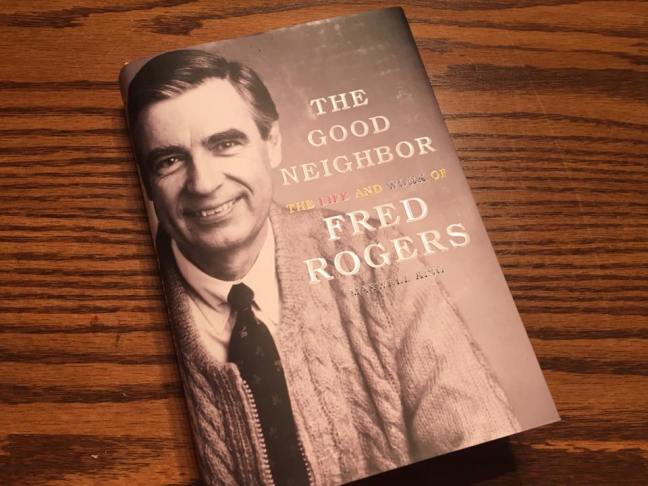
I’ve started reading this wonderful, new biography about Fred Rogers, entitled, The Good Neighbor: The Life and Work of Fred Rogers by Maxwell King. In particular, I love a story in this book which I’ve never heard before.
Once, an intern who was working on the Mister Rogers Neighborhood television show traveled with Fred Rogers to Boston. A very influential executive at the Boston public television station had invited them to dinner with the rest of his family. The executive arranged for a limousine to pick up Fred and the intern and bring them both to his home. Once the limousine arrived at the house, the driver asked what time he should return to pick them up again. But instead of sending him away until a later time, Fred Rogers just invited him to the dinner! And the wife of the television executive was completely caught off guard and bewildered by this.
Then after the dinner was over, Fred Rogers sat up front with the limo driver and spent time getting to know him. His name was Billy. After connecting so wonderfully, Billy invited Fred and the intern over to his parents’ house. While there, Fred played the piano and people from the neighborhood kept coming over and joining the spontaneous time together. And Fred and Billy stayed in touch. A few years later, Fred learned that Billy was in the hospital and dying, and he made a personal phone call to say goodbye.
Connection, friendship, and kinship can happen at any time. And I suppose if we want to live in a world where they transform us, we have to be willing to do the unexpected and upend the labels and class structures that divide us.
This story is found on page 39 of The Good Neighbor: The Life and Work of Fred Rogers. It comes from an interview with Elaine Rogers Crozier, Fred Rogers’ sister.
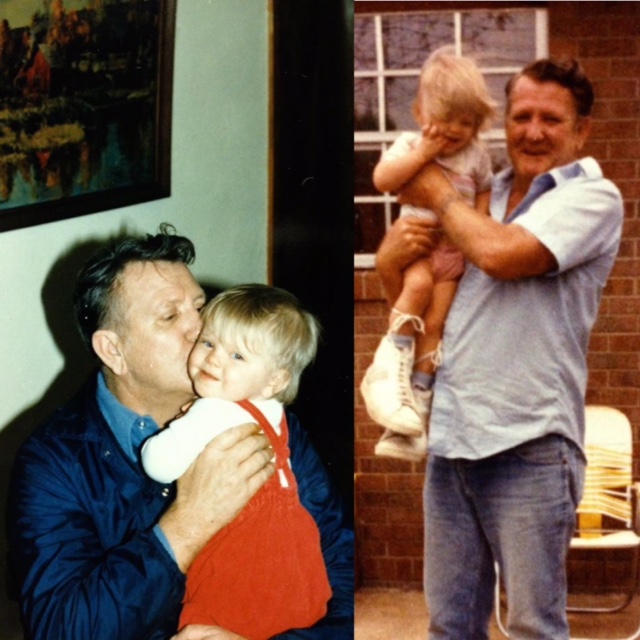
My grandfather was an orphan.
That’s a stark sentence, I realize, yet a true one. My Grandpa Jim’s early life was very rough. He was the youngest of five children. When his Mom was pregnant with him, or shortly after he was born — I’m not sure — his Dad died. This part I do know: My Grandpa Jim was born on the very day of the 1929 Stock Market Crash. That plunged the United States into the Great Depression.
His mother could not afford to raise her children so she placed them all in a Catholic orphanage. Then she set a plan in motion; she started selling moonshine! When she made enough money to bring her eldest home from the orphanage, that child helped her with the business. And when they had enough money to bring the second eldest home from the orphanage, that child helped her with the business. This pattern continued until they were all home. My Grandpa Jim lived in the orphanage the longest. He spent his first seven years of life there.
It was a challenging place. They had so little. He once found a chocolate bar wrapper and kept it for a good while just so he could smell it. This was a very vivid memory to him. It was rare that the children had big joys or delights.
But as an older adult, my Grandpa Jim loved to delight in small things.
Here’s a very vivid memory that I have: When my Great Uncle and his Brother-in-law died, most people were out in the hallway after the visitation was over, but he and I sat in the room together for a bit, and he started telling me ghost stories. They felt especially playful and spooky in a funeral home. All these years later, I don’t remember any of the details of those stories, but what I remember very clearly is that he had a red lollipop in the breast pocket of his dress shirt. Maybe that was an odd context to have a sucker sticking out of your pocket and visibly (I mean, there were pants pockets too). But I imagine he found it lying around somewhere in the funeral home — maybe they were there for guests or for children — and he snagged one for himself so he could enjoy it later.
There were other silly, simple delights too. He used to sing these really goofy songs. All these years later, his grandchildren remember all the words. He loved to whistle and shuffle his feet in a little dance. And I honestly believe he was just as excited as the children, if not more excited, to open presents for Christmas.
Earlier this week, when I was leaving my workplace, I saw some Hersey Kisses in a bowl, and I put about five of them in the pocket of my jacket. All week long, every time I’ve put on my jacket and grabbed my keys in my pocket, I’ve also been surprised that I have these there. I just keep forgetting they’re there. And each time, I have this huge spike in delight. People who know me well also know how excited I get for little treats, and how much I enjoy the surprise of them, whether they’re displayed for a group or whether people give them to me personally. It’s a big swell of delight for something small yet unexpected.
And I’ve never made the connection before. This week, for the first time in my life, I asked myself, “Do I get this from Grandpa Jim?”

These days, it’s so important to give and receive gentleness from one another.
Gentleness is a consistent human need, but right now, we may need it in a particularly deep and present way. Our world seems to be reeling from waves of trauma. When we hold awareness of traumatic pain, whether we’ve experienced it directly or felt it via the news cycle, our bodies, minds, and spirits can be deeply affected.
Waves of trauma in our world are not new, of course, but right now, we are especially aware of injustices and forms of insecurity – a pandemic ,white supremacy, economic inequality, numerous natural disasters, deportations and family separations, and violence on a massive scale. To be aware of these things is not merely to know about them but to be affected by them.
We need action – decisive, creative, and disruptive action to adequately address and rectify all of these.
And alongside that action, we also need gentleness.
Our bodies need it, our minds need it, our emotions need it, our sense of spiritual longing needs it.
And perhaps, our sense of time needs it too. Here is a paradoxical thing I have learned over the years about trauma:
Trauma often distorts time. This is especially true in a post-traumatic experience. A small detail in the present moment can suddenly pull us back into the past, making it feel as though a past upheaval is happening right now. Likewise, a small detail in the present moment can suddenly ignite anxiety, causing a tailspin of fear in which we imagine a future where the upheaval might repeat itself. In these ways, trauma can bookend the present moment with a past and future that feel quite painful and insecure.
But with gentleness,
Trauma also opens up time. This is a pretty miraculous thing. There is also concept called post-traumatic growth. (Watch this video). Some people who experience the upheaval of trauma are able to remake their lives and live them more deeply, often with a greater sense of love and spiritual meaning than they might have had before. This is in no way to suggest that the trauma is somehow a good thing or a blessing in disguise. Certainly not. But post-traumatic growth can happen alongside the traumatic distortion. When it comes to a sense of time, there can actually be a bit of reversal of what I’ve articulated above. Good memories and meaningful relationships can be internalized in such a way that they are felt as deeply present. Beloved people and life-giving moments from the past and hopes for the future can feel more accessible in the present moment among people who have experienced post-traumatic growth.
So what helps people experience this kind of growth? Two things are very important:
1) being surrounded by a community of care with relationships that add gentleness and sustaining presence
and
2) becoming enabled to make meaning of the traumatic experience, while learning to create a new narrative with that meaning.
So these days, in this time we’re living, I wonder,
Can our world collectively experience post-traumatic growth? Can this be a collective awakening toward deeper love and greater meaning?
Those questions are not easily answered, so they linger.
But I know this: Gentleness will be important.
Earlier this week, while scrolling through Instagram, I saw a post by @_the_open_space, that I found to be real, raw, beautiful, and inviting all at once. May connection be fullness for us, even if it’s just one, initial, small, honest step in a direction. That step and that direction could open up a larger process toward healing.
Here’s the post:

The text reads:
I will consider isolating when I feel overwhelmed by my inner & outer worlds.
I will sense myself folding inward & swallowing my feelings into some wide, open void of emptiness.
It will hurt on more levels that I can even comprehend or express.
I will yearn for the familiarity of numbness to ease both the original overwhelm & the sorrow of resolving my pain in this way.
I will consider writing this all down & sharing it with you.
And when I do, isolation be damned.
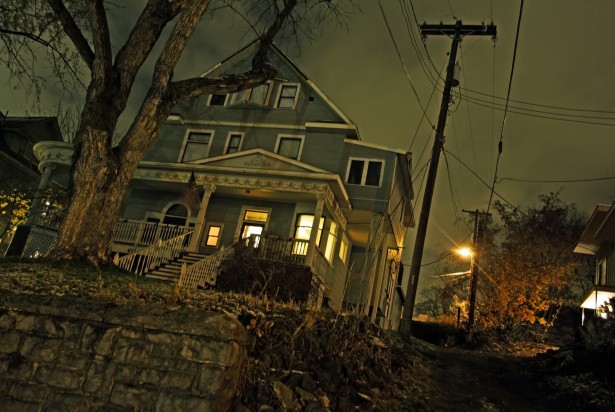
More than a decade ago, I stood outside in a parking lot on a dark, October evening with a number of college students. I want to imagine that we were cold while we waited in line, but who am I kidding? This was Texas. Still warm enough, I think we were certainly intrigued and maybe a little nervous while we waited.
We had decided to go to a Hell House. This was becoming a bit of a phenomenon. Some churches were mashing up the genre of a haunted house with the fundamentalist theology of hell. Onlookers were invited to walk through the rooms where they would see dramatized versions of people committing terrible sins and then… they would end up in hell. (By the way, there was no nuance of complexity in the life situations, and I also don’t consider some of these things to be sin). We would also walk by their hellish fate and see that they were tormented for all of eternity. The clear message was, you don’t want to end up like them, do you?
This tour concluded with a room where members of the church were present to pray the sinner’s prayer with you so you would spend your eternity in heaven instead of hell.
We did not stay for that part. We ended up at this Hell House because we watched a documentary together with the same name, and we were curious to see it in action. We processed before and afterward. We were also from a church community, but we had a different view of this.
Last week, I read an interesting article in the New York Times by David Bently Hart entitled, Opinion: Why Do People Believe in Hell? He writes,
No truly accomplished New Testament scholar, for instance, believes that later Christianity’s opulent mythology of God’s eternal torture chamber is clearly present in the scriptural texts. It’s entirely absent from St. Paul’s writings; the only eschatological fire he ever mentions brings salvation to those whom it tries (1 Corinthians 3:15). Neither is it found in the other New Testament epistles, or in any extant documents (like the Didache) from the earliest post-apostolic period. There are a few terrible, surreal, allegorical images of judgment in the Book of Revelation, but nothing that, properly read, yields a clear doctrine of eternal torment. Even the frightening language used by Jesus in the Gospels, when read in the original Greek, fails to deliver the infernal dogmas we casually assume to be there.
On the other hand, many New Testament passages seem — and not metaphorically — to promise the eventual salvation of everyone. For example: “Therefore, as one trespass led to condemnation for all men, so one act of righteousness leads to justification and life for all men.” (Romans 5:18) Or: “For as in Adam all die, so also in Christ shall all be made alive.” (1 Corinthians 15:22) Or: “He is the propitiation for our sins, and not for ours only but also for the sins of the whole world.” (1 John 2:2) (Or: John 13:32; Romans 11:32; 1 Timothy 2:3-6; 4:10; Titus 2:11; and others.)
Hart believes that the concept of hell is psychologically alluring. (It’s for others, of course.)
I also think of my late friend and colleague, the Rev. Keith Wright, who wrote a book entitled, The Hell Jesus Never Intended. He looks at the Bible exegetically and also raises questions ethically. The concept of hell, as it was interpreted in that Hell House, isn’t found clearly in the Biblical texts as some would like to believe.
This is all on my mind because the Revised Common Lectionary, a calendar of Biblical texts to be read in worship, will soon include the section of the Sermon on the Mount where Jesus speaks about adultery, lust, and anger and says things like, “And if your right hand causes you to sin, cut it off and throw it away; it is better for you to lose one of your members than for your whole body to go into hell.”
Only in the Greek text, he says more literally, “It is better to lose one of your members than for your whole body to go into Gehenna.”
Gehenna was a forever burning trash heap on the outskirts of Jerusalem in the Valley of Hinnom. It’s this-earthly. And it makes me wonder…
Are there ways — a myriad of them — in which we find ourselves living a bit of a half-life, when instead, we are invited continually into fullness? And are there ways — a myriad of them — in which we create hellish conditions for some, right here and often systematically, when instead, we are called continually to participate in collective justice and wholeness?
I think so. And I’m glad those invitations remain.
If anything is consistent and eternal, perhaps it’s those. I’m going to keep pondering these things this week…

Spontaneously, we turned off the lights and began passing around a single candle in a glass jar. We had time to kill as we waited for the last person in our group to arrive at the house, so we sat at the kitchen table and passed this candle around. It was storytime. We giggled as it illumined faces, and when the candle came to them, each person added a phase to a story we were building.
And it was so silly.
Goodness, as I recall this, there were so many goofy themes that became a part of this story, which we built for a long time. Our other member had to come late, so we just kept going.
By the time she arrived, we had all planned to stay in the dark, silent, just sitting there with this candle burning, so she would think, “Wait… what are you doing…?”
But of course when she arrived, we tried that and just started laughing.
These are the silly moments of belonging — mundane, yet spontaneous, yet memory-making. These are the moments of having an expansive sense of household. These young adults have become a chosen family group, and I get to house that experience every time they come over. With gratitude, we’re building that bit by bit too.

In his lovely book, Being Peace, Buddhist Monk Thich Nhat Hahn says this,
“Interbeing: If you are a poet, you will see clearly that there is a cloud floating in this sheet of paper. Without a cloud, there will be no rain; without rain, the trees cannot grow; and without trees, we cannot make paper. The cloud is essential for the paper to exist. If the cloud is not here, the sheet of paper cannot be here either. So we can say that the cloud and the paper inter-are. ‘Interbeing’ is a word that is not in the dictionary yet, but if we combine the prefix ‘inter–‘ with the verb ‘to be,’ we have a new verb, inter-be.
“If we look into this sheet of paper even more deeply, we can see the sunshine in it. If the sunshine is not there, the forest cannot grow. In fact, nothing can grow. Even we cannot grow without sunshine. And so, we know that the sunshine is also in this sheet of paper. The paper and the sunshine inter-are. And if we continue to look, we can see the logger who cut the tree and brought it it to the mill to be transformed into paper. And we see the wheat. We know the logger cannot exist without his daily bread, and therefore the wheat that became his bread is also in this sheet of paper. And the logger’s father and mother are in it too. When we look in this way, we see that without all these things, this sheet of paper cannot exist.”
“Independence is a myth,” I said yesterday over the phone. I shared this to encourage someone who felt pressure to stand alone and keep their needs quiet and totally out of view.
Afraid that we will be — cultural shudder — a burden, we have been taught to believe that we are all solitary units and that there is high value in needing as little as possible. Some have been socialized to take up as little space as possible. Some have been socialized to wear a mask of invulnerability and show strength only, carrying an internalized message that it is acceptable to provide for others but completely unacceptable to receive care from others.
“Independence is a myth,” I said. “If we think about it, we all depend upon each other. Every single one of us has needs that are unique to who we are and how we move in the world. And every single one of us has gifts and strengths unique to who we are that allow us to care and provide for others.”
Then looking at my meal on my desk and remembering Thich Nhat Hanh, I added, “I have a bowl of pasta in front of me. If I slow down and think just about this one meal which is sustaining me today, how many people have been involved in bringing this bowl of pasta to me? People grew the wheat. People grew the zucchini, bell peppers, and onions, and likely in different places. How much sunshine, water, and soil participated in growing all of these? How many farmers participated in bringing this to me, and in how many locations? How many workers harvested these foods? Who canned the tomato sauce? Who drove the elements of this food to distribution centers? Who displayed these vegetables in the grocery store? How did my own coworkers provide funding for me to purchase these items?”
Even a bowl of pasta reveals that independence is a myth.
Interdependence is a reality. It is also our greatest possibility to grow and distribute care so no one is standing solitary, isolated, and without what they deserve to need.
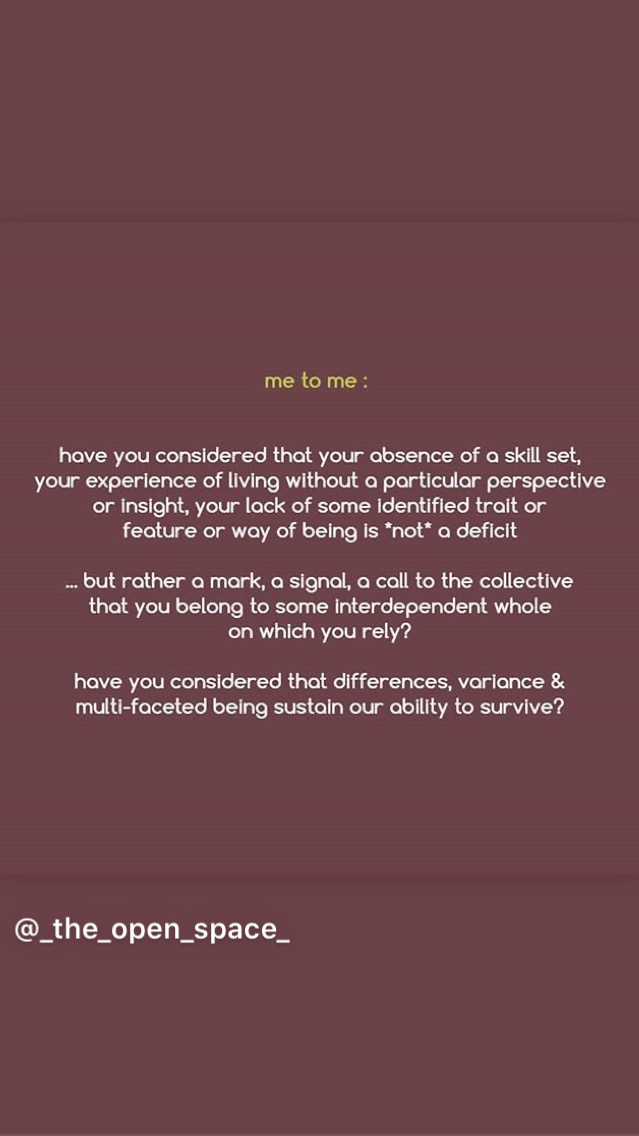
Today, I’d like to share a quote and an image from @the_open_space_ — an account I so appreciate on Instagram. What do these questions call to mind for you when we think about need, difference, calling, belonging, and community?
The image reads…
me to me:
have you considered that your absence of a skill set, your experience of living without a particular perspective or insight, your lack of some identified trait or feature or way of being is *not* a deficit
— but rather a mark, a signal, a call to the collective that you belong to some interdependent whole on which you rely?
have you considered that differences, variance & multi-faceted being sustain our ability to survive?

In a couple weeks, I’m going to be speaking on a beautiful passage from the Hebrew Bible. The poetic text of Isaiah includes this vision:
And now the Lord says,
who formed me in the womb to be his servant,
to bring Jacob back to him,
and that Israel might be gathered to him,
for I am honored in the sight of the Lord,
and my God has become my strength—
God says,
‘It is too light a thing that you should be my servant
to raise up the tribes of Jacob
and to restore the survivors of Israel;
I will give you as a light to the nations,
that my salvation may reach to the end of the earth.’
(Isaiah 49:5-6)
An unexpected vision… one that might be hard to believe? Nearly impossible to believe?
These words were originally spoken to captives — people who had been forcibly removed from their homeland with no obvious likelihood of return. They were stripped of their culture and humiliated. They were traumatized, separated from layers and layers of their identity, and treated as the lowest people. Why should they believe in any form of expansiveness? For their lives? For their community’s lives? For the world?
It is too light a thing…
It makes me wonder how a vision can catch us, unexpectedly, in ways that are hard to believe right when we’re traumatized and feeling broken. Maybe it is also too light a thing to lose vision.
Returning to ourselves
Returning to each other
Returning to hope
Returning to possibility
Expanding ourselves
Expanding each other
Expanding hope
Expanding possibility.

