Every morning, an Australian composer named Dean Stevenson writes a new piece for string quartet. Then, each afternoon at 4 p.m., four orchestra musicians gather to rehearse and perform it together.
This is part of an exhibition at the Museum of Old and New Art in Berriedale, Tasmania, and it will continue daily until May 11. They’ve been doing this for more than a year. There is also a YouTube channel where people can watch the rehearsals and each day’s performance.
I’m not really sharing this for any particular reason, except that I think it’s fun. I learned about it from The Good List, a weekly newsletter from the New York Times, curated by Melissa Kirsh.
But after reading this, I found myself thinking: if we have daily rhythms that matter to us, maybe we can invite other people into them. And if we have a day when those rhythms fall apart, it’s nice to know we can begin again tomorrow.
We are often inundated with waves of heartbreaking news — each article, podcast, or breaking news alert sharing details of real-life devastation, both near us and around the world. In the midst of this, it is easy to feel overwhelmed, flat, or cynical. How can we possibly make a positive impact on all of this?
This may sound simple, and perhaps even simplistic, but sometimes the most meaningful thing we can do is to be a caring adult. We can be a steady, trustworthy presence — not perfect, but steady — for children and youth, and for the adults around us as well.
Last week, I came across a set of statistics that stopped me in my tracks. I realize this may feel like one more wave of difficult information, but it also brings into focus just how significant this kind of presence can be:
Percentage of Americans who say that, as children, they knew a compassionate, nonjudgmental adult: 35%
Of those, the percentage who say that person was their mother: 50%
The percentage who say it was their father: 5%
These figures were published in theMay 2026 Harper’s Index, which compiles statistics from a range of underlying sources. In this case, the data is attributed to BSM Media, a research and marketing firm.
What if you can simply be a solid, trustworthy version of yourself and make that much of an impact?
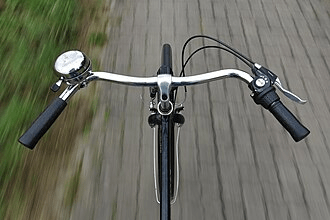
The point of view of a cyclist, if looking down at handlebars. Wikimedia Commons.
I have several elementary school–aged children in my life who use their imagination abundantly throughout the day. Nearly everything can be made into a game, a discovery, or an opportunity to pretend. And I admire this. We adults don’t often get to daydream for long stretches of time or turn our office into a game of tag or leapfrog.
But maybe we could let our imagination flow more often. Maybe we could leave some space for our minds to drift.
People often share that some of their best ideas emerge in the shower. In those moments, we’re not often thinking linearly, and we’re definitely not scrolling through our phones.
I experience something similar when I’m biking. I’m paying attention to my surroundings — I have to — but I also have imaginative thoughts based on what I see along the way. Sometimes, they make me laugh, too.
For instance, I probably wouldn’t have noticed the dumpster I was passing, except it was from a company called “Dignified Dumpsters.” Those words were displayed prominently on the side. What would make a dumpster… dignified? What would you need to have in order to think, “Oh yes, well, this one is dignified?”
My mind went in that direction for a while, and it’s not a question I ever thought I’d ask.
About fifteen minutes later, while passing by many houses, I wondered, “If the multiverse is real, and there are parallel universes, do various versions of me know various versions of every single person in this town?” If so, I think that would be neato.
However your day is going, I hope you have time for imagination and a few stream-of-consciousness thoughts.
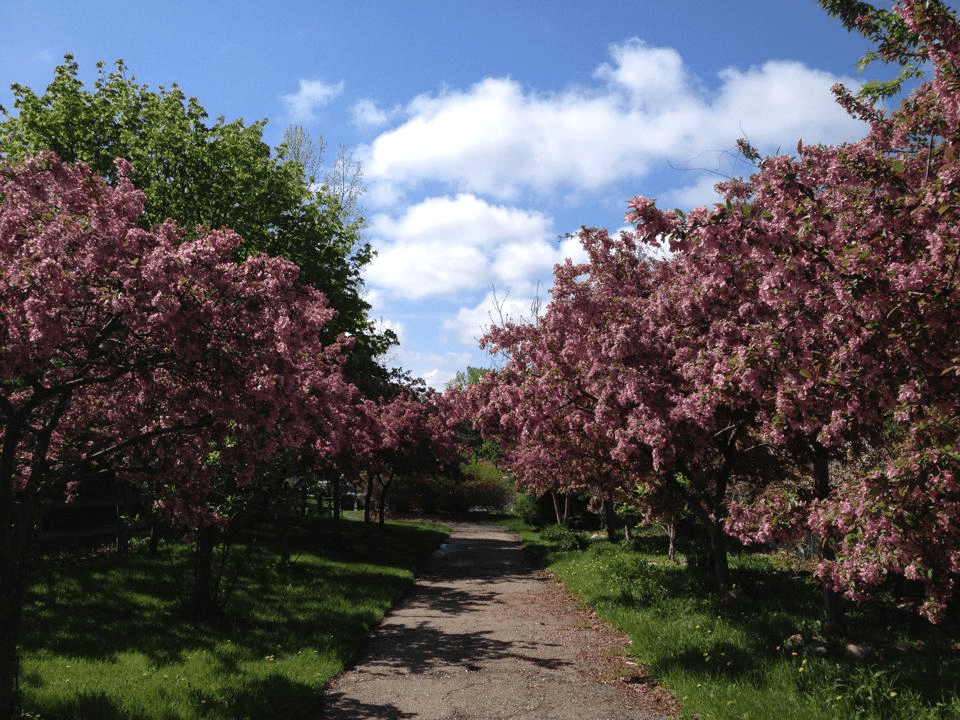
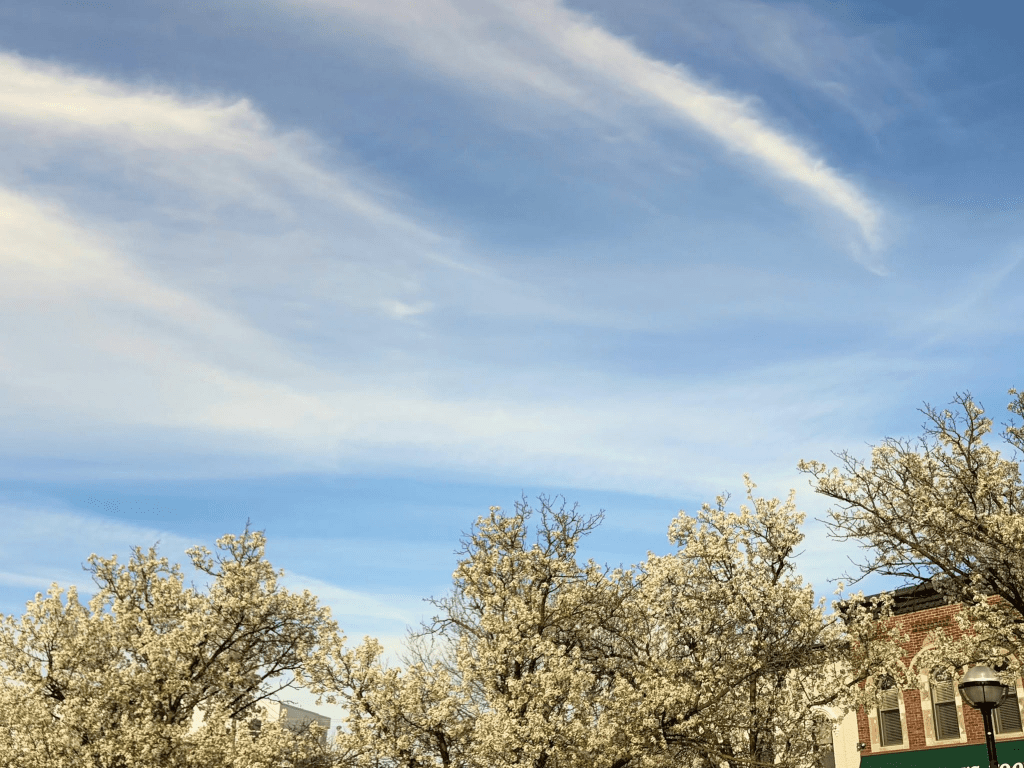
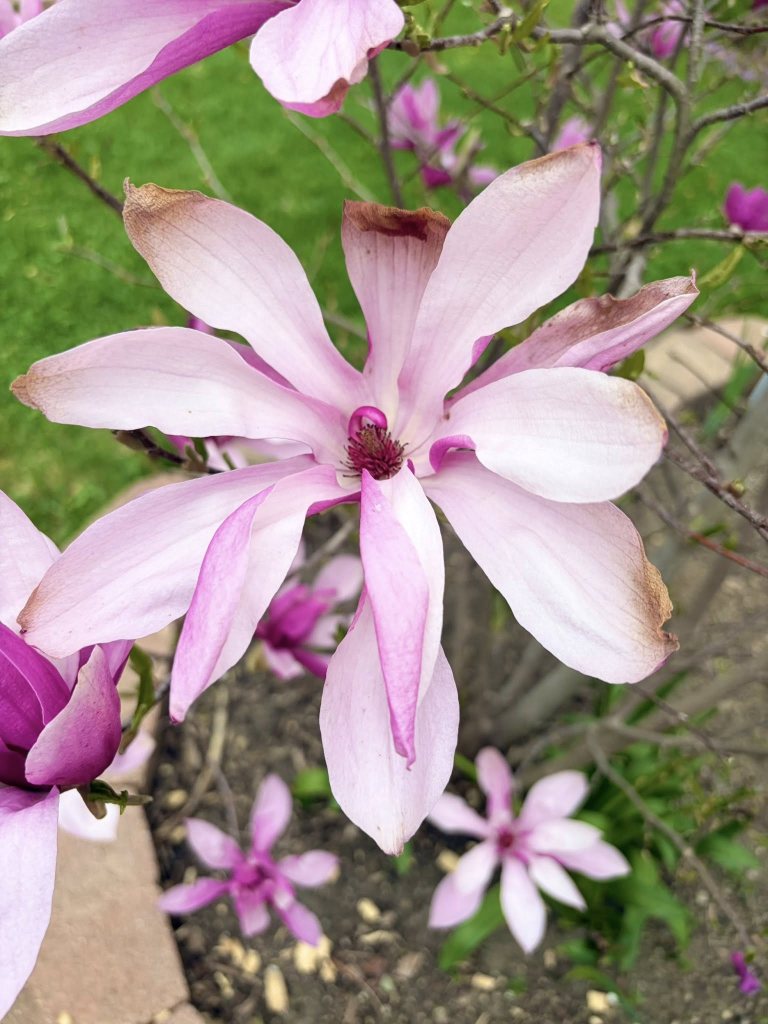
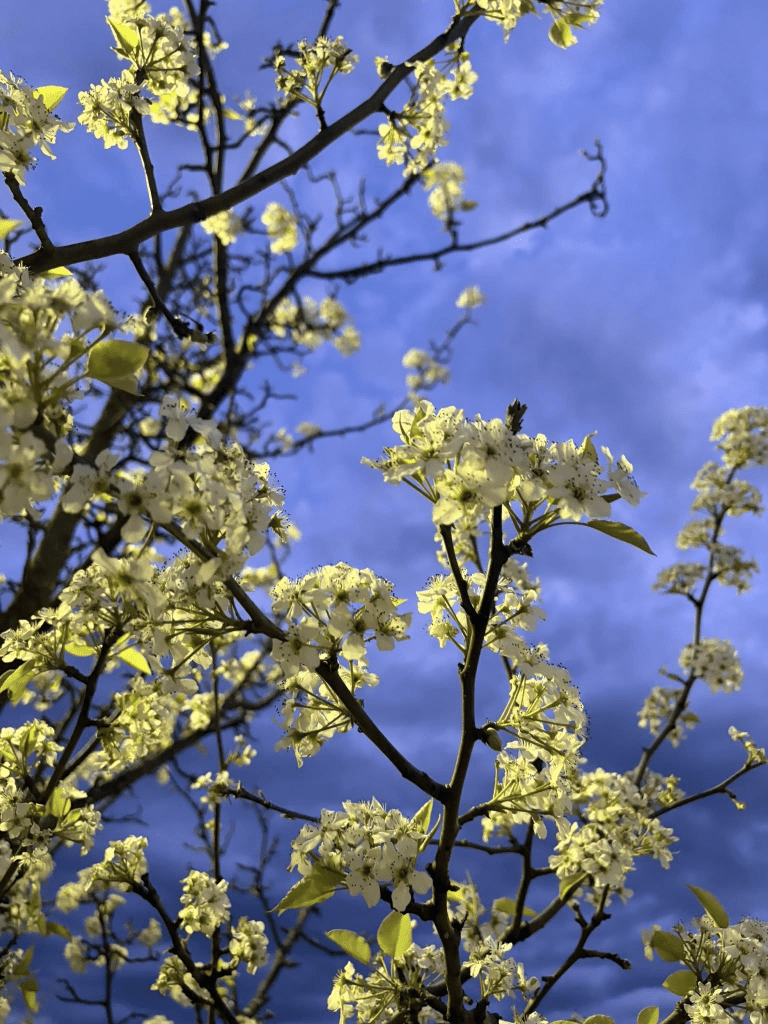
We have reached the week in our spring season when the gorgeous, pink crabapple trees are collectively in bloom. I love seeing them throughout my town. When this process starts, they are only in bloom for about 10–14 days. That’s such a short time, but they are certainly noticeable — not only because they’re remarkably beautiful, but because they are all in bloom at once.
As I was riding my bike and admiring them, I thought about how these trees have faithfully bloomed every late April and early May for decades. But then, that led to another thought.
Every flowering tree blooms for the first time.
Out of curiosity, I wondered how long it takes for crabapple trees to bloom. I looked it up, and it usually takes three to four years. Young trees spend their first years forming their roots, establishing themselves for the long haul.
That’s just a fact, but I like knowing it. There is a kind of patience built into it. The visible beauty comes later.
And every one of those trees has a first spring — a year when, after seasons of unseen growth, something finally breaks through and becomes visible to the rest of us.
We notice them when they are in bloom. But the work that made that possible began long before we ever paid attention.
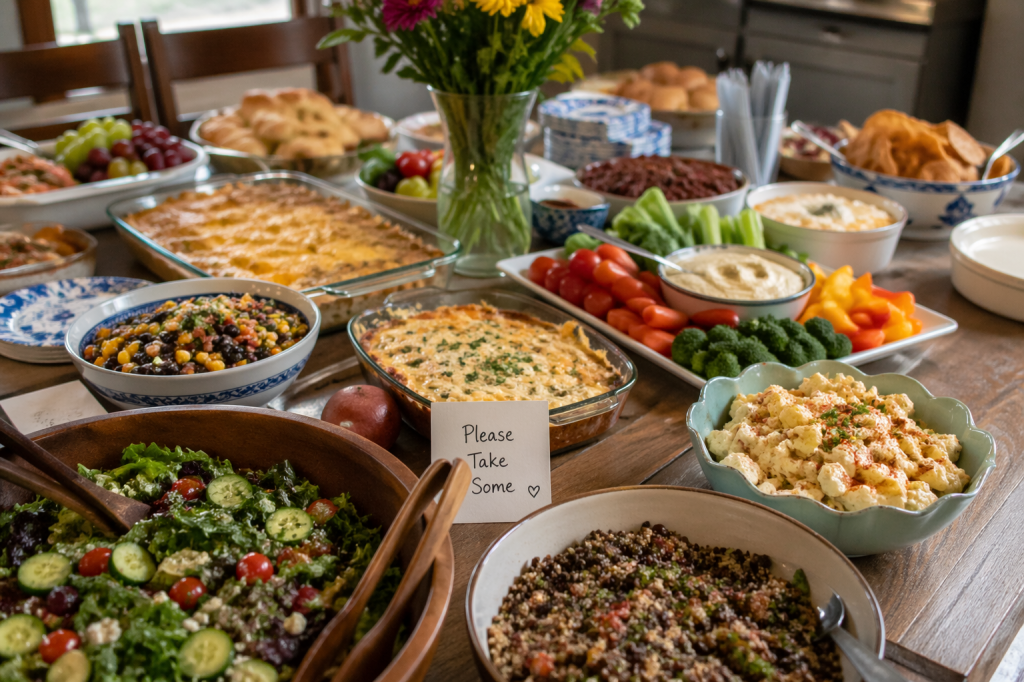
A table is set with dishes for a potluck. Public domain image.
I have been in many worship services where my clergy colleagues set the table for communion, then look out at the people and say, “All is ready.”
Usually, words like these are followed by an invitation to be a part of this experience. I’m thinking about that phrase today. It’s a statement, but it’s a feeling, too.
It says, “We are ready for you.”
We curate moments like these all the time. Maybe it is preparing a meal at home for our kids or a group of friends. Maybe it is tending carefully to a hospital room, shaping a space so that someone can be received with care. Maybe it is setting a table, arranging a room, or making sure the small details are in place.
There is a quiet kind of work that goes into those moments. And then, at some point, there is a shift — from preparing to welcoming.
“All is ready.”
Tonight, the Epilepsy Foundation of Michigan, where I work, is hosting an Open House. We will open our office space, invite people to meet our team and one another, and share about our mission and vision.
We are getting ready this afternoon. And I am looking forward to that moment — which I will probably say inwardly —
One hiker offers a hand to another while climbing a mountain. Public domain.
I’ve been thinking lately about the word entrust.
Not just trust, but entrust.
Entrusting involves placing something in the hands of others, sharing responsibility, and believing that something meaningful can be held not by one person, but by many. I’ve been leaning into this lately, and I find myself searching for words to describe how liberating it can feel to trust a community — and to entrust a shared vision to that community.
This is remarkably countercultural. We are so often told, in subtle and explicit ways, that we should be able to do things on our own, that we should be self-sufficient, and that strength looks like independence. But that story has its limits. The truth is, most meaningful work — and most meaningful life — is not something we build alone.
This is not about being naive. After all, trust is earned and built slowly, through experience and relationship, through people showing us who they are over time.
But once it is there, something shifts. We can begin to move forward without having everything figured out. We can begin to act, not from a place of certainty, but from a sense of rootedness in relationships. We can bring forward ideas that are still forming. We can take steps without seeing the entire path. We won’t have all the answers, but we will know who we can help.
In the midst of a cancer diagnosis, I know someone who has shared this with me: “I would never wish this diagnosis on anyone, but I wish everyone knew what it felt like to have your community catch you.”
This kind of care is necessary and vital in times of crisis. But I wonder if it is also true when we are stretching toward something new, nurturing shared visions and possibilities, and bringing forward something imperfect, unfinished, still becoming.
Can a community catch us there, too? In the bright spots? In the joy? In the possibilities?
If so, I am still searching for words to describe that feeling.
Yesterday, I wrote a bit about Hildegard von Bingen and shared a translation of one of her quotes. Today I’d like to share some of her music. I love it.
Hildegard von Bingen and her nuns. Wikimedia Commons.
I want to say that Hildegard von Bingen was a “Renaissance woman.” Except she lived before the Renaissance (c. 1098–1179).
She was creative and prolific in so many ways. She founded monasteries. She composed music. She wrote about medicine. Some scholars consider her the founder of scientific natural history in Germany. And she was a mystic. She was filled with imagination.
I recently encountered this quote from her, and I appreciate it. I thought I would share it.
Humanity, take a good look at yourself. Inside, you’ve got heaven and earth, and all of creation. You’re a world — everything is hidden in you.