
There’s a plant in the Sahara Desert that can regenerate itself long after it has died. As much as 100 years later.
I recently watched this video in total amazement.
And it makes me wonder what could still be possible —
what could still take shape among us too —
we who are still living,
we who can choose, and
we who can become utterly surprised
when the unthinkable and the seemingly impossible presents itself.
Jumping For Joy
This week in my writing, I’d like to invite us to become students of nature. This may be well timed because I’ve been watching a lot of David Attenborough documentaries lately. 🙂 But also, over the last month, I’ve had the occasion to visit a lot of local parks in my town. There is always much to notice, discover, appreciate, and reflect upon.
There’s that saying, too: You learn something new every day.
Yesterday, I learned a new word — When springbok in Africa discover the joy of a rare rain in the Sahara Desert and the subsequent growth of new grass, they begin pronking.
As we begin a new month, we can practice slowing down and noticing.
As we begin a new month, we can practice appreciating what’s around us.
As we begin a new month, we can practice gratitude for what we can witness.
And this very day, may something cause you to jump for joy.
Know Anyone Who Would Enjoy Reading This Blog?

At the end of the month, I always like to say thank you for following here at Smuggling Grace. I appreciate you taking the time to connect here, and as always, thanks for engaging too. I enjoy reading and hearing your comments virtually on the platform, in emails, or during real time conversation. Thank you!
And I’m always happy to expand the audience as well. Do you know anyone who might enjoy connecting with this blog? If so, feel free to pass it along. The more the merrier!
And I wish you a wonderful spring! Wherever you are, I hope you’re starting to have some lovely weather.
Thanks for engaging in community with me!
–Renee Roederer
Also at the end of the month, I always extend an invitation to support this blog on Patreon. Or! You can tip me with a coffee! Both of these are always great gifts, but are never expected. I appreciate you being here.
She

She.
When I lead worship in congregational settings, I typically use gender-neutral language for God. But over the last few years, in my own personal, spiritual practice, I use feminine language and imagery almost entirely.
It’s not that I believe God is literally female. I don’t believe God is literally male either. God is a Mystery beyond our our limited language.
But yet, precisely because God is Incarnational, God can be made known and revealed to us in our limited language, often in very intimate ways. Jesus used the personal title Abba to address God, a word that might be translated, “Papa.” I find this at once to be endearing and intimate, while revealing an orientation of trust.
Biblical scriptures are written in Hebrew and Koine Greek, and because of their particular grammatical structures, a lot of language about God gets translated into a grammatically masculine framework. (Think about languages like Spanish or German and the ways they assign grammatical gender to nouns).
Then all of that grammatical gender gets internalized inside of us. Quite naturally, we begin to make connections between that grammatical gender, our cultural understandings of gender, and God. More challenging, we take the those very cultural understandings, including distortions of masculinity, and paste them onto God. Then, we make these distortions Ultimate in our world.
When all of this happens, we stop noticing the feminine imagery for God in those very same Biblical texts. (For more on this, see Elizabeth Johnson’s enlightening book, She Who Is). Worse, we begin to connect with a god who is primarily distant, angry, and vengeful (again, distortions of masculinity) – one who wields power over others and initiates the very hierarchy by which we do the same.
So here’s a question for us:
How many of us grew up picturing God as a bearded man in the sky — perhaps even an angry, bearded man?
Most of us don’t believe in that god anymore. Thank goodness.
But even if we don’t believe in such a god anymore, this old, internalized understanding can still get in our way. It can be challenging to pray to God when that ghost of a god keeps popping up. Maybe we don’t even notice he’s there. But in conversation about God, we keep finding ourselves feeling afraid or ashamed. Or maybe prayer feels silly and embarrassing because our understanding of God, however amorphous, still feels like a cartoon or a caricature.
This can be challenging. For all of these reasons, I often encourage the people I mentor to try using feminine language for God exclusively for a while. Does it feel different? Does it open up new understandings? Does God feel closer, and less like a cartoon?
It might not be helpful for all people, but I have found it to be helpful for me. It’s just something to try. Thankfully, the God Beyond Our Understanding is quite capable of revealing Herself in our very limited language.
To close, a brief story:
If you’ve followed this blog for a while, you know that I love the moon. Referencing Harry Potter, I’ve joked that The Moon is My Patronus. Years ago, I wrote a series with photos of the moon, delving into feminist spirituality, and adding some poetry.
Years ago, I was walking around the University of Michigan campus, and in just the right place at the right time, I saw the full moon very low in the sky. In contrast to all that was around it, the moon looked so enormous, bright, and present.
And always — always! — when the moon is like this, I want to snap a really good photo of it. I always try. But you know what is true every single time? It’s utterly impossible.
Unless you have special equipment, you cannot get an adequate photo of a contrast moon because the camera does not process that contrast in same ways our brains do. Every photo looks woefully inadequate. I just cannot capture the experience.
I think God is like that. Our language and imagery is woefully inadequate. But as we open ourselves to the moment — endearing and intimate, trusting with the fullness of ourselves— She will surely meet us.
Enjoy this choral piece called “Evensong” by Stephen Paulus. The text is from Matthew Claudius.
“See how the moon has risen, among the stars that glisten high in the firmament. Dark stand the woods and silent while from the meadows island white veils of ghostly mist ascend. Now has the world grown silent, while in the evening’s twilight we find protective peace, as in our quiet chamber after much toil and labor in healing sleep we find release. Look, how the half moon shineth while from our view it hideth its fullness, round and whole. Thus many truths are hiding from utter lack of striving on our part to see them whole. The hour draws near for sleeping, and rest and in God’s keeping entrust we body and soul. Protect us, Lord from danger, keep watch o’er barn and manger and make our ailing neighbor whole. Entrust we body and soul. And make our ailing neighbor whole. See how the moon has risen.”
Everything Catalyzes Everything

Everything catalyzes everything.
Everything affects everything.
This, of course, is so obvious that it’s hardly worth being the topic of a blog post. But perhaps it’s obvious to the point that we could think about it more often. Maybe with some intention, we might feel greater hope too. Because….
What we do matters.
Now surely, some actions have bigger impacts than others. And when we move in directions we regret, we can always change course. After all, everything catalyzes everything, and our course correction shifts the whole. Even the recognition that we need a course correction had a catalyst. Something woke us up to that. And now the shift will have impacts too, creating space for new possibilities.
So back to this:
What we do matters.
What we do – how we spend our time, how we speak, how we relate, how we create, how we care – it all matters.
Because it always initiates a sequence of effects, often well beyond what we might have imagined. It’s not about us. But our actions matter. We impact things, just as they impact us.
Collaborative Leadership

Every morning, I receive daily email meditations from Richard Rohr. I love them, and I recommend them to people all the time.
Richard Rohr sent a piece about collaborative leadership, juxtaposing it with the kind of leadership that dominates and determines decisions alone. He lifted up what is possible when leaders and entire communities begin to create cultures of collaboration. I like his list, so I’m going to share it today:
“Here are some insights into what every good, servant-hearted, nondual leader knows and practices, whether in community, in the workplace, or in the classroom. Creative leaders:
- are seers of alternatives.
- move forward by influencing events and inspiring people more than by ordering or demanding.
- know that every one-sided solution is doomed to failure. It is never a lasting solution but only a postponement of the problem.
- learn to study, discern, and search together with others for solutions.
- know that total dilemmas are very few. We create many dilemmas because we are internally stuck, attached, fearful, over-identified with our position, needy of winning the case, or unable to entertain even the partial truth that the other opinion might be offering.
- know that wisdom is ‘the art of the possible.’ The key question is no longer ‘How can I problem solve now and get this off my plate?” It is “How can this situation achieve good for the largest number and for future generations?’
- continue finding and sharing new data and possibilities until they can work toward consensus from all sides.
- want to increase both freedom and ownership among the group—not subservience, which will ultimately sabotage the work anyway.
- emphasize the why of a decision and show how it is consistent with the group’s values.”
We can cultivate this kind of leadership. The challenge, of course, is learning how to organize communities in these ways when there are so many cultural pulls to keep organizing ourselves in top-down models. But new ways are always possible. They lead to an empowered community.
And sometimes, a community has to become empowered enough to say, “We want that.” When this happens, the community itself is the leader.
Taking Heart
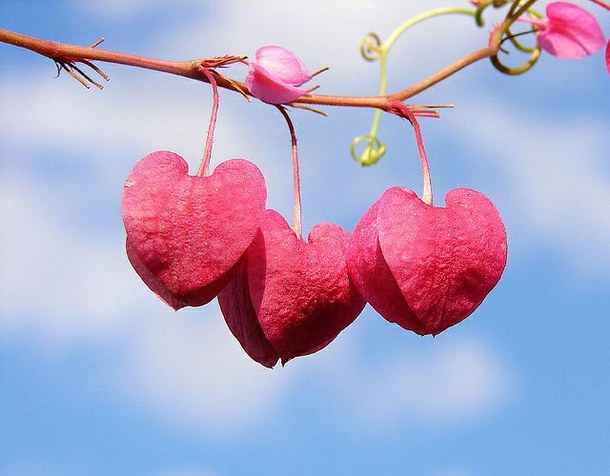
What would feel like to take heart just a little bit more today?
To remind yourself that people are indeed working for good in the world, even in the midst of pain?
To remind yourself that you’ve been surprised at other times, so why not be surprised by goodness again?
To remind yourself that taking heart, while vulnerable, is really giving heart by allowing yourself to have hope and trust, and that this can actually lean into the creation of goodness in the world? Especially it takes to imagination? Especially when it takes to action?
We know that hope needs imagination and action.
Your neighbor is worth that risk.
You’re worth that risk.
Weeds
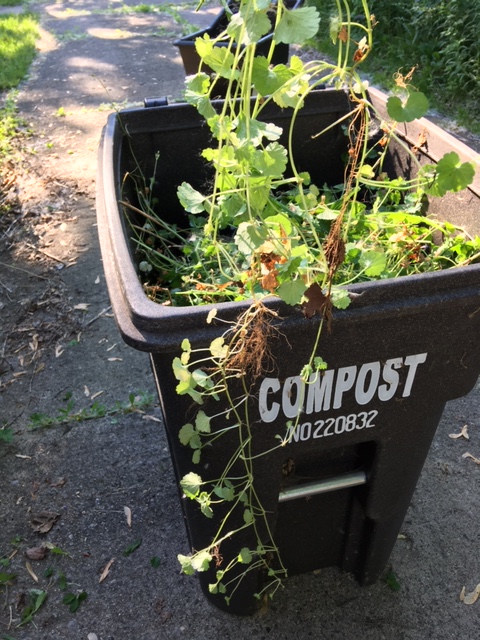
I pulled a whole heckuva lot of weeds over the weekend. If I may be honest, I found this to be fun. Perhaps there was something cathartic and soothing about it.
The most satisfying weed to pull was a particularly long and windy kind. It has a system of stems and leaves connected to a shared vine. It’s the kind pictured above, spilling out of the compost bin. This plant — I don’t know its name — wove its way effectively and adeptly around my day lily plants. And most of it was hidden and out of view.
I’d find one piece and begin to pull on it. Then I’d discover much more, a system all connected.
I reflected on the beliefs we carry…
… about ourselves,
… about our relationships,
… about our neighbors,
… about the ways we structure our society,
and this plant seemed to convey a lot.
Sometimes, within ourselves, there are whole, connected systems of beliefs, fears, and emotional triggers that need to be explored and healed. Sometimes, within our communities, there are large, connected systems of harm intended to bolster some and disadvantage others.
We have to start somewhere — pulling, uncovering connections, examining, and uprooting.
Confession

In my Christian faith, the word confession is used in two ways:
1) It’s an occasion to name truthfully how we have hurt our neighbors and fallen short of God’s calling for the life of the world,
and
2) it’s an occasion to proclaim what we believe.
White Christians, and I am among them, need to confess in both directions.
1) We are complicit in the systemic violence that harms our Black siblings and siblings of color.
and
2) Unequivocally, Black Lives Matter.
This is a proclamation we must affirm with our words, intentions, relationships, and actions. It shifts us; it calls us to take risks in love.
— Renee Roederer
Here is a list of anti-racist actions we can take:
Actions Toward Justice for Black Lives
And I want to share some articles that have challenged me. Sitting with these,
Now is the Time to Defund the Police by Melissa Gira Grant
Of Course There are Protests. The State is Failing Black People by Keeanga-Yamahtta Taylor
Shifting Internalized Ableism (Psst: In All of Us)
Last summer, I had the privilege to attend the second in a series of webinars of the Virtual Summer Camp from Crip Camp. If you haven’t seen the new film Crip Camp: A Disability Revolution on Netflix, I highly recommend it. Did you know that a large number of the central leaders who fought for the formation of the signature Americans With Disabilities Act legislation met each other at a summer camp? I did not know that. Their years in relationship and community empowered them in transformative ways as they built a disability culture of inclusion. Their work has created substantive changes in the lives of disabled people.
Here’s the Trailer for Crip Camp: A Disability Revolution:
The webinar I watched last summer was about shifting internalized ableism. I offer some of the insights in this post today, because ableism has been internalized inside all of us. Most significantly, it has devastating impacts upon disabled people. But whether you have a disability or not, you have likely internalized some of these messages. I hope it is freeing to you to question these internalized messages.
I’ll share some of those in a moment, but first, let’s talk about ableism. Internalized ableism exists because of a culture of externalized ableism. TL Lewis offers a powerful definition of ableism:
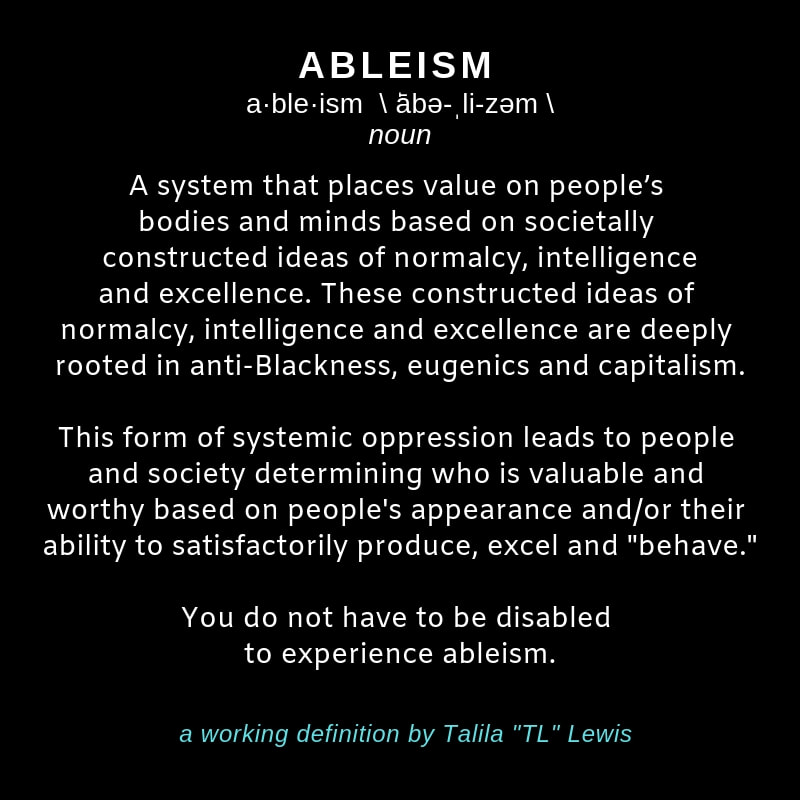
[Image of a black square with white writing in it that says: ABLEISM a·ble·ism \ ˈābə-ˌli-zəm \ noun A system that places value on people’s bodies and minds based on societally constructed ideas of normalcy, intelligence and excellence. These constructed ideas of normalcy, intelligence and excellence are deeply rooted in anti-Blackness, eugenics and capitalism. This form of systemic oppression leads to people and society determining who is valuable or worthy based on people’s appearance and/or their ability to satisfactorily produce, excel & “behave.” Importantly, you do not have to be disabled to experience ableism. a working definition by Talila “TL” Lewis]
We see here that in many ways, ableism and racism are linked, as are other forms of oppression.
Here are some messages of internalized ableism, offered by the leaders of that Crip Camp webinar. How might we feel if we shift these inside ourselves? How might we feel if we help dismantle the relational and systematic impacts of these messages?
Some messages of Internalized Ableism:
1) I feel like I need to work to be worthwhile.
2) I am a “burden” due to my needs.
3) I can “cure” my illness or disability by trying hard enough/eating a specific diet/working out.
4) I need to make other people feel comfortable with my disabilities by being extra nice/funny/accommodating.
5) I should not ask my household members to take precautions in pandemic, even though I am at risk and feel frightened.
6) Sometimes I feel like my life is less valued than able-bodied or able-minded people.
Questions for reflection
— Do any of these resonate? What else might you add?
— How can we love our body-minds precisely as they are? How can we shift messages of internalized ableism into messages of greater hope and empowerment?
— How do these messages impact our wider communities? How do they do harm to disabled people, Black people, Indigenous people, people of color, people who are LGBTQIA+, and others?
— How can intersectional movements uproot oppression in powerful ways?

