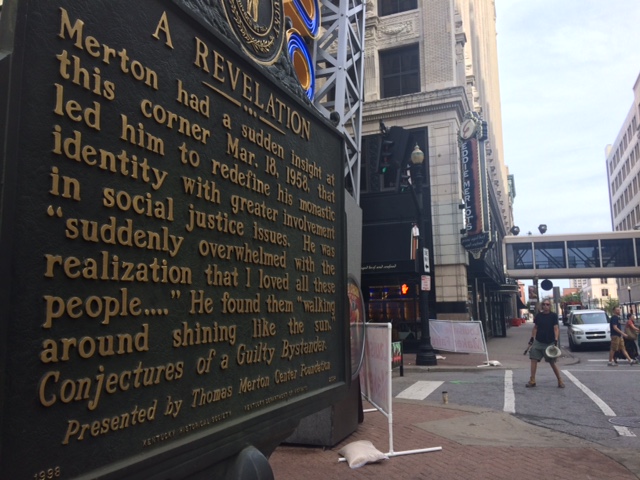
Image Description: A placard at Fourth and Walnut in Louisville, KY, marking the spot where Thomas Merton had a significant spiritual realization.
Any Place and Any Moment
can be the Space and the Time
of Revelation and Awareness.
Any single place and any single moment can open us to understanding and connection.
I’ve been learning a bit from Thomas Merton lately. Merton (1915-1968) was a Monastic Christian who lived in Kentucky. I love a particular both/and in his personal faith: He was a mystic, yet not at all removed from the world. He delved into some of the largest challenges and traumas that humanity has faced. He was a practical theologian and a humanitarian, grounded deeply in a sense of mystical communion with God and other people.
These two aspects of Merton’s faith really came together when he was simply standing at an intersection. He was standing on the corner of 4th and Walnut (now Muhammad Ali Blvd.) in Louisville, Kentucky. As he watched people walk by, he was suddenly overcome with a deep sense of connection. He said he was, “suddenly overcome with the realization that I loved all these people. . .” as they “walked around shining like the sun.”
It changed his whole life.
He probably wasn’t expecting that when he was out running some errands. But any place and any moment can introduce us to a revelation of understanding and connection. Any place and any moment.
When in Louisville a few years ago, I went to this corner. It’s really fitting because there’s still a great deal of foot traffic. There is a placard that commemorates this place and moment, and right behind it, is 4th Street Live — two city blocks typically blocked off for foot traffic with restaurants, and often, live music.
I snapped a photo of this place. I also stood there and remembered people I know as well. It was a meaningful experience.
Image Description: A very small, round orange tomato in my hand.
This year, I grew nothing. Or so I thought.
I stepped outside, and this little orange ball caught my attention. One of the tomato plants that I last minute, oh what the heck, transplanted late into the season gave me a single precious, tiny, orange, unexpected tomato.
Image Description: A drop falls into some water and creates a ripple effect.
That tiny thing you’re great at. . . is a big deal. Really. When shared with others purposefully and resourcefully, it catalyzes change. So what is it?
– Do you have an ability that seems tiny only because it comes so naturally to you?
– Do you engage with it regularly to the point that it doesn’t seem like a real gift?
– Do you forget to marvel at it because it seems so routine or easy?
Well, that’s a gift you need to put into the world. Purposefully.
That’s a gift that seeks greater expression in your community, neighborhood, nation, and world.
These days, when we see the great needs and concerns around us, and when we ponder our fears about needs and concerns to come, we can become absolutely overwhelmed. Our meager work and purposeful sharing can seem. . . well, tiny. It may feel that way, but. . .
That tiny thing? Do not underestimate what it can do.
– When placed strategically with the gifts of others, it can become organized change. It can become organized resistance. What resources can you bring uniquely — money, connections, abilities? Some of which come so naturally to you? Do all you can to make those things fit with the leadership and commitment of others. Look purposefully for where they can be placed alongside the great work that is already happening. Your tiny gift will easily multiply.
That tiny thing? Do not underestimate what it can do.
– When launched into the world with intention, that tiny thing may add a level of care that increases relational safety. Even if only for a moment, it matters. In this current climate, people are reasonably fearful and discouraged. Your tiny thing in a tiny moment may serve as a reminder of human worth and connection. It may provide a needed boost which encourages others to put their gifts into the world too.
Image Description: The title openings for two shows — Buffy the Vampire Slayer and The Waltons.
Yes, this is a mashup photo of Buffy the Vampire Slayer and The Waltons. These two shows may seem like an odd couple, but for the very same reason, both have been on my mind this week.
With all my heart, I love Buffy and the universe Joss Whedon created through it. The show is masterful with the use of symbols and metaphors, and over seven seasons, the character development is immense. On Sunday, I watched the series finale again. I had not seen it in years. Then I circled back to the opening and watched the very first episode too.
I couldn’t help but view the opening scenes as a grand, albeit campy, prelude to where it was all headed. The end illumined the beginning, and I was watching with that end in view.
Later in the week, I was thinking about this once more when a beautiful memory came to mind. The memory is about David, a person beloved and deeply influential in my life. When he was living through a challenging cancer diagnosis, he suddenly became obsessed with the reruns of another show: The Waltons.
We all knew we were not allowed to call David during the 9am hour. That was The Waltons hour. If we did call David, he would scold us playfully. But he was also serious. He would not talk to anyone during that hour, nor would he do anything else. It was all about The Waltons.
This morning ritual went on every weekday for about a year. Then one particular day, he watched the series finale. The final episode reveals the future directions of the main characters. It skips ahead to reveal what their lives will become.
A few weeks later, I said something like, “I’ll give you a call tomorrow.” Then teasing him, I added, “But don’t worry. I won’t call during The Waltons.”
David told me he had finished the series. I assumed he would just start again at the beginning, but instead, he said, “Actually, I’m done with it. You know, I’ve been thinking about this. I needed to learn that everything would turn out alright, and that all those characters would be okay in the end. What I needed to learn most is that all of you will be alright too.”
David was speaking about his diagnosis, knowing that he would eventually leave us. He binge watched The Waltons, and with the end in view, he was comforted. He knew we would love and grieve deeply, but we would also live well.
David wasn’t merely talking about his illness alone, however. He was also talking about purpose. The word end has two meanings. It can mean finality, but it can also mean purpose or goal. Though it would indeed be painful, David needed to know our lives would continue after he was gone. But even more, he needed to know that our lives would continue in the purpose of the love we had shared with him.
I am so glad that we had that conversation. Years later, I know that he was right.
We still know that love. We know love in our bones.
And more and more, I hope to live with that end in view.
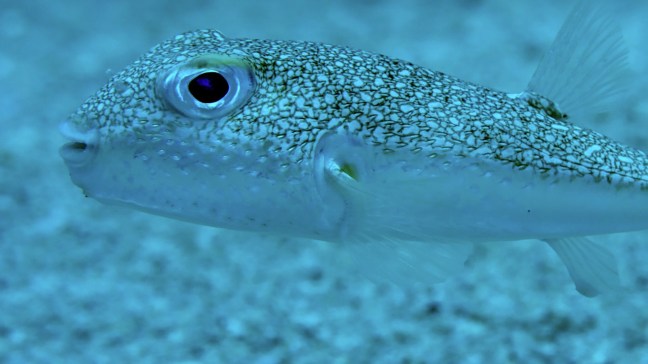
This tiny, seemingly insignificant pufferfish astounded me the other day. I have never heard of such a little artist until I watched a BBC Earth video a few days ago.
This little fish creates an artistic structure in the sand – one that’s complex in its detail and mathematical precision. It’s astonishing. We’re left curious, how does this little being have such an ability?
And we feel a sense of wonder.
I think we need a sense of wonder, particularly in times of great stress. We need to be reminded that there is a world worth feeling awe about – a world worth living in, a world worth protecting.
Perhaps there are times when we struggle to access a feeling of wonder. And if so, that’s completely understandable and okay. But thankfully, curiosity and wonder are things we can practice. They aren’t goals or benchmarks. They’re play. We can always engage them.
So what initiates your sense of wonder these days?
Image Description: The words ‘cancer’ and ‘COVID’ are spelled on a Scrabble board.
Today, I’d like to share a piece from Ben Johnston-Krase. He reflects on the ways he’s lived well and grown in strength for nearly three years with a stage IV cancer diagnosis. Maybe we are also carrying something we never expected. Maybe in the midst of it all, our “mind-soul-spirit muscles are going to get jacked.” Love to Ben.
A year ago a woman I’d just met and I sipped lattes and chatted about the intimate horrors of stage IV cancer. In a more care-free, pre-cancerous life, things like death and dying, fear and enraged disbelief weren’t particularly appropriate introductory material in any conversation, but there we were in our most unlucky of kinships, diving in deep.
She was a two-week cancer survivor while I was two years in. Being with her reminded me of the stunning despair I felt in the days immediately after my diagnosis. At one point she asked, how do you manage living with this?
It’s a question I’d given considerable thought by then. How do I live now that I’m carrying this previously unimaginable burden? And not just how do I live, but how do I live well? Is that even possible anymore? How do I navigate the world when the horrific reality of cancer has stolen an outsized portion of my thought life?
The best analogy I’d come up with is one I shared with her that day, and I’ll elaborate here: You know how you go to the gym, and occasionally you see somebody there who’s just utterly ripped? He’s lifting weights or she’s doing squats, and you look over and think, ‘Good God, so that’s what muscle looks like!’ and then you begin to ponder the sheer magnificence of the human form and your mind wanders to contemplate the hundreds or thousands of trips to the gym you would need to make for your body to perform in such a way.
That, I said, is going to be you. Not right away, but it is coming. Being diagnosed with stage IV cancer is like being told to walk through your life carrying the heaviest weight you can possibly imagine. Always. Morning, noon, night, 2AM, when you feel strong, when you don’t, through parenting, carpools, sex, family vacations, scans, mindless TV, work… Through it all, you’re going to carry this ridiculously heavy thing called cancer.
And people are going to look at you and think, “How on earth?” because they won’t be able to imagine carrying what you’re carrying. You’ll be like that person at the gym, lifting shit they just can’t fathom lifting. And this will happen not because the burden gets any lighter but because you learn to carry it better. Your mind-soul-spirit muscles are going to get jacked and you will teach yourself a new definition of strength.
Christmas, your kids’ birthday parties, trips to the grocery store, waiting in line at the DMV, walking the dog – there’ll you’ll be looking to the untrained eye like an ordinary member of the human species. Little do they know you possess an unasked-for superpower, which is that you can stare death in the face and shop for breakfast cereal at the same time. You can mentally dance with the thought of not living to watch your children graduate high school while you try to figure out if the dishes in the dishwasher are clean, dirty, or some combination thereof.
I have this strength. So does my friend, and so do many others I have the privilege of knowing and loving. Many of them have cancer but many more carry a burden that’s differently shaped but no less heavy. And I believe that we super-strength humans have something to say to the world about COVID-19:
It’s shitty. We understand. You didn’t ask for this. We know. You’d like to live in a land of make-believe where there is no pandemic and you can have your old life back. Bless your heart, we know. You’re angry. Mm-hmm. And now you won’t wear a mask because it threatens your freedom. God, how I wish my political convictions could create a world in which the realities of science were irrelevant. I’d join the Cancer-Free Party, an alliance of cancer patients who stop chemo treatments and refuse to get CT scans and brain MRI’s, as these things threaten the freedoms once enjoyed. (Much more, by the way, than your cloth facemask.)
We get it. The reality of COVID-19 is heavy and difficult to carry. It isn’t a burden you asked for and you would love, love, LOVE to put it down. Maybe that’s why you think and act like it’s not serious. But take it from the people around you who’ve already learned to carry unimaginable weight – ignoring the burden does not help you lift it and not lifting it will not make you strong.
Cancer and COVID-19 are just two proofs of life’s terrible fragility and unfairness. It takes so little strength to ignore or belittle these realities. But oh, when we dig deep – deeper, perhaps, than we ever have before – deep enough to find pools of power and resilience that we didn’t even know we had… When we dig deep and lift, we begin to train our minds and our spirits to bear the unbearable. We find new strength and then go on living, and living well.
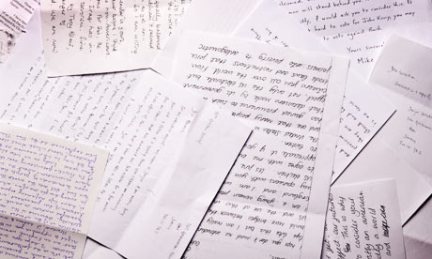
Image Description: Handwritten letters piled on top of one another.
Do you know what’s great? Handwritten letters.
I didn’t really know I was missing this. In fact, I viewed letter writing purely as a genre from the past. But during this pandemic, I’ve received a number of them, and they give me joy. One of my very best friends sends many people handwritten cards, and they are such a gift. She’s made this a personal practice. I love it.
This has helped me think about something within the letters too. It has me thinking about the beauty of slow connections. We need these.
When I say slow connections, I’m talking about more than the amount of time between sending and receiving mail, though that’s certainly a slow connection. (And getting slower all the time? Eeek?) I’m also talking about the types of life snapshots we might capture in handwritten letters – how letter writing depicts them in a slow and unique way, then uplifts their value as we share them with others.
As I mentioned, this person is one of my very closest friends. We talk over the phone about significant things that are happening in our lives. I send her photos and videos over texts. We connect about large things and immediate things. But when she writes me a handwritten card, I have the opportunity to learn what’s going on that particular day and that particular moment through written words.
For instance, the cats just jumped across the room in a funny way, though they were cuddly a few minutes before. The tea is really good this morning. Her husband just said a funny one-liner.
Slowness takes time to capture these, prioritizing the small things as meaningful. Slowness takes time to share these with a friend.
To enjoy them. To choose them. To write them down. To put them in the mail in the anticipation of a friend seeing them too.