Christianity: An Organizing Religion. . .? 

I recently had the opportunity to read some words that are going to stick with me for a long time. They’re from Brian McLaren (see below) and have encouraged me to ponder these questions:

What if Christianity moved from being an organized religion to an organizing religion?

Not just some organized effort to promote and protect propositional beliefs, but more — so very much more — an organizing religion for compassion, contemplation, spiritual connection, and human flourishing?

What if we could see this happen? What if folks could participate in it happening?

Here’s what Brian McLaren has to say:

“For centuries, Christianity has been presented as a system of beliefs. That system of beliefs has supported a wide range of unintended consequences, from colonialism to environmental destruction, subordination of women to stigmatization of LGBT people, anti-Semitism to Islamophobia, clergy pedophilia to white privilege. What would it mean for Christians to rediscover their faith not as a problematic system of beliefs, but as a just and generous way of life, rooted in contemplation and expressed in compassion, that makes amends for its mistakes and is dedicated to beloved community for all? Could Christians migrate from defining their faith as a system of beliefs to expressing it as a loving way of life?

“For centuries, Christians have presented God as a Supreme Being who showers blessings upon insiders who share certain beliefs and proper institutional affiliation, but who punishes outsiders with eternal conscious torment. Yet Jesus revealed God as one who ‘eats with sinners,’ welcomes outsiders in, and forgives even while being rejected, tortured, and killed. . . . He preached that God was to be found in self-giving service rather than self-asserting domination. . . . What would it mean for Christians to understand, experience, and embody God as the loving, healing, reconciling Spirit in whom all creatures live, move, and have their being?

“For centuries, Christianity has presented itself as an ‘organized religion’—a change-averse institution . . . that protects and promotes a timeless system of beliefs that were handed down fully formed in the past. Yet Christianity’s actual history is a story of change and adaptation. . . . What might happen if we understood the core Christian ethos as creative, constructive, and forward-leaning—as an ‘organizing religion’ that challenges all institutions (including its own) to learn, grow, and mature toward a deepening, enduring vision of reconciliation with God, self, neighbor, enemy, and creation?

“Many people today are leaving the belief systems of their parents and grandparents. This is a mass exodus from institutional faith that demographers are calling ‘the rise of the Nones.’ Nones comprise about twenty percent of all Americans, and one-third of Americans under thirty. Having little patience with (or appreciation for) mystery, as well as so little humility or basic love for groups other than our own, maybe Christianity in its present formulation has to die for a truly universal and love-centered spiritual path to be born. I sincerely wonder if this might be true.”

What do you think?

“We Wouldn’t Want You to Go Hungry”

Chipotle

Last week, the staff at Chipotle was really kind to me.

I had a meeting at the University of Michigan campus, and when I finished, I realized I was really hungry. It was almost 10pm, close to Chipotle’s closing time. I walked in, and I was just about to order. Then, at the precise moment when the staff member asked me what I would like, I realized I had left my wallet in the car.

“Oh, you know what? Nevermind. Don’t start that. I just realized I left my wallet in the car.”

“That’s okay. We’ll make it for you anyway.”

“But I don’t –”

“Oh, no worries. Really, it’s okay. Glad to do it. We wouldn’t want you to go hungry.”

He said this in such a sincere way and seemed to take pleasure in offering this gift to me. I ended up with a free burrito bowl, and it was very kind.

When I left, I found myself reflecting upon those words of intention and action:
“We wouldn’t want you to go hungry.”
He meant it.
It was kind.

But when I left, I began to reflect. . . wondering how often people are honest that they’re hungry without ever receiving such a statement from us, or most importantly, the food they need. I found myself thinking about times when we’ve encountered the needs of people but consciously or unconsciously, put them into the category of, “They’re always hungry. That’s a type of person who is hungry. And a person to avoid.” Racism and classism are certainly a part of this.

I found myself remembering that there is a humanitarian food crisis in parts of the world this summer — 20 million people in agricultural crisis in South Sudan, Somalia, Kenya, and Ethiopia; a massive food shortage and political unrest in Venezuela – and it’s quite rare for me to even think about it.

And then there are people we meet in our daily encounters.

“We wouldn’t want you to go hungry.”

That intention and that action needs to grow in us.

Renee Roederer

What If We Could Create a New System?

capitalism

Jason Hickel and Martin Kirk have written an article with a title that poses a direct question to us: Are You Ready to Consider that Capitalism is the Real Problem?

Are you skeptical of titles like this one? Would you be open to reading and seriously considering this article?

I think it’s becoming increasingly clear that if we cannot or will not adapt ourselves toward greater forms of cooperativism, both in the large and small scale, we will continue to greatly increase suffering.

Loving your neighbor includes caring for your neighbors’ freedom to have access to resources.

And capitalism. . . and late-stage capitalism in particular. . . ? Well, that’s an enormous loss of freedom for most of us – a loss of freedom to choose the direction of our lives, particularly as more wealth is concentrated among the few, and an enormous loss of freedom for our children, grandchildren, and great-grandchildren to choose the direction of theirs.

I’d say we are more free collectively when we value the worth of our neighbors and their intrinsic right to live well. And we are more alive when we stop uplifting profit as the primary motive for work and unmitigated greed as the unquestioned pursuit for life, moving instead, toward a motive of sustainability at work and the life-filled pursuit of uplifting each other.

What is possible if we move toward such change?


Renee Roederer

What If We Change a Rhythm?

Facebook

This month, I decided to try something new. With the exception of yesterday (because the news was definitely not a nothing burger) I’ve been engaging a new rhythm where I only check Facebook twice per day — once in the morning and once in the evening.

This shift has changed lot for me. I have discovered that. . .

1) I’m still informed about things happening in our world,
2) I’m still connected to people (in fact, I have increased my personal connections)
3) I’m less anxious,
4) I’m more reflective,
4) I’m more focused,
5) I’m more active (including in activism; this new rhythm is not escapism)
6) I’m more productive, and
7) I’m more purposeful.

And I’m happier. I feel more joy.

And frankly, there is more time— for purposeful reflection, solidarity work, in-depth exploration of social concerns, vocational projects, phone conversations with friends, being nature, and . . . whatever else calls to me. There’s more energy for these too.

And I still feel connected to what’s happening with friends on Facebook. I’m just choosing a rhythm where I spend less time there over all. In fact, I really look forward to checking twice a day. There’s more anticipation to see what those notifications have been all about.

I don’t say any of this in a prescriptive way for anyone else. This rhythm need not be anyone else’s rhythm. But it has been a good example that one shift can change and free up a lot.

So I wonder, is there a new rhythm you’d like explore? I wonder, what might be possible if you try it out?

Renee Roederer

What If We Ask A Different Question?

There are times when we find ourselves mulling over the very same problems in our thinking.

There are times when we feel weighed down by longstanding frustrations that rarely seem to shift.

There are times when we feel stuck, like we’re not moving forward in the ways we hope.

So. . . What if we ask a different question?

This is something that a friend of mine says often, and I really appreciate it.

What if we do that? What if we ask a new question? Could that open up new possibilities – creative pathways or new angles of relating?

Maybe that seems like a small thing, but it’s actually a large thing. Frameworks affect how we view situations, feel, and express hope.

So what if we try it? Might it open up something different?

What’s possible?

Renee Roederer

What If The Butterfly Effect Is Real?

butterfly

I was thinking about the butterfly effect this weekend, and specifically, I was wondering, is that really real?

Do you know which thing I’m talking about? Sometimes, it’s also called Chaos Theory. Ultimately, it’s a realization that very small actions can lead to very large effects, particularly as they create a series of changes in large systems. The butterfly effect gets its name due to Edward Lorenz. He demonstrated that the flapping wings of a butterfly in one part of the world could ultimately lead to a tornado weeks later somewhere else. Thankfully, this doesn’t happen all the time; otherwise, we’d have tornados and hurricanes everywhere. But the point is this: Tiny, miniscule changes can create complex results in large systems.

It turns out that this theory is true.

It’s pretty astounding, actually. It means that every thing — every action, every interaction — is affecting a whole, enormous host of other things.

In a tumultuous time, don’t underestimate how positive actions can lead to large scale results. Even tiny ones have an effect. Each and every day, what we do matters. What we do this very day matters.

So what kind of change is possible, not only when we act alone, but when we act together?

Renee Roederer

Voter Suppression: 45 States

Nope

On June 28th, Kris Kobach, chairman for the national “Commission on Voter Integrity,” sent a letter to all 50 states requesting a great deal of data about their voters — names, addresses, military history, criminal backgrounds, party affiliation, social security numbers,  and voting history since 2006.

And 45 states said, “Nope.” Some even said, “Oh hell, nope.” The Secretary of State in Mississippi said they can go “jump in the Gulf of Mexico,” clarifying that Mississippi is a great launching pad from where they can do it.

These states are not sending that information on. Or at the very least, they’re not sending anything that isn’t already public (like names and addresses). And this is significant. There may be a legal battle to fight their refusal, but this is significant.

This undertaking has the name “Commission on Voter Integrity,” but it’s really a commission on voter fraud. In a tweet the other day, Donald Trump even called it the Voter Fraud Commission. When we hear the words ‘voter fraud,’ they are not only indicative of the foundational lie behind this commission — the false claim that 3 to 5 million people voted illegally in the 2016 election – but they are code words for future voter suppression.

How do we know this? They are already the code words for voter suppression in 22 states.

Kris Kobach has been a major architect of voter suppression in Kansas, and now, he’s in charge of the commission. Read this crucial piece from The New York Times that discusses Kris Kobach’s career; the SAFE Act (Secure and Fair Elections Act), his signature piece of legislation that has faced four different challenges from the A.C.L.U.; his use of Crosscheck to remove voters from rolls; and his likely aims for this commission, including the creation of a national voting registry from which to use Crosscheck again.

This cannot go forward.

We need to stand against it, and we have to work to eliminate the previous laws that have bolstered voter suppression. These laws target minoritized communities, especially African Americans and immigrants, and they lead to policies that harm all of us. Voter suppression is completely undemocratic. It bars the crucial voices of individuals and entire communities, and leads to policies that uphold the interests of the few rather than the vast majority of people who live in this country.

It needs to end.

We need to make it a priority.

We need to make it a fight.

Let’s go.

Renee Roederer

This post is a part of a series on voting rights and voter suppression. If you’d like to read more, feel free to check out these other posts: Voter Suppression: 45 States
1469 Days.
Voter Suppression: Hearing From People Directly Affected
Rev. William Barber: 5 Fears that Fuel Voter Suppression
Voter Suppression: 22 States
Voter Suppression: 45 States

Voter Suppression: 22 States

Since 2013, 22 states have passed laws that bolster voter suppression. In particular, these laws put an undue burden on communities of color. They suppress their votes and gerrymander to limit their influence.

North Carolina additionally passed a law that if college students changed their voter registration to the county where they are in school rather than keeping it at home, their parents could no longer claim them as dependents for tax purposes.  Thankfully, that one was overturned in 2016, but it was there long enough to suppress young votes.

Here’s how some of this voter suppression works:

This post is a part of a series on voting rights and voter suppression. If you’d like to read more, feel free to check out these other posts:
1469 Days.
Voter Suppression: Hearing From People Directly Affected
Rev. William Barber: 5 Fears that Fuel Voter Suppression

Rev. William Barber: 5 Fears That Fuel Voter Suppression

img_8931

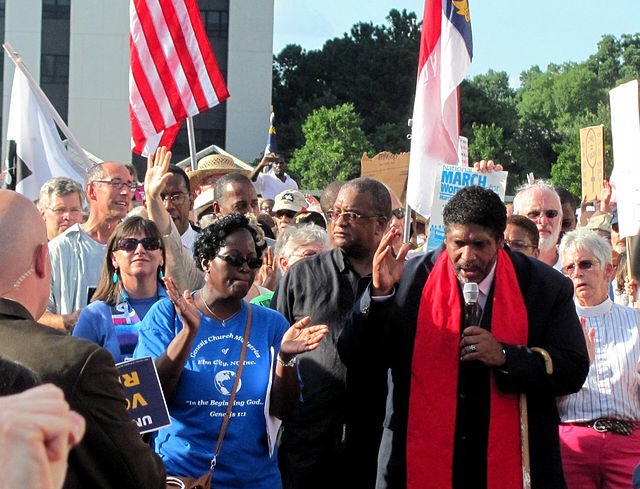
Last Sunday, the Rev. William Barber, Repairers of the Breach, and people from the Moral Monday movement held an event in Raleigh, North Carolina called “The Gathering: Voting Rights.” It was live-streamed, and you can see it here (go to Livestreamed Events). I especially encourage you to watch Rev. Barber’s speech, starting at the 58 minute mark.

In that speech, Rev. Barber talked about voter suppression and five fears that fuel it. Today, I’d like to mention those fears and encourage people to engage the thoughts more deeply by watching Rev. Barber’s speech.

Rev. Barber says that voter suppression is motivated by a Fear Factor – fears of losing and sharing power and fears that we will have to recognize the full humanity of people long dehumanized.

The Fear of Full Citizenship

In the wake of the Civil War, when enslaved people were no longer enslaved, fearful debates ensued. Whites, particularly in the South, were asking fearful questions and making demands. “Were Black people going to be considered. . . full citizens?” Rev.  Barber says that people shuddered at the thought.

“The fear was, if Black people got freedom, they would want citizenship. That was the debate when Lincoln pushed the 13th Amendment — go back and read the testimony. The question kept being asked, ‘Does this mean citizenship?’. . . And this has been the fear at the heart, not only of racism, but of sexism and every other ism. Fear that some people will not only want to be free, but they will want full citizenship and all the rights thereunto.”

Fear of Legitimacy

A few months ago, a national commission was created to investigate voter fraud. Rev. Barber says that this commission created by Donald Trump is not ultminately about securing the legitimacy of his 2016 election. Instead, it exists to delegitimize the elections of Barack Obama and provide psychological cover to explain his election wins.

“This fraud commission ain’t about Trump’s election. Thought I’d tell you that. . . It’s about Obama’s election. It’s not about the last election. It’s about the two elections prior to that because birtherism didn’t work. And the role of birtherism was to provide psychological cover for those who could not bring themselves to accept a black man in a White House. . . But now, birtherism has been debunked, and so, there is a need now to delegitimize. And so what he’s trying to do with the commission is to bring up fraud, which is fraudulent in itself, to come out with a report that says these past elections — not just 2016 — were fraudulent. To give people relief. One psychologist calls it white fragility. To give people relief from the fragile state when certain people see their world falling apart.”

Fear of Changing Demographics

Demographics are changing rapidly in the United States. In 2042, Non-Hispanic Whites will no longer be in the majority of the population, and right now, for the first time, minority communities are having more births than white communities. In the midst of this, twenty-two states have passed voter suppression laws since 2010. These stats demonstrate some of their present and future impact:

“Those states represent 250 electoral votes. They also represent 54% of the Black vote in those 22 states. They also represent 44 Senators and 50% of the United States Congress. So if you can control those 22 states, you enter into the race only 20 votes short of an Electoral College win. We had 868 less voting sites in the poor and black and brown and poor white community in 2016 than we had in previous elections. . . The Brennan Center has noted that nearly 20 seats in the U.S. House of Representatives would probably not be Republican if it were not for apartheid redistricting that has gone on in the South and in the Rustbelt and in the Midwest.”

Fear of Policy Possibilities

In his speech, Rev. Barber showed a number of charts, demonstrating which states have the highest voter suppression, least healthcare expansion, lowest living wages, and highest child poverty. They overlap with the states that have the highest levels of Evangelical Protestants. Voter suppression puts people in office who promote harmful policies.

“The states that claim to have the most evangelical folk, are the same states that have the most voter suppression, the most denial of healthcare, the most denial of living wages, and the highest rates of child poverty. That is a moral sickness. That means that there’s a false brand of morality that has been playing havoc with the spirit and souls of people in America, but there’s a tide rising. See, the fear is, that if there wasn’t voter suppression and people voted, then persons that support denying healthcare and paying insurance companies, and people that support keeping living wages low, wouldn’t be in office to do those things. And that is why, my white friends, my gay friends, my labor friends, my healthcare friends, if you believe in healthcare, if you believe in living wages, if you believe in addressing poverty, you better make sure you understand: Voter suppression is not about black folk. It hits black folk, but it undermines all people and hurts every one of us.”

Fear of Other People’s Humanity

Above all, there are fears of recognizing other people’s humanity. There are fears of accepting and valuing that humanity, along with the gifts, needs, and sacred contributions that humanity presents.  Rev. Barber says,

“Underneath all of this though is a deep theological issue. . . We’ve got to bring a moral critque to the public square. Because the greatest fear, I believe, behind voter suppression is the fear of other people’s humanity. . . Systemic racism is actually an irreverant theological concept. Racism is an unholy religion. It’s not just a sociological sickness. It’s not just a political malady. It is, in fact, a disease of the spirit. Racism is idology – self worship. . . When you see voter suppression in the 21st century, understand that we are still wrestling with what we call false ontology or heretical ontology – that is, that God intended for some folk to be different, and God has made some people who were born for mistreatment. They were born for discrimination. . . And it’s time for U.S. citizens and people of faith to admit that we still have operating in our politics this irreverent religiosity that may not always be articulated in the voice, but it comes out in the policy. . . Whether they ever say it or not, there are some people who believe that there are those for whom you do not have to honor their full humanity. Which means voter suppression is sin.”

This post is a part of a series on voting rights and voter suppression. If you’d like to read more, feel free to check out these other posts:
1469 Days.
Voter Suppression: Hearing From People Directly Affected


Voter Suppression: Hearing From People Directly Affected
voter supression

Today, many people across the U.S. will celebrate Independence Day with parades, parties, cookouts, and fireworks. Yet in the legacy of Frederick Douglas – abolitionist, escaped slave, and orator – it is crucial to remember that many in our nation do not experience with the full expressions of freedom we are quick to celebrate. In 1852, he gave a speech entitled, “What to the Slave is the Fourth of July?” I commend this to our reading today.

Today, may we remember and advocate for people who do not live with an abiding sense of freedom — indigenous people who have encountered genocide and lost land; black and brown people enduring mass incarceration and labor inside of for-profit prison systems, immigrants who are currently living in the shadows; and people who fear violence and loss of life from the state.

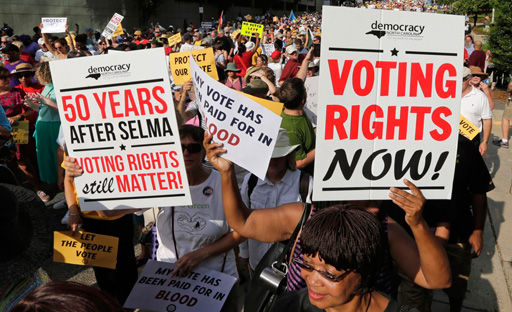
Along with these, we also remember people who do not have full access to the voting booth. All week long, I am engaging an exploration of voting rights and voter suppression. We know that our nation has a long history of blocking people from the right to vote. In the last three years, we have seen renewed efforts that have led to massive amounts of voter suppression, particularly targeted against people of color and people in poor communities.

Today, let’s hear from people who have been directly affected by this history and by these recent efforts to suppress votes. Each link below is a video to a personal testimony:

Rosa Nell Eaton: 92 Year Old Moral Monday Arrestee Fired Up

LaToya Caldwell: Why Being Poor Can Make It Hard to Get a State Issued ID

Scott Douglas: Birmingham Revival Testimony on Voting Rights

Ricky Brown: Ex-Offenders Should have the Right to Vote

Mike Hiser: 180,000 People in Kentucky Are Not Allowed to Vote

See also, the other posts from this series:
1469 Days.