The Loving Act of Agreement

Flags made at a Pride festival, lining the sanctuary of Northside Presbyterian Church


On Sunday morning, I was in a sanctuary, sitting in a circle with a loving community, and together, we had a time of prayer. During a portion of this prayer, people in the circle were invited to share their joys and concerns, and each time they mentioned a need or a gratitude aloud, they would conclude with,

“God in your mercy…”

and the whole circle of people would respond with, “… Hear our prayer.”

One of the things I noticed during this time was the energy I felt as people named those joys or concerns. I felt in my own body a “yes,” agreement, and it seemed we were all connected in the same energy.

I think this is much of what prayer is about, as well as an address to a Higher Power.

We hear each other deeply, and we
agree,
affirm, and
align.

We cast our hopes in the same direction.

I remember a mentor of mine concluding such moments with the phrase, “May we be a part of the prayers we make.”

The moment of this prayer — this address, this agreement, this alignment — is an invitation to care and act in these very directions. When we address together what’s most Ultimate for us, we align ourselves too. There is great love in the act of agreement.

Renee Roederer

When My Quirky Hobbies Combine, There’s a Throughline

My smiling face while biking.

When I was six years old, I would wait for the school bus at the end of my driveway, and every morning, I would make up little songs daily, singing to God. I don’t remember at all what sorts of things I would sing but I know it wasn’t praise choruses or something like that (there was no 7-11 music, i.e. seven words sung eleven times). I think I would just tell stories but sing them.

Anyway, one night a neighbor was taking an evening walk. She was someone who lived not on my street but on the street well behind my house. She saw me outside, and she said, “I hear you singing every morning.” Of course, she was delighted to say this a six year old, but I was mortified to learn I was that loud.

If you fast forward all these decades later, I’ve had two, quirky, overly-specific hobbies over the last year and a half. Since January 1, 2023, I have spent a solid hour+ per day learning German. I am about 30 days away from finishing German DuoLingo, and it’s very satisfying. (Es ist sehr zufriedenstellend!) Meanwhile, since I bought my e-bike last September, I’ve been biking to the streets in my town in alphabetical order. I’m about mid-way through the Cs.

We had a big heatwave recently, so I found myself riding my bike in the early morning, and whatever time of day it is, if I may reveal something silly, when I’m on my bike, I sometimes zoom down the street, singing in German. (Keine sieben-elf musik.) I just find myself singing auf Deutsch about things I see while I Zoom past.

I’m not so loud this time. No one can hear me but the wind in my face. But I’m having fun. And suddenly, making a turn down a particular street, I remembered being six at the edge of my driveway, and I thought, “Oh, this is a throughline.”

Renee, you’re a delightful weirdo. A weirdo, who loves spotting things that delight. And… singing about it. Warum nicht?

Renee Roederer

Mental Health Monday: Transforming Pains We Carry

Angelo Pantazis, untitled (detail), 2018, photo, UnsplashClick here to enlarge image. 

This morning, I’d like to share this reflection from the daily emails of Richard Rohr and the Center for Action and Contemplation:

Psychotherapist Resmaa Menakem connects our individual healing from trauma with our communal healing from racism and other social ills. He describes “clean pain” as that which is faced and transformed instead of denied:  

Healing trauma involves recognizing, accepting, and moving through pain—clean pain. It often means facing what you don’t want to face—what you have been reflexively avoiding or fleeing. By walking into that pain, experiencing it fully, and moving through it, you metabolize it and put an end to it. In the process, you also grow, create more room in your nervous system for flow and coherence, and build your capacity for further growth.  

Clean pain is about choosing integrity over fear. It is about letting go of what is familiar but harmful, finding the best parts of yourself, and making a leap—with no guarantee of safety or praise. This healing does not happen in your head. It happens in your body. And it is more likely to happen in a body that can stay settled in the midst of conflict and uncertainty.  

When you come out the other side of this process, you will experience more than just relief. Your body will feel more settled and present. There will be a little more freedom in it and more room to move. You will experience a sense of flow. You will also have grown up a notch. What will your situation look like when you come out the other side? You don’t know. You can’t know. That’s how the process works. You have to stand in your integrity, accept the discomfort, and move forward into the unknown. [1]  

Richard Rohr considers the effects of trauma in individuals and social systems:  

When people at work, in our families, in politics, or in the church seem to be completely irrational, counterproductive, paranoid, or vengeful, there’s a good chance they’re acting out of some form of the survival mode, which can be triggered in many ways. Persons with trauma deserve deep understanding (which is hard to come by), sympathy (which is difficult if we have never been there ourselves), patience (because it’s not rationally controllable), healing (not judgment), and, frankly, years of love from at least one person or animal over time. 

Could this be what mythology means by the “sacred wound” and the church meant by “original sin”—not something we did, but the effects of something done to us? I believe it is. It’s no wonder Jesus teaches so much about forgiveness, and practices so much healing touch and talk. [2] 

Menakem emphasizes the possibilities for liberation created by the settling of our bodies:  

We need to join in that collective action with settled bodies—and with psyches that are willing to metabolize clean pain. I can’t stress this enough. Bringing a settled body to any situation encourages the bodies around you to settle as well. Bringing an unsettled body to that same situation encourages other bodies to become anxious, nervous, or angry. [3] “

[1] Resmaa Menakem, My Grandmother’s Hands: Racialized Trauma and the Pathway to Mending Our Hearts and Bodies (Las Vegas, NV: Central Recovery Press, 2017), 165–166.  

[2] Adapted from Richard Rohr, introduction to Oneing 9, no. 1, Trauma (Spring 2021):  18. Available in print and PDF download.  

[3] Menakem, My Grandmother’s Hands, 238. 

A Certain Kind of Eden by Kay Ryan

The Carousel of Time | Elena Markova l | Acrylic on canvas | 2021


A Certain Kind of Eden by Kay Ryan

It seems like you could, but you can’t go back and pull
the roots and runners and replant.
It’s all too deep for that.
You’ve overprized intention,
have mistaken any bent you’re given
for control. You thought you chose
the bean and chose the soil.
You even thought you abandoned
one or two gardens. But those things
keep growing where we put them—
if we put them at all.
A certain kind of Eden holds us thrall.
Even the one vine that tendrils out alone
in time turns on its own impulse,
twisting back down its upward course
a strong and then a stronger rope,
the greenest saddest strongest
kind of hope.

The Longest Hug

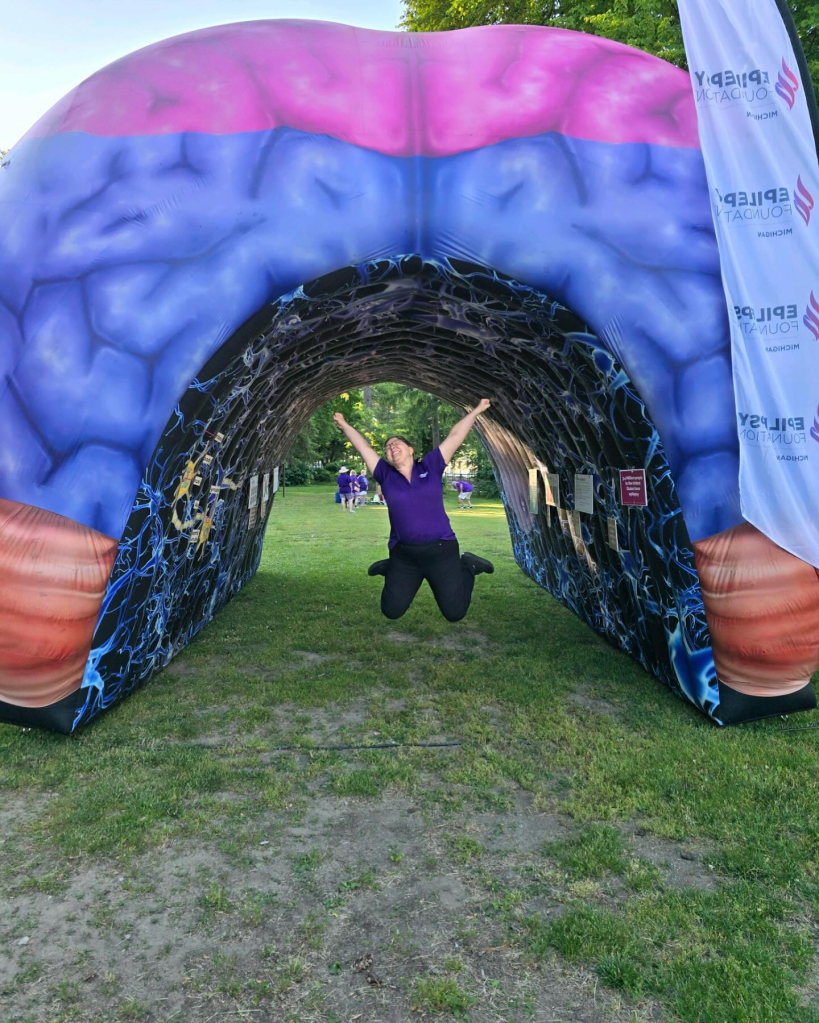
Jumping for Joy at the Metro Detroit Stroll for Epilepsy

In my work, I get to participate in building a deep sense of community across distance. People can forge very strong bonds even when they don’t see each other in person.

This takes place over the landscape of the epilepsy community we serve. At the Epilepsy Foundation of Michigan, we serve our whole state geographically, and many members of our community do not drive. For this reason, we create circles of support across distance, and you may be surprised how deep a phone call or Zoom meeting can go. In fact, I’ve watched these be transformative.

This is always on display in moments when our community members do get meet one another, and I was touched by one of these moments last weekend when we held our annual Metro Detroit Stroll for Epilepsy. This is our largest event each year, and it always feels like a family reunion.

For some, it’s a sacred introduction for the first time: Case in point, at one moment, I realized that two members of our phone-based support group were nearby each other. “T, this is C!” I said (not their name letters), and I am telling you, T ran over, scooped C, and they hugged each other in the sweetest embrace that must have lasted 40 seconds.

They have never met in person. But they know each other, and they know each other well. In fact, they love each other well, and you could see this in what must have been the longest hug that happened at the Stroll.

These bonds matter. Community matters. And we can forge these relationships far and wide.

Renee Roederer

Mental Health Monday: What Is Structural Dissociation?

Dissociation is a mental process that causes a person to disconnect from their thoughts, feelings, memories, sense of identity, or surroundings. It can be a method for the mind to cope with stress, such as during a traumatic event, or it can be a symptom of a dissociative disorder.

Dissociation also falls on a spectrum. We all encounter typical, daily instances of dissociation. For example, when we’re deeply engrossed in a book or movie, we might lose track of our surroundings. Or if we’re driving on a familiar path, we may reach our destination without recalling the journey.

But dissociation can become more pronounced, often involuntarily as a response to high stress or trauma, and it can disrupt daily life and a person’s sense of self. Structural dissociation refers to a theory in psychology that explains how trauma can cause a person to feel as though they exist in distinct parts, often as an attempt to manage their internal world and their emotions and relationships to that trauma or history of emotional neglect. There are a number of evidence-based, therapeutic approaches to help with this, including Internal Family Systems (IFS), which cares for dissociation and provides assistance in addressing the various parts of the self, particularly when these parts feel in conflict with one another.

Here is more information: