I recently sat down with a young person who wants to get involved with the organization I serve. As I shared some possibilities for involvement, I watched her light up with excitement. I lit up, too, because I love working with young adults.
I left that meeting already energized. Then, while driving home, one of my favorite pieces of choral music came on shuffle. A year and a half ago, I had the chance to perform Gustav Mahler’s Symphony No. 2, the Resurrection Symphony, and I remember feeling so much joy while singing it that I was moved to tears. It was visceral, filled with meaning and gratitude. That music lights me up, too.
What lights you up?
In times of great change and anxiety, we need these moments — these sparks that keep us going. But maybe the world needs these moments from us as well.
As Howard Thurman once said, “Don’t ask what the world needs. Ask what makes you come alive, and go do it. Because what the world needs is people who have come alive.”
I recently attended a lecture by Dr. Keith Payne, a Professor of Psychology and Neuroscience at the University of North Carolina, who is changing the way we understand implicit bias — how it forms, how it operates, and how it functions within particular contexts.
We often think implicit bias works like this: When we are young, we absorb stereotypes and beliefs about race and ethnicity that begin to operate at a subconscious level. Unless we bring them to consciousness and challenge them, we assume they’ll stay fixed, deeply embedded in us.
But Dr. Payne’s research reveals something unique. It turns out that the context, the place, and the setting we’re in have a much bigger impact on the development and expression of implicit bias than we realize. For example, if someone takes an implicit bias test twice in the span of a couple of weeks, we might expect their results to stay roughly the same, right? Surprisingly, they don’t. The results can vary, sometimes quite widely.
However, while individual scores fluctuate, the collective score of a given place —say, a county— tends to stay remarkably constant. What’s even more telling is that the average implicit bias score of a county is highly correlated with levels of socioeconomic inequality, stratification, and segregation between racial and ethnic groups within that place. The context, the structures, and the markers of socioeconomic status and race shape implicit bias collectively.
This research offers a powerful insight: Implicit bias isn’t just an individual phenomenon. It’s a collective one, influenced deeply by our environment. And this brings us to an important takeaway. Implicit bias is not fixed, nor is it solely an individual problem. It’s shaped by systems, histories, and the settings we occupy.
This means that the work of changing implicit bias involves tackling systemic barriers and inequalities, but it also offers a profound opportunity. By making intentional changes in our contexts, we can reduce implicit bias.
When we change the context — by increasing diverse representation in leadership roles, creating more opportunities for voices from underrepresented groups to be heard, and actively working toward equity in our spaces — we’re not only working toward righting past wrongs. We’re actively reshaping the context that influences how implicit bias forms and expresses itself.
Increasing diverse representation is a matter of justice. And this fundamentally changes contexts. When people of different racial and ethnic backgrounds are visible in leadership, in decision-making, and in day-to-day interactions, it transforms the environment. And when the environment is changed, we reduce implicit bias, not just at an individual level, but collectively.
We often think of change as the work of heroes — individuals with extraordinary courage or talent who rise up to save the day. But what if we’ve been thinking about change all wrong? What if that’s not the true narrative?
I recently watched a TED Talk by David LaMotte titled “Why Heroes Don’t Change the World,” and I’ve been reflecting on it since. In his talk, David challenges the idea that large-scale change is brought about by individual heroes. Instead, he argues that true change happens within movements, in community, through the actions of many.
It’s not naive to think we can change the world; what’s naive is to think we could exist in the world without changing it. The real question is how we choose to influence that change—and the answer, as David explains, lies in community. It’s the small, seemingly ordinary contributions that add up to make the extraordinary possible.
David LaMotte’s perspective is one of hope and empowerment, but it’s also a reminder of our collective responsibility. We all have a role to play, and it’s not about being a hero—it’s about showing up with others, making space for change, and taking action together.
I highly recommend giving this talk a watch. It might just shift the way you think about your own impact, and the power we have when we work together.
Today is an excruciating anniversary for many people — those known to us and those unknown to us.
We remember and pray for hostages and their families who face this difficult first anniversary, a year of great angst, loss, and empty seats at the table.
We remember and pray for the people of Gaza who have lost tens of thousands of loved ones, their infrastructure, their homes, and their way of life.
We remember and pray for the people of Lebanon who are in harm’s way now, crying out for safety and justice, and for their families around the world.
We remember and pray for people in our own towns — Muslims, Jews, Christians, and all people of conscience — who are connected to the Middle East, who fear for their own safety locally in times of rising anti-Semitism, Islamophobia, and xenophobia.
In all of this collectively, and in each piece of this particularly, I will share what my friends at Farm Church say: “In whatever you’re feeling, don’t feel it alone.”
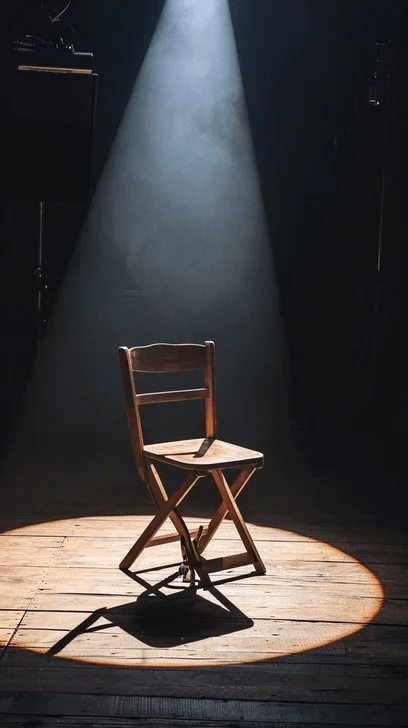
An empty wooden chair sits in a spotlight on a dimly lit stage, creating a reflective and introspective atmosphere. Public domain.
Earlier this week, I attended a talk by a former CEO of a family-owned company. It was advertised as a lecture, so people likely expected to hear insights about business strategies and management tactics. But instead, I experienced something much richer.
There were no PowerPoint slides. No outline of key business takeaways. Instead, he sat before us in a small group, now in his mid-70s, sharing stories and personal wisdom. He spoke about changing company culture, prioritizing employees who are curious and open, and building trust within teams. But what struck me most was what he shared about his own life and personal growth.
At a critical point earlier in his career, he went to therapy during a difficult period of change. He shared how this experience shaped him, describing how the therapist would ask, “And how did that make you feel?”
“I’d say, ‘Well, I think…’” he explained, then mimicked his therapist’s gentle persistence. “I hear that, but I didn’t ask what you think. I’m curious about how it made you feel.” This experience helped him access his emotions and grow wisdom within them.
“That experience changed my life,” he said. “And this is what I want you to know: anyone can change if they’re motivated to do it. Sadly, it usually takes something very difficult or life-altering to push us in that direction. But anyone can do it.” And he recommended therapy.
I loved that this talk—presumably framed around business acumen—became an opportunity to share how real transformation can take place when we’re willing to ask big questions of ourselves and the cultures we want to create. Here was a man who had held a powerful position, now openly reflecting on how therapy shaped his growth and changed his trajectory.
It was a reminder that real insight doesn’t always come in the form we expect. And maybe the best wisdom is the kind that surprises us.
In my work, have the great privilege of leading a number of support groups. Together, these groups are called the Call and Connect Network, and participation is segmented based on age or connection to epilepsy.
Here is something I think about often:
When a community is organized around one thing, they’re organized for anything.
In ways that are deeply significant to inclusion and wellbeing, if we organize a community around one thing — in this case, epilepsy — that community is now in place to care with, for, and about the additional needs of life that emerge. This is because we have created a relational network. In shared kinship and connection, beyond the organizing center, we can also carry each other’s grief. We can rejoice in each other’s celebrations. We can pitch in with resources or referrals if someone needs food, housing, financial assistance, or social connection. The relational center is epilepsy, but this becomes about the fuller range of our lives, too.
When a community is organized around one thing, they’re organized for anything.
This can also involve play and social connection. One of these groups met recently, and multiple people discovered that they had the Tigers game on in the background. So with enjoyment, we moved back and forth between epilepsy topics and updates about the baseball game. Neuromodulation — someone stole 2nd base — stigma has gotten better over time — they’re changing pitchers — epileptologists and nurse practitioners — the Tigers scored!
Everyone participated in all of these directions, and I got the sense that everyone was enjoying the whole of it. If you organize a connectional space around one thing, you have relational space for all things.
When I was seven, I felt like a really big girl on the day I stepped into our local high school for dance camp. This was a five-day experience where the Dazzlers, the extremely cool, popular, way-older-than-me heroes I thought I would want to be like when I got older, taught us how to dance, just like they did for high school sports games.
Toward the beginning of the experience, they told us that they were going to give out a number of specific awards at the end of the week. One of them was “Miss Smiley.” Well, my seven year old self decided I really wanted to be Miss Smiley. So what did I do? For five days of my young, first-grade age life, I smiled consistently all day long like a cute, creepy freak.
Whether the music was playing —
You broke my heart, ’cause I couldn’t dance, You didn’t even want me around, Well now I’m back to let you know, I can really shake it down. Do you love me? (This song by the Contours was the one for the dance they taught us) —
Or whether I was walking through the hall, eating lunch, or tying my shoes,
I was smiling SO BIG. So fake and contrived, but so consistent.
I am here to tell you that I did not win Miss Smiley. I was not even chosen to do this dance at the high school football game like some of the other little girls. I faked it until I did not make it.
Later in life, I would come to learn that sometimes, people expect women to smile a lot, and I would find that expectation to be sexist. It absolutely is.
But interestingly enough, people often tell me that they like how often I smile. It turns out that when it’s genuine and hard-wrought after having a full human range emotions, including difficult ones, it’s pretty contagious. I don’t have to have smiles (no awards, no sexism) but I’ll take it.
I went to a Get Out the Vote event last night. Beyond signing in and sharing our commitment to vote for Harris/Walz, there was no talk of the election. We were invited to a bowling alley for this event by a description that read, “Do you like bowling? Do you like Democracy? Do you like joy?”
There is a time for play, and a time for rejoicing.
But then I came home, and I saw social media posts with pain about the invasion into Lebanon and an article about Dearborn, Michigan, where the majority of the population are Lebanese immigrants. In that article, many shared that they don’t feel comfortable voting this year, because they don’t believe either party is willing to protect the lives of their families. And these lives deserve freedom and protection.
Additionally, I spent part of the day with Jewish friends in my town, where anti-Semitism continues to grow; where a young, Jewish student was recently assaulted; where people are also afraid for their families in Israel; and where the summer was described as “intense.” These pains are right here in our towns. And these lives deserve freedom and protection.
There is a time for grieving, and a time for protecting.
This is a time to be present, listen, care, and act.