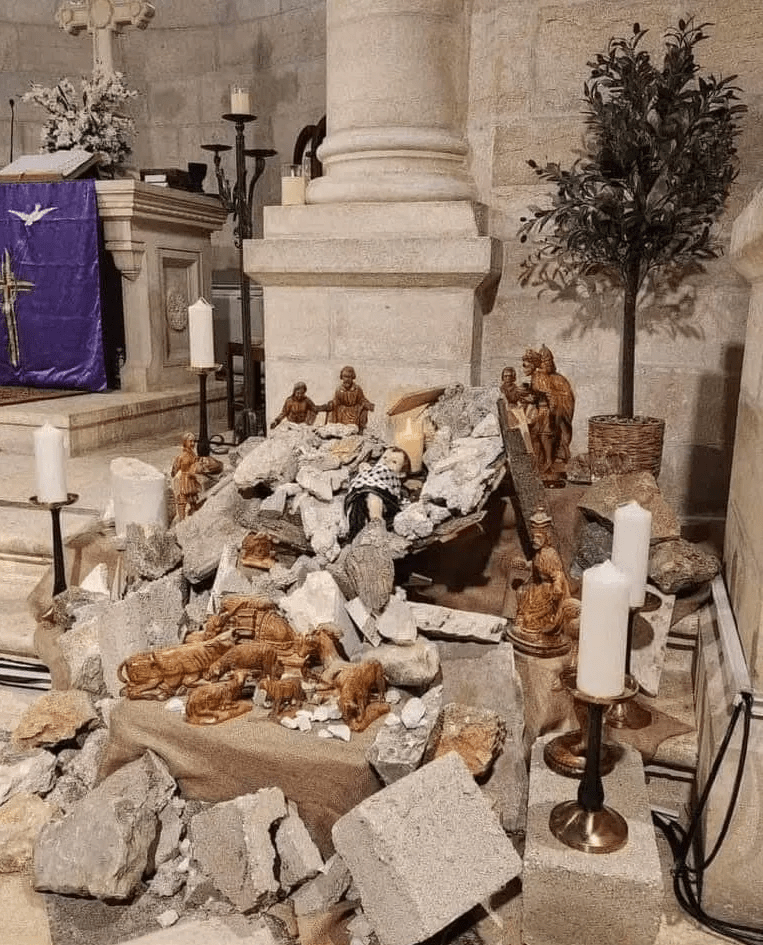
“Love Among the Rubble” by Katy Stenta

A nativity scene this year among rocks and rubble in Christmas Lutheran Church in Bethlehem

Jesus Christ,
I think it’s much easier to picture you
in a stable, cozy among the hay–
Then in the cave that they showed me
in Palestine, where all the animal are stabled.

I remember, when I toured Bethlehem
among the Christians
hearing talk of building permits
and dirt roads
the lack of passports
and that a lot of the fighting
was really about water access
“Is it like Syria?” I asked?

Aware, that
Syria was
is turning into a desert
before our eyes

“Exactly” they answered
Like a deer thirsts
for water
So our soul longs for God
“But I never hear that people are fighting
over water?” I wondered

Christmas Day
Eastern Orthodox
Christmas
we went to the tomb
of Jesus
Where seven (the holy number)
crowded in

Each with clear
ropes
labels
and signs claiming
this piece of the Savior
is mine.

“Merry Christmas!”
Our Eastern Orthodox Brethren Proclaimed
“Here touch the head of the tomb,
Normally, it is not allowed,
But today is a merry day”

I do not know, if I wanted
To feel so closely
the desperation
Of occupied
wartorn Gaza
must have
felt like
at your birth Jesus

But when I visited
Lo those 13 years ago

I remember–too
The hope of
Love among the
rubble

The joy of “Merry Christmas”
amongst many faith
The sharing of a a meal
with Muslims, Christians, Jews and Druze

Love among the rubble
As real as a Savior
born in a cave–
as real a glimpse as peace,
in war.
As real as hope,
in a capitalistic, political scape.
As real as joy,
in the midst of weariness.

As real as faith,
in the midst of doubt.

As real as Christmas,
in the midst of the Advent of Life.

That’s my God
the one who shows up in the rubble of life.
Amen, Alleluia, Amen.

–Rev. Katy Stenta

You can find this poem and more of Katy Stenta’s writing at KatyandtheWord.

Be Tender with Your Grief

A red heart, colored by crayon. Public domain.

Grief is love. It can be felt. It can be known. It can be supported by others, and it can be supportive of others. However it feels, may the love within it bring tenderness toward yourself.

As Jamie Anderson says,

“Grief, I’ve learned is really just love. It’s all the love you want to give, but cannot. All that unspent love gathers up in the corners of your eyes, the lump in your throat, and in that hollow part of your chest. Grief is just love with no place to go.”

Renee Roederer

The Inevitable View of Belovedness

“One eye open;” Public domain image.

One of my favorite books is Gregory Boyle’s Tattoos on the Heart: The Boundless Power of CompassionI admit that I cry easily, but still, I do not exaggerate: The first time I read this book, I had to close it and pause at least 20 times due to tearing up.

Greg Boyle tells powerful vignettes about his community at Homeboy Industries in Los Angeles. Homeboy Industries provides jobs, counseling, and classes for people who are looking to exit gangs. Many of them are teenagers and young adults. Many have known long spells of incarceration. But long before they ever joined a gang or experienced that incarceration, they have carried deep burdens of trauma. As Boyle says, “Kids who join a gang are not running toward something. They are always running away from something.”

The whole book is filled with compassion, and it works to address an internalized belief we tend to carry, one that distorts our views of others and ourselves – that is, “the sneaking suspicion that some lives are worth less than other lives.” That is the lie we must confront.

Greg Boyle tells a sweet story about a man and his father, and he opens that story up to speak a conviction about human worth. I want to leave it with all of us today for own thinking and our own loving.

As his health was failing, an old man moved in with his adult son, someone that Greg Boyle knows personally. In the evening before bedtime, the son would read aloud to his father. In a beautiful role reversal, the adult son put his father to bed every night.

The son would often invite his father to close his eyes while he read aloud, but over and over again, he would catch his father looking at him. He would say, “Look, here’s the idea. I read to you, you fall asleep.” The father would apologize, but at some point, one eye would eventually pop open. This went on every single night. When it was time to sleep, the father could not take his eyes off of his own son.

Greg Boyle says that God is like this: “God would seem to be too occupied in being unable to take Her eyes off of us to spend any time raising an eyebrow in disapproval. What’s true of Jesus is true for us, and so this voice breaks through the clouds and comes straight at us. ‘You are my Beloved, in whom I am wonderfully pleased.’”

One eye open, looking at us with love and wonder.

Maybe we need to pop one eye open and view each other with this kind of love too – no longer heaping shame upon shame, accusation upon accusation, or stereotype upon stereotype, but viewing one another love and wonder.

One eye inevitably and playfully open.

Renee Roederer

Parables

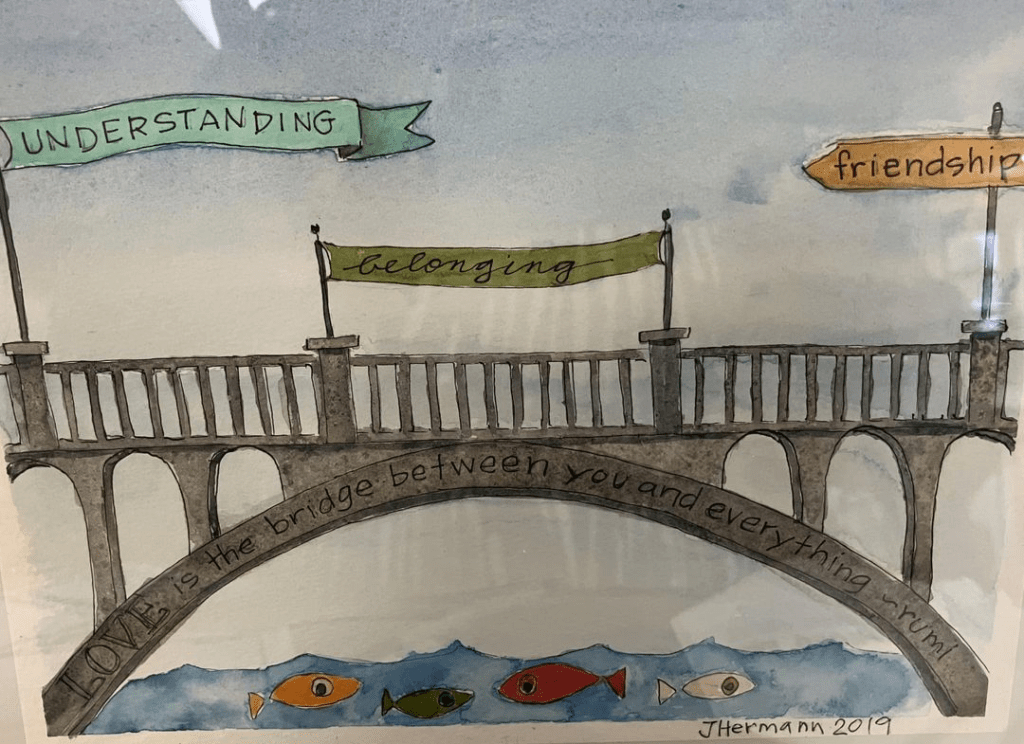
A framed painting at Parables. Four fish are swimming in a river. The red fish is moving in the opposite direction of the orange, green, and white fish. There is a bridge above the fish that reads, “Love is the bridge between you and everything” — Rumi. On the bridge, there are three flags that read, “Understanding,” “Belonging, and “Friendship.” The painting is signed, “J Herman, 2019.”


Once a month, I have the privilege of leading a Sunday morning service at a local church among a community called Parables. This community centers the needs of disabled and neurodivergent community members. I have loved building friendships with this community.

Recently, as I began my time to speak, I read Matthew 7:3-5, where Jesus asks pointed questions about judging others: “Why do you see the speck in your neighbor’s eye but do not notice the log in your own eye? Or how can you say to your neighbor, ‘Let me take the speck out of your eye’ while the log is in your own eye?'”

After reading that, I asked the gathered community, “As you heard that parable, was there anything that you noticed? What did you hear? Did anything stand out to you?”

Someone spoke up,
“L is my best friend. I know that even if life gets hard, L is always going to be one of my best friends.”

That wasn’t the answer I was expecting, but it was the right one. L was there too, and she smiled when she was affirmed.

We never know what someone will bring to a passage, how they’ll hear it, or how they’ll apply it. But isn’t this response just as valid as a comment about what’s in the text itself — i.e. what it literally says? Somewhere within it, this is what it meant to A, the person who answered. And love was lifted up.

In that moment, it was a great answer.

Renee Roederer

Peace and Justice

Photos from IRT’s Event

Over the weekend, I had the opportunity to attend the annual November gathering of the Interfaith Round Table of Washtenaw County which was titled this year, “Together We Heal: Interfaith Gathering for Peace and Unity.” It moved me deeply.

The gathering was hosted by the First Unitarian Universalist Congregation of Ann Arbor, and we heard music and moving speeches by members of Muslim, Jewish, Hindu, Christian, Baha’i, and Unitarian faiths. Front and center, was concern over what is happening in Gaza and Israel. I found the event to be comforting and challenging, both in the best ways, as people were moved to act, speak authentically of convictions and collective shortcomings, and care deeply for one another. It was real; it was transformative.

I kept thinking… If we want peace and transformation, we have to create those kinds of moments at every step of the process, not only as an end goal. If we want to see justice, freedom, and end to violence, that takes also confession, reflection, and action right here.

Interfaith dialogue provides community spaces and conversational frameworks to do meaningful, life-changing work.

Renee Roederer