Reconciliation is a Deep Gift

Mended ceramic hearts. Public domain.

I wonder if you’ve ever had these feelings that I’m about to describe. If not, I hope that you will have them one day.

There is this palpable feeling in a relationship or set of relationships that have been reconciled after a difficult conflict or chapter of painful history. As that relationship moves forward, there are two distinct moments that bring an incredible sense of awe.

The first moment and first sense of awe is when you realize you’ve truly moved beyond the conflict. As you engage with one another, it becomes clear that the old story is no longer active. It’s not that the past wasn’t significant—it absolutely was — and it’s not that anyone has forgotten it. But now, the pain is no longer active. You’ve reached a point where there’s a completely new normal. And you think, “Wow, that place of pain we once had just isn’t here anymore. We’re in a new time.” You’re writing a different chapter now, and it’s obvious. This moment invites a deep sense of gratitude and awe.

The second moment and second sense of awe comes after even more time has passed. When you’re in each other’s presence, there’s a shared, unspoken awareness that things didn’t have to turn out this way, and it’s miracle that they did. This relationship is what it is now because everyone put in the work to make change and transformation possible. This invites gratitude and awe too. But that’s not all. Here’s what I want you to know if you’ve never felt this before: It feels wildly subversive, as if you are aware in each other’s presence of the gift of one another and how rare this is. And not only that. It’s this feeling that all of the pain, conflict, and trauma could not, in the end, keep you from loving one another. And you know, within your relationship or set of relationships, you are a subversive example to anyone who can see it.

It didn’t have to end up this way. Sadly, sometimes it doesn’t. Sometimes, pain remains.

But when it does end up like this, it’s one of the best feelings in the world. In my life, I can think of four different experiences of relational transformation like this. These weren’t small things, either; these are relationships that emerged from the other side of conflict, trauma, and estrangement, and all that comes with it. I realize that having four reconciling experiences of this magnitude may be more than most people experience in their lifetimes.

I would prefer not to have experienced the conflict, trauma, or estrangement, of course. But on the other side, the feeling is sacred and profound. It’s quite literally one of the best feelings I know.

And if you’re not there yet, please know that these moments can sometimes surprise you. If you’re not there, or can’t even imagine getting there (I wasn’t able to imagine it easily either) but still wish for it, know that even the desire to be reconciled is born of love. That desire is love at work. And when you put that love into the world—even if you can’t send it in the relational direction you wish you could — you place it somewhere and allow it to be active. That love is still real, and good things can come from it, for you and for others.

Renee Roederer


Facing One Another

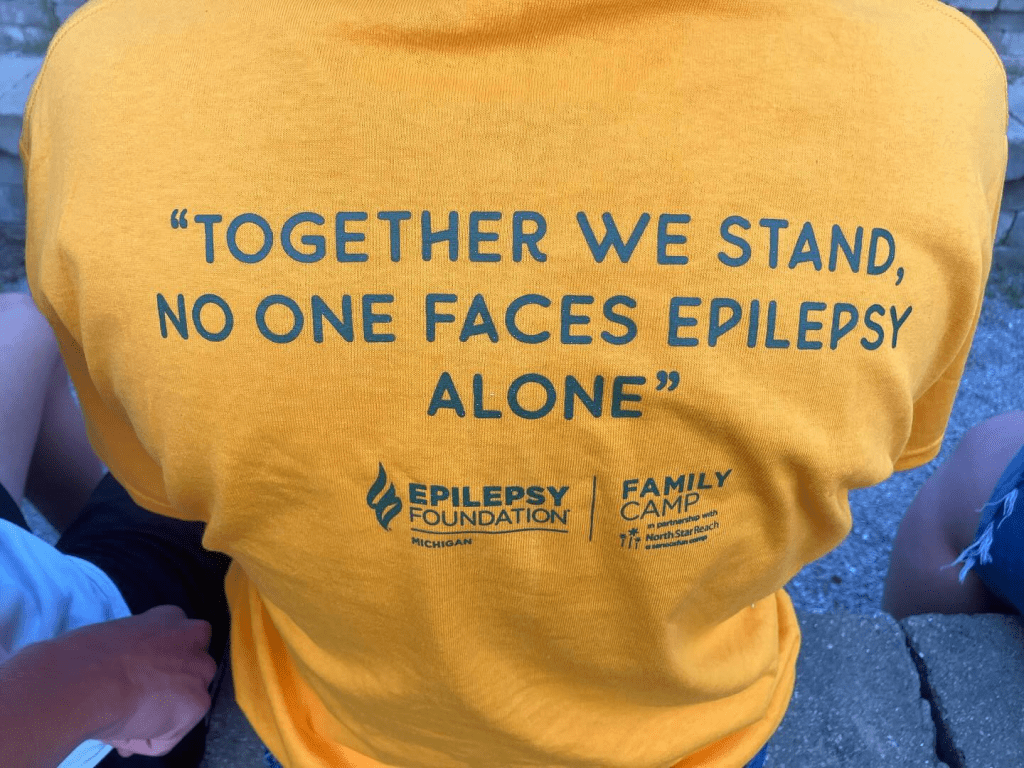
A golden, yellow T-shirt reads, “Together, we stand, no one faces epilepsy alone.”

There is no doubt that without community connections, an epilepsy diagnosis can feel remarkably isolating and lonely. At the Epilepsy Foundation of Michigan, we are always seeking opportunities to forge kinship through connection, joining our entire network in the commitment to ensure that “no one faces epilepsy alone.”

At Family Camp this weekend at North Star Reach, children and families were able to face one another with joy-filled introductions, knowing that they were in the presence of people who understand the epilepsy journey — each story unique, each relationship supported with care.

On Friday, I got to attend the opening gathering when children and families introduced themselves to one another and shared their excitement for camp and all its activities. Each family unfurled an introductory banner that they had created.

Together, we move away from isolation toward relationships of celebration and care. It’s a precious privilege to witness the transformation.

Renee Roederer

Needs

A heart-shaped stone, lying on a table. Public domain.

At some point, likely already when we were very young, we began to internalize a cultural message that told us increasingly, “If you ask for what you need (or perhaps even reveal you have needs) you are burdensome.”

Where does this come from? If we reflect for a moment, it’s probably rare for us to believe people are burdensome when they share their needs with us. Why do so many people then fear being burdensome when expressing their own needs? Why does that fear come over us?

Even people with the most privileged identities fear this. For instance, how many men fear revealing their emotional needs and expressing them with others? And people with large financial needs or large health needs constantly have to navigate this landscape of internal fears.

So… if so many of us feel this way about ourselves… but not others… and those others don’t feel this way about us… Why are we living this way? Clearly, we do not have to live with these narratives. It is morally neutral to have needs. In fact, it is beautifully human.

So if no one has told you lately,

It’s okay to have the needs you have.
It’s okay to express them.
It’s okay to invite people around them.
It’s okay to make asks within them.

It’s okay to be a person with needs.
It’s okay to need.

Renee Roederer

Mental Health Monday: Transforming Pains We Carry

Angelo Pantazis, untitled (detail), 2018, photo, UnsplashClick here to enlarge image. 

This morning, I’d like to share this reflection from the daily emails of Richard Rohr and the Center for Action and Contemplation:

Psychotherapist Resmaa Menakem connects our individual healing from trauma with our communal healing from racism and other social ills. He describes “clean pain” as that which is faced and transformed instead of denied:  

Healing trauma involves recognizing, accepting, and moving through pain—clean pain. It often means facing what you don’t want to face—what you have been reflexively avoiding or fleeing. By walking into that pain, experiencing it fully, and moving through it, you metabolize it and put an end to it. In the process, you also grow, create more room in your nervous system for flow and coherence, and build your capacity for further growth.  

Clean pain is about choosing integrity over fear. It is about letting go of what is familiar but harmful, finding the best parts of yourself, and making a leap—with no guarantee of safety or praise. This healing does not happen in your head. It happens in your body. And it is more likely to happen in a body that can stay settled in the midst of conflict and uncertainty.  

When you come out the other side of this process, you will experience more than just relief. Your body will feel more settled and present. There will be a little more freedom in it and more room to move. You will experience a sense of flow. You will also have grown up a notch. What will your situation look like when you come out the other side? You don’t know. You can’t know. That’s how the process works. You have to stand in your integrity, accept the discomfort, and move forward into the unknown. [1]  

Richard Rohr considers the effects of trauma in individuals and social systems:  

When people at work, in our families, in politics, or in the church seem to be completely irrational, counterproductive, paranoid, or vengeful, there’s a good chance they’re acting out of some form of the survival mode, which can be triggered in many ways. Persons with trauma deserve deep understanding (which is hard to come by), sympathy (which is difficult if we have never been there ourselves), patience (because it’s not rationally controllable), healing (not judgment), and, frankly, years of love from at least one person or animal over time. 

Could this be what mythology means by the “sacred wound” and the church meant by “original sin”—not something we did, but the effects of something done to us? I believe it is. It’s no wonder Jesus teaches so much about forgiveness, and practices so much healing touch and talk. [2] 

Menakem emphasizes the possibilities for liberation created by the settling of our bodies:  

We need to join in that collective action with settled bodies—and with psyches that are willing to metabolize clean pain. I can’t stress this enough. Bringing a settled body to any situation encourages the bodies around you to settle as well. Bringing an unsettled body to that same situation encourages other bodies to become anxious, nervous, or angry. [3] “

[1] Resmaa Menakem, My Grandmother’s Hands: Racialized Trauma and the Pathway to Mending Our Hearts and Bodies (Las Vegas, NV: Central Recovery Press, 2017), 165–166.  

[2] Adapted from Richard Rohr, introduction to Oneing 9, no. 1, Trauma (Spring 2021):  18. Available in print and PDF download.  

[3] Menakem, My Grandmother’s Hands, 238. 

The Longest Hug

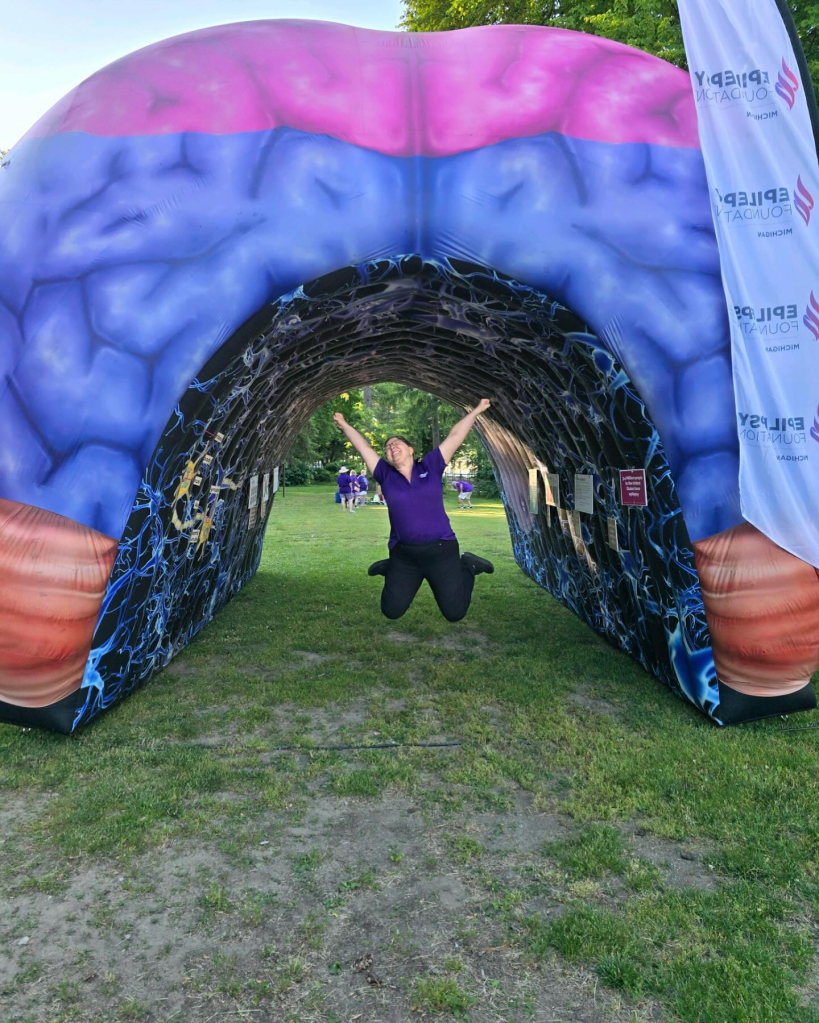
Jumping for Joy at the Metro Detroit Stroll for Epilepsy

In my work, I get to participate in building a deep sense of community across distance. People can forge very strong bonds even when they don’t see each other in person.

This takes place over the landscape of the epilepsy community we serve. At the Epilepsy Foundation of Michigan, we serve our whole state geographically, and many members of our community do not drive. For this reason, we create circles of support across distance, and you may be surprised how deep a phone call or Zoom meeting can go. In fact, I’ve watched these be transformative.

This is always on display in moments when our community members do get meet one another, and I was touched by one of these moments last weekend when we held our annual Metro Detroit Stroll for Epilepsy. This is our largest event each year, and it always feels like a family reunion.

For some, it’s a sacred introduction for the first time: Case in point, at one moment, I realized that two members of our phone-based support group were nearby each other. “T, this is C!” I said (not their name letters), and I am telling you, T ran over, scooped C, and they hugged each other in the sweetest embrace that must have lasted 40 seconds.

They have never met in person. But they know each other, and they know each other well. In fact, they love each other well, and you could see this in what must have been the longest hug that happened at the Stroll.

These bonds matter. Community matters. And we can forge these relationships far and wide.

Renee Roederer

Mental Health Monday: What Is Structural Dissociation?

Dissociation is a mental process that causes a person to disconnect from their thoughts, feelings, memories, sense of identity, or surroundings. It can be a method for the mind to cope with stress, such as during a traumatic event, or it can be a symptom of a dissociative disorder.

Dissociation also falls on a spectrum. We all encounter typical, daily instances of dissociation. For example, when we’re deeply engrossed in a book or movie, we might lose track of our surroundings. Or if we’re driving on a familiar path, we may reach our destination without recalling the journey.

But dissociation can become more pronounced, often involuntarily as a response to high stress or trauma, and it can disrupt daily life and a person’s sense of self. Structural dissociation refers to a theory in psychology that explains how trauma can cause a person to feel as though they exist in distinct parts, often as an attempt to manage their internal world and their emotions and relationships to that trauma or history of emotional neglect. There are a number of evidence-based, therapeutic approaches to help with this, including Internal Family Systems (IFS), which cares for dissociation and provides assistance in addressing the various parts of the self, particularly when these parts feel in conflict with one another.

Here is more information:

Mental Health Monday: Lead with Gratitude

“Thank You!” written in the sand on a beach.

Intentional gratitude practices can make a huge impact on our mental and physical health. Have you ever tried something like this? Perhaps keeping a short gratitude journal, or rehearsing moments of gratitude in your own mind before going to bed? Perhaps sharing your gratitude with another person?

A study designed by Dr. Martin E.P. Seligman, psychologist at the University of Pennsylvania, invited 411 people to deliver a letter of gratitude to someone who they had never thanked for their kindness, and participants exhibited such a large increase in the study’s happiness scores that the boost of that benefit could be noticeably measured for a month.

The study didn’t measure the happiness score of the person who received the letter, but I wonder how its impacts may have lingered meaningfully as well.

If we lead with gratitude, there are benefits for ourselves and those around us.

Renee Roederer

Safe Bodies, Transformed Minds

“So it’s very important to be very aware that these reactions emanate from your body, and so the big challenge of treating trauma is, how do you help people to live in bodies that feel fundamentally safe?”
— Bessel van der Kolk

In this video, Bessel van der Kolk discusses
1) Psychotherapy
2) EMDR (Eye Movement Desensitization and Reprocessing)
3) Yoga
4) Theatre & Movement
5) Neurofeedback
6) Psychedelics

“Part of what has kept me so busy all these years is, how can we find a treatment that allows the basic sense of defectiveness and self-loathing to be controlled, and now it looks like we have found something that has found a very substantial drop in PTSD… But what is important here is that one size doesn’t fit all. Different people need very different things. What worked for my last patient may very well not work for you. Everything is an experiment in life, and healing from trauma is an experiment.”
— Bessel van der Kolk