Health Equity (And All Equities) Won’t Get Better On Their Own

 Figure 3 from The Misperception of Racial Economic Inequality by Michael Kraus et. al. Underestimates of the Black–White wealth gap from 1963 to 2016. Each of the small colored dots represents one respondent’s estimate. The large black dots represent mean respondent estimates of Black wealth when White wealth is set to $100. The diamonds represent the actual median Black wealth when White wealth is set to $100, calculated using federal data from the Survey of Consumer Finances (Bricker et al., 2017). Error bars indicate 95% confidence intervals around the mean estimates.

I recently attended a lecture at the University of Michigan by Dr. Michael Kraus, a Professor at Northwestern University, titled The Narrative of Racial Progress. His research challenges how we understand progress, and how our assumptions about progress can work against actual change.

One powerful part of the lecture involved a question Dr. Kraus asks his research subjects: “In the United States, if an average white family has $100 in wealth, how much does the average Black family have?” He asks participants to estimate this answer across various years in our history and to project it into the future. The answers are revealing.

As Dr. Kraus shared, every U.S. racial and ethnic group overestimates the level of racial wealth equality in our country, but white Americans overestimate it the most. The truth is stark: from 1963 to the present day, the average wealth of Black families has hovered around $8 for every $100 held by white families. The number has moved slightly up or down, but it has never moved steadily upward as we might hope.

This gap between perception and reality speaks volumes. Many of us have internalized the belief that racial progress is natural—that it simply happens as time goes on. But Dr. Kraus challenged this narrative directly. He asked, “If you expect that progress happens naturally, why would you think policies are needed to increase equity?”

It’s a sobering reminder that the story we tell ourselves about progress is often a comforting one, but it isn’t necessarily true. Progress doesn’t happen without effort, and without policies and community-driven action, inequities persist or even worsen.

This connects directly to the work we do at the Epilepsy Foundation of Michigan and within our national Epilepsy Foundation network. We are continually seeking to understand the data and personal experiences around health inequities, so we can close these gaps and build health equity. If the average Black household holds only 8-10% of the wealth of the average white household, is it any wonder that these inequities echo across our health systems, education systems, and social services? Wealth shapes access to care, stability, and opportunities, and disparities in wealth contribute to disparities in health outcomes.

Dr. Kraus’s lecture was a crucial reminder: Equity, whether in health or economics, will not improve on its own. It requires foresight, intention, research, and tangible action. We can’t afford to be passive; progress demands our active participation.

The disparities we face today weren’t created by chance, and they won’t be dismantled by chance either. It will take all of us, committed to recognizing inequities, understanding their roots, and working intentionally to create a fairer future.

Reference: The Misperception of Racial Economic Inequality by Michael W. Kraus, Ivuoma N. Onyeador, Natalie M. Daumeyer, Julian M. Rucker, Jennifer A. Richeson.

Renee Roederer

Facing One Another

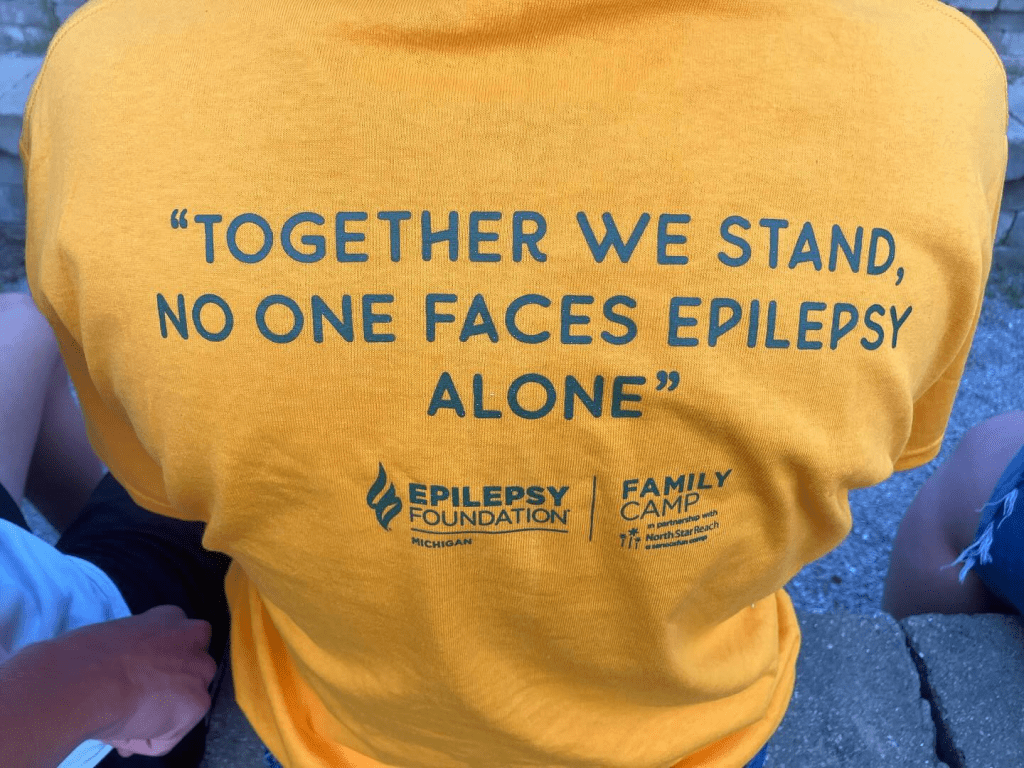
A golden, yellow T-shirt reads, “Together, we stand, no one faces epilepsy alone.”

There is no doubt that without community connections, an epilepsy diagnosis can feel remarkably isolating and lonely. At the Epilepsy Foundation of Michigan, we are always seeking opportunities to forge kinship through connection, joining our entire network in the commitment to ensure that “no one faces epilepsy alone.”

At Family Camp this weekend at North Star Reach, children and families were able to face one another with joy-filled introductions, knowing that they were in the presence of people who understand the epilepsy journey — each story unique, each relationship supported with care.

On Friday, I got to attend the opening gathering when children and families introduced themselves to one another and shared their excitement for camp and all its activities. Each family unfurled an introductory banner that they had created.

Together, we move away from isolation toward relationships of celebration and care. It’s a precious privilege to witness the transformation.

Renee Roederer

The Longest Hug

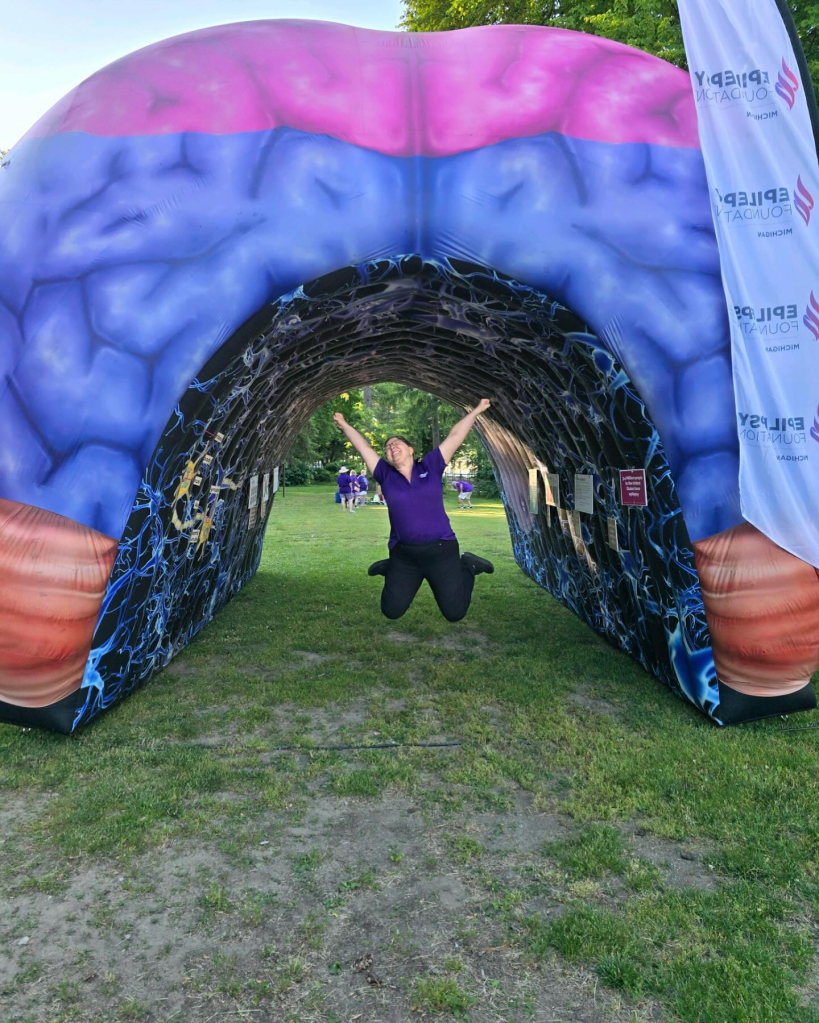
Jumping for Joy at the Metro Detroit Stroll for Epilepsy

In my work, I get to participate in building a deep sense of community across distance. People can forge very strong bonds even when they don’t see each other in person.

This takes place over the landscape of the epilepsy community we serve. At the Epilepsy Foundation of Michigan, we serve our whole state geographically, and many members of our community do not drive. For this reason, we create circles of support across distance, and you may be surprised how deep a phone call or Zoom meeting can go. In fact, I’ve watched these be transformative.

This is always on display in moments when our community members do get meet one another, and I was touched by one of these moments last weekend when we held our annual Metro Detroit Stroll for Epilepsy. This is our largest event each year, and it always feels like a family reunion.

For some, it’s a sacred introduction for the first time: Case in point, at one moment, I realized that two members of our phone-based support group were nearby each other. “T, this is C!” I said (not their name letters), and I am telling you, T ran over, scooped C, and they hugged each other in the sweetest embrace that must have lasted 40 seconds.

They have never met in person. But they know each other, and they know each other well. In fact, they love each other well, and you could see this in what must have been the longest hug that happened at the Stroll.

These bonds matter. Community matters. And we can forge these relationships far and wide.

Renee Roederer

The Community is The End

Vignette 1:

Every year, I like to make a pilgrimage of sorts. I get myself to a Jacob Collier concert, which is always an experience like none other. This is not an opportunity to be a mere spectator, by the way. If you are in the audience of a Jacob Collier concert, you are also a performer — an integral part of the experience.

Here are two things I typically share with others when I mention what this experience is like:

— Jacob Collier is a person of near unbelievable talent. He plays at least five instruments during a given concert and masterfully. And he improvises brilliantly, especially on the piano and the harmonizer, an instrument he himself invented, which allows him to sing one note and play keys to create harmonized versions of his own voice. Basically, he is singing chords with himself.

— Despite this near unbelievable talent on display, there is no Jacob Collier concert without the audience. He is all about collaboration, and he can craft a collective, interactive musical experience with the audience that feels powerful, playful, and sacred. He is remarkably skilled in being a moment-maker.

And here’s what I noticed in the concert I attended this year:

He always ends with us. He always ends with the community.

We were the finale to the concert. After the long set was over, he concluded by making us into an audience choir. He makes eye contact with certain sections of people, gets them singing a note, and then adds the others. He gestures up or down, and we know what to do with our voices. Now we are singing chords with ourselves. How many audiences end up being a choir and the conclusion to the concert?

There were encores, of course. And in this instance, too, he always found a way to end with us. He put us on display each time, and this was a collective experience. As a remarkably talented person, collaboration and transformation matter most to him.

Vignette 2:

This past Saturday, I was driving to the Midland Stroll for Epilepsy, one of the annual events at the Epilepsy Foundation of Michigan. I was just about to pull into the location, when the short conclusion of the Beatles’ album Abbey Road started playing. It’s just two minutes long and is called “The End.”

It’s a jam. But the final words are reflective,

“And in the end… the love you take… is equal to the love you make.”

I thought, “Here, too, the community is the end.” My colleagues do all sorts of detailed planning to make the Stroll happen, and individuals and team captains organize themselves, raise money, make t-shirts, or get themselves ready to volunteer. And… it’s all leading to the community experience. It’s all leading to being together, celebrating one another, and casting a vision where all belong, are included, and empowered to be advocates. It’s all leading there.

And a word like ‘end,’ brings this home. Yes, it can be a conclusion. But ‘the end’ can also mean the goal or the purpose.

And so,

The community is the end, and
The end is community.

Renee Roederer