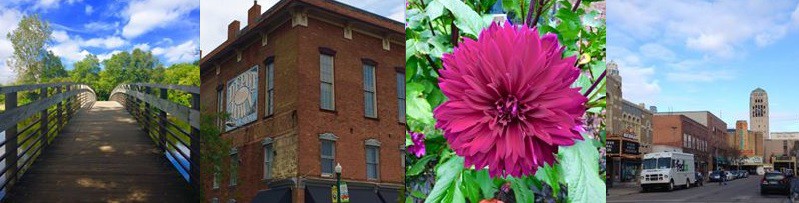
The Daily Joys of a Geezer Millennial

“We’re Geezer Millennials,” I said last night, pointing to Ian and me as we sat around a table with students.
This came up first when we were talking about age, and then later, when we were dating some old shows and video games — that is, if or when we knew about them as children. In all of this, when I used this silly, self-descriptive term, I was conveying that we are in fact, among the very oldest Millennials. My high school graduating class in 2000 helped give this generation its name: We initiated the bracketing.
I’m still relatively young, but I don’t consider myself to be a ‘young adult’ anymore. (Unless, perhaps, you’re in the Presbyterian world, where anyone under 50 is considered a young adult. The PC(USA) has its own version of dog years, but in reverse: Maybe every 7 years only equals 1?)
At age 36, I lapped adulthood this year. This means I am also double the age of a college freshman.
And friends, I love all of this.
Last night, I told this table of people that hardly a day goes by when I don’t think about how much I love being in my mid-30s. This is true. This is one of the fullest, most meaningful eras of my life so far, and it is, in part, connected to age.
It’s this sense that if I’m fortunate to live a long time, I still have a lot ahead of me. But I have some significance behind me too. I have lived a lot. I even have some wisdom to share. (Still much to learn though!)
And I have the opportunity to keep doing what I’ve been doing now for more than a decade – cultivating intentional, nurturing space for young adults – but now, I get to do it with more age. This has always been a rich life-calling, but it just keeps getting richer.
And in all of this, a particular joy finds me on an everyday basis. This is my deepest joy as a Geezer Millennial: I know a large number of young adults who now live all over the place — people with whom I am inextricably linked in community and kinship; people who are doing amazing things with their lives —
They live in 3 nations,
and at least 14 states (hopefully, I didn’t miscount those)
I’ve known some of them for a couple of years,
and some for more than a decade (by the way, this is astonishing to me)
I’m in touch with them regularly. And every single day, at least one of them says something so loving, caring, compassionate, and affectionate to me; something so wise; something that teaches me about life; something that speaks to the particularity of their being and calling in the world.
Do you know how lucky I am to experience and hear these things every single day?
This is undoubtedly one of the reasons I love my mid-30s so much. I keep having this experience and marveling about how rich it is.
Ah, the daily joys of a Geezer Millennial. . . This keeps getting broader; this keeps growing deeper.
Can These Bones Live?

Bob Ballard is an explorer with an insatiable desire to make discoveries in the depth of the ocean. With submersibles and a host of underwater technology, he has found many sites of significance. If you’ve ever heard his name before, it’s probably due to his most famous discovery: He is the person who found the Titanic on the ocean floor seventy-three years after it sank to the bottom.
Recently, Ian and I have been watching a series on Netflix called Alien Deep. In each episode, Bob Ballard and his crew set off to make discoveries of various kinds, either to find items in the dark ocean or to uncover new information about the earth itself.
Last night, we watched Bob Ballard and his team find ancient shipwrecks in the Mediterranean Sea. This was astounding. First, they discovered items from a Byzantine Era shipwreck in the 6th century CE. Then, they found a remarkably well preserved shipwreck from 4,000 years ago. The location, along with the depth and consistency of the water, was just right for preservation. The actual wood from the ship still remained! Incredible.
But the most astonishing discovery was that they found human bones within this shipwreck from 4,000 years ago. In all his years of exploring, Bob Ballard has never found remnants of a person. Here was the human connection. Here were the remains from a human person who had died — likely, a member the crew who has never been seen again until this moment.
This connects to one of the most powerful aspects of Bob Ballard’s work. He and his crew find ways to bridge time and bring dignity to the lives of real human beings — people who experienced terror and trauma in their last moments, whose bodies entered a frigid, dark, unseen place. By discovering their artifacts, and in this astonishing case, by discovering their very bones, Bob Ballard invites us to remember and contemplate their lives. This certainly does not redeem their tragedies, but perhaps in entering them, it ensures that these human beings are not forgotten.
Once when I was in seminary, author Timothy B. Tyson was a special guest lecturer. I remember him speaking the words of Ezekiel, recalling the vision of the valley of dry bones. “Can these bones live?” Ezekiel had asked his audience.
Timothy Tyson began to speak of the transatlantic slave trade and utter horrors of enslavement on those ships, bodies disregarded, chained, and stacked on top of one another. He reminded us that human beings with Black bodies were thrown overboard for uprising, or for sickness. In a haunting way, Timothy Tyson spoke of their bones too, their remains on the ocean floor: “Can these bones live?” he asked us, his audience.
Perhaps that question ought to linger.
Can these bones live?
We cannot redeem the tragedies of these bodies, these human lives either. But perhaps in entering their history and taking their legacy seriously, we will ensure they are not forgotten. And, perhaps with intention, we will cease reenacting such traumas generation after generation.
We Need Gentleness

A few days ago, I was present in the midst of a group conversation where multiple people said,
“You just don’t see that anymore.”
and
“I just don’t see many present examples right now.”
and
“It’s so rare to experience that these days.”
At one point, we were talking about forgiveness. At another point, we were talking about kindness. No one in this conversation had become cynical; instead, I believe I was hearing a yearning for expressions of care, both public and personal.
Along with this, I also recall how many people shared the trailer of the upcoming Fred Rogers documentary on Facebook recently. I saw that posted all over the place. (I also love it and can’t wait to see the film myself.) Right now, I think there is a longing to see and experience kindness on display, not just for the sake of it being on display, but for the inherent sake of kindness itself.
Or to use another word, we need gentleness. We need to practice it. We need to receive it. We need a gentler world.
This is different, of course, than needing a comfortable world. As a caveat, this is not an effort to decrease the tenacity and strength of voices crying out in anger and pain when they are experiencing violence and being marginalized (as if we could do this anyway). Sometimes, we make calls toward kindness and “civility” so we don’t have to be uncomfortable with the righteous anger and pain people are expressing. That’s just tone-policing and respectability politics, and it does more harm.
But I wonder what would happen if we responded with kindness and tenderness? I wonder what would happen if we responded not with defensiveness but gentleness?
I also wonder what would happen if we chose to practice more gentleness toward ourselves right now. This is a human need all the time. I think it is especially needed right now.
On these all of things, I’m just wondering aloud today. I would love to hear from you too.
What do you wonder?
What do you think?
What do you long for?
Table Flipping Monday

Today’s piece is a re-post, a reminder that resistance and protest can be important actions of faithfulness.
A blessed Table Flipping Monday, y’all.
A couple of years ago, my friend and pastoral colleague Sarah Ross made a suggestion that the Monday of Holy Week ought to be considered Table Flipping Monday. Of course, that’s a pretty humorous title, but Sarah also helped me think about this . . .
During the last week of his life, when Jesus arrived in Jerusalem to celebrate the Passover, the very first thing he did was walk into the center of communal, religious life and hold it accountable. He went into the Temple, the most holy place, and was horrified to discover that some were making unjust money as they oppressed the Jewish people in their religious devotion. He turned over the tables and chased out the money changers, quoting Jewish scripture, saying, “It is written, ‘My house shall be called a house of prayer, but you have made a den of robbers.’”
I want to be careful about how I talk about this story, in large part because throughout history, Holy Week has been an occasion when Christians have oppressed Jews and even caused violence. When I think about this day, I don’t aim to criticize the Temple or the religious heritage of which Jesus was fully a part.
Instead, I want to consider the ways in which my own religious tradition ought to be held accountable. That includes this painful history we have caused our Jewish siblings. And it includes a host of other abuses fully expressed in the present.
Religion can give life and meaning, and it can be twisted as a tool for oppression.
There are a multitude of ways in which tables ought to be flipped over. In fact, accountability and truth telling can be acts of spiritual devotion in and of themselves.
Jesus rages against the oppression and manipulation of others. Today, we need prophets and holy agitators to follow into this calling. I offer my gratitude today for people who hold my tradition and our actions to account.
One of Christianity’s foundational teachings involves a holy leveling – an inverted shift where the marginalized become the most empowered and the most powerful are brought into humility.
But too often, we fall far short of this vision. Today can serve as a day of confession.
May Jesus and a host of others flip the tables.
Zusya and Us

Chasidic masters told this story about Rabbi Zusya of Hanapoli:
Once, the Hassidic Rabbi Zusya came to his followers with tears in his eyes. They asked him:
“Zusya, what’s the matter?
And he told them about his vision; “I learned the question that the angels will one day ask me about my life.”
The followers were puzzled. “Zusya, you are pious. You are scholarly and humble. You have helped so many of us. What question about your life could be so terrifying that you would be frightened to answer it?”
Zusya replied; “I have learned that the angels will not ask me, ‘Why weren’t you a Moses, leading your people out of slavery?’ and that the angels will not ask me, ‘Why weren’t you a Joshua, leading your people into the promised land?”‘
Zusya sighed; “They will say to me, ‘Zusya, why weren’t you Zusya?'”
Zusya, why weren’t you Zusya?
[________], why weren’t you [________]?
We can easily place our names in those boxes. In lifting this story up today, my point is not to raise the possibility of judgment, either here or in some future afterlife. My point is to raise questions like,
[________], what has gifted you to be [________]?
[________], what could be possible if you lived as [________]?
[________], how might your neighbors connect meaningfully to [________]?
[________], what is possible if you are fully [________]?
After all, there are gifts and abilities that come quite easily specifically to you. What could be possible if you felt their joy — a joy that then extends well beyond yourself? What could be possible if those very qualities, traits, gifts, abilities, and passions were turned in the direction of some of the greatest needs we witness and experience?
How could we give? How could we receive?
I inserted this story of Zusya, as I found it here: Be True to Yourself — Ask Zusya’s Question
Joyful Homecoming

What could be possible if we put joy at the center?
For me, this question is connected to Radical Homemaking, and it has been energizing me since I’ve returned home after spending much of last week in Durham, North Carolina. I visited very beloved folks there and then attended the Why Christian Conference.
Some context…
The name of the Why Christian conference is actually pretty apt. Organized by Nadia Bolz-Weber and Rachel Held Evans, the conference invited eight incredible women to give testimony, answering these questions:
“Why, in the wake of centuries of corruption, hypocrisy, crusades, televangelists, and puppet ministries do we continue to follow Jesus? Why, amidst all the challenges and disappointments, do we still have skin in the game? It’s a question that may take a lifetime to answer, but we hope the next two days inspire you to wrestle with it in some new and fresh ways.”
All of the stories were remarkably powerful and compelling. They weren’t crafted to convince people of anything, or move to some sort of ‘or else,’ grand conclusion, as many of us have experienced in fire-and-brimstone churches. These were life testimonies of experience, speaking to deep conviction, love, and joy, and that took place right alongside stories of honesty, confession, loss, trauma, and vulnerability.
The piece that impacted me the most was one of the breakout sessions. I attended a session with the Rev. Amy Campbell, pastor of the BeLoved Community in Asheville. This session was called, “The Radical Art of Making Home.” “What if our primary vocation as humans is to make home?” she asked. Over these last years, she has been making home together with people who are acquainted with the painful experiences of homelessness. The BeLoved Community is an intentional community in a house in Asheville. People worship, share meals, sleep, build friendships, and beautifully celebrate one another — especially making space for people who have no shelter or people who are estranged from a sense of home in one way or another.
Radical Homemaking. . . I can’t begin to tell you how much this spoke to me. In my own context, I feel like this framework names the calling that energizes me as well.
What does it mean to be at home. . .
. . . in our bodies?
. . . in our selves?
. . . in our relationships?
. . . in connection to the Sacred?
. . . in the ways we organize our communities?
. . . in the beautiful broadening of kinship belonging?
. . . in the ways we shape family and choose family?
. . . in the cultivation of space (including literal homes) for hospitality and nurture?
. . . in the inclusion of people (or perhaps, parts of ourselves) that feel estranged from home in one way or another?
Radical Homemaking. . . Radical: meaning, of, relating to, proceeding from a root. . . Last week, I found myself pondering this so much. This is newer language for what I know has been calling me all along.
So that brings us back here: What could be possible if we put joy at the center?
Radical Homemaking is one of my deepest joys. And I have returned home with such deep awareness that I need to put this calling and joy right at the center. Giving and receiving from this framework, I wonder what is possible?
Horizontal Church: Christian Education

I know a young adult who is really into the study of theology. All the time, people ask him, “Have you thought about seminary?”
This is a worthwhile question. First of all, it would be a great opportunity for him to learn more. But also, there may be a question of calling for him to consider within this. “Have you thought about….?”
But I also think there’s an underlying assumption within this question too: The study of theology is for ministers with seminary degrees. In other words, it’s for ministry professionals. But what if more people in our churches had access to the study of theology, Biblical Greek and Hebrew, and preaching? For the benefit of the church? For the practice of a horizontal vision? For the Priesthood of All Believers?
In the Presbyterian Church (USA), my own tradition, we require our pastoral leaders to have a rigorous education. There is value in this, as we want people to have skills in exegeting Biblical texts in their original languages, making theological connections, and practicing pastoral care. I think this is important.
Earlier last week, I cast a vision for worship that is more participatory – a vision which invites the voices, wisdom, and teaching of many people into the time we often call the sermon. First of all, I believe it’s possible for people to speak about Biblical texts from their convictions and life experience. I can learn a great deal and be deeply inspired when I encounter how others hear, interpret, and live the texts of the Bible.
But I do believe it is important for a congregation to hold the depth and skills of Christian education. I just don’t believe this kind of education needs to be held solely within a professional class. It’s possible for knowledge and skills to be held more collectively. Not everyone can go to seminary, so. . . how can some of the learnings and skills of seminary be taught more broadly?
I suspect this would require more teaching in relationship. Not classes alone. But apprenticing and mentoring. I wonder what might be possible?
This post is a part of a series. Feel free to check out the other pieces as well:
This Week: Horizontal Church
Horizontal Church: Who Speaks, Prays, and Preaches? — Why?
Horizontal Church: Participatory and Empowering (Part 1)
Horizontal Church: Participatory and Empowering (Part 2)
Horizontal Church: The Priesthood of All Believers and Collective Organizing
Horizontal Church: Accountability
Post navigation
Horizontal Church: Accountability

The word corporate has at least two meanings with two different connotations.
-Perhaps corporations first come to mind, and along with them, broader corporate culture. We might imagine board rooms, shareholders, and CEOs. Perhaps we imagine the organizational flow charts that describe how individuals and groups answer to individuals and groups. Profit margins, stock prices, cutthroat competition. . .
-But the word corporate also means ‘of the body.’ In the context of Church, this calls our minds to the language and imagery of the Body of Christ — the whole, collective body — every person, every part, every spiritual gift.
If we’re honest. . . I think our Church organizational models often look a lot like the first example. We already have a shared Church history that includes traditional, hierarchical roles and vertical organizing. In the American context, we then additionally infuse those roles and structures with the culture and power of the corporate business world.
With this in mind, I want to challenge a particular assumption today. Consciously or perhaps unconsciously, many of us believe this:
The more vertical a church is (i.e. the more top down and hierarchical) the more accountability there will be. We assume, when there is a clear and firm understanding that certain people will always answer to certain people, we will have greater accountability within an organization.
But. . . I actually believe the direct opposite.
The more vertical and hierarchical we become, the less accountability we tend to have. Because people and groups at the top have a great deal of power. That power is easily abused.
First of all, when any of us has a tremendous amount of concentrated power, it’s not good for us or an organization. In fact, studies are showing that concentrated power can actually lead to brain damage, greatly decreasing the ability to feel and demonstrate empathy. This is not only crucial for exhibiting kindness and compassion; it also makes it challenging to read people within the organizational structure.
But beyond this, in addition to concentrated power being abused in highly vertical models, it is also easily covered up. The same individuals and groups that benefit from vertical organizing models and concentrated power often use vertical organizing models and power to silence dissent. And people toward the top tend to protect one another. One only needs to recall the horrific sexual abuse scandals of the Roman Catholic Church. Or perhaps, scratch the surface in mainline churches, and discover just how many incidents of sexual harassment and employment abuse are routinely covered up.
Hearing this may sound depressing. (You may also disagree with me and want to challenge me here. Please add your voices. Let’s have a horizontal conversation!) But deep down, hear this good news: I believe there are other ways to organize church communities.
I certainly don’t claim to know all the answers. I am more in a learning place than a teaching place, but I do think that horizontal organizing structures can actually lead to greater accountability. They can certainly lead to greater transparency. I’ve seen this work in activist organizing collectives. Why not also in Church?
Here, I find myself especially wanting to take my learning cues from the Quakers. (See also, My Awakening). I am aware that there are different accountability risks with horizontal models, including,
pressures to conform to the collective,
group shaming,
sudden shifts in group vision, especially when dictated by dominant individuals.
I’m wondering how the shared practices and procedures of the Quakers (and other horizontal collectives) can help avoid these pitfalls, increase accountability and transparency, and ultimately lead to a life-giving, collective body.
Pondering. . .
This post is a part of a series. Feel free to check out the other pieces as well:
This Week: Horizontal Church
Horizontal Church: Who Speaks, Prays, and Preaches? — Why?
Horizontal Church: Participatory and Empowering (Part 1)
Horizontal Church: Participatory and Empowering (Part 2)
Horizontal Church: The Priesthood of All Believers and Collective Organizing
Horizontal Church: Christian Education
Horizontal Church: The Priesthood of All Believers and Collective Organizing

I want to thank you all for following along with this series on Horizontal Church this week. As I said at the beginning, my thoughts on this are all in process. Though these thoughts are unfinished and still emerging, I’m glad to be writing about these things, because when it comes to church and spiritual communities, I believe these are important conversations for us to be having.
I’m going to continue discussing some of these things next week, particularly some of the ways I believe vertical structures and cultures (not limited to, but certainly including entrenched hierarchy) are falling short. These thoughts are all in process too. There is much for me to learn, and I’m glad to explore a variety of ways that communities are organizing their collective life.
But I will say this: In large part, I base all these emerging thoughts on the foundation of two things. . .
–The theological conviction of the Priesthood of All Believers
-and-
–The wisdom of activist organizing
Early Christian communities were pretty radical in their forms of collective community life, particularly in the ways they included people in belonging, participation, and leadership across economic, ethnic, and gender lines. “You are a chosen people, a royal priesthood. . .” the epistle of 1 Peter says. Much later, the concept of “The Priesthood of All Believers” became one of the foundations of the Protestant Reformation, with the conviction that people should have access to the scriptures themselves (not just priests and scholars) and participate directly in their interpretation.
Part of my curiosity with pondering all of these emerging ideas and convictions is rooted in wondering, “How can we put this conviction — the Priesthood of All Believers — into practice in concrete, life-giving ways, in the context of our particular 21st century culture?”
And along with that, much of this has become important to me because I’ve experienced what horizontality can look like outside of the context of church. Horizontal organizing, in practice and as a term, comes in large part from the world of activist organizing, including Black Lives Matter. I have witnessed and participated in organizing collectives where there is no formal leader. I have watched communities utilize shared procedures and practices to guide their community life, without setting apart a particular class of leadership roles. And if I may be honest, all of these ideas and wonderings became especially important in my mind because I saw that organizing collectives were more committed to egalitarianism as a core principle than most churches I know. I think that’s a core conviction of our tradition. And though it’s never practiced perfectly in any context, I see that this principle is important to a lot of people who do not typically connect with organized religious communities.
So keeping these frameworks in mind, both theological and cultural, what might we learn? What might we try? How might we change?
(And also for your enjoyment, here’s a funny: This is definitely not Horizontal Church.)
This post is part of a series. Feel free to check out the other pieces as well:
This Week: Horizontal Church
Horizontal Church: Who Speaks, Prays, and Preaches? — Why?
Horizontal Church: Participatory and Empowering (Part 1)
Horizontal Church: Participatory and Empowering (Part 2)
Horizontal Church: Accountability
Horizontal Church: Christian Education
 Smuggling Grace