Rising to Community Care

goicecream

Yesterday in Ann Arbor, we had temperatures that included a -45 degree windchill. -45 degrees! That’s almost incomprehensible. It’s just completely outside of our typical experience. It’s also dangerous to people, animals, and infrastructure.

In the final days before we reached these temperatures, I was moved to see community members cultivating care and safety for one another. There were big efforts to ensure ample shelter resources for people experiencing homelessness. Some initiated a very successful and helpful GoFundMe fundraiser to provide hotel rooms to people who have been living in tents throughout the winter so far.

Students from the Michigan Student Power Network launched a petition for the University of Michigan to close and cancel classes on Wednesday and Thursday, arguing that staying open (its nearby counterparts tend to close, but the University of Michigan has only closed twice since 1978) casts disproportionally negative impacts upon students, faculty, and staff with disabilities and low-income status. And the University closed for the third time since 1978.

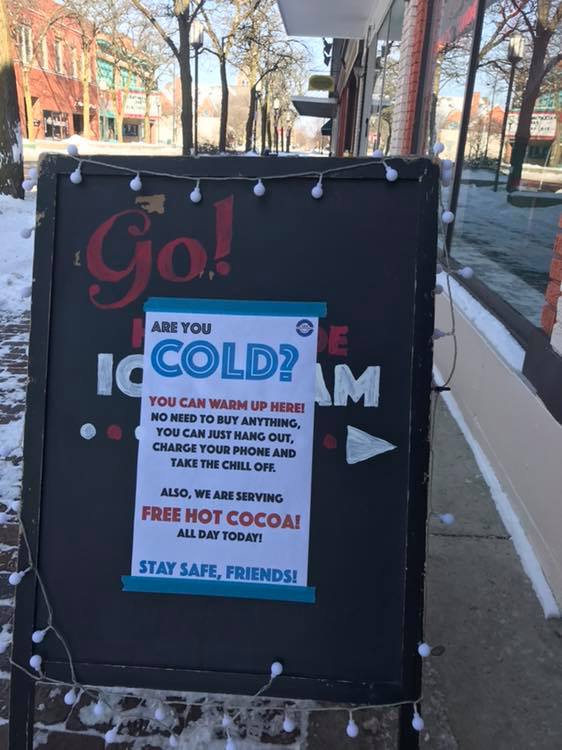
A number of places opened their spaces as warming centers, including Go Ice Cream in Ypsilanti, whose staff said, “You don’t have to buy anything. We just want you to be safe!” and they offered hot cocoa throughout the day.

This is community care at its best.

I also think… what if community members had not risen to these occasions personally on their own? Would there have been adequate resources in the city? Or adequate attention to people who have vital needs in times like these?

After all, right here throughout this winter, people are living in tents in 20 and 30 degrees. And students with disabilities experience barriers in academia quite frequently. Some street dependent people cannot choose to go to daytime warming centers because they have to make money outside to pay for hotel rooms at night.

There is more to do. More solidarity, more advocacy, and more community care.

This week revealed more of what is needed and more of what is possible.

Renee Roederer

Watching the Crows. Pondering Connections.

While walking around this morning, I watched the crows embark from their nightly roost. I enjoyed how they took up the whole space of the sky. There were so many of them, cawing, leaving collectively and moving collectively to wherever they were going.

I immediately thought of this wonderful quote from adrienne maree brown, the author of Emergent Strategy, a phenomenal, imaginative book about collective change. On page 13, she writes,

“There are examples of emergence everywhere.

“Birds don’t make a plan to migrate, raising resources to fund their way, packing for scarce times, mapping out their pit stops. They feel a call in their bodies that they must go, and they follow it, responding to each other, each bringing their adaptations.

“There is an art to flocking: staying separate enough not to crowd each other, aligned enough to maintain a shared direction, and cohesive enough to always move towards each other. (Responding to destiny together). Destiny is a calling that creates a beautify journey.

“Emergence is beyond what the sum of its parts could even imagine.

“A group of caterpillars of nymphs might not see flight in their future, but it’s inevitable.

“It’s destiny.”

As I continued to walk outside, I saw cars moving around town, driven by their people, and I wondered, do we feel connected to one another? I saw students walking around, listening to music on their own phones as I also do so often, and I wondered, do we feel connected to one another?

I thought about several community efforts this week to keep people safe in very harsh weather we’re experiencing (perhaps more about that tomorrow). Some truly work to survive in weather like this. I wonder, do we feel connected to one another?

It’s good to keep pondering and strengthening those connections. The crows were a good reminder.

Renee Roederer

Every Body is a Good Body

💜 Every body is a good body. 💜

Every body is a worthy-of-love body.

Every body is a worthy-of-care body.

Every body is a worthy-of-resources body.

Every body is a worthy-of-taking-up-space body.

Every body is a worthy-of-dignity body.

Every body is a worthy-of-connection body.

Every body is a worthy-of-self-expression body.

Every body is a worthy-of-advocacy body.

Every body is a worthy-of-self-determination body.

Every body is a worthy-of-having-needs body.

Every body is a worthy-of-tenderness body.

💜 Every body is a good body. 💜

Renee Roederer

Realignment Toward True Self

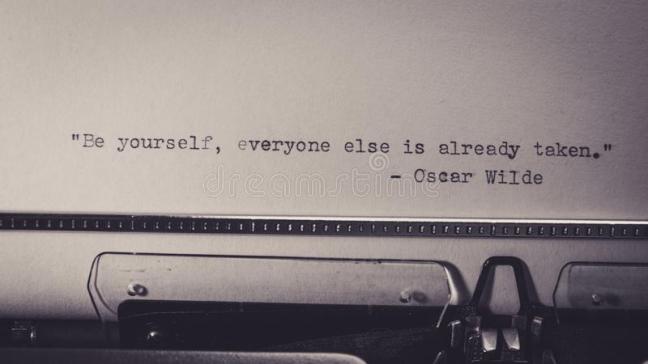
oscar wilde

[Public Domain image]

I want to begin this post with four powerful quotes:

Borrowing language from Thomas Merton, Richard Rohr, a Franciscan priest and wisdom teacher, writes frequently about what it means to give up our ego and ‘false self’ to live as our ‘True Self.’ In the midst of writing about that, Richard Rohr says,

1) “You (and every other created thing) begin with your unique divine DNA, an inner destiny as it were, an absolute core that knows the truth about you, a true believer tucked away in the cellar of your being, an imago Dei that begs to be allowed, to be fulfilled, and to show itself.”Daily Meditations, July 31, 2016

Author Paul Coelho says,

2) “Maybe the journey isn’t so much about becoming anything, maybe it’s about unbecoming everything that isn’t really you so you can be who you were really meant to be in the first place.” 

The story of the Chasidic Master Zusya of Hanapoli is told in the Talmud:

3) “Once, the Hasidic Rabbi Zusya came to his followers with tears in his eyes. They asked him:

‘Zusya, what’s the matter?’

And he told them about his vision: ‘I learned of the question that the angels will one day ask me about my life.’

The followers were puzzled.

‘Zusya, you are pious. You are scholarly and humble. You have helped so many of us. What question about your life could be so terrifying that you would be frightened to answer it?’

Zusya replied, ‘ I have learned that the angels will not ask me, ‘Why weren’t you at Joshua, leading your people into the promised land?’

Zusya sighed, ‘They will say to me, ‘Zusya, why weren’t you Zusya?’”

And author Marianne Williamson writes,

4) “Our deepest fear is not that we are inadequate. Our deepest fear is that we are powerful beyond measure. It is our light, not our darkness that most frightens us. We ask ourselves, Who am I to be brilliant, gorgeous, talented, fabulous? Actually, who are you not to be? You are a child of God. Your playing small does not serve the world. There is nothing enlightened about shrinking so that other people won’t feel insecure around you. We are all meant to shine, as children do. We were born to make manifest the glory of God that is within us. It’s not just in some of us; it’s in everyone. And as we let our own light shine, we unconsciously give other people permission to do the same. As we are liberated from our own fear, our presence automatically liberates others.”

How do these quotes connect with you? Do they speak to certain parts of you? Particular roles, archetypes, and identities that lie at the root of who you are? Aspects you want to connect with more deeply? The True Self? The parts of ourselves that “beg to be allowed, to be fulfilled, and show themselves?”

I hope so.

This week I did some reflection about “unbecoming,” as author Paul Coelho writes above. There are times I have tried to place myself in roles that don’t exactly fit me. For instance, my internal framework and concept of what “a community organizer is” has been too narrow to include what my actual strengths are or make space for own my limitations and needs. And… it’s pretty hard to do something well if your framework for that role or task does not include space for your best skills or the necessary grace, accommodation, and adaptation to embrace your own particular-to-yourself needs.

I need to expand my framework and concept for what “a community organizer is.” But as I reflected on that this week, I realized I also need to think about my own particularity. My gifts, my strengths, the at-the-core-of-myself callings. My deep-down, truest parts. The kinds of things that reveal themselves through those quotes above.

True Self stuff.
Deep Yes stuff.

So I sat down and asked myself, “What are the roles, archetypes, or identities that are central to me being… me?”

And I wrote down five.

And simply naming them felt utterly invigorating. I don’t know if it was like the Captain Planet of myself coming together or what (a 1990s joke! You should watch this goofy intro!) but this felt powerful. I felt a huge amount of energy and a physical settling into myself.

And literally none of these roles, archetypes, or identities were new thoughts or sudden discoveries. I just loved naming them together. I loved choosing them again. These are the kinds of things I can keep realigning myself with when I get off track (and I do) … returning to again… my actual list… because each of these and all of these are deeply rooted in a calling beyond myself alone… these are the spaces within myself by which I make space for others.

So — you knew this was coming right? — I’m going to invite you to do the same. Ponder this question, and write them down if it’s helpful:

What are the roles, archetypes, and identities that are central to you being… you?

Renee Roederer


The Cultural Trivialization of Trauma

img_9426

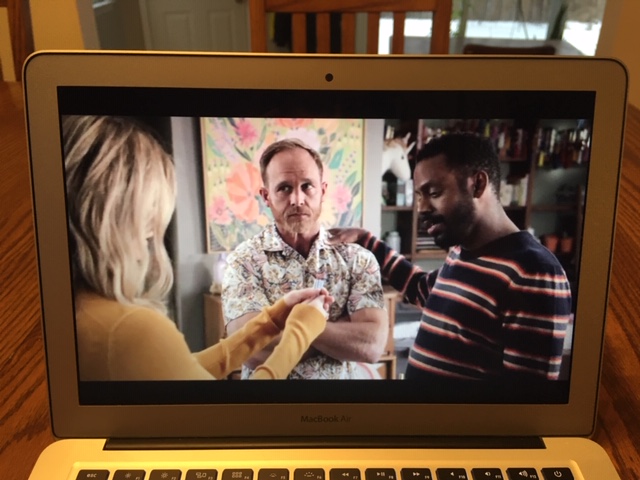
[My laptop plays Grace and Frankie]

Here are some questions I’ve been reflecting on lately:

Why do people increasingly call non-trauma things ‘trauma’? Like, in a joking way? How did it become acceptable to use the words ‘trauma’ and ‘PTSD’ as jokes? What moved us in this direction? And most of all, what is the impact of using language in these ways?

You may ask yourself, what do you mean, Renee? Who uses these words as jokes?

I actually hear this a lot. I hear it several times a month, and it always sends me down a trail of reflection. You might hear it too once you think about it. This has become an increasingly normalized thing to do.

Here are some things I’ve heard lately:

— “I almost slipped on the ice back there. It was so traumatic!”

— “The trauma of not having coffee today!”

I wrote about these kinds of comments and the larger questions above in an Instagram story just two days ago. The very next day, I was watching Grace and Frankie on Netflix (new season!) and there it was again.

The four adult children of a blended family are standing around, trying to figure out how they’re going to tell their mothers that they think they need to move back into an assisted living apartment complex. They decide to draw straws to determine who will have the conversation.

That’s when Coyote, one of the sons, says, “I still kind of have PTSD. This is how we decided who was going to tell Mom that Paul Newman died.”

Bud, his brother, says, “Yeah, she hit you pretty hard.”

Coyote adds, “Not as hard as she’s going to hit the person who tells her she has to move back to Walden Villas.”

I know people do not intend to be hurtful when they say things like these, but consider how minimizing of trauma this is… Sometimes, these comments are made in presence of actual trauma survivors. (Surprise! We blend in!)

I mean, travel down this rabbit hole of reflection with me… How did this, and why did this become increasingly common language? For instance, imagine inserting a different word. Go ahead. Really imagine that. A synonym of some kind.

Would we use that word for our almost-ice-slipping and not-coffee-having, etc.?

No, we wouldn’t.

And experiences of trauma, post-trauma, and being traumatized involve physical symptoms. Sometimes, these can be debilitating. Imagine inserting some big, physical challenge as a symptom.

Would we say that’s what our almost-ice-slipping and not-coffee-having was like?

No, we wouldn’t say that.

How did it become okay, unquestioned, or funny to call them “trauma”?

So often, trauma survivors have to worry about being believed,
about

…the events of trauma themselves

and

…physical and emotional needs, which may look invisible but be pronounced.

When we trivialize what trauma is, we make these things harder. That’s probably not intended, but it has a big impact. To demonstrate this, let’s travel back to that scene on Grace and Frankie.

Coyote says, “I still kind of have PTSD” as hyperbole in an attempt to express how angry his Mom is going to be. Sure, this is a joke, but… it would be insensitive to say we have Cancer, AIDS, and Diabetes “about things,” right?

We would never say that.
How has PTSD so often become a hyperbole joke?

This has a real impact. My point is, if culturally, trauma and PTSD are used frequently as nods toward exaggeration — “Geez, Mom was so upset about Paul Newman that it gave me PTSD!”And if this happens often…

… is it that much of a stretch that folks will begin to treat trauma survivors and people with PTSD like they’re exaggerating? Their symptoms? Their needs for accommodation?

If everything is “trauma…”

… “is your trauma really that bad? Or that serious?”

This is what’s at stake with minimization.

And if PTSD is an exaggerated word meaning “the pinnacle of something terrible” — This is how angry Mom is going to be, etc — and this usage becomes commonplace in every day language…

… is a person with actual PTSD “just really extra” and someone to be avoided? Maybe overdramatic? Maybe even dangerous? I mean… do we really want them on our workforce? Can they adopt a child? Can they serve on our committee?

And in order to do these things without negative consequences to themselves, do trauma survivors and people with PTSD need to hide this part of their lives from you? Their stories? Their needs for accommodation?

This is what’s at stake with exaggeration.

Minimization of trauma and exaggeration of the ‘badness’ of PTSD are both at stake when these jokes are made in everyday language. If you hear someone do this, please find a time to say something. If it’s hard to do that in the moment, then perhaps later. Permission to send this post along.

Renee Roederer

The Call Toward Anti-Racism

Over the last day, I’ve been reflecting on a quote from Angela Davis:

“In a racist society, it is not enough to be non-racist — we must be anti-racist.”

I am reflecting on this quote because Zhaabadiis Bedoske, an Indigenous person who I follow and respect, lifted it up after the racist harassment of elder Nathan Phillips in Washington D.C. Bedoske shared that many people expressed outrage at what happened, but often through the lens of, “Who raises their kids this way?” with the implication of, “Good thing I’m raising my kids differently. Good thing we’re not racist like these families, or this school, or this church etc.”

Racism is pervasive, but it is in some ways taboo, even as it is expressed systemically and very overtly. And white people (I’m among them) often spend a lot of time trying to prove to ourselves and others that we are non-racist — not like “those people.”

But at the very same time, we may be doing very little to challenge, disrupt, and change this reality. We paste quotes of MLK over our social-media sites on a day like today, but then become uncomfortable, radio silent, or actively resistant when people challenge, protest, and disrupt the systems of white supremacy — both within and beyond the legacy of MLK.

Do we know the larger oppressive, systemic issues that were raised during the Indigenous Peoples March? Or how barriers and racist policies are placed in our local areas against the rights and resources of Indigenous people?

I don’t know those details. Should I learn them? Yes. And work alongside others who are planning liberation? Yes.

“In a racist society, it is not enough to be non-racist — we must be anti-racist.” – Angela Y. Davis

Renee Roederer

Deep Yes-And

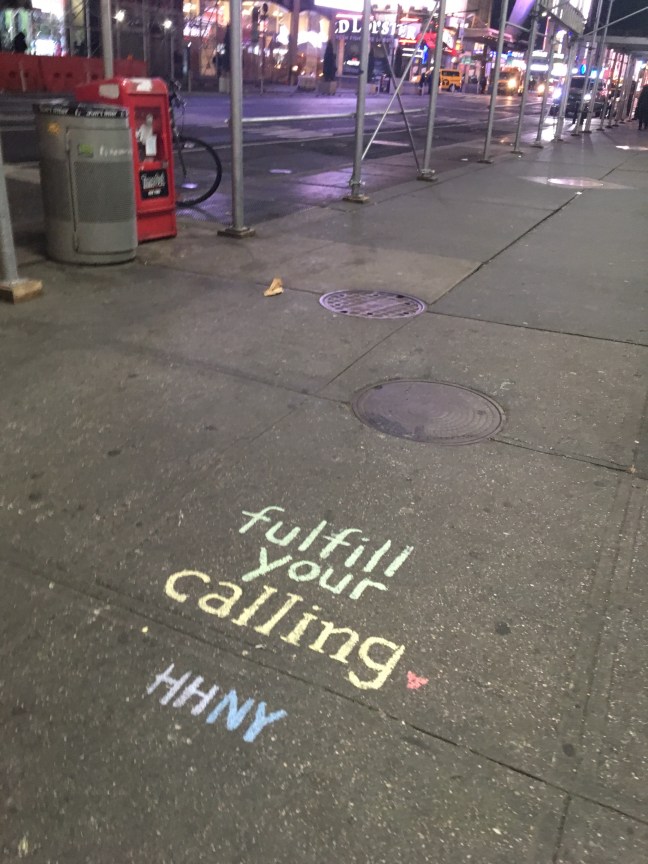
[Photo Credit: Carson Smith. Hans Honschar is an artist who leaves encouraging chalk messages for people to discover throughout the neighborhoods of New York City.]

“How do we live and work as people who are connected to our whole selves?”

This was the very excellent question someone asked me this week.

Of course, none of us has a full, definitive answer to a question as large and expansive as that one, but it’s the kind of question that can sit with us for a while. Maybe it’s the kind of question that asks good questions of us:

What is wholeness? Who are we called to be, and how do we partner our deep-seated callings with the callings of others? How do we embrace our vulnerabilities? How do we give voice to our vulnerabilities and allow them to provide leadership as strengths? How do we give and receive care in relationship and community? How do we cultivate space for healing and wholeness — for ourselves? alongside others? How do we lead with our unique gifts? How do we open ourselves to a sense of the whole within our life and work, even if we have only a glimmer of understanding that we are connected to a vision and sense of mutuality much larger than ourselves alone?

When this expansive question at the top came up (which has now offered a cascade of questions) the two of us were talking about vocation and calling and what it’s like to bring our fullest, particular selves to our living and our work. This was a meaningful conversation that has stayed with me throughout the week.

Today, as I ponder this conversation and these questions, I’d like to place the writings of two authors side by side.

Richard Rohr talks about vocation and calling as the Deep Yes:

“The doctrine of haecceity is saying that we come to universal meaning deeply and rightly through the unique and ordinary, not the other way around, which is the great danger of all the ideologies (overarching and universal explanations) that have plagued our world in the last century. Everything in the universe is a holon and a fractal, where the part replicates the whole. Go deep in any one place and we will meet all places where the divine image is present.”

-And-

“In the moments of insecurity and crisis, ‘shoulds’ and ‘oughts’ don’t really help; they just increase the shame, guilt, pressure, and likelihood of backsliding. It’s the deep ‘yeses’ that carry you through. Focusing on something you absolutely believe in, that you’re committed to, will help you wait it out.”*

MaryAnn McKibben Dana has written a great deal about the concept of Yes-And in improv, applying that vision to our daily living. She recently published a book entitled, God, Improv, and the Art of Living. She also has a blog, and last week, she wrote a piece called, The Joy of Yes-And. I recommend reading all of it. She talks about embracing our limitations and making choices about what is most important to us:

“But too often, our culture looks at people who take a step back in terms of what is lost. Maybe Ohashi will not end up at the Olympics as a result of her choice… [See the piece for this story.] But it’s clear from her performance how much has been gained.

“Sure, sometimes Yes-And is a process of sheer addition, and making it work imperfectly and beautifully. But other times – maybe more often – it’s about subtraction. Clarification. Deepening.”

What does it mean to practice a Deep Yes-And?

There are many ways to answer that question, of course, but I think it leads us back to this question:

“How do we live and work as people who are connected to our whole selves?”

We make the main calling the main calling, whatever that may be for us. We choose it deeply, even as it is most readily choosing us.

But we don’t have this all figured out. How could we? It’s all in process, and we never arrive fully. We just keep adding our yes to the Deep Yes that beckons us, little by little, moment by moment.

Deep Yes-And…

Deep Yes-And…

Deep Yes And…

Renee Roederer

*The two paragraphs from Richard Rohr above come from his daily meditations. I recommend subscribing.

Making Mistakes: My Piece about Ableist Language Was Ableist

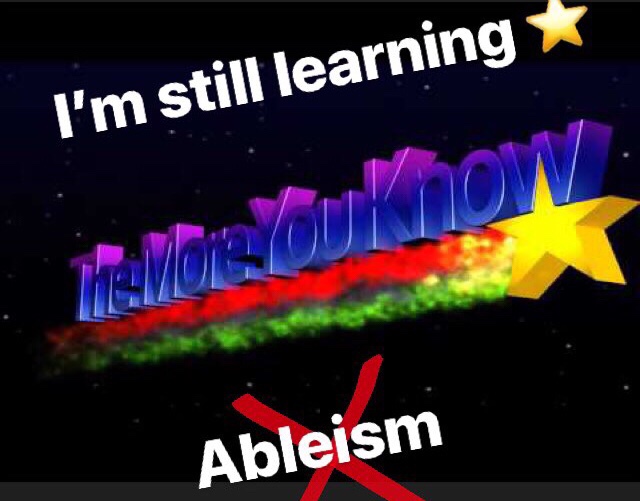
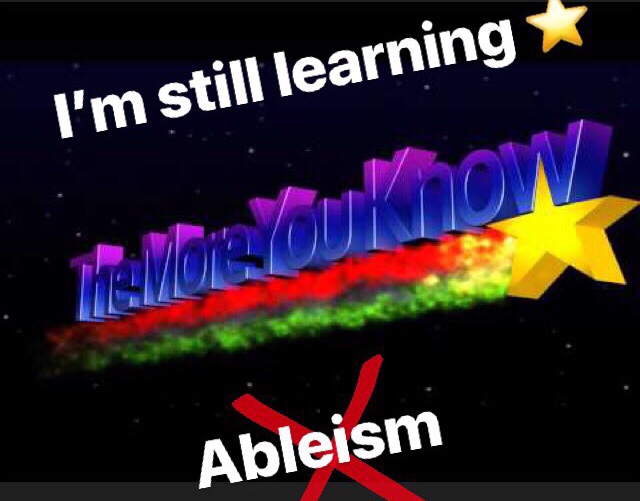
I’m still learning, indeed. And I need to take responsibility when I make mistakes. I made a big one yesterday when I wrote a piece called, Some Thoughts on Ableist Language.

I said some statements that were too broad in their generalizations which led to erasing communities and individuals that prefer identity-first language to person-first language. This is particularly true of the autism community.

Let me get a little more specific:

I started out by saying, “No one is *an* ‘ic'” and then listed a number of words like… an anorexic, a bulimic, an autistic, an arthritic, an asthmatic, a diabetic, an epileptic, a schizophrenic, etc.

It is true that many people in these communities bristle at that kind of language, but “No one is”? What if someone chooses that language?

But here’s where I made my biggest mistake:

I had originally posted these thoughts on Twitter the night before. I had made a tweet that followed this list, which said,

“It’s possible that someone might use this language as a self-descriptor, but it doesn’t mean everyone would want to be named/described in that way. It’s always good to use person-first language.”

Later, when searching for an image to place in the post here, my searching led me to the realization that many people in the autism community reject person-first language and prefer identity-first language.

In other words, many prefer “autistic person” to “person with autism.” The first frames autism as an identity, and the second frames autism as a condition.

So when I placed the language from that tweet in this post, I added,

“Some may also reject the adjective version too. They/she/he is _________(ic). Though some embrace the adjective version as an identity. That’s important to lift up. Others do not, however, and prefer to talk about these as conditions that they have.”

But see what I did there?

I added this, yes, but I had already said, “It’s always good to use person first language.” ‘Always’ is a strong, generalizing word. My second statement about identity language sounds like an afterthought and indicates that person-first language is normative.

Yesterday, an autistic person shared with me that this is ableist and that the autism community “overwhelmingly prefers identity-first language.”

I had used generalizations in ableist ways which erased communities and individuals. I am not in a position to speak for those communities, and I should not erase them with broad words like “always.”

I apologize for this and take responsibility.

And I’ll keep learning.

Renee Roederer

Some Thoughts on Ableist Language

Some thoughts on language and ableism:

People are not *an* ‘ic.’ I’ve been called one of these. (I bristle at it.) At times, I’ve caught myself using a couple of these.

But no one is

an anorexic

a bulimic

an autistic

an arthritic

an asthmatic

a diabetic

an epileptic

a schizophrenic

etc.

It’s possible that someone might use this language as a self-descriptor, but it doesn’t mean everyone would want to be named/described in that way. It’s always good to use person-first language.

No need to say they/she/he is a/an __________(ic). For some, this is reductive and offensive.

Some may also reject the adjective version too. They/she/he is _________(ic). Though some embrace the adjective version as an identity. That’s important to lift up. Others do not, however, and prefer to talk about these as conditions that they have.

They/she/he has __________.

Also, spastic and manic are medical terms. When applied to people or things outside of that context, this is ableist language too. These are not personality traits or feelings of able-bodied people. (Saw this happen yesterday!) No one is ‘spastic’ or ‘manic’ about such-and-such.

There’s lots more to learn. But today, lifting these up.

Renee Roederer

[Important Edit: I made a big mistake in this piece which is itself ableist, particularly in the way I said, “It’s always good to use person-first language.” I have learned that people in the autistic community overwhelmingly prefer identity-first language to person-first language. My generalization erased communities and individuals that prefer to use identity-first language. More about that in a follow-up piece called, My Piece About Ableist Language Was Ableist.]