
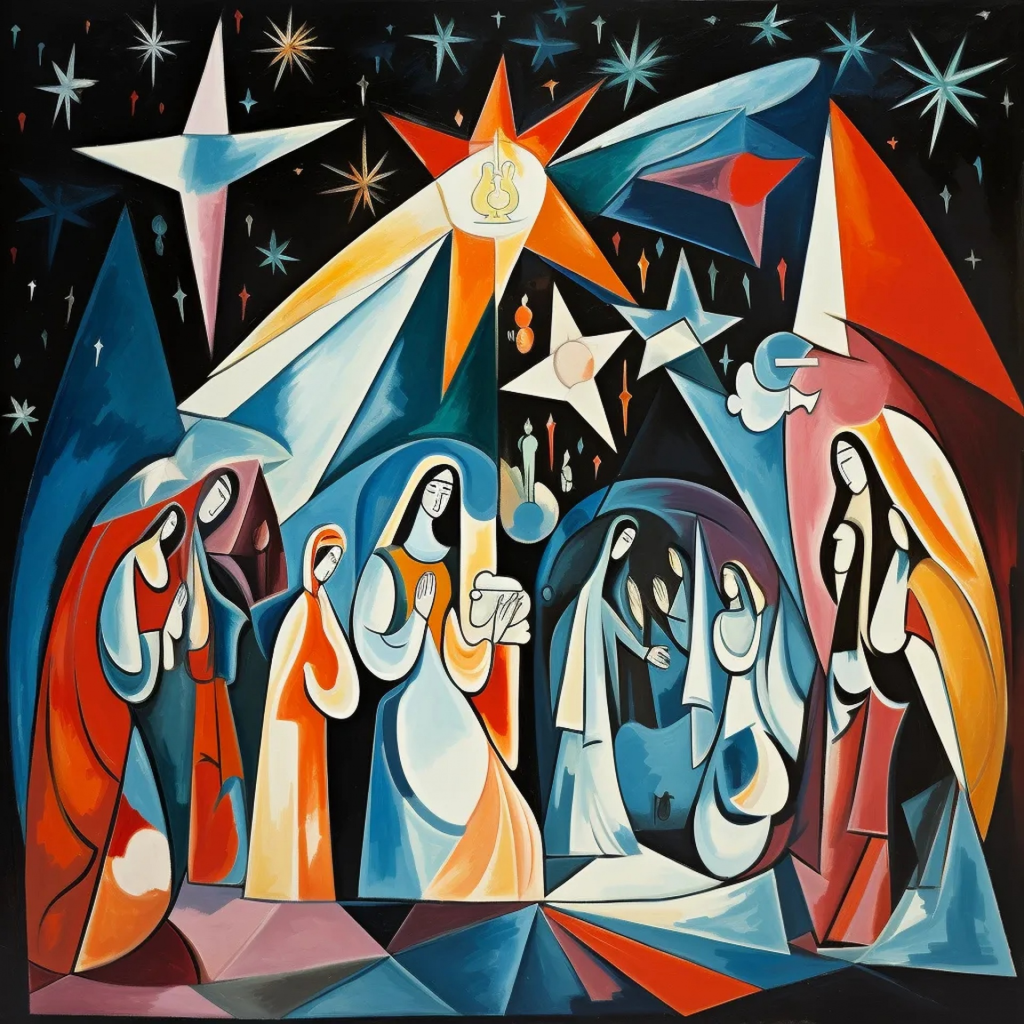
I love singing “O Come All Ye Faithful” on Christmas Eve. Though I suppose it could be sung again any time during the 12-Day season of Christmas, I typically only sing this once per year. It’s wonderful when an organ is leading it loudly in concert with all the voices, or as I experienced this year, alongside a brass ensemble, too.
I did not get to sing the line that typically makes me laugh though. It’s just an absurd line. We didn’t sing that verse.
The verse in question begins with,
God of God, Light of Light…
And then we get to the line in question:
Lo, he abhors not the virgin’s womb!
What a weird thing to say. I mean, we could say anything about this newborn baby, or make great meaning about the Christ, but instead, we have this bizarre exclamation:
Well, would ya look at that! Can you believe this tiny baby actually does not detest with perfect hatred the uterus of his virgin mother?!? How amazing is it that he does not abhor it? Not even one little bit!
Just a wildly weird thing to say. Also, is he supposed to abhor it? Is there like a de facto abhoring that most people would have, but he’s just rising above it? Or are we saying, well, you’d think he’d abhor that womb, but I think that crying baby would rather be back in there!
Who knows.
Instead, like this quote better. Cole Arthur Riley writes,
“For me, the story of God becoming body is only matched by God’s submission to the body of a woman. That the creator of the cosmos would choose to rely on an embodied creation. To be grown, fed, delivered—God put faith in a body. In Mary’s muscles and hormones, bowels and breasts. And when Christ’s body is broken and blood shed, we should hold in mystery that first a woman’s body was broken, her blood shed, in order to deliver the hope of the world into the world.
“We are remarkably material beings. When we speak of bearing the image of God, I believe no small part of that is a physical bearing. You may have heard it said, ‘You don’t have a soul. You are a soul. You have a body.’ I’m not sure exactly where this notion came from, but the sentiment survives. Many of us, in pursuit of the spiritual, become woefully neglectful of the physical. We concern ourselves with a doctrine of salvation that is oriented around one underlying hope: heaven. And our concepts of heaven are often disembodied—a spiritual goal to transcend the material world eternally….
Our tales of Christian escapism lead us to the place where the physical is damned and the immaterial is gloried. Where the only holy things are invisible. How could you expect me to believe this when I’ve met a God who drank from the breast of his creation? [1]
Yes, that’s much better.
— Renee Roederer
[1] Cole Arthur Riley, This Here Flesh: Spirituality, Liberation, and the Stories That Make Us (New York: Convergent, 2022), 57, 58.
 Smuggling Grace