I’ve been at the Public Health Institute in Tulsa this week, hosted by the Epilepsy Foundation of America. Since we’re only together for a few days, we’ve jam-packed our time with a lot of learning, as well as a few opportunities to be social. I remember feeling a bit sad that I wouldn’t have much time to explore the city itself.
Tulsa has some important history.
In the early 1920s, it was home to Black Wall Street, a thriving, self-sustaining Black district filled with businesses, hotels, movie theaters, and luxury shops.
But this was burned to the ground during a devastating act of racial terror between May 31 and June 1, 1921. After false accusations about an encounter between a Black man and a white woman, a white mob descended upon Black Wall Street, looting and burning homes and businesses across roughly 35 blocks and leaving as many as 300 people dead.
This is known as the Tulsa Race Massacre.
For decades, much of this history was erased from larger public awareness and left out of schools and history books, though it continued to live in people’s memories. In more recent decades, survivors, descendants, Black residents, historians, and others in Tulsa have worked to ensure that this history is remembered and honored — including telling its story on the 100th anniversary in 2021.
Yesterday, I stepped outside Langston University, where we are holding our conference. Langston is Oklahoma’s only HBCU and the only HBCU west of the Mississippi River in the United States.
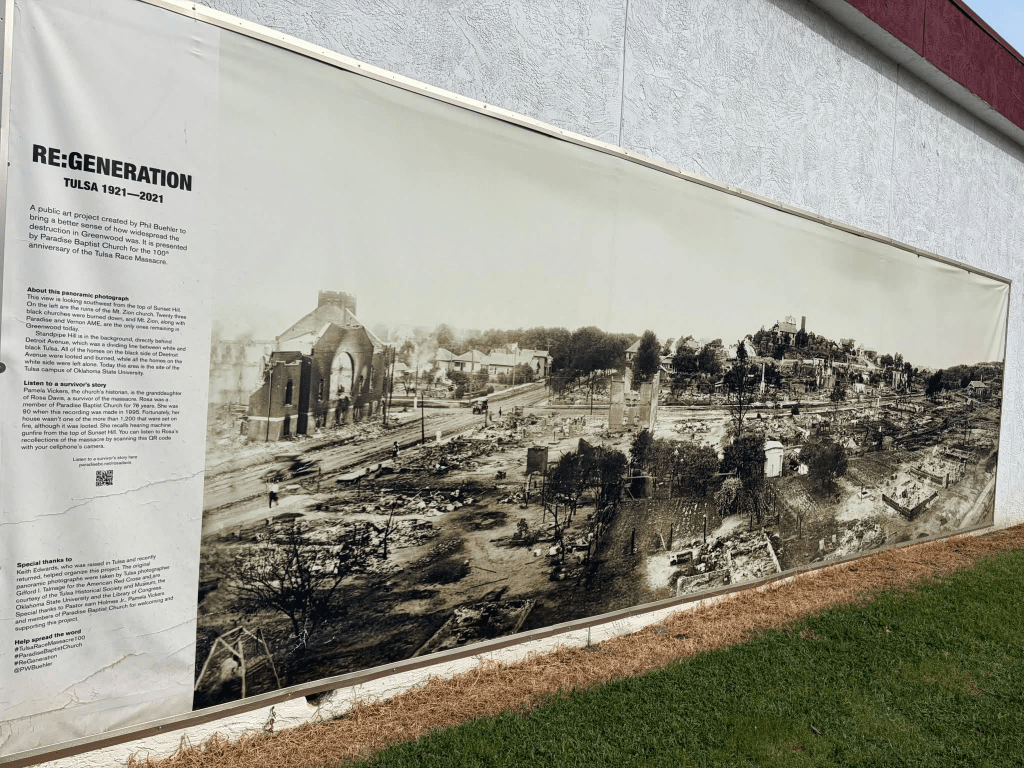
I decided to take a short walk around the surrounding neighborhood. That’s when I saw this photo on the side of Paradise Baptist Church. It shows the aftermath of the massacre, after city blocks had been decimated by fire. I am grateful I stumbled into this.
As I was returning, a woman from the custodial staff saw me and said, “Are you enjoying taking a stroll around Greenwood?”
“I am,” I said.
And I realized that I was on the very land where this had taken place. Greenwood is the neighborhood that was home to Black Wall Street.
I should know more of this history. And I could have — and likely should have — looked it up on a map before coming. But still, I stumbled into it, and I’m glad to honor it in my own way.
I recognize that I am a visitor here, and my knowledge is incomplete. But this history lives in the bones and veins and voices and fears and hopes of descendants who still live here — people whose parents, grandparents, and great-grandparents lived through the most terrorizing night of their lives, along with the fear of not knowing how much more would or could follow.
And if we know this history — or we stumble into it — we should be motivated to right the wrongs and work for equity on the very land that has known the opposite.
—Renee Roederer

