
Anytime I hear anything about the Voyager Mission, I’m amazed. I can’t believe it worked, and I’m stunned that it’s still active.
NASA launched two spacecraft, Voyager 1 and Voyager 2, in 1977 to explore the outer planets of our solar system. They sent back extraordinary images and scientific discoveries from Jupiter and Saturn, and Voyager 2 went on to visit Uranus and Neptune. Both spacecraft eventually traveled beyond the protective bubble created by our Sun and entered interstellar space. Nearly 50 years later, they’re still out there, sending information back to Earth.
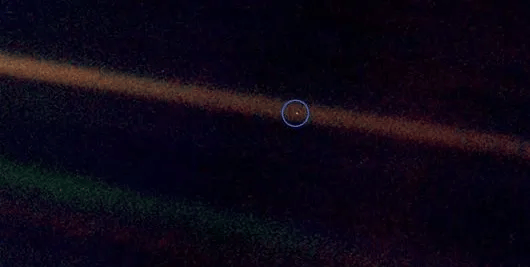
One of my favorite moments in the mission’s history happened in 1990, when scientists instructed Voyager 1 to turn around and take one last photograph of Earth. From 3.7 billion miles away, our entire planet appeared as a tiny speck of light in a sunbeam. The image became known as the Pale Blue Dot, and Carl Sagan’s reflections on it invited us to consider our finitude, our fragility, and our power. I wrote about that moment several years ago, and it still moves me.
And now, this week, Voyager 1 has reached another extraordinary milestone. On November 18, it became the first human-made object to travel one light-day away from Earth. That’s approximately 16.1 billion miles — the distance light travels in 24 hours. In other words, even traveling at the speed of light, a message from Earth now takes an entire day to reach Voyager 1, and another day for a response to return.
Nothing human-made has ever traveled so far. This little spacecraft, launched nearly half a century ago, is still moving through space, still teaching us about the universe, and still connected to the people who sent it on its way.
You can read more about this historic milestone in NASA’s announcement.
This is still worth our amazement.
—Renee Roederer

