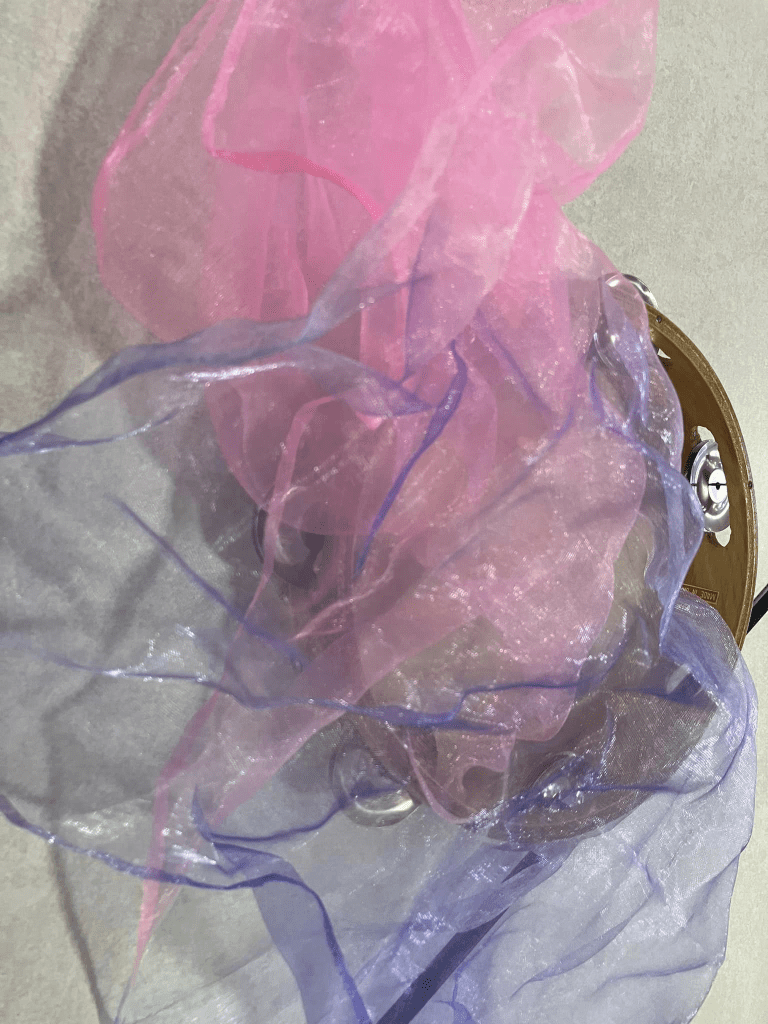
Pink and purple, light-weighted cloth, draped over a tambourine.
In the Parables Community, we call these “spirit scarves.”
Once a month, I have the privilege of leading a spiritual reflection service with a community called Parables. This service is planned with, for, and by disabled and neurodivergent community members.
Have you ever been in a setting where people “Pass the Peace?”
We use these scarves to do the same. We exchange them with one another and invite that act to convey a deep sense of welcome and care. And this is a way to practice accessibility too. People can stay right where they are to exchange the scarves, or they can move around the space. People can hold onto their scarves, or they can exchange them many times with a lot of people. People can say words — “Hello,” “I’m [Name],” “How are you?” or “Peace be with you” — or people can be silent. People can exchange without eye contact, or people can exchange with eye contact.
It’s all welcome. It’s all exchange. It’s all peace. It’s all care.
Over the next few Mondays, I plan to share some resources that will allow us to learn about attachment styles. There are many wonderful YouTube channels, books, blogs, and podcasts on this topic, and I find them to be helpful as we consider how our relationships function, and how they, and we, can grow.
John Bowlby, a British psychologist and psychiatrist, is the pioneer on this research. He discovered that in early life, young human beings develop ways of attaching and detaching to caregivers in infancy and in toddlerhood, and these attachment styles continue to shape their relationships in the future. These patterns show up in all kinds of relationships, but especially in romantic partnerships and family connections, where attachment needs run the deepest and evoke both present emotional needs and past fears (often, unconscious).
There are four primary attachment styles. There is the secure attachment style, and three insecure attachment styles — 1) anxious preoccupied, 2) fearful avoidant (also sometimes called disorganized or anxious-avoidant), and 3) dismissive avoidant.
— People who are anxious preoccupied value closeness and tend to fear abandonment. — People who are dismissive avoidant value their space and independence and tend to fear engulfment in other people’s needs. — People who are fearful avoidant have a mix of both anxious and avoidant tendencies, and they move back and forth between these needs and fears. For this reason, in relationships, they can move closer and farther away intermittently (literally and/or internally where there is a lot of back and forth second-guessing in relationships).
Two important things to remember: — While we all have a primary attachment style, each of these styles can be a spectrum too. People can simply lean anxious preoccupied, with fears triggered in times of stress. Or people can be dismissive avoidant, impacted by certain fears but still connected to relationships that are meaningful to them, rather than being deeply detached all the time. Or people can be fearful avoidant, but more secure because they’ve become aware of their patterns and worked to meet their needs and heal core wounds.
— No matter what attachment style we developed in early life, we can all work toward healing these fears and patterns. We can work toward having a secure attachment style. Sometimes this is called earned-secure (healed and developed in adulthood).
My favorite YouTube channel on attachment styles is Thais Gibson’s The Personal Development School. It’s also one of my favorite YouTube channels overall. So many wonderful things to learn!
Here is her introductory video about the four major attachment styles:
When I woke up yesterday, we only had one degree. One, little degree outside. So cold!
We’ve also had snow and ice. It was shockingly mild from November to mid-January (equal parts disturbing and comfy) but winter is here in earnest, at least this week.
During one of the support groups I lead, people shared these lovely stories about what it was like to have good neighbors during snowstorms. It made me grateful for my neighbors as well. One person loves to use a snow blower to clear sidewalks and driveways. (So kind!) Another likes to make us hot toddies. (I’ll take them!) We know we can count on each other.
I’ve also lived in some places where I didn’t even know neighbors’ names. This is the kind of thing that has to be cultivated, and it typically starts when one person receives from another. It makes a big difference. Plus, it’s fun to know neighbors.
I recently stayed at a friend’s apartment for a few days, and in so many directions where I looked, there were sweet, little messages and reminders of what matters. I look in the mirror, and see a little sign that says, “You’re beautiful!” I turn a corner and see, “You’re terrific!” I go to wash my hands and am reminded of how precious and capable they are: “Please wash your precious, capable hands.”
There were words of poetry, quotes, and reminders to uphold and honor the lives of people who are most frequently marginalized in our country.
Reminders everywhere.
What reminders do you need? If you need to, write them down and display them. At the very least, tell yourself often. And tell yourself beautifully.
Thanks to the Nasa Juno Probe, we have the closest images we’ve ever taken of Jupiter:
NASA image, Jupiter
Thanks to the James Webb Space Telescope, we have images like this one below. From just a tiny sliver of observed space, we can see that every one of these dots is a galaxy… each with roughly 100 billion stars, and… each star has at least one planet. How could we possibly be alone?
JWST, Galaxies
It causes us to wonder. I like what astronomer Dr. Caitlin Casey says,
“If you look back to the Big Bang, the dark ages, the cosmic dawn, the creation of stars, galaxies, planets – we are a consequence of this. We can’t see ourselves as being apart from this. We are of this. Humans, trying to understand the universe, are really the universe trying to understand itself.” — Dr. Caitlin Casey, Vox’s Unexplainable Podcast
Intentional gratitude practices can make a huge impact on our mental and physical health. Have you ever tried something like this? Perhaps keeping a short gratitude journal, or rehearsing moments of gratitude in your own mind before going to bed? Perhaps sharing your gratitude with another person?
A study designed by Dr. Martin E.P. Seligman, psychologist at the University of Pennsylvania, invited 411 people to deliver a letter of gratitude to someone who they had never thanked for their kindness, and participants exhibited such a large increase in the study’s happiness scores that the boost of that benefit could be noticeably measured for a month.
The study didn’t measure the happiness score of the person who received the letter, but I wonder how its impacts may have lingered meaningfully as well.
If we lead with gratitude, there are benefits for ourselves and those around us.