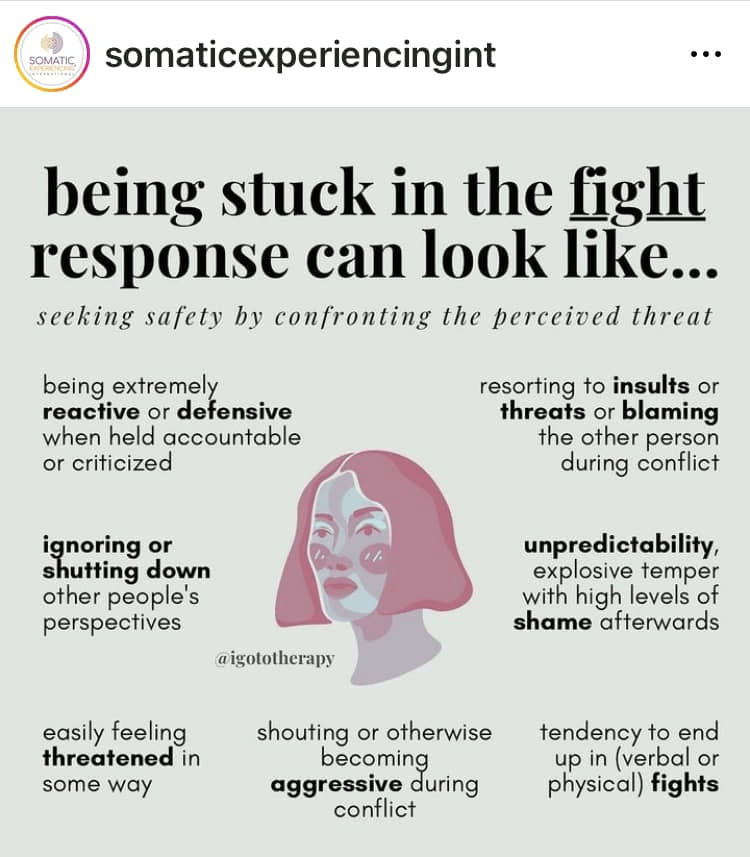
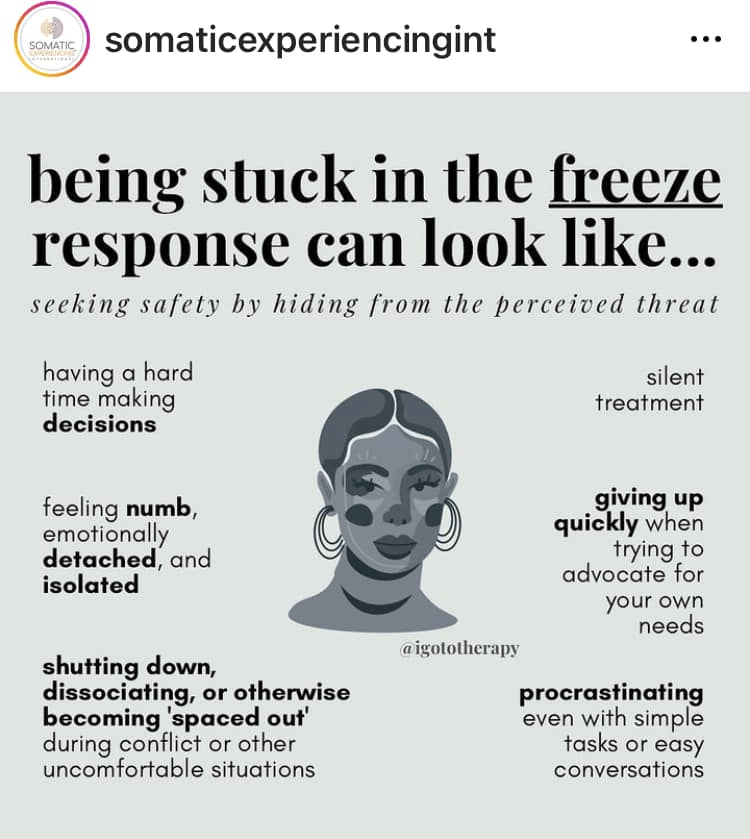
Trauma often reveals itself as a cluster of reactions, rather than a set of memories.
On Instagram, @Somaticexperiencingint and @igototherapy shared these images about fight, flight, freeze, and fawn reactions in relationships. We might see these emerge in friendships, romantic relationships, among family members, or within workplaces.
As I was walking into the grocery store, a person asked me, “Would you like to buy a paper?”
This man was selling GroundcoverNews, a local newspaper. Their mission statement reads, “Groundcover News exists to create opportunity and a voice for low-income people while taking action to end homelessness and poverty.” We can find folks selling the paper in a number of locations, often downtown on street corners.
I answered him, “Yes. But would it be okay if I did that on the way out?”
“Sure thing,” he said.
I wanted to get some cash when I was checking out. And that’s what I did. I used my debit card to get some cash back, and I brought it back outside.
I handed it to the man, and I said, “I don’t need a paper, but I can give this.”
In all honesty, this was because I was unlikely to read the paper, at least beyond the front cover. Not because it isn’t worth reading, by the way. It is, and there’s some good stuff in there. I just know myself, and I get busy. Why take the wares off of this person if I’m not going to read it? Doesn’t that take one more that he then can’t sell to someone else?
“Actually, I’d like it if you’d take the paper,” he said, “It makes me feel like I’m doing something.”
“Oh, you are. Sure,” I said.
He handed me two.
“Thanks for giving me two,” I added as I began to walk away.
“Well, you bought them.”
I walked to my car, and I thought, Oh… Renee. Sure, I was trying to save his papers so he could keep selling them, but in handing this guy some cash, I was undercutting the fact that this guy has a job. He felt more dignity in selling the paper. Plus, wasn’t I kind of dissing the work that went into the paper?
And his answer was, “Duh, well you bought two.”
This is my confession today: How easy it is when trying to support others, and in trying to “do good,” to just keep the same stratified roles that a paper like this is trying to bust. “I don’t need your paper… but you need my money.” That’s not what I was thinking internally, but that was absolutely the impact. And that’s gross.
A flower growing in the crack of a sidewalk. Wikimedia commons.
An Invitation Oriah Mountain Dreamer
It doesn’t interest me what you do for a living. I want to know what you ache for and if you dare to dream of meeting your heart’s longing.
It doesn’t interest me how old you are. I want to know if you will risk looking like a fool for love, for your dream, for the adventure of being alive.
It doesn’t interest me what planets are squaring your moon. I want to know if you have touched the centre of your own sorrow, if you have been opened by life’s betrayals or have become shrivelled and closed from fear of further pain.
I want to know if you can sit with pain, mine or your own, without moving to hide it, or fade it, or fix it.
I want to know if you can be with joy, mine or your own; if you can dance with wildness and let the ecstasy fill you to the tips of your fingers and toes without cautioning us to be careful, be realistic, remember the limitations of being human.
It doesn’t interest me if the story you are telling me is true. I want to know if you can disappoint another to be true to yourself. If you can bear the accusation of betrayal and not betray your own soul. If you can be faithless and therefore trustworthy.
I want to know if you can see Beauty even when it is not pretty every day. And if you can source your own life from its presence.
I want to know if you can live with failure, yours and mine, and still stand at the edge of the lake and shout to the silver of the full moon, ‘Yes.’
It doesn’t interest me to know where you live or how much money you have. I want to know if you can get up after the night of grief and despair, weary and bruised to the bone and do what needs to be done to feed the children.
It doesn’t interest me who you know or how you came to be here. I want to know if you will stand in the centre of the fire with me and not shrink back.
It doesn’t interest me where or what or with whom you have studied. I want to know what sustains you from the inside when all else falls away.
I want to know if you can be alone with yourself and if you truly like the company you keep in the empty moments.
Image Description: A purple speech bubble says, “HI!” in white letters.
I facilitate several groups in my work role at the Epilepsy Foundation of Michigan, and this is one of my favorite aspects of the job. Each group has its own character, and I enjoy the ways they collectively create the experience. Four groups meet over Zoom, and one meets over a conference call. This last group enjoys connecting over the phone. It was the first group we ever organized, and it has our largest participation. Though a conference call may seem behind the times for this era, they enjoy it like this, and they make it a deep and meaningful opportunity for connection. In fact, this group calls itself a chosen family, and its members show up in each others lives in beautiful ways, including rhythms of calling each other to check-in throughout the week.
All of this is lovely. And as I shared, full of character: There’s a fun, silly practice that this group does week to week, and I’ve been pondering this sweet, simple act of care. When people are signing into the conference call, I can see who is in process of joining on the computer screen. Their name emerges on the screen about five seconds before we hear the beep announcing their arrival. In that time, I’ll tell the people already on the line, “Here comes [Name].”
And we wait in silence.
BEEP.
“Hi, [Name]!” says everyone in unison and with gusto.
We call it surprise-partying.
Depending on when they emerge, [Name] gets somewhere between 5-15 people greeting them playfully and enthusiastically.
And this is a small thing, but in this era in which we live, it can feel so lovely to be greeted with joy in a way that genuinely conveys, “Everyone is glad that you are here.”
This is my personal phrase lately: “Receive from everything, share from everything.”
It’s also how I’m trying to live in these days.
There are times of upheaval, both personal and collective, when we rightfully ask ourselves, “What should I do? How should I act? How are my neighbors and my community calling to me? What do I need? What do my loved ones need? What do my neighbors need?”
We might ask these questions out of urgency. We might ask these questions out of anxiety. We might find ourselves zooming out of the moment, getting perspective, yes, but also distance, asking these questions hypothetically within the big picture rather than dealing with the reality of the day-to-day picture.
Within it all, my personal phrase is, “Receive from everything, share from everything.”
The truth of the matter is… change happens in the day to day, mundane aspects of life, and above all, change happens through a web of relationships. There are times, absolutely, when our daily, mundane lives need to be disrupted with cries for large-scale change.
We activate change, however, in the daily mundane aspects of life and above all, through our relationships. We need to build change, not hypothetically in some conceptual big picture, but in the communities we are already in, allowing those very communities to expand, transform, and transform us.
Receive from everything, right where we are — receive care, receive messages, receive love, receive challenge, receive questions, receive resources, receive conflict, receive imagination, receive lament, receive hope, receive connection, receive relationship.
Share from everything, right where we are– participate in being a catalyzer, share care, share messages, share love, share challenge, share questions, share resources, share conflict, share imagination, share lament, share hope, share connection, share relationship.
We can participate in building change when we act, when we share, in our daily, mundane lives through the web of our relationships.
Let life catalyze us. Participate in catalyzing change.
Bryan Stevenson, Executive Director of the Equal Justice Initiative
Who are the people who influenced the people who influenced you?
We might call them the GrandInfluencers. I like to think of this question and these people from time to time.
We are connected more broadly and expansively than we are always aware. Whether we know their names or not, there are people who have had a major impact upon the shape and direction our lives because they had a major role in shaping the people who most influenced and inspired us.
I found myself reflecting on this several years ago when I heard Bryan Stevenson speak in Ann Arbor. Bryan Stevenson was presented with the Wallenberg Medal at the University of Michigan for his vision and service, and afterward, he gave the Wallenberg Lecture.
Bryan Stevenson is the founder and Executive Director of the Equal Justice Initiative, an organization committed to ending mass incarceration in the United States, protecting human rights and dignity, and challenging racial and economic inequities. Within the large, crucial vision of this work, Stevenson has spent decades entering personal relationships with the people he represents in court. They have impacted his life, as he has impacted theirs.
His lecture was filled with stories of human connection as he challenged us to do justice in our neighborhoods, nation, and world and to change our narratives about race and poverty.
He opened the lecture first with a story about his Grandmother. He grew up calling her Mama. When Stevenson was a child, she would give him enormous hugs, and when she finished, she would ask, “Okay, can you still feel me hugging you?” If he said no, she would do it all over again. This became one of their playful rituals, and Stevenson came to know that he was loved and absolutely cherished.
As she was dying, her last words to him were, “Can you still feel me hugging you?”
Beautiful. It’s clear that he does.
She shaped so much of his vision and calling. She was the daughter of enslaved people, and she taught him about the terror and trauma of slavery. She also filled him with a sense of love and worth. Stevenson has been addressing slavery in its many forms throughout his life, protecting human lives, standing up to false narratives, and telling the truth — both about our national history and about human dignity.
In many ways, this started with his Grandmother. Unknown to many future clients, she impacted their lives — and in many cases, affected their freedom — through the formation of Bryan Stevenson.
And Stevenson told us stories about some of these clients. Unknown by name to us, they have impacted the formation of Bryan Stevenson as well, and their stories are now challenging the narratives and power structures of mass incarceration.
We are connected more broadly and expansively than we are always aware.
Who influenced the people who influenced you? Who are your GrandInfluencers?
We honor them with our lives by being ourselves. And though we cannot always predict the direction entirely, when we demonstrate love to others and are present in formational ways, we will embolden and empower people we will never meet.
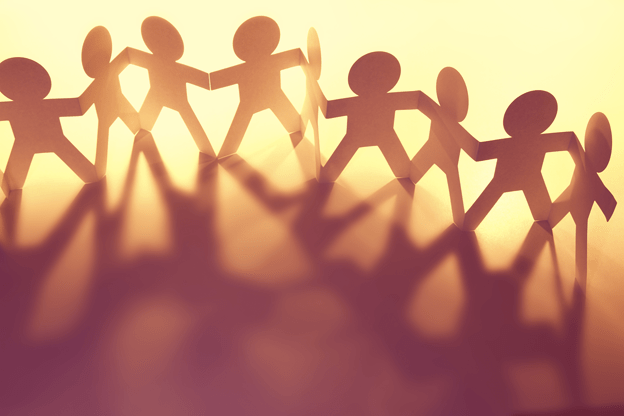
Image Description: Paper cut outs of people all connected, as if they are lining up and holding hands. There’s a light shining from behind them, casting an orange shadow. Public domain.
Sometimes when I’m gathered with a group of people, either in a physical space or on a Zoom screen, I’m aware that the influence of additional people is present during that time. Embedded in everyone’s relationships, there are hidden conflicts, attachments, and places of grief that influence that time. But most often, I like to think about the meaningful, formational influences that are present.
There are people who have participated in fashioning who we are along with our values, hopes, and even mannerisms or ways of phrasing our words. Their influence is in that space too because these people are part of who we are. They have “particularized us;” that is, they have made us more specifically who and how we are. When we are present, their influence is present too.
And this means when we are connected to people in a physical space or on a Zoom screen, we have the occasion to interface with the influences of others too. We are impacted meaningfully by people we cannot see and in most cases by people we have not known ourselves.
When we are aware of people beyond us, we feel more connected, and often, we can be inspired. Consider this post an invitation to reflect intentionally about whose influence is also in the room. And if we know people well enough, we might even ask.