


-Photos by Renee Roederer
“I don’t know what you all want trans people to do. I remember growing up in elementary school and having that one kid in class whose body didn’t seem to match his behavior in our eyes, and how they were never spared a single second of humiliation, threats, bullying. Even teachers wouldn’t stand up for them when they saw this stuff happening. If another kid stood up for them, they were bullied too…
“So what do you all want to see trans people do? Because to see someone bullied, harassed, and threatened — told that they were too feminine, they’d never be a man — only to transition and be told they could never be a woman, makes it seem like you don’t want them to be.
“I understand the whole concept makes you uncomfortable. I was socialized in the same world you were. But there are people who are going through some thing that you don’t understand. And I don’t understand it either, but it’s not for me to understand. It’s enough for me to know that people have been subject to harm their entire lives just for trying to be the most authentic version of themselves in ways that I’ve taken for granted by entire life. So it’s not too much for me to stand in solidarity with them or applaud them when they break barriers, because it’s taken an immense amount of courage just to be here.” — Jamyle Cannon
The bills targeting trans youth, their parents, and drag are an emergency.
If you’ve read the stories — the ones people claim to revere —
It’s so easy to imagine Jesus eating with the Drag Queens.
It’s so easy to imagine Jesus saying,
“Let the Trans Youth come to me.”
It’s so easy to imagine him telling us,
“Don’t throw those stones.”
It’s so easy to imagine him telling us,
“Love your neighbor as yourself.”
It’s so easy to imagine him telling us,
“What you do these, you do to me.”
What is that sacred in-between? That space right before death where powerful things seem to happen?
The truth is, I don’t know.
Is it a new reality coming into being? Is it simply (but still, amazingly!) the human brain giving a euphoric experience at the end of life? Is it a liminality between what has been and what will be? Is it an expansion of time — either in reality, or perhaps, in a beautiful illusion during a near-death state?
I don’t know. All I know is that I find it to be comforting.
I mean this: Sometimes, when people near death, they rally quite unexpectedly and receive a burst of strength that seems unexpected. Some appear to experience joy. Or in a last bit of consciousness in their bodies, some experience the presence of people who have died before them.
Before she died, my grandmother Ruby was unconscious and on a ventilator. After the ventilator was removed, she died pretty quickly. But right at the end, she suddenly opened up her eyes, looked up and smiled, and a couple tears dripped down her cheek.
I don’t know what that is, but I find that to be comforting.
I’ve also known of situations where people have spent whole days moving back and forth between conversation with people who are in the room and the next moment, announcing they could see someone from the earlier part of their life. It seemed that everyone was present at once.
I don’t know what that is, but I find that to be comforting.
In pondering this, I don’t mean to put a silver lining on death. I know these kinds of things can be hard to celebrate when loss is recent and grief is acute. But at the same time, it’s all such a mystery, and perhaps these kinds of moments can give some solace too.
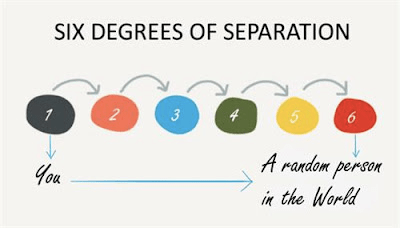
A friend of mine recently said this:
Wouldn’t it be great if we could walk around in the world, and every time we see someone or pass someone, a little number would appear, telling us how many degrees of separation are between us? Then if we wanted to, we could try to figure out who we know in common?
That would be really fun. And I bet we’d be shocked at how many 2s and 3s there would be.
–Renee Roederer
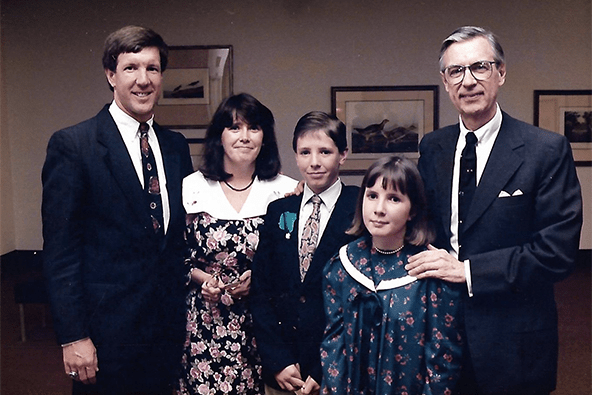
A reading recommendation for your morning:
How Mr. Rogers Saved My Life by Beth Usher

When we were closing up a Zoom, a wise, sage elder who I love and respect said,
“Can I say something as we finish?”
She then quoted Belva Davis, the first Black woman to become a news anchor on the West Coast.
“Don’t be afraid of the distance between your dreams and reality.”
I sat with that quote, and I knew that multiple people on the screen were applying her words to situations in their lives. So today, I want to pass those words onto you if they resonate with anything in particular:
“Don’t be afraid of the distance between your dreams and reality.”
–Renee Roederer

Spring is in March, and
Today is March.
🙂