Image Description: Within a blue and white, splotchy background, the quote reads, “Trauma comes back as a reaction, NOT A MEMORY.” — Bessel Van Der Kolk
Fight, Flight, Freeze, Fawn, Dissociation, Depression, Anxiety, Numbness, Overwhelm, People-Pleasing, Overwork, Somatization, Hypervigilance, Avoidance, Insomnia, Inability to get out of bed, Difficulty being with others, Difficulty being alone,
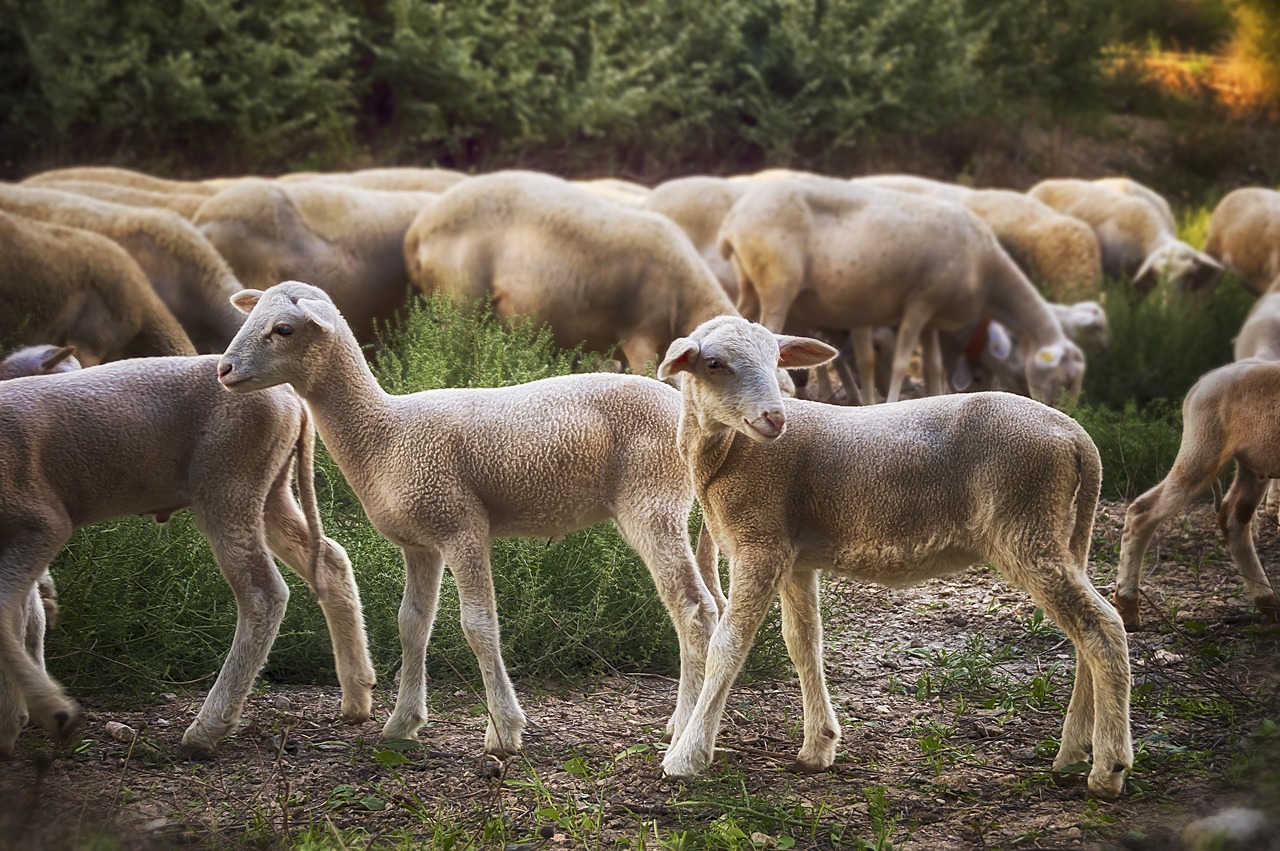
Image Description: A group of lambs. Some are eating grass. Some are looking around. Public domain image.
If you’re feeling stressed in any way, I just want you to know about this thing that happens. I want you to imagine it and smile.
I have a friend who lives on a farm where they raise sheep. And every night before sunset, all of this year’s lambs, who are now functionally tweens, get together in a little tweeny bopper gang and run around the farm en masse. It’s a thing they do.
As they near dusk, they just get the urge to be with their peers and exert their energy in a collective romp around all the grounds of the farm. A little gang. Of tweeny bopper sheep. Running around together. In the joy of adolescence.
I just want you to know about these tweeny bopper sheep. I want you to know that this happens every day.
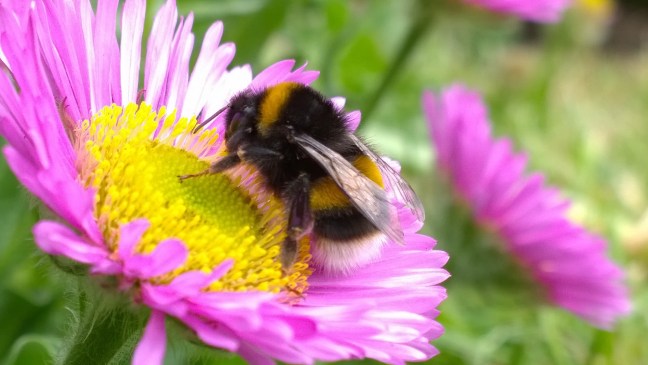
Image Description: A bee collecting nectar from a pink flower.
Bees bumble from flower to flower, using the navigation of bright colors to bring them to life-giving nectar. They collect it and covert it to honey to care for their young, and by extension, the whole hive.
But they have no idea about something else. . .
They have no idea they are pollinating the world’s food supply.
It helps me to remember that. The lives of bees are already so intricate and complex even in what they do intend, but beyond that, their work yields more life and complexity than they know.
Maybe this can remind us:
Individually, and especially collectively, our best intentions, our best connections, our best work, our best loves, and our best visions may yield more life and complexity than we know too.
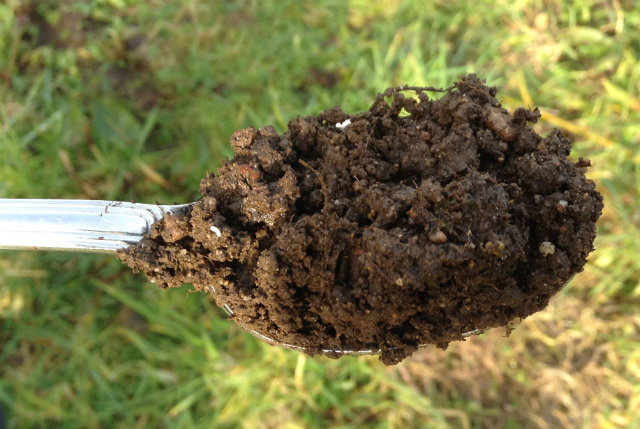
Here’s a mind-blowing fact: There are more living organisms found in a single teaspoon of soil than there are people on the earth.
More than 7 billion living organisms. In just one spoon-full.
That’s incredible.
And like us, every organism in the soil is supported by the sun, a burning sphere of hot gas, fusing its energy 93 million miles away from us. This means our lives are sustained by an
enormous, far-away source of heat and light
and
tiny, nearby creatures, so numerous that we could barely begin to count them.
There are always more forces sustaining us than we can easily see.
So how much more?
In the earth? In the Spirit? In the dreams? In the relationships?
Did you know that every time we take a step, we have about 300 miles of mycelium stretching below the surface?
Mycelium are the highly connective, thread-like strands of fungi that do so much to transform our world. They help plants communicate and spread nutrients. They transform the ecosystem.
Here’s a great Ted Talk by mushroom expert, Paul Stamets: “6 Ways Mushrooms Can Save the World.” Enjoy!
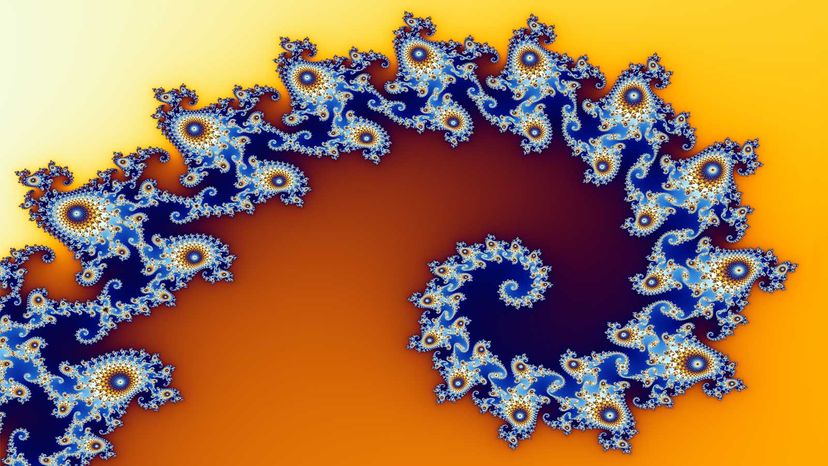
This partial view of the Mandelbrot set, possibly the world’s most famous fractal, shows step four of a zoom sequence: The central endpoint of the “seahorse tail” is also a Misiurewicz point. WOLFGANG BEYER/(CC BY-SA 3.0)
This week, I’ve been listening to Emergent Strategy: Shaping Change, Changing Worlds on audiobook, read by its author adrienne maree brown. The book opens up analogies to us through biomicry, inviting us to learn from nature-inspired innovation and organize our human living, loving, and changing through these patterns of nature.
Today, I’d like to share a quote about fractals. We often live in patterns: The small mirrors the large. Likewise, the small can shape and change the large. If we want to change big things, we can start small and let our largest values show up in our small, day-to-day interactions, especially through our relationships. If we want liberation, love, wholeness, and interdependence to be lived on the large scale, we must practice it as lived right where we are in the relationships we have and in our day to day living.
adrienne maree brown says,
“A fractal is a never-ending pattern. Fractals are infinitely complex patterns that are self-similar across different scales. They are created by repeating a simple process over and over in an ongoing feedback loop.
“How we are at the small scale is how we are at the large scale. The patterns of the universe repeat at scale. There is a structural echo that suggests two things: one, that there are shapes and patterns fundamental to our universe, and two, that what we practice at a small scale can reverberate to the largest scale…
“This awareness led me to look at organizations more critically. So many of our organizations working for social change are structured in ways that reflect the status quo. We have singular charismatic leaders, top down structures, money-driven programs, destructive methods of engaging conflict, unsustainable work cultures, and little to no impact on the issues at hand. This makes sense; it’s in the water we’re swimming in. But it creates patterns. Some of the patterns I’ve seen that start small and then become movement wide are:
— Burn out. Overwork, underpay, unrealistic expectations. — Organizational and movement splitting. — Personal drama disrupting movements. — Mission drift, specifically in the direction of money. — Stagnation — an inability to make decisions.
“These patterns emerge at the local, regional, state, national, and global level — basically wherever two or more social change agents are gathered. There’s so much awareness around it, and some beautiful work happening to shift organizational cultures. And this may be the most important element to understand — that what we practice at the small scale sets the patterns for the whole system.
“Grace [Lee Boggs] articulated it in what might be the most-used quote of my life: “Transform yourself to transform the world.” This doesn’t mean to get lost in the self, but rather to see our own lives and work and relationships as a front line, a first place where we can practice justice, liberation, and alignment with each other and the planet.”
Image Description: The words “Yes” and “No” written on a green chalkboard. “No is underlined. Public domain image.
It’s a new month.
This month, I’ve decided to reflect upon, choose, and act upon what it means to say, “No.”
This might mean… — saying no to tasks that aren’t best for us to do, — saying no to what brings down our energy, — saying no to beliefs that no longer serve us, — saying no to narratives (external, internal, or cultural) that are painful distortions, — saying no to injustices, — saying no to systemic ways of doing harm, — saying no to old patterns we no longer want, — saying no to doing too much, — saying no to unreasonable expectations, — saying no to… (fill in the blank)
And I’m also going to reflect upon, choose, and act upon this realization: When we say “no,” to some things, we are making way to say “yes” to other things.
We are making space for our best affirmations, intentions, and priorities.
A snowy landscape with the sun rising. Public domain image.
I’ve written about this before, but it’s on my mind again this this morning, so I thought I’d share it once more. I love a particular quote from Frederick Buechner.
This quote has been voiced during milestone events in my life and the lives of people I love. I first heard it when a loved one spoke it aloud to frame my ordination service (that was so meaningful). I have voiced it when I’ve officiated weddings. I wrote it at the beginning of someone’s commencement letter.
There’s something special about this because the quote has become communitied. Ordination services, and weddings, and commencements. . . A whole bunch of people in my wider community know this quote and hold it dear. Here it is:
In the entire history of the universe, let alone in your own history, there has never been another day just like today, and there will never be another just like it again. Today is the point to which all your yesterdays have been leading since the hour of your birth. It is the point from which all your tomorrows will proceed until the hour of your death. If you were aware of how precious today is, you could hardly live through it. Unless you are aware of how precious it is, you can hardly be said to be living at all.
Yes, this is great for milestone days.
But also. . . Frederick Buechner didn’t write this about milestone days. His point is that every day — every single today — is this unique. Every day is a hinge moment. Every day is precious.
So every day this week, I’ve said this quote aloud first thing in the morning. I’ve invited this to frame my days. It doesn’t mean that every day is easy. I’ve actually waded through some challenges this week. It just means that every day is particular. Every day has value. Every day can teach us.
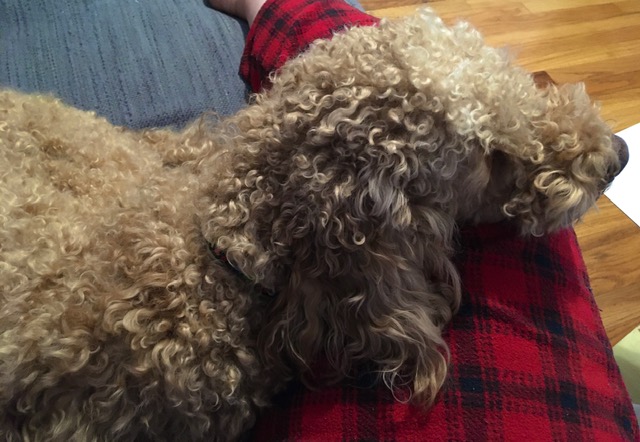
Image Descriptions: Two pictures of a golden doodle resting his head on my leg. I’m wearing red and black plaid pajama pants.
Sometimes, I get to watch this little buddy. He’s my friend’s golden doodle pup, and he’ll be with me this weekend. When he stays with me, I notice this:
He’s nearly always aware of me. He follows me around the house. He watches me. He lies at my feet. He explores the house, sniffing things, but then he looks at me here and there to anchor and orient himself.
It makes me wonder…
To what… to do I orient myself? What am I aware of? What’s in my consciousness? Who and what are my anchors? Who and what do I attune toward?