mage Description: Geese flying in a V formation. Public domain image.
That moment when you awaken to the sound of geese flying over, and you think peacefully, ah, yes, Mary Oliver… That’s right… You don’t have to be good…
Then three minutes later, you hear giggidy jillion more fly over, and it sounds like an utter symphony of clown horns.
And you lose it with laughter.
Good morning, everyone. YOU DON’T HAVE TO BE GOOD.
Image Description: Geese flying in a V formation. Public domain image.
Earlier this week, I was on a call when someone read aloud Mary Oliver’s poem, Wild Geese. I thought I would share that here if you could use any part of this message today.
Wild Geese by Mary Oliver
You do not have to be good. You do not have to walk on your knees For a hundred miles through the desert, repenting. You only have to let the soft animal of your body love what it loves. Tell me about despair, yours, and I will tell you mine. Meanwhile the world goes on. Meanwhile the sun and the clear pebbles of the rain are moving across the landscapes, over the prairies and the deep trees, the mountain and the rivers. Meanwhile the wild geese, high in the clean blue air, are heading home again. Whoever you are, no matter how lonely, the world offers itself to your imagination, calls to you like the wild geese, harsh and exciting— over and over announcing your place in the family of things.
Image Description: Two hands come together and make the shape of a heart. The light of the sun is shining through it.
Never underestimate the power of connections.
This is something I tell myself often. When I say this, I’m not talking about networking or schmoozing. I’m simply talking about the power of being connected in relationship.
I’m talking about building awareness of one another. Knowing names. Introducing people and deepening friendships. Living in kinship. Understanding the stories people carry. Engaging with the giftedness people have to offer. Living in awareness of needs.
Hugh Hollowell of Love Wins Ministries, a community of care and presence with people experiencing homelessness, often says, “The opposite of homelessness isn’t housing. The opposite of homelessness is community.” People often fall through the cracks because they do not have a community deep and wide enough to hold them up in a time of crisis.
So never underestimate the power of connections.
You never know how someone’s story might connect to someone’s story.
You never know how someone’s presence might connect to someone’s need.
You never know how someone’s awareness might increase empathy, solidarity, and action.
Introduce people. Cultivate community space. Learn more about people around you. See what commonalities you might find. Because when we do all of these things, we create the conditions that make support possible — sometimes in ways we haven’t yet imagined.
“If we have no peace, it is because we have forgotten that we belong to one another.” -Mother Theresa
When we view the many societal difficulties of our age, we often encounter systemic complexities that can be challenging to map, let alone unravel. Where do we start? How do we engage? How do we connect with others, share our experiences, and hear testimonies from those whose life journeys are uniquely different from our own? When we ask these questions, it is important to return our awareness to a foundational conviction: We belong to one another. With eighty-three years of experience between them, the Interfaith Council of Peace and Justice (ICPJ) and the Interfaith Round Table of Washtenaw County (IRT) have served as two, dynamic interfaith community organizations within Washtenaw County. Amidst generations of service, these organizations have invited people of faith and conscience to expand how we belong together. Through compassionate community conversations and social justice organizing, IRT and ICPJ have shaped the landscape of belonging within Washtenaw County.
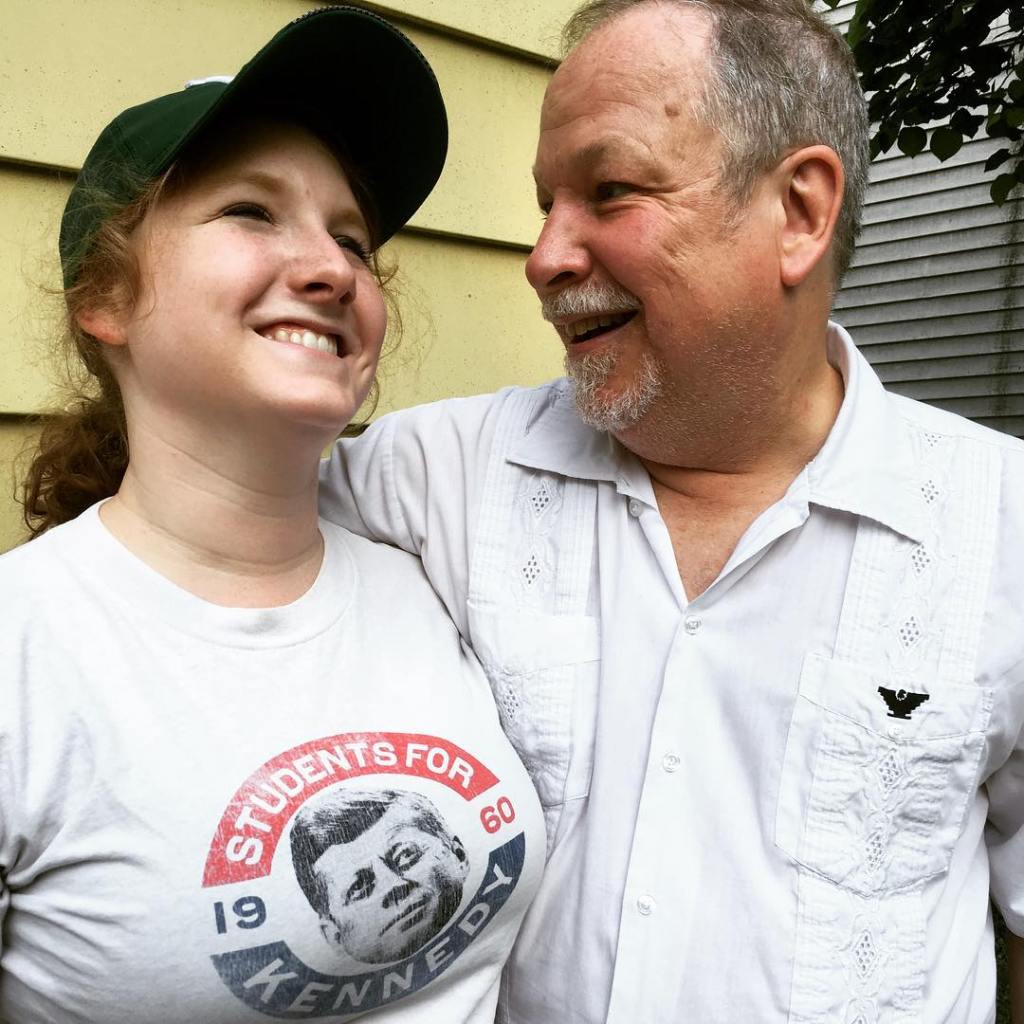
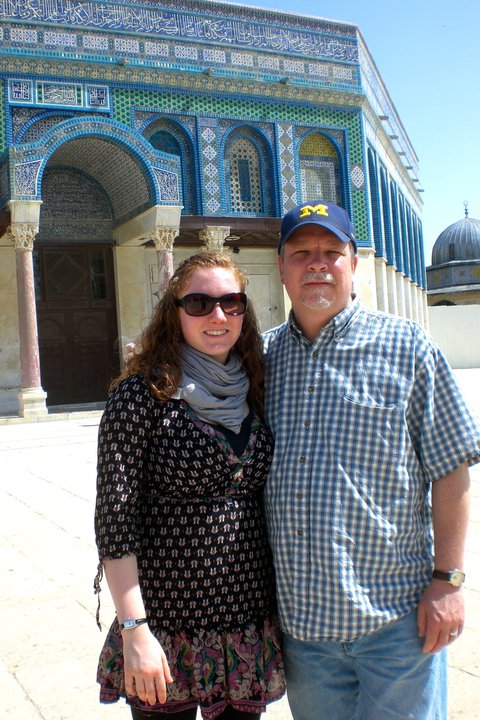
And if we zoom in to focus upon these organizations, we can see connections to larger, unfolding narratives of belonging too. This is certainly case when we explore the unique relationship between the two outgoing Board Chairs of IRT and ICPJ. They are Bryan Weinert and Emmeline Weinert — father and daughter. Both are long-time participants and supporters of these two interfaith communities.
It is not every day, of course, that a father and daughter share these roles at the same time, so they bring unique perspectives on the histories and strengths of both communities from which they have learned and received much. Alongside the gifts of what they have inherited, their forms of leadership within ICPJ and IRT have shaped the direction of both organizations in substantial ways. They have made meaningful contributions to interfaith connections in Washtenaw County as they have invited people to interfaith dialogues, created occasions for religious communities to form friendships, and helped organize neighbors to advocate for human rights. These include conversations and campaigns that work toward anti-racism, the eradication of poverty, the protection of immigrants, and equitable access to resources within Washtenaw County.
The occasions to serve as Board Chairs of ICPJ and IRT have also enriched their own family relationship. Bryan Weinert, Chair of IRT since 2013, says it has been particularly meaningful to see his daughter, Emmeline Weinert, step into leadership of ICPJ in 2016 and serve as Board Chair for the last year. The Weinert family has been involved in the life of both interfaith communities over many years. In this context, Emmeline Weinert shares that she benefited from growing up connected to many interfaith relationships. Among them, she experienced a strong calling toward social justice. She shares that she has benefited from Bryan Weinert’s institutional knowledge and personal wisdom, and he shares that he learns regularly from her deeply held commitments and her access to newer waves of social justice activism. Together, as they prepare to step down from these roles within the next year, they find themselves reflecting on the unique visions that ICPJ and IRT provide Washtenaw County.
Relationships are central to these visions, reminding us that we do belong to one another and are therefore called to consider how we belong to one another. In their own unique ways, IRT and ICPJ seek to cultivate interdependence, care, and shared activism for human dignity and rights.
“It is such a value to our community to have both of these organizations,” Emmeline Weinert shares. They each play unique roles: IRT focuses on transformative conversations and interfaith dialogue, and ICPJ focuses on social justice organizing. “IRT, in my experience, does a lot of that foundational work of building interfaith relationships,” she says. “It really is surprising how many misconceptions people have, and some have not had the opportunity to share spiritually and communally with people of different faiths.” She adds, “You have to have that shared fellowship to take shared action, which is what ICPJ is so focused upon. Relationships are central to a justice-filled and peace-filled world.”
Bryan Weinert agrees and affirms the ways that these organizations complement each other. He also shares how meaningful these community relationships are to him personally. Within this work, he has learned that, “I need the fellowship and experience of other people. Time and time again, I have been affirmed and inspired by the witness of people who aren’t like me. And thanks be to God in the literal sense that I’ve had that exposure.” As a life-long Lutheran, he says, “Worship is now more meaningful for me — worship in the sense of being together with others, experiencing and expressing our deeply held beliefs with others.” He adds, “And I think it’s because of that connection with people who are different, but who are likewise on a similar path with me. There is a desire to love one another and understand one another.”
Imandeep Grewal, a long-time friend of Bryan Weinert, belongs to the Sikh community, and she shares that she has enjoyed these kinds of interfaith connections and conversations with him. She says, “At a time when intolerance and divisions run deep, it is of particular value to recognize individuals in our community who are doing the hard and necessary work of creating spaces where meaningful dialogue is encouraged and appreciated, spaces where all feel truly welcome and cherished. Bryan lives his life in service, with generosity, and with profound love.”
Mary Anne Perrone, a local educator and activist with ICPJ, likewise shares that she and others benefit from the leadership of Emmeline Weinert. She adds, “Emmeline approaches her work with us with skill and expertise, a passion for justice and a heart of compassion. She measures her words, even in the heat of inevitable conflict, with straightforwardness and kindness all at once. Emmeline’s orientation is toward problem-solving and then moving forward in ways that include all who want to bring ourselves closer along the path toward peace.”
Washtenaw County residents have also built relationships with the Weinert family through their places of employment, where their daily work is connected to their values. Emmeline Weinert brings her passion for economic justice to her role as Food Program Manager at Hope Clinic in Ypsilanti. Bryan Weinert’s environmental values have played out throughout his career in the non-profit and municipal recycling field, where he currently serves as the Director of Strategy at the non-profit Recycle Ann Arbor.
The Weinert family has participated in both IRT and ICPJ with longevity, but they see themselves primarily as recipients who have been invited into a larger, collective vision. The initial invitations to get involved came through personal circles of belonging within their own friendships and local communities. Bryan Weinert was first invited into interfaith organizing through Sister Dori Gapsynski, whom he met at Lord of Light Lutheran Church. In his college years, he was also influenced greatly by Russ Fuller, one of the founders of ICPJ. Emmeline Weinert grew up around these communities, and during her youth, she was involved with the Crop Walk and attended ICPJ events, learning about social justice. After she graduated from Loyola Marymount University and returned to Ann Arbor, she became involved alongside others in the One Human Family Campaign in 2015.
A joint venture between ICPJ and IRT, the One Human Family campaign invited local residents and congregations to organize community events and display lawn signs and banners that shared support for Muslim neighbors and refugees who were facing discrimination. Out of the One Human Family Campaign, Bryan and Emmeline Weinert then helped to found Washtenaw Refugee Welcome, a nonprofit dedicated to giving long-term support to refugees in Washtenaw County.
Emmeline and Bryan Weinert express how meaningful it is to participate and lead alongside those who share the collective vision of ICPJ and IRT. “Within organizations, you want to make sure that multiple communities are represented and that people who are most impacted by the work are represented,” Emmeline Weinert shares. “It needs to be the default to make sure that different voices are represented. We have to mirror the world we want to see at every level of the work we do.”
They share that they have been stretched and challenged in ways that have strengthened them over time. With a variety of voices present within the organizations, people have expressed mutual encouragement and occasions for learning. There have have also been examples of conflict and decisive moments when both organizations needed to center more intentionally the representation and concerns of racial minorities, immigrants, and members of the LGBTQIA+ community. “We want to bring people in, but we really need to go where others are as well,” Emmeline Weinert shares.
“I’m a 60-something, white, male, straight, Protestant,” Bryan Weinert adds. “I’m not saying that someone with that background can’t serve. They can, and I have. But I think it’s healthy for the organization to be more proactive about who gets recruited to serve within leadership roles.” He shares that he has learned so much over the years from Board members who have backgrounds and identities different from his own, and he believes it is important to be aware of how various forms of privilege can silence or sideline some participants and leaders if we are not intentional to avoid this. “These are things to be aware of, and acknowledge, and proactively engage,” he says.
Bryan and Emmeline Weinert have received great gifts of belonging in their work with IRT and ICPJ, and they have worked alongside many other leaders to expand how neighbors belong within Washtenaw County. This work has been particularly vital during the pandemic. ICPJ has coordinated care alongside a variety of faith communities to ensure that people had access to safe housing during lockdown and the dangerous months of winter. ICPJ has also drawn attention to inequities in criminal justice sentencing within Washtenaw County. During the 2020-2021 program year, IRT has held more than forty virtual, conversational events, inviting neighbors to discuss pressing needs and reflect spiritually, all in the hopes of bringing neighbors together around shared values and curbing social isolation.
In the season ahead, ICPJ and IRT will continue to expand upon these visions, mindful that invitations of belonging lay the necessary foundation for peace and justice. Within this work, Washtenaw County can express gratitude for the unique bond of belonging between Bryan and Emmeline Weinert — father and daughter. They have received much from the community visions at IRT and ICPJ, and they have provided leadership during a unique era in both organization’s histories. Amidst these gifts, the relationships continue to grow — theirs and ours. And we, too, are invited into this expansive work, recognizing that we belong to one other.
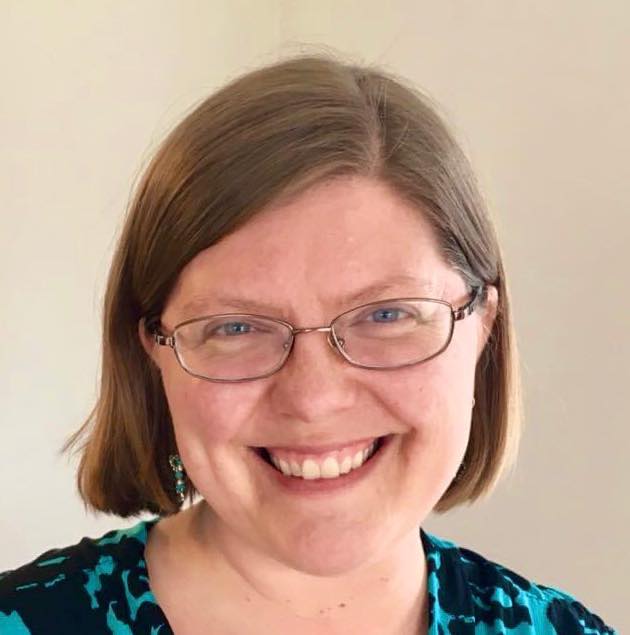
Rev. Renee Roederer serves as the Director of the Interfaith Round Table of Washtenaw County (IRT). She is an ordained Presbyterian Church (USA) minister and a local community organizer who seeks to nurture belonging, dialogue, and spiritual formation throughout Washtenaw County. She lives in Ann Arbor and belongs to a large, chosen family of people who delight her daily.
A few years ago, I had the opportunity to listen to an interview with Pádraig Ó Tuama on Krista Tippett’s On Being. I was so grateful to hear it because it has turned out to be one of my favorite episodes of her podcast.
Pádraig Ó Tuama is a poet, theologian, and at the time of the podcast, he was the leader of the Corrymeela community, a peace and reconciliation center in Northern Ireland. On this podcast, entitled, Belonging Creates and Undoes Us Both, Pádraig Ó Tuama says so many powerful things about voicing and hearing stories. He describes the experience as sacramental.
Have you ever thought about story as sacrament? A means of grace? An opportunity to connect with God and neighbor? An moment to make the past or hoped-for-future present? An invitation toward recreation? The promise of belonging, no matter what? New life — resurrection?
Perhaps when we have the opportunity to tell or hear a story, especially one that is very true and formational to life, we can remember this framework. I’ll share some of Pádraig Ó Tuama‘s quotes below:
“And therefore, every possibility of a person putting words to something, especially something that’s been difficult, is in itself a sacrament.”
“Words are the way to put narrative onto something, and to turn an experience — and especially, I suppose, thinking of conflict situations — to turn an experience that you would rather not have had into something where you can say, at least I’ve had the capacity to tell a story about it, even when that story is painful and unfinished and unresolved, nevertheless, there is a way in which to have words for it. You’re crystallizing it. You’re sacramentalizing it.”
“Let’s begin to be gentle and soothe the fear of fear and find a way that story can be its own liberator if you can find a way to hold it in a generous way.”
“And that is where language is limited because language needs courtesy to guide it and an inclusion and a generosity that goes beyond precision and become something much more akin to sacrament, something much more akin to how it is you can be attentive to the implications of language in the room for those who may have suffered.”
“Don’t let the terrible narrative be the thing that holds you. There is the possibility that you can be the site of generosity from which you, and also your own can benefit. You can be the place from which goodness and generosity can come — that is, the person who has held in their body the most hostility might be the possibility of the place of hospitality also. And that is a story worth telling.”
Image Description: A microphone on a stand with shimmering lights in the background. Public domain image.
We internalize voices of people — people near, people far, people recent, people long past, people who affirmed, people who criticized.
Sometimes, we carry these voices around for a long time.
Who is telling you about you recently? In your own mind, whose voices are chiming up? If we could see a pie chart, what percentage of time and space do those voices take up in our thinking? In our processing? In our feelings? In our beliefs about what is possible?
This may be something to consider, because I know that in many cases, we privilege the most cynical voices.
Maybe we need to turn this completely in the opposite direction. How can we privilege the voices of those who gave affirmation? Those who challenged us because they believed in us? Those who opened up our perspectives on the world? Those who helped us find a calling larger than ourselves? Those who loved us no matter what? Those who created space for us to be ourselves – including opportunities to try things and fail, and get back up again?
Though we are each one person, we are made of these many parts. As we negotiate these, in a real sense, we are in relationship with ourselves. So how do we integrate the best voices into our own internal voice?
Image Description: An invitation in an envelope. The piece of paper is peeking out, saying, “You’re invited.” Public domain image.
I’d like to share something that I desire:
I want a new ecosystem of invitations — that is, a renewed flow of people inviting each other to do things. I need this. Maybe you do too.
We’re in this strange in-between place, aren’t we? We’re still in a pandemic, yet beyond the phase of lockdown. We’re beginning to connect again and establish new routines, but we’re also experiencing fatigue and a variety of physical, emotional, and social reactions that convey, “What on earth did we just go through?”
On the other side, we can be more social, but many of us have crossed that threshold to find ourselves precisely in a state of limited energy. And if we want to rev up our social life again — perhaps from nearly 0 to a more typical 60 — THAT takes energy. Some of us need connection to re-energize, but it takes energy to initiate that connection, especially if you’re starting anew.
Are you feeling this too?
I plan to invite people to do things. Meals, coffee, walks, time in parks, time playing games, and times going to fun events.
-And –
I’m deliberately encouraging people to invite me to do things. Meals, coffee, walks, time in parks, time playing games, and times going to fun events.
I am ready to build a new ecosystem of invitations together.
Hot air balloons spell out the word “Joy” in the sky; Public domain image.
I was on a Zoom call when quite spontaneously, every single person on the call gave each other a heartfelt complement of what they most notice in each other. It all started with someone expressing a vulnerability, and another person adding encouragement — not only a sense of, “you can do it,” but “you can do it because this is who you are and how we experience you.”
Then somehow, that snowballed in a lovely, spontaneous way. The rest of the call, perhaps the last twenty minutes, became a collective opportunity for all participants to affirm every member. The facilitators couldn’t have planned this if we tried. It just happened, and it felt like joy.
Life is too short, and we’ve gone through too many things even just this year, to let those meaningful affirmations go unnoticed and unvoiced. Let’s share them.
Hot air balloons spell out the word “Joy” in the sky; Public domain image.
One of the dearest toddlers in my life has sent me a voice recording to say goodnight for the last 12 days in a row. How lucky am I?
Sometimes we get to participate in joyful rituals with others – the kinds that we come to expect, at least for a period of time, and yet they are received as a total gift every single time.
Hot air balloons spell out the word “Joy” in the sky; Public domain image.
Last night, I asked a simple question on Facebook, and it turned into a special experience of sharing together. I asked, “Would you share with us a joy-filled picture you’ve taken in the last month?”
As of a few minutes ago, this post has 141 comments with visual snapshots of joy in people’s lives. This reminded me that people love to be connected and identified with the people and experiences they love.
What about you? What images are present on your phone, or perhaps, present in your memories from the last month? Maybe we should open that app and look again or simply visualize them in our minds.