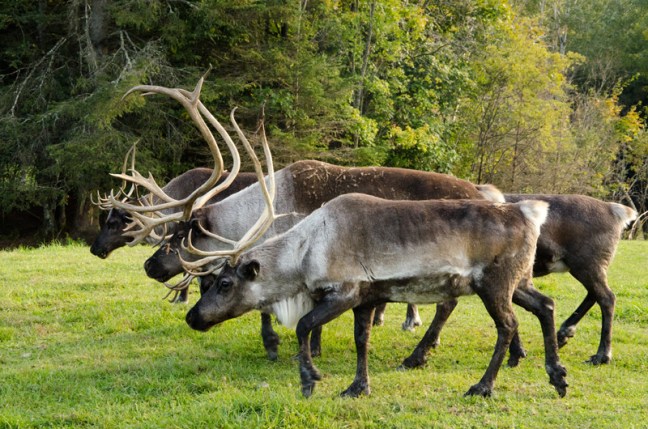
Image Description: Four very real reindeer are eating grass. Public domain image.
This is one of my favorite questions to ask people:
What is something you learned incorrectly as a child but only realized well into your adulthood?
This is a fantastic question! It leads to stories that are very dear and often, quite hilarious. Some people talk about words they mispronounced for decades, only revealed, of course, when they blurted them aloud in a group setting. Others talk about illogical beliefs they internalized as kids which emerged unexpectedly in their minds years later (or were also voiced aloud!) These come as a total surprise because people hadn’t even thought about the topic, let alone questioned their young belief, until that very moment.
This American Life has an entire episode of stories like these. My favorite involves a moment when a college student approached other college students at a campus party and asked the question, “So… are unicorns just really rare, or did they go extinct?”
Hysterical. Totally embarrassing. But also so dear. I love it!
With all of this in mind, I will now admit that I have an embarrassment of riches of stories like these from my own life. And I will share one of them today.
My favorite personal story of this kind involves the nine year window when I didn’t believe in reindeer.
Yes, you heard that correctly.
Now I hope this doesn’t come as a total surprise or crush anyone’s dreams, but when I was eight years old, I learned the sad truth that Santa wasn’t real. (Are you okay? I hope so). In the moment of this revelation, I was pretty of devastated. I was also deeply concerned that I wouldn’t get presents anymore.
So in the midst of my sadness, I resigned myself to reality. So much so, in fact, that I just kind of… over-steered. I just assumed… that… reindeer weren’t real either.
I mean, come on… They fly! Flying reindeer? No way.
At least there was some sort of evidence of Santa’s existence. Gifts showed up annually, so there was something tangible to associate with him. Plus, I saw him in all the malls!
But once I knew the sad truth, how could I possibly believe in flying, antlered caribou? Reindeer quickly went the way of the unicorn. (Ahem… not extinct. Non-existent).
That is, until… I was 17 years old. That is, until… I was flipping through the channels and saw a nature documentary on my television set.
A British accented, David Attenbourough wannabe voiced commentary as creatures walked around in the snow, plunging their faces into the frigid stuff, attempting to nibble on frozen grasses. “The reindeer are in the tundra,” the David Attenbourough wannabe said in all his formal tones.
And I started laughing. Laughing! “The reindeer! In the tundra! Yeah…”
But then, my laughing stopped abruptly, and my mouth gaped open. As I sat alone in the living room of my childhood home, in my last year before legal adulthood, a recognition completely washed over me. It dawned on me — at age 17 — that reindeer are REAL.
I had indeed over-steered. The reindeer had been in the tundra this whole time.
the Kingdom of God is like a mustard seed. Small, tiny, and yet, expansive. Growing and making space for many others…
There’s a document from the Middle Ages called Trinity Carol Roll. It’s a 15th century manuscript that contains thirteen English carols. One of these is called, “There is No Rose of Such Virtue,” and this text has been set by many, perhaps most famously by Benjamin Britten in his piece Ceremony of Carols. In that ancient document, and in many, various choral settings over 600 years, there is a particular line about Mary, which I find to be quite beautiful:
“For in this rose contained was heaven and earth in little space. Res miranda.”
Res miranda – That means a wondrous occurrence.
For in this rose, Mary, contained was heaven and earth in little space — a whole universe of possibility and belonging, a whole universe of transformation.
The Kingdom of God is like a mustard seed. Small, tiny, yet expansive, “for when it has grown, it is the greatest of shrubs and becomes a tree, so that the birds of the air come and make nests in its branches.”
The Kingdom of God is like this mustard seed, aways expansive, making space for others — many others.
Mary, the Mother of Jesus, Mary, the Mother of Christian community, was not the type of person who was highly regarded in her day and age. She was young. She was a woman. She was unmarried. She was poor. She did not have high status. In fact, she may have been seen as small and insignificant.
And yet, a great calling comes to her.
Gabriel comes as a Messenger from God and immediately says, “Greetings, Favored One.” In the eyes of God, this very young, unmarried, poor woman is highly favored. She is favored in herself, and she is favored toward a calling that is res miranda, a wondrous occurrence.
Of course, she wasn’t expecting any of this, and the Messenger says, “Do not be afraid, Mary,” again reminding her, “for you have found favor with God. And now you will conceive in your womb and bear a son, and you will name him Jesus. He will be great. He will be called the Son of the Most High, and the Lord God will give to him the throne of his ancestor David. He will reign over the House of David forever, and of his kingdom, there will be no end.”
She’s confused. Perhaps she feels wonder. She has many questions, But in the end, Mary says, “Here am I, the servant of God. Let it be with me according to your word.” Yes. Mary says Yes. And so, in all of this — the confusion, the wonder, the questions, and the great Yes — Mary quickly gathers herself to meet in kinship with Elizabeth, one of her relatives.
Elizabeth is a Messenger too, reminding Mary of this great favor — favor in herself and favor in this calling — reminding her of possibility, expansive belonging, and great transformation.
And in the presence of Elizabeth’s joy, Mary breaks into song.
We call this song the Magnificat. It’s a song that marvels at the recognition of favor, particularly among the marginalized, those made to be small by others. And this is a song of liberation, understanding that God has chosen the people and is acting now in great justice, building the kinship community in deliverance and peace.
Today, we have this song translated before us into English. But in Greek, its original written text, there are nuances we cannot easily see. Many of the verbs — the words of action in this song — are in the perfect tense. This is a unique way to talk about the past.
It is to say,
This action has already happened and has continual significance in the future, and right now, in this present moment.
This is a way to bring time together, past, present, and future, to talk about what is at its center.
And so hear these words of Mary again this morning, recognizing how God has acted with continual significance — how God will act, and how God is acting now — through this birth of Jesus, through humanity, through the most marginalized. In this song, may you hear something you need for this day:
Mary sings, “My soul magnifies the Lord, and my spirit rejoices in God my Savior, For God has looked with favor on the lowliness of God’s servant.
Surely, from now on all generations will call be blessed; for the Mighty One has done great things for me, and holy is God’s name.
God’s mercy is for those who fear God, from generation to generation.
God has shown strength with his arm; God has scattered the proud in the thoughts of their hearts.
God has brought down the powerful form their thrones, and lifted up the lowly;
God has filled the hungry with good things, and sent the rich away empty. God has helped her servant Israel, in remembrance of her mercy, according to the promise made to our ancestors, to Abraham and to his descendants forever.”
This is who God has been with continual significance, for who God will be and how is acting right now.
Can we allow ourselves to dream of this?
Jesus says, The Kingdom of God is like a mustard seed. Small, tiny, and yet, expansive. Growing and making space for many others…
“For in this rose contained was heaven and earth in little space. Res miranda.”
It is a wondrous occurrence.
And what if… we allowed ourselves to believe just a little more… if we allowed ourselves to trust just a little more that this wondrous occurrence is still occurring, still active, still being created in our world now, among the marginalized now, among us and the whole kinship community of God now….
Mary uniquely gave birth to Jesus, the one who would go forward to speak, enact, and create the Kingdom of God, this realm of new possibility, rooted in who God has been all along. And this is not ultimately a Kingdom in the same kind of framework we often think about Kingdoms. This is the opposite of imperial power.
It is about God at work in humanity, in community, so some have begun to translate this phrase as the Kindom of God.
The Kindom of God… What if we allowed ourselves to believe just a little more… if we allowed ourselves to trust just a little more… that this wondrous occurrence is still occurring? Perhaps even in us…
Ancient theologians called Mary theotokos, a title of tremendous honor. They called Mary “the Mother of God” seeing in her that she was a God Bearer, one bringing forth God into the world.
And so Jesus was blessed in and through her, and the Kinship Community was blessed in and through her, for she was favored as the one she was, marginalized and made to be small, and yet expansive for Jesus and for all of us.
God is still partnering in the world with those who marginalized.
God is still partnering with the Kinship Community of God, all of humanity, calling us to these forms of liberation, calling us to these forms of transformation. Mary is an archetype for all of us.
She expands what belonging means, She expands a vision for liberation, and she lives into that transformation with her very life.
We are invited to do the same.
We too are God Bearers, with all that we are and all that we have — who we are, the gifts we have, the image of God we carry, the connections we have among each other, and this vision that is placed before us, expecting that God will show up among the marginalized and those who being made small.
Of course, no human being is small. No human community is small. Every human life and every human community is expansive with worth and possibility.
And so today, we pray for all those who are marginalized, daring to expand what belonging means.
We pray and advocate for immigrants who are scapegoated, those who struggle to know where their next meal will come from, people who are longing to have their bodies cared for and yet do not have access or are ostracized, those who are gay, lesbian, bisexual, transgender, and queer, those who are struggling in their personal lives, in their families with grief, or infertility, or departure, or estrangement, or diagnosis, or addiction.
Might we allow ourselves to believe just a little more…. and trust just a little more …that God is active and will be active, even there, and that God is calling us to liberation, transformation, and deep connectional care in all of these places…
We are God Bearers, each one of us and all of us, with heaven and earth contained in little space, sacred possibility.
The Kindom of God is like a mustard seed. Small, tiny, and yet, expansive. Growing and making space for many others…
Advent exclaims that Time
is an ever-expanding universe of arrival.
Christ has come,
Christ is coming,
Christ will come again.
Above and among,
Beyond and beside,
God stuns with sacred presence.
Abstract and adnate,
Boundless and bodied,
God surprises with sudden reverence.
In this universe of Advent,
Time accelerates with increasing, expansive speed, and
Time slows with easing, pensive stillness.
Advent jumbles all eras of time together,
Collapsing them into one another —
colliding galaxies,
continually merging.
Sacred past and sacred future converge,
revealing a sacred present,
A Holy, Sacred Now
for
The One
Who Was,
Who Is,
and
Who Is to Come.
[2]
Mary was a universe of possibilities,
God’s Mother, a cosmos of potentiality, “For in this rose contained was heaven and earth in little space, Res miranda. . .” [3]
Res miranda! — A Wondrous Occurrence. . .
The Holy Spirit appears
to reveal the sacred prospect,
And Mary adds her YES,
ushering in Emmanuel,
God With Us.
Mary,
Theotokos, bears God into the world. Res Miranda.
Mary,
Theotokos, bears God’s child, Res Miranda!
a galaxy of unending grace.
[4]
And. . . if Advent is a swirling collision of Holy Time,
making all things present,
making all things new. . .
Perhaps the Holy, Sacred Now
is upon us,
Perhaps the Holy Spirit
is appearing among us,
Right now,
Right here,
This very hour,
summoning us to add our YES,
so that we too
might bear God into the world.
[1] This is an image of Spiral Galaxy ESO-137-001 as captured by the Hubble Space Telescope.
[2] This image was created by Deborah Koff Chapin and is part of her Soul Cards collection.
[3] This text is a portion of “There Is No Rose of Such Virtue,” a 15th century English Carol. Feel free to listen to the version that the King’s Singers perform:
[4] This is a NASA image of colliding galaxies.
[5] This image comes from wallpaper created by Fanpop.com. You can access the image here.
Candles and a plate on the table at Canterbury House. Photo, Renee Roederer.
Last night via Zoom, I attended Compline, a beautiful service to mark the transition into evening. This service is held by Canterbury House community on Wednesday nights. Over the last few years, I’ve spent many Wednesdays actually in the house for this weekly time together.
Last evening, I was present on Zoom for the first time this entire semester. So I heard an Episcopalian prayer that I typically voice weekly for the first time in many months. Given the collective grief in the United States, this really hit me:
Keep watch, dear Lord, with those who work, or watch, or weep this night, and give your angels charge over those who sleep. Tend the sick, Lord Christ; give rest to the weary, bless the dying, soothe the suffering, pity the afflicted, shield the joyous; and all your love’s sake.
Such a tender prayer, always relevant, and yet now, deeply resonant. I’ve heard these words many times, but they took on form in a new way. Yesterday, for the first time, our country lost more than 3,000 people from the coronavirus in one day — a new, terrible marker of grief.
Even if we knew none of these people personally, it makes sense to pause to feel our feelings around losses like these, recognizing that more people are dying daily.
I saw an image this week that brought home the sobering size of these losses. It said,
Deadliest Days in American History:
1) Galveston Hurricane — 8,000 2) Antietam — 3,600 3) September 11, 2001 — 2,977 4) Last Thursday — 2,861 5) Last Wednesday — 2,762 6) Last Tuesday — 2,461 7) Last Friday — 2,439 8) Pearl Harbor — 2,403
When I heard yesterday’s numbers, I knew we had lost more people from this virus on a single day than 9/11.
Today, I’d like share an article so we can hear from some ICU Nurses about the virus. Their perspectives are so important. Health care workers need our support.
There’s so much need and so much grief, and they are present to experience it all.
I was on a Zoom call (becausepandemic) and I said,
“I think one of the most difficult things about this pandemic is that it’s stretched on without us really knowing when it might end. If we knew when that might be, even relatively, we could gauge it more easily. Now, with the vaccine on the horizon, there’s no more… what should we call it? FOMOP? You know, FOMO? Fear of Missing Out? We’ve had FOMOP — Fear of Missing Out Perpetually.”
We’re in such a dichotomous time. We hear hopeful stories about new developments and the game changer of vaccines. But this is also the most perilous timeframe so far. All of those numbers have names attached…
I find myself truly dreaming of what my post-pandemic life might look like. And I sit in concern as this virus comes closer to loved ones and upends so many people. What an odd, in-between time.
In the fifteenth year of the reign of Emperor Tiberius, when Pontius Pilate was governor of Judea, and Herod was ruler of Galilee, and his brother Philip ruler of the region of Ituraea and Trachonitis, and Lysanias ruler of Abilene, during the high priesthood of Annas and Caiaphas, the word of God came to John son of Zechariah in the wilderness. He went into all the region around the Jordan, proclaiming a baptism of repentance for the forgiveness of sins, as it is written in the book of the words of the prophet Isaiah, “The voice of one crying out in the wilderness: ‘Prepare the way of the Lord, make his paths straight. Every valley shall be filled, and every mountain and hill shall be made low, and the crooked shall be made straight, and the rough ways made smooth; and all flesh shall see the salvation of God.’”
This passage begins with words that don’t seem particularly significant to our 21st century context, so if you’re like me, as you read them, you might tend to tune them out. Luke initiates this section of his Gospel with a list of rulers from the 1st century — despots, kings, foreign occupiers, and the highest religious officials.
It takes a bit of time to move through these names, which adds to the probability that our brains might move elsewhere. But these words are absolutely significant to the message Luke intends for us to hear.
So let’s consider them again.
In the fifteenth year of the Emperor Tiberius. . . Tiberius was the primary ruler and ultimate authority in the expansive Roman Empire.
When Pontius Pilate was governor of Judea. . . Pilate was the Roman prefect who governed a large portion of the occupied land.
And Herod was ruler of Galilee, and his brother Philip ruler of the region of Ituraea and Trachonitis. . . The Herod dynasty included kings who ruled harshly as a client state for Rome.
During the high priesthood of Annas and Caiaphas. . . Annas and Caiaphas were the highest religious leaders put in place by Rome.
This is Luke’s list at the opening of this passage. But take notice of what happens after he lists all of these powerful leaders with high status. Luke says. . . During the time when all of these powerful people governed, “the Word of God came to John in the wilderness.”
The Word of God came to John and it came to him in the wilderness.
This is significant. At first, it may seem like Luke is simply setting the scene and establishing the time period as he mentions what was happening in the government, but it’s so much more than that.
Luke wants us to know that at the time these leaders ruled — some with corruption and all with wealth and influence– the Word of God came to one of society’s so-called nobodies in the wilderness, a remote spot entirely removed from society’s center.[1]
And this man named John went into many places in this wilderness. Luke says that he went into all the region around the Jordan River, and as he did that, he baptized people into the very waters of that river, proclaiming good news and a message of repentance. The word ‘repentance’ literally means to ‘turn around.’ John invited people to turn around toward a lifetime of good news, living toward God with worship, passion, and justice.
And John did this with power.
John the Baptist did not have the world’s power. He wasn’t wealthy. He wasn’t welcome in high society. He didn’t have a position in the government. He wasn’t the leader of an army.
But John was a prophet of God, a fiery prophet of power who did not mince words. Without question, John would have made us uncomfortable, and he might have made us angry too. Like so many of Luke’s characters, John preaches a radical Gospel: God is turning the world upside down. The powerful are becoming de-centered, and the people on the margins are empowered to lead the way toward new life.
With this message in the wilderness, John cries aloud the very words that the prophet Isaiah proclaimed centuries before him. “Prepare the way of the Lord, make God’s paths straight. Every valley shall be filled, and every mountain and hill shall be made low, and the crooked shall be made straight and the rough ways smooth; and all flesh shall see the salvation of God.”
God is turning the world upside down. The mountains and hills and bastions of power will be made low! And the valleys of those who are humbled, despised, and marginalized shall be filled so that all people will see and know the salvation of God.
As John proclaims this message, he serves as a messenger, preparing the way for Jesus who will indeed turn this world upside down. When John cries words aloud in the wilderness, Jesus is about thirty years old and on the verge of his public ministry. John is the herald, inviting people to prepare their anticipation, because once Jesus comes into the fullness of this ministry,
He will speak truth to power, He will uplift the downtrodden, He will eat in full communion with the ‘outsiders,’ And he will empower these very people to take his message of worship, passion, and justice to the ends of the earth. All people, All people, will see the salvation of God.
This world-turning intention is central to the character of God. It is a vital part of Who God Is. So it makes me wonder. . .
How is God moving now? How is God proclaiming a message of salvation now? How is that happening in our own time and in our own modern forms of wilderness?
After all, isn’t that just the kind of thing this God would do? Arrive in the middle of wilderness places that some label insignificant?
This is one of the primary messages of Advent —
God is always coming, Always arriving in this Jesus, Always initiating movements of power and good news through the Holy Spirit, often in the least likely of places.
So it makes me wonder how God is showing up in the wilderness.
We certainly have many places of wilderness in the landscape of our lives. These places seem rough and are perhaps on the outside of anyone’s knowledge or notice.
Our losses, Our addictions, Our health crises, Our disappointments, Our broken relationships. . . They can feel like places of wilderness.
But we can take heart, And we can remember, God shows up even there and can turn the world upside down.
Your life is not insignificant in God’s vision. It is immensely significant. Even in these places of wilderness, God turns our lives upside down, so we can turn toward the direction of new life.
It makes me wonder how God is showing up in the wilderness.
We also know that there are many in our neighborhoods and many around our world who experience burdens that are heavier than we can easily imagine —
People struggle through poverty, Children fall through the cracks of failing schools, Some are despised and disenfranchised through racism, Some are stigmatized and treated as less than because of disability, Men, women, and children are caught in the trauma of wars, Refugees escape those wars but have nowhere to go, And victims die and are wounded by the senseless and seemingly continuous gun violence in our country. These are wilderness places, These are painful wilderness places.
And these lives are not insignificant in God’s vision. They are immensely significant. Even in these places of wilderness, God turns our lives upside down, so we can turn toward the direction of new life.
It makes me wonder how God is showing up in the wilderness.
I know this. . . God often shows up in the presence of other people, and God can arrive in these realities of wilderness through our very presence.
In the midst of heartache, God brings comfort and good news through our presence.
In the midst of challenges, God turns the world upside down through our presence.
In the midst of wilderness, God provides a way in the desert and makes all things new through our presence.
How will we add our presence? How will we be a part of the very prayers we make? How will we act on that small thing or that large thing that keeps arriving in our minds and hearts? How will we reach out to that person or community that keeps showing up in our thinking and praying? How will we follow John into the wilderness to proclaim good news? How will we also turn the world upside down?
Sometimes, you’re busy, or you run out of things to say, or both, so you conclude, “You know what? Let’s make this baby animal week on Smuggling Grace.”
And then you remember how wonderful it would be to hug baby goats. Yes, let’s definitely share that. 🙂
 [1]
[1]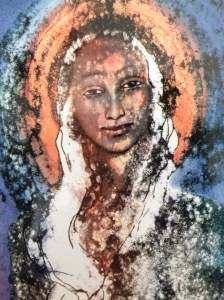
 [4]
[4] [5]
[5]