Little Joys

Now that it’s warmer, this Michigander so thoroughly enjoys keeping her windows open all day. It’s lovely to work outside or at my table in the sunroom because I can watch nature too. As I type this, a squirrel is pulling up grass in the yard, assembling it into a ball, and carrying it in her mouth up to the trees to make a nest.

And yesterday, this very little, fuzzy worm traversed on my MacBook Air for a while:

I hope there are moments when we can get outside, open a window, or just thoroughly enjoy a sunbeam shining into our quarantined living spaces.

Terry Tempest Williams, author and conservationist writes, “To be whole. To be complete. Wildness reminds us what it means to be human, what we are connected to rather than what we are separate from.”

Maybe we need that especially right now.

–Renee Roederer


Mental Health Monday: The Deeper Healing

No photo description available.Image Description: The top says, “What we think healing will look like,” and the bottom has a pie graph with various responses to “What healing actually looks like.” This image is by @heidipriebe. Text in full below.

Healing is… not always easy. But it’s deeper and fuller than coasting or living in a conflicted way. Maybe there are rifts we need mend in our relationships. Maybe we need to stand up for ourselves. Maybe we need to be kinder to ourselves. Maybe we need to apologize.

Healing often requires risk and vulnerability.

So I like this image from @heidipriebe.

The top says,

“What we think healing looks like”

There’s a solid, light blue circle filled in full with the response,

— Meditating peacefully

Then below, there’s a pie graph with a deeper and fuller list.

“What healing actually looks like”

— Unpacking Trauma
— Having Difficult Conversations
— Taking Radical Responsibility for Your Actions
— Implementing Healthy Routines
— Setting & Enforcing Boundaries

What does this evoke in each of us?

Yesterday, during a Zoom worship service, someone mentioned one of Jesus’ teachings from the Sermon on the Mount that I haven’t thought about in a while — the portion about the speck in your brother’s eye and the log in your own? I think that probably landed in a really humorous way in its original context because it’s so preposterous. I once heard a translation (can’t find it now, sadly!) that said, “How can you get the sawdust out of your brother’s eye when you have a telephone pole in your own? First take the telephone pole out of your own eye, and then you will see clearly to take the sawdust out of your brother’s eye.”

It made me laugh. I just imagine someone knocking others over with their telephone pole while they try to analyze and pick at others. Ouch, but also very cartoon-y. It’s a silly image about a very true experience.

We all have our work to do. Let’s choose the deeper healing.

–Renee Roederer


–

Grace

MrR

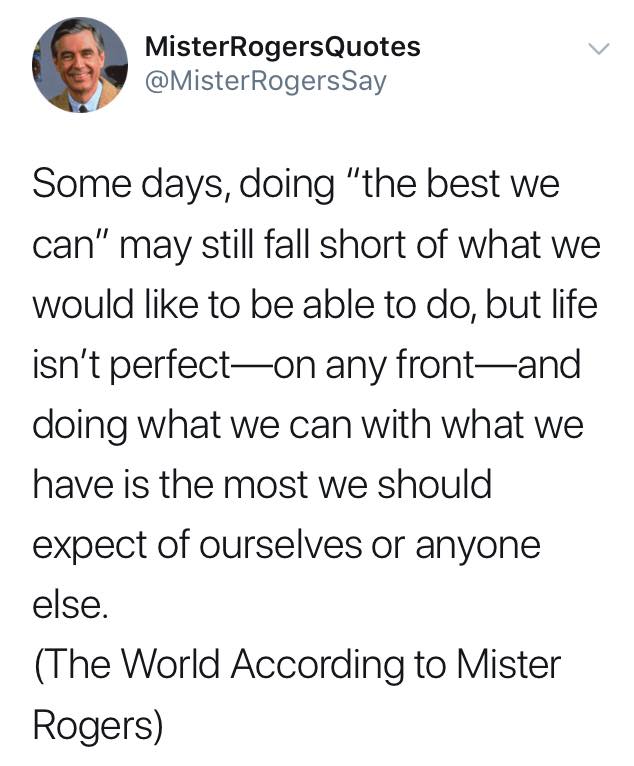
It’s pretty rare for a Facebook post to have more shares than likes, but that’s what the stats currently tell me about a post I made. There were 63 likes, but there are 113 shares.

I follow the MisterRogersQuotes handle on Twitter, so my screens receive daily quotes from Fred Rogers. I’m glad for that. Occasionally, I’ll screenshot one on my phone and then share it to Facebook also. That’s what I did last week.

He says,

“Some days, doing ‘the best we can’ may still fall short of what we would like to be able to do, but life isn’t perfect — on any front — and doing what we can with what we have is the most we should expect of ourselves or anyone else.”

In an screenshotted image, this simple but very helpful quote spread fast on Facebook. And I realized, people are really longing for this kind of grace, hoping to stand in the presence of people who convey, “‘the best you can do’ is truly enough.” And, of course, we need to hear that we’re worth loving and are ourselves ‘enough’ even when ‘the best we can do’ falls short as well. This is true when circumstances inhibit us or when we fail. Our worth and acceptance need not be conditioned on ‘the best we can do.’ Worth and acceptance can be unconditional. This is grace.

It seems that a large and quick number of shares reveal that we need to hear this message again.

So I wonder, which ongoing stories in our lives need this posture from us?

–Renee Roederer

Quarantine Learnings

laptop desk computer smartphone table technology workspace furniture work space home office brand design magazines multimedia acer workplace desktop computer personal computer computer hardware public domain images

Image Description: An open magazine, a laptop, and a smart phone on a wooden table.

I know there are deeper discoveries we might have have during this time. Eureka moments about life or epiphanies about our inner workings as people. But I’ll just say…

Even though I deeply miss human contact — I really do — I’ve learned that I really enjoy working from home.

I’m in an ideal work rhythm now, and I find myself getting into flow. This is good.

-I’m also fortunate to still be working.
-I’m also fortunate to work for organizations that are supportive of staying put and working remotely.

Not everyone has those options before them.

I don’t take it for granted.

I’m just learning that I like it very much.

–Renee Roederer

Concern or Worry?

ask #blackboard chalk board #chalkboard #faq #help #question ...

Image Description: A white question mark, written in chalk, on a blackboard.

These days, I find myself thinking about this often:

Concern and worry are not quite the same. They’re different experiences, I think.

When we’re concerned about something, we take it seriously. And this feels proactive: We think ahead. We consider consequences. We galvanize our strength, our inner resources, and our community resources.

But…

When we’re worried about something, we just spin around our own anxiety. It can feel like a whirlwind.

It’s not easy, and sometimes, not possible to just snap our fingers and exit worry. Anxiety is very physical, and when it takes hold, we’re really in it. This deserves compassion and never shame or criticism.

I wonder, if we can practice moving our worry energy into concern energy, might we inhabit a different stance? Then we can be in a different relationship with what we face or fear.

–Renee Roederer

Mental Health Monday: Trauma-Healing

9CF1FFEA-A323-4B3D-BD85-A18171EB788F

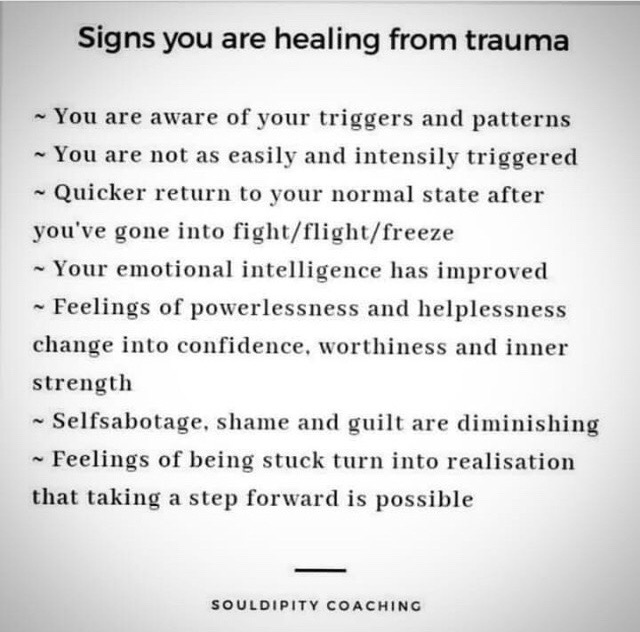
Image Description: A list from Souldipity Coaching. Gray background, black text. The text is written out below in the post.

I find myself saying this a lot, but it bears repeating: In the COVID-19 pandemic, we are living a time of collective trauma. In the midst of it, it may be helpful to hear this again and repeat it to ourselves; we need reminders to be gentle with ourselves and one another.

These things are true as well:
-It’s okay to be upset and in a place of need in our lives.
-It’s okay to feel confused and unsure of what to do about it.
-It’s okay (and good, even if it doesn’t feel easy) to seek help for trauma, pain, or difficulty.

For the sake of our own health, that of our family, and that of our community, I think this is a good time to learn more about trauma — not only because of this collective one we’re facing, but also, because some of us have been carrying and processing previous traumas for a good while now. Or we may feel stuck in physical trauma reactions without knowing that’s what’s happening inside our nervous systems. This is particularly true if we are cycling through these physical fight, flight, freeze, or fawn reactions, but are not quite aware of a single event or storyline to point to as their cause. (<— Helpful link there)

I really appreciated this image that I placed at the top of today’s post. It’s a list from Souldipity Coaching. I offer it as encouragement, particularly if we want to celebrate the ways we have already healed. It reads,

Signs you are healing from trauma

-You are aware of your triggers and patterns
-You are not as easily and intensely triggered
-Quicker return to your normal state after you’ve gone into fight/flight/freeze
-Your emotional intelligence has improved
-Feelings of powerlessness and helplessness change into confidence, worthiness and inner strength
-Selfsabotage, shame, and guilt are diminishing
-Feelings of being stuck turn into realisation that taking a step forward is possible

That’s encouraging, isn’t it? And if you read this and think, “I’m not there yet…” I still want to offer that encouragement. We’re always in process, and these things can become true for us:

–You can become aware of your triggers and patterns
–You can learn how to regulate your nervous system so it’s not so easily and intensely triggered
–You can have quicker return to your normal state after you’ve gone into fight/flight/freeze/fawn
–You can grow in your emotional intelligence
–You can change your powerlessness and helplessness into confidence, worthiness and inner strength
–You can diminish self sabotage, shame, and guilt
–You can shift your feelings of being stuck and realize that a step forward is possible

Therapy is crucial for healing trauma. If you can, please seek it out.

Community is crucial for healing trauma (it can’t stand in for a therapist, but it’s also just as important). If you can, please seek this out.

Our best inner resources are crucial for healing trauma, and we all have them. If you can, please activate them. And remember, you don’t have to do this all by yourself or by your own strength alone.

Opportunities to check in with each other are crucial during times of collective trauma. It’s good to check in personally with loved ones and invite others to check in with us. I hope you hear that intention in this post too. If you need someone to talk to, I will listen.

–Renee Roederer