I don’t think it’s a stretch to say that it’s rather rare for a sermon to get passed around the way Bishop Curry’s has over these last few days.
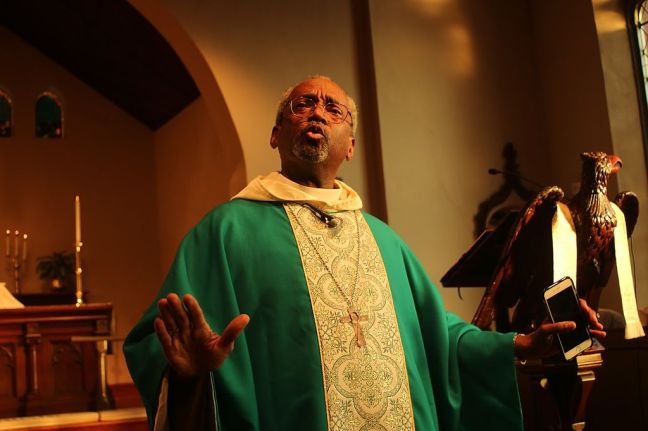
After Michael Curry, Presiding Bishop of the Episcopal Church, preached the homily at the Royal Wedding on Saturday, his sermon has been shared all over social media. It has made its way into articles for a large number of magazines (also shared on social media), and it has been featured in a lot of prime time news slots — temporarily, I might add, displacing the person who seems to dominate television around the clock.
Bishop Curry preached about the power of love — not just the love between a couple, but the calling to love our neighbors — and he invited those listening to imagine a world where humanity had learned to harness the power of love. It was hopeful and inviting. It was empowering.
I love that Bishop Curry’s sermon brought together massive amounts of people who are not typically a community – that is, the 3,000 or so who were present and the many millions who were watching on television. At the very same time, he dared to be remarkably subversive. Both of these were so moving.
Fred Rogers used to say, “I’m so convinced that the space between the television set and the viewer is holy ground. And what we put on the television can, by the Holy Spirit, be translated into what this person needs to hear and see. . .” I think a sense of holy ground was created as 29.2 million people watched and felt a sense of connection with one another. People were moved. Lots of folks who are not overtly religious shared this sermon and spoke to the power of it.
And make no mistake, this sermon was subversive as well. Throughout the sermon, Bishop Curry represented and referenced Black liberation theology as he was in a space historically associated with colonialism, white supremacy, and subjugation. He quoted the Rev. Martin Luther King Jr., and he referenced the influence of enslaved people in the United States. The sermon was powerful for all these reasons too.
So if you haven’t seen it yet, and you’re so inclined, here is a video of the sermon, and here is a transcript. I hope you find it moving too.
This sermon was preached at First Presbyterian Church in Saline, Michigan and was focused upon the story that is told in Acts 2:1-21. The audio recording is above and a written manuscript is below.
I hear that word weaving its way throughout this entire story. It’s a word that is big, expansive, and at times, remarkably surprising.
All.
It’s right there at the beginning, in the very first sentence of the story: When the day of Pentecost had come, they were all together in one place. The disciples of Jesus were all in a house together. The twelve disciples were there, likely with other men, women, and children who called themselves disciples too. We don’t know exactly what they were doing when the great, surprising moment of the Spirit came, but we do know that they were together in community. We do know they were all in one place.
They had been doing this together for a while in a season of waiting. Now surely, they couldn’t have anticipated the full power of this moment in all its details, and most likely, they wouldn’t have necessarily expected it to happen that very day. They couldn’t have anticipated this in its entirety, but they were waiting purposefully.
After Jesus died and showed himself unexpectedly raised to new life, he spoke to his disciples, saying, “Thus it is written, that the Messiah is to suffer and to rise from the dead on the third day, and that repentance and forgiveness of sins is to be proclaimed in his name to all nations, beginning from Jerusalem. You are my witnesses of these things. And see, I am sending upon you what my Father promised; so stay here in the city until you have been clothed with power from on high.”
So when the day of Pentecost had come, they were all together in one place. They were waiting purposefully for the promises of God. But in any given moment, could they have anticipated that the time was right upon them? I bet they were just as stunned as anyone else was that day.
Suddenly from heaven there came a sound like the rush of a violent wind, and it filled the entire house where they were sitting.
I’m sure they were startled.
Divided tongues, as of fire, appeared among them, and a tongue rested on each of them.
What strange, wonderful details.
And that’s when we hear the word again. . .
All of them were filled with the Holy Spirit and began to speak in other languages, as the Spirit gave them ability.
Could they have possibly anticipated this holy moment and what it would be like?
Could they have possibly known how deeply empowered they would become without a moment’s notice?
When the Holy Spirit suddenly entered that room, God empowered them to become witnesses to proclaim this great message of love, liberation, forgiveness, and renewal for the people.
They spoke good news about all these things, and initially, all those who heard them were stunned. Pentecost was an ancient, annual festival of the Jews. People from many different nations were present during this holy moment. They were Jews who lived in other places. They came to Jerusalem from every nation to celebrate this great festival of the harvest.
When the people heard all this sound and these words of love, liberation, forgiveness, and renewal they were shocked. They said, “Are not all these who are speaking Galileans? So how is it that all of us – all of us, wherever we have come from – are hearing these words in our own languages?” They were stunned by this. The story says, All were amazed and perplexed, saying to one another, ‘What does this mean?’
So often, when we enter our own celebration of Pentecost and remember this holy moment, we think of this story as a miracle of tongues. Certainly it was, for in this story, the disciples were speaking languages previously unknown to them. But Eric Law, an Episcopalian priest and author, frames this moment in another way. He says that this Pentecost moment was a miracle of the ear.[2] Suddenly, people divided by language, national origin, and cultural upbringing were connected, and all were able to understand one another.
This is a miracle of God, bringing people together so that this message of good news may be known.
This is what they understood:
Peter, standing with the eleven, raised his voice and said to all of them, People of Judea and all who live in Jerusalem, let this be known to you, and listen to what I say. (And I love this next part). These people are not drunk as you suppose. It’s only 9 in the morning! No, this is what was spoken by the prophet Joel.
And listen as the word all weaves its way through Peter’s speech.
In the last days it will be, God declares, that I will pour out my Spirit upon all flesh, and your sons and your daughters shall prophesy, and your young men shall see visions, and your old men shall dream dreams. Even upon my slaves, both men and women, in those days I will pour out my Spirit; and they shall prophesy.
And Peter closes by saying,
Then everyone who calls on the name of the Lord shall be saved.
All who call on the name of the Lord, leaning in the direction of this vision,
shall know love, liberation, forgiveness, and renewal.
That’s what happens in this moment of Pentecost.
Beyond the portion of the text we read today, Peter continues in his speech. He talks about the life, death, and resurrection of Jesus. He talks about love, liberation, forgiveness, and renewal. Peter shares all of this with the people, for God is providing all of these for the people.
And after they heard all of this, the story continues, saying that they were cut to the heart. They said to Peter and the other apostles, “What should we do?” Peter invites them to repent — which means to change one’s mindset — be baptized, and receive the Holy Spirit.
And they do. The story goes on to say,
Those who welcomed his message were baptized, and that day, about three thousand persons were added.
So this day of Pentecost –
the day we are living together –
I keep thinking about this word All
and the power that is within it.
I marvel at the power and the beauty of the large, expansive vision of God. All.
I marvel at the power and the beauty present
when we are all gathered together,
not simply living a mundane moment,
not simply living one of 52 Sundays on the calendar,
but being present this day and waiting upon God.
All.
I marvel at the power and beauty that takes place
when all are empowered, including those beyond our sanctuary,
perhaps to do things that have seemed impossible. All.
I marvel when all are able to understand each other,
especially in this world where see so many divisions —
our genders,
our races and ethnicities,
our class structures,
our political divisions,
our expressions of culture,
our expressions of church culture. . .
What a miracle it is when we are all able to understand one another and our neighbors, and recognize that the Spirit of God can be found in and among all of these human lives.
I marvel at this word: All.
And it makes me wonder. . .
When we are gathered together — when all of us are in one place — do we expect very much from that experience?
Do we think that anything transformative is possible? Or do we see this gathering as just another run-of-the-mill routine in our lives?
Do I expect very much? Or do I assume that yes, I’m going to be guest preacher, and step into another pulpit, and speak for a while. Go home. . . have lunch. . . and continue in a run-of-the-mill day? Sometimes, I think that way.
Or might we expect that God will show up and expand our vision, our thinking, our understanding of ourselves, and indeed the whole world?
Might it be possible that the love, liberation, forgiveness, and renewal of God might be present, on display, and transformative in ways that are surprising and uplifting? Might that presence of the Spirit help us expand the ways we view our neighbors and understand how we are called to love — breaking open all those ways in which we limit our understandings of who we are and who our neighbors are, ways that we sometimes reduce ourselves or our neighbors?
My goodness, do we think that the Spirit could change us? Even today? Even this very hour? Do we?
I wonder. . .
Yesterday — you might have heard about this — the world had a Royal Wedding. Lots of people in the world, depending on where they live, woke up early or stayed up late to watch this wedding take place live.
And during the wedding, Michael Curry, the Presiding Bishop of the Episcopalian Church in the United States, preached the homily. Maybe you heard about this too, because all day long, I saw social media feeds on Facebook and Twitter filled with his presence, as people shared his words and praised the moment. How often these days do we sermons shared so broadly on social media?
In his sermon, Bishop Curry did some things that were unexpected. And who can know all the ways the Spirit might have unexpectedly impacted human hearts in that moment, in his words, and in the particular thoughts and unfolding callings of people around the world? Because millions upon millions of people were watching, all gathered in one place.
Bishop Curry brought the influence of Black liberation theology into the Royal Family, quoting Martin Luther King Jr. and uplifting the witness of American slaves. And Bishop Curry talked universally about the power of love, inviting us into its power. “There is power in love,” he said again and again.
He spoke about fire, and all that has been possible — health, migration, science, medicine, technology — because humanity has harnessed the power of fire. He asked us, What might be possible if humanity began to harness the power of love?
Yes, what might be possible? What unexpected, transformative good news might be possible — for our neighbors, for ourselves, for the whole world? What love? What liberation? What forgiveness? What renewal?
And friends, how can we be a part of it?
Isn’t that one of the questions that is before us today on Pentecost — a day so surprising and wonderful? How can we be a part of this?
So let’s close in the same way we began,
with that opening sentence of the scripture made present to us now:
When the day of Pentecost had come, the people of First Presbyterian Church of Saline were all together in one place.
We’ve passed Mother’s Day, I recognize. But I still find myself pondering questions around it all — in part, because I know the day can be acutely painful for many, even as it can be authentically celebratory too.
Though I am writing five days after the date itself, today I want to 1) raise some questions — what might be possible if we opened our frameworks for family much wider? — and I want offer 2) a very powerful prayer voiced by the Rev. Krystal Leedy, my friend and colleague. I believe these words are an example of opening those frameworks, and they represent the array of emotions that are felt on days like Mother’s Day. If the day was challenging or grief-filled for you, I hope you will find this post comforting.
First, some questions. . .
Last Friday, I offered up a post in a Facebook group of young clergy. Because of the context of the group, I raised questions about how we might talk about Mother’s Day in churches. There are a variety of ways to open up frameworks for family and belonging, of course — that is, not only using Christian language — but I wondered if the language of theology might be especially helpful in naming the array of experiences and emotions of Mother’s Day, ultimately expanding the frameworks for family and belonging themselves:
TL:DR Family-of-Choice; The Kin-dom of God; Queering Family; What if we just totally expand what family and belonging can mean this weekend?
Each year in this online community, we have some important posts around this weekend as we approach Mother’s Day. People are wise to name the array of feelings and experiences that folks may bring into our sanctuaries – celebration, longing, grief, connection, estrangement, adoption, birth, infertility, pregnancy, and more – and I know that lots of us ponder how to make space for all of it, because we’re ultimately trying to create an inclusive posture and avoid opportunities for exclusion, especially if people are already feeling pain.
I’ve also appreciated that in other social media spaces this year, people (nod to Layton E. Williams!) have raised questions about why we tend to voice some of these experiences and feelings *only* on Mother’s Day – like, what do we create if we only speak and pray about experiences like infertility on Mother’s Day itself? Of course, we shouldn’t leave such things out, but how might a one-day-per-year mention itself be hurtful? And what might be possible if we talked and prayed about these things at other times of year too?
Along with these good questions and ponderings, I’d also like to raise another set of conversations as well:
What might be possible if found ways to open up what family and belonging look like in the first place? I mean, isn’t that a major piece of our shared faith?
– At times, we use language of the Kin-dom of God.
– We hear Jesus say things like,
“Who are my mother and brothers? Here are my mother and brothers! Whoever does the will of my Father in heaven is my brother and sister and mother.”
and
“Truly I tell you, there is no one who has left house or brothers or sisters or mother or father or children or fields, for my sake and for the sake of good news, who will not receive a hundredfold now in this age — houses, brothers and sisters, mothers and children, and fields. . .”
and
When Jesus saw his mother, and the disciple whom he loved standing near, he said to his mother, “Woman, behold, your son!” Then he said to the disciple, “Behold, your mother!” And from that hour the disciple took her to his own home.
– We also see Jesus receiving and blessing children as if they are his own.
Because here is something I feel most years when I walk into sanctuaries, not only on Mother’s Day, but on any of the days we tend to uplift family relationships in worship —
I am immediately reminded that in church, we tend to frame family relationships in the same traditional frameworks as folks do in pretty much every other space. And I know this can hurt.
Alongside our families of birth, there are times when our wider experience of family simply does not fit a lot of these traditional frameworks. For instance — not only in church, but in general — we don’t really have adequate shared language around family-of-choice. How do we make space to celebrate those relationships? Especially when this is actually a very natural and central piece of our faith tradition? I mean, church could actually take the lead on this in some ways.
On traditional family holidays, I think we do a good job at trying to make space for the variety of feelings around family (grief, celebration, etc) but we don’t necessarily do much to open up those frameworks for family themselves — the variety of ways we are connected in kinship, including in the Household of God (I like that the NT uses household language for church!)
What if we did find more ways to open things up?
With all of this in mind. . .
I spent Mother’s Day at University Presbyterian Church in Austin, Texas, and I absolutely loved the Prayers of the People voiced by the Rev. Krystal Leedy. These words, adapted from a prayer by Amy Young, voiced the huge array of emotions that people feel on Mother’s Day. Along with that, the expressive language of the prayer expanded frameworks for family and belonging, even opening wide the word Mother itself. This prayer is spacious. I hope you find yourself in it. With permission, I offer it below:
Let us pray:
God, who like a mother hen gathers all of your children under your wings, hear our prayer on this Mother’s Day, where we experience a wide array of emotion. We know that you are our creator, who continues to form and shape us to be like you, who protects and teaches us to be more like you.
Teach us now on this day to care for those who take on the roles of mothers, for there is no one right way to be a mom, and hear us now as we pray for them and how we may best serve them:
Teach us to celebrate with those who gave birth to a child this year.
Teach us to mourn with those who lost a child this year.
Teach us to appreciate those who are in the trenches with children every day, wearing the badge of food stains, forgetting the sippy cup on top of the car, lifting up little ones to smell their diapers, and comforting humans both little and not so little who cry without reason.
Teach us to mourn with those who experienced loss this year through miscarriage, failed adoptions, or running away. Lord in your mercy.
Teach us to walk with those who must take the hard path of infertility, fraught with pokes, prods, tears, and disappointment. Forgive us when we say foolish things.
Teach us to thank those who are adoptive moms, foster moms, mentor moms, and spiritual moms for they carry extra.
Teach us to celebrate with those who have a close relationship with their children. Teach us to sit beside those who have distance from their children for we know their hearts ache. Lord in your mercy.
Teach us to grieve with those who have lost a mother this year. Teach us to pray with those whose mamas are sick. Teach us to acknowledge and respond to those who experienced abuse at the hands of a mother.
Teach us to honor those who live through driving tests, medical tests, and the overall testing of motherhood. Lord in your mercy.
Teach us to listen to the mothers of Scripture, even if they don’t speak. As we read your word, help us to stand in the shoes of the mother of Jesus, the mother of Peter, the mothers of the Twelve, the mother of Matthias the forgotten, and even the mother of Judas.
Teach us to stand in the midst of grieving and rejoicing with those who have become “empty nesters” this year.
Teach us to anticipate joy with those who are pregnant with new life.
Teach us to be an empathetic friend to the Reh family, and the mother country of Burma that nurtured them for as long as it could. And to be an empathetic friend to Mama Reh who birthed children in a refugee camp in Thailand. Though we cannot imagine, help us to try to put ourselves in her shoes.
Teach us to be a mother to these children of the church that you have entrusted to our care, to teach the faith even when we don’t feel like we know it well enough. Lord in your mercy.
Teach us to be a good enough Mother Church,* whom you love deeply, in all of our circumstances, and teach us to care as you care for us. Teach us to take good minutes as a church, not because it’s what we’ve always done but because we cannot bear NOT record the good that you are doing in the world. May our notes be a living scrapbook of your goodness. Because in all of these circumstances, you celebrate and stand and grieve and walk beside us. For your life’s example and your saving act of love, we thank you. Amen.
*This language was influenced by the Rev. Ted Wardlaw, President of Austin Presbyterian Theological Seminary, in a commencement sermon.
Here is some good news: We can open up these frameworks for family and belonging all the time, even more than one day per year. I hope you find yourself within it.
Human Beings are Human Beings –
Persons in every sense of the word.
Persons who have worth and deserve dignity,
Persons who have particularity –
passions,
gifts,
callings.
relationships,
responsibilities,
commitments.
personalities,
names,
dreams.
ways of caring,
ways of laughing,
ways of hoping.
It is wrong and thoroughly dangerous to say immigrants are not people but animals. Our history is replete with examples of leaders dehumanizing entire groups of people, then promoting and enacting violence, while others dismiss it or claim it is completely deserved.
Don’t think this is serious? Our nation is already ripping families apart, and has been doing so for years through mass deportations under the last two Presidencies. And now, there is an official policy to take children away from their parents at the border. This policy is specifically designed to create a scenario so traumatic that it will deter people from crossing the border and seeking asylum. We are purposefully inflicting trauma on parents and children.
These beloved children
do not know other caregivers,
do not know what military bases are,
do not know English,
and thus, do not know how to make their devastating needs known,
and they are treated as pawns in a scenario specifically designed to terrify people from crossing the border and asking for asylum.
There is no way under the sun we would accept this for our own families.
There is no way under the sun we would accept this for people we know intimately.
So we dehumanize.
Speak out. Say this is intolerable. If it is tolerable, I suspect we will tolerate much worse. We can’t let that happen.
In the midst of pain — our own or that of the world around us – it can sometimes seem downright foolish to let ourselves become hopeful. It can even be risky —
What if things never get better than this?
What if the next catastrophe still happens?
What if I look like a fool?
Hope takes risk, I suppose. Hope certainly doesn’t put us in control. Hope might invite us to desire things that in the end, we do not get to see.
But hope also has a way of creating things – things that could barely be imagined before. Hope helps our imagination become alive, and from there, when we envision other possibilities, we soon discover that we are called to participate in their creation. Hope leads us somewhere.
And so, in the midst of it all — whatever it is for you; whatever it is for the world — what might it look like to dare to take heart?
Imagine holding views of a particular form of Jesus –
a Jesus that requires you do to violence in order to create conditions necessary to rebuild a temple in Jerusalem,
upon which he is also completely dependent, and without which he cannot act,
yet when completed, he will act,
that is, act with even greater violence to destroy most of humanity,
but not you – you who are first immediately ushered away, raptured into heaven apart from the tumult of utter catastrophe – a catastrophe initiated, completed, and celebrated by a God of vengeance.
Imagine that you believe this violence is necessary and good. A fulfillment, really.
Why not then work to do your part, and initiate the violence you believe is your mandate?
Or applaud politicians who are doing good and necessarily violence in your view? For Jesus’ sake?
And of course, why mourn, raise anger, or advocate for the lives of Palestinians? I mean, aren’t they just going to hell anyway?
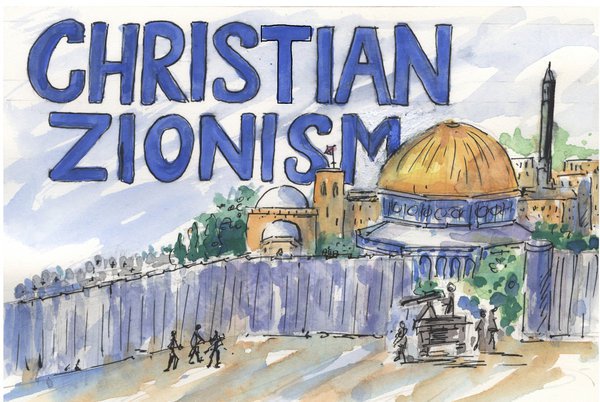
This is the theology of Christian Zionism, and it is now impacting U.S. foreign policy in tangible ways. This is the theology — an utter distortion of a peaceful Jesus — that leads to a distortion of the value of particular, Palestinian human lives. It leads to violence, injuries and deaths of Palestinians. And perhaps later, others too.
And in response to this, some just shrug with the assumption that these beloved lives are merely collateral damage in a process to initiate the Second Coming of this version of Jesus.
Well,
This is dangerous theology.
This is a dangerous way to view fellow human beings.
This is a dangerous way to enact violence.
And I could say, as I thoroughly believe, that the God of the Bible and the incarnate person of Jesus are all about peace, that the Book of Revelation is about the Roman Empire, and that ultimately, the texts of the Hebrew Bible and New Testament invite participation in the peaceable kingdom and beloved community.
But whether people hold that view, or believe in no God at all, what we have before us are human lives – lives made for value, worth, and flourishing; never slaughtering.
And we must lift up our voices and enact a vision that both upholds their value and initiates peace.
Last week, I happened to be out when I realized I needed a plastic fork. I had some leftover food that I wanted to eat, and since I didn’t have easy access to kitchens, I decided I needed to make a plan.
I noticed a coffee shop across the street. I thought I would wander in there, find something small to purchase, and additionally ask for a fork.
That’s what I did. I wandered inside, picked up a package of mini, chocolate-dipped sponge cakes, and I stood in the line. When it was my turn, the barista began to ring me up. That’s when I asked, “Oh, also, could I have a fork?”
“Yeah,” she said. She turned around, picked one up, and handed it to me. Suddenly, she realized I probably wasn’t going to eat this little snack with this little piece of cutlery. She realized I had come specifically for the fork.
“Oh, you know, you don’t have to buy this to have the fork. You can just have it.”
“Really?”
“Yeah.”
I mean, for a moment, I thought about how good mini, chocolate-dipped sponge cakes are. I also thought about how I didn’t really need them in the moment. I just thought about needing the fork.
And here she was, just giving it to me. Such a simple thing.
How often do we assume that interactions have to be transactional in some way?
Of course, sometimes baristas and managers think this themselves.
But sometimes, folks can just give away a fork. And sometimes, with gratitude, we can receive it. And that’s enough.
When we pulled into the driveway late last night, we had a laugh. “There they are! The dandelions!” we exclaimed while snickering. “It’s tradition!”
I resisted bursting into a certain song from Fiddler on the Roof, though I thought about it. Somehow, four years in a row, we’ve managed to be out of town the first week of May. And always — always — when we return home, we have an embarrassing amount of dandelions growing in our front yard. A couple of times in this four year period, we’ve returned home the second week of May, and then. . . Hooboy. I’ve always wondered if the lack of lawn care during our absence might have embarrassed our neighbors.
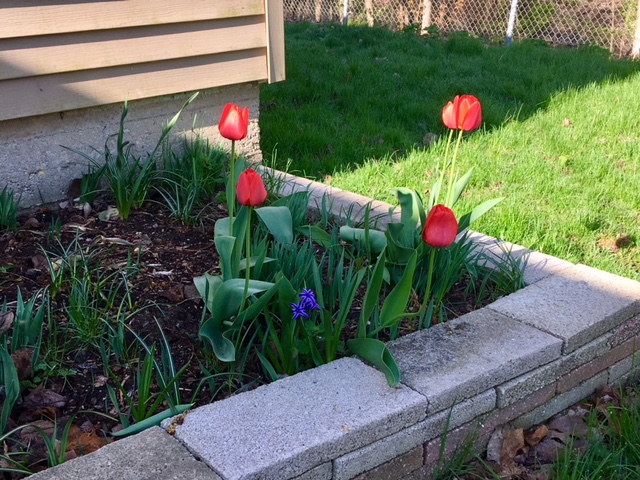
I’m not sure, but along with the absurd amount of dandelions, when we manage to come home at this time of year, we also see leaves for the first time! They’re just sprouting. And not only that: We are seeing the tulips in our backyard and the white blooms of bradford pear trees down the street. I’m sure there is more to discover throughout our town too (and on this 78 degree day. Yes!)
I’ll tell you, I’ve never appreciated spring to the degree I do now, and that is certainly linked to living in a space that favors a long, winter climate. Some of it is simply enjoying the warmer temperatures. But I love spring because you can see an obvious, visual expression of life claiming the space.
It’s a parable that writes itself.
And we need life to claim all kind of spaces — the anxiety, the grief, the hopelessness, the overwork, the boredom, the less-than-ness (internalized or wrongly proclaimed by others). We need this.
Dr. Michael Jinkins will soon retire as the President of Louisville Presbyterian Theological Seminary, but before he served there, he was Academic Dean of Austin Presbyterian Theological Seminary, where I studied. He was a great mentor and friend to me during those years. He used to say,
“You can’t really believe in resurrection.” He may have meant a couple of different things by this expression, but mostly, I think he was saying, while resurrection is something hoped for, it is hardly ever foreseen. In other words, resurrection is experienced and proclaimed more than believed. It’s hard to envision it beforehand; when life claims the space, it’s almost always a surprise.
Resurrection is hard to anticipate, especially in its specific forms. But when it comes, we experience it and proclaim it with a sense of wonder.
This, of course, is so obvious that it’s hardly worth being the topic of a blog post. But perhaps it’s obvious to the point that we could think about it more often. Maybe with some intention, we might feel greater hope too. Because….
What we do matters.
Now surely, some actions have bigger impacts than others. And when we move in directions we regret, we can always change course. After all, everything catalyzes everything, and our course correction shifts the whole. Even the recognition that we need a course correction had a catalyst. Something woke us up to that. And now the shift will have impacts too, creating space for new possibilities.
So back to this:
What we do matters.
We can trust that what we do – how we spend our time, how we speak, how we relate, how we create, how we care – it all matters.
Because it always initiates a sequence of effects, often well beyond what we might have imagined.
I am afraid of a harmless thing.
It looks like it could creep,
or bounce,
or pounce,
or charge awkwardly with its considerable appendages.
But it does none of these.
It stays in place all day long,
content to rest in a single crevice,
or reside in clumps of countless others.
It wishes me no harm;
likewise, I wish it no hurt.
Unlike curious schoolchildren at recess,
I will not examine it,
or smash it,
or dash it,
or remove any of its legs.
But –
I will stand irrationally in fear.
I will freeze in the presence of a childhood phobia.
No matter the logic:
“It can’t bite you,”
“It can’t poison you,”
“It can’t jump on you,”
I will cringe with revulsion and anxiety.
I am afraid of a harmless thing.
It makes me wonder. . .
When
the word can’t enters our thinking, or
the word won’t enters our hoping, or
the word don’t enters our dreaming,
perhaps we fear something harmless too?