The White Supremacy Within

CAWS

On Sunday, after the wake of the horrific display, violence, and terrorism of white supremacy in Charlottesville, the Collective Against White Supremacy in Ann Arbor released a statement that I’d like to share here as well. It is a reminder that white supremacy pervades through much of our collective American life. And it is important to remember that it is internalized within us. Anti-racist work is a lifetime effort of internal reflection and external action.

Statement from CAWS

Yesterday, hundreds of white supremacists gathered in Charlottesville wielding torches and nazi salutes and at the end of the day, one of their members drove his car into the crowd of Black Lives Matter activists and antifa, injuring many and killing a young member of the IWW, Heather Heyer. Today, folks across the United States and the world are saying “This is Not Us” and declaring the events Un-American.

We, the Collective Against White Supremacy (CAWS), a predominantly white group, denounce all forms of white supremacy and refute any claim that white supremacy is “not us.” We denounce not just the proud declarations of white superiority and dominance represented in Charlottesville yesterday, but the entire spectrum and multitude of white supremacy, from systematic oppression of Black folks through law and order, to classrooms that teach alternative histories in which Black folks and Native folks are only oppressed and never their own liberators, to white families sitting at dinner tables letting “casually racist” speech slide. We say that what happened in Charlottesville IS US. The foundations of social life and civil society in this country are racist. We, white organizers and white community members, contain multitudes of implicit and explicit racism through every day of our lives because it is how we were taught, how we were raised–it is in our good intentions, our yard signs, and our anti-racist rallies. To deny this is to challenge only the racism that is not within ourselves, allowing our own complicity to continue.

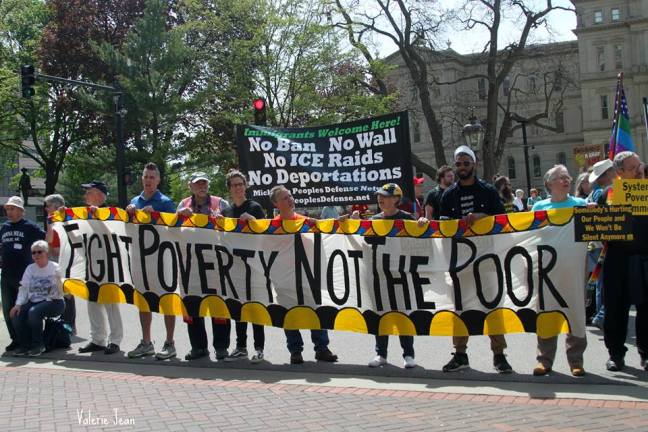
In Ann Arbor, white supremacy is the Alt-Right and Identity Evropa flyering on U-M’s campus. It is also Ann Arbor Police Department’s murder of Aura Rosser, a Black woman in crisis. White supremacy exists in historical gentrification all but demolishing the Black community in Ann arbor; in affordable housing budgets dependent on approval of funding of profitable downtown development projects; in the surveillance of housing insecure folks throughout public spaces in the city; and in the destruction of tent communities. White supremacy exists in the construction of pipelines over local lands and lakes, and in Ann Arbor activism declaring this “our land,” erasing Michigan’s Native populations, among the largest in the United States, and a long history of genocide and dispossession. White supremacy is in Ann Arbor City Council not approving a Citizens Oversight Board for Ann Arbor Police Department, it is in I.C.E. eating breakfast and then raiding Sava’s restaurant this spring, in I.C.E deporting Lourdes Salazar and Jose Luis Sanchez-Ronquillo this month, and I.C.E. consistently harassing mobile home communities. White supremacy is in U-M students of color being called racist for asking for a space to organize against white supremacy without being silenced by white people White supremacy is in the daily criminalization and targeting of youth of color by the police, then in inhumane sentencing and incarceration in our Juvenile Youth Center and Adult County Jail.

This is white supremacy under the guise of a wealthy white liberalism. This is white supremacy in our white people’s name. White supremacy lives within us, in our internalized racial superiority that manifests in the maintenance of a white supremacist system.

Let us be reminded of a long history of Black struggle with these words by Martin Luther King, Jr. from Birmingham, “I have almost reached the regrettable conclusion that the Negro’s great stumbling block in his stride toward freedom is not the White Citizen’s Counciler or the Ku Klux Klanner, but the white moderate, who is more devoted to “order” than to justice; who prefers a negative peace which is the absence of tension to a positive peace which is the presence of justice; who constantly says: “I agree with you in the goal you seek, but I cannot agree with your methods of direct action”; who paternalistically believes he can set the timetable for another man’s freedom; who lives by a mythical concept of time and who constantly advises the Negro to wait for a “more convenient season.” Shallow understanding from people of goodwill is more frustrating than absolute misunderstanding from people of ill will. Lukewarm acceptance is much more bewildering than outright rejection.” (Letter from a Birmingham Jail, 1963.)

We do not call for unity as that is asking for the status quo — we call for agitation and justice. This looks like:
— active life-long engagement from our fellow white folks committing to a LIFE of anti-racism.
— reparations (i.e. donate to Black-led organizations like BLM, to start)
— breaking white silence – talk to your white family and friends today, right now.
— educating yourself – sign up for an Undoing Racism workshop or organize a local reading group alongside folks who have been doing anti-racist work
— joining and/or showing solidarity with anti-fascist and anti-racist actions employing a variety of tactics aimed at dismantling white supremacy

What happened in Charlottesville is also “us,” in the sense that though we may have a lifetime of work to do to change the ecology of white supremacy in our social lives and our institutions, there will always be folks who stand in solidarity against the KKK, nazis, and the murder of Black and brown people in the name of law and order. Like the people of Charlottesville who faced armed white supremacists of many uniforms, who were doused with chemical weapons, struck with blunt objects, and charged with vehicles–we will look white supremacy in the eye, stand our ground, and state without hesitation that This is Us and we will root it out of ourselves with every ethical tactic that leads toward liberation.

Charlottesville

Today, we need to call it what it is: Terrorism.

That’s what happened in Charlottesville yesterday. It is rooted in centuries of internalized belief and externalized violence that white people and a myth of a white nation are inherently superior, and all people who we deem not “white,” (a reminder that “white” is a made-up category, though with disastrous effects), especially those with black and brown skin, are not fully human, not fully deserving, and not worthy of full empathy.

“Both sides” is garbage. Worse, it is dangerous fuel on the fire of white supremacy.

There was one side of violence yesterday when a white supremacist drove a car intentionally into a crowd, murdering a person with a name, a family, dreams, and a courageous conviction to be present; and injuring many more with names, families, dreams, and courageous convictions to be present.

There was one side of violence when clergy made themselves present yesterday — as they said, determined to be a presence of truthtelling and greater love — and were then met with brass knuckles and baseball bats. 

Folks may not like hearing their friends get angry on Facebook about the consequences of the last election, and that language may be strong. But you know why? Some fear for their very lives. Yesterday, we saw the clearest example of why this is so. Don’t “both sides” that. It’s a dangerous false equivalency.

Speaking out against racialized hatred and violence and standing up to it in self and community defense will never, ever, not for a moment, be a “both sides” situation. White supremacy is the catalyst, the motivation, and the actualization of a wave of terror taking place in our nation.

And in the wake of it, we better ask ourselves some challenging, internal questions.

Above all, in the wake of it, we have the crucial occasion to decide that we will stand definitively alongside the most marginalized people in our nation. 

“Both sides” is a great way to deny the reality of that marginalization, while pouring fuel on the lie that it actually belongs to people bearing torches.

Bunny Update!

On Tuesday, I wrote a piece about the two cottontail rabbits who have lived with us over the last three years.

Well, I need to update that because there’s a new, third bunny! Lita had a baby, and her little one emerged out of the nest yesterday.

This baby is tiny and remarkably unafraid of us. Last night, we sat on our deck, and she (they’ve been shes so far, so I’m just going with that) kept hopping closer and closer to us. At one point, she jumped right next to Ian’s shoe. We kept talking to her, and she was totally cool with us.

So welcome Lou into the world, short for Litalou.

And remember this too: Though the world may feel heavy at times, there are joys, surprises, and new life that cause us to feel a great sense of wonder.

Keep seeking those out.

Much love and many bunnies,

Renee

Who Is In Your Spiritual DNA?

DMA

I love to ponder this question: Who is present in your spiritual DNA?

Have you ever asked yourself this? I invite us to reflect upon it.

A multitude of people have shaped our deepest sense of meaning, belonging, and discovery. If we ask this question — who is present in my spiritual DNA? — I imagine that names people will quickly come to mind. . . Folks with whom we’ve had proximity. . . People who have loved us into being and invited us toward the Great Love in whom we live, and move, and have our being. . .

As we call them to mind, we easily feel gratitude.

And that gratitude can grow even larger when we ask this question: Who shaped these people? Who loved them into being, taught them that they have worth and value, and sent them in the direction of spiritual discovery? Because those people are in our Spiritual DNA too. Their presence is alive in us, even if we never met them.

I can think of a few people right away who are present in my life, perhaps in ways I am not always fully aware, because they shaped people who shaped me. Some died long before I could ever have the occasion to know them, but I feel that they directly impacted my life. I have deep gratitude for them.

And of course, there are so many names we will never know. A great mystery.

They way these people lived their lives. . . reached us. That’s pretty miraculous. And they couldn’t have predicted it either. That’s also miraculous. When they embarked upon meaning, belonging, and discovery, they opened a whole world of meaning, belonging, and discovery.

And we get to carry it on.

Renee Roederer

When Delight Finds Us

bunny

For three summers in a row, a bunny has taken up residence in our yard. Simply put, she delights us.

She started living among us when she took up residence under our deck during the Winter of 2015. When spring arrived, she emerged more often, and of course, she ate our grass to her fill. That entire spring and summer, we loved watching her. We took pictures of her. We talked to her. She became a bit of a character on Facebook.

This bunny loved to spend time under our rose of sharon bushes, so we named her Rosa. And though we seemed silly with our smitten love for a pet yard bunny, I will tell you honestly that she gave us so much joy.

For a few months during next the Fall and Winter, she left us for a bit. But that next spring, she returned. At first, we decided she was “the same bunny.” But after watching her behaviors and interaction with the yard, it became pretty clear that this was really Rosa. After her return, she gave us another surprise too (though with cottontail rabbits, is this really surprising?) She had a baby. Smitten weirdos that we are, we named this bunny Rosalita and started calling her Lita for short.

Well, here we are three summers later, and our bunny is still with us. Truth be told, we don’t know if this is Rosa or Lita this time, but she is not very nervous around us, so she’s very likely one of the originals. We’ve decided she’s Lita.

And guess what? We take pictures of her. We talk to her. Occasionally, I put her on Facebook.

And from time to time, I occasionally think about this too:

This bunny has no idea about our lives. She recognizes us visually and knows our voices, but she has no earthly clue about the larger picture of our lives. She doesn’t know that we have names, work rhythms, or larger community connections. She doesn’t know that there is such a thing as Facebook.

But we delight in her, and I think that somehow matters.

She gives us delight, and we send that energy of delight back to her. Does it affect her? I like to think so. Deep down, in a way I don’t understand, I think it probably does.

And that makes me wonder. . . ? Who or what delights in us? Perhaps in ways that we can barely understand? Perhaps from a larger reality that we can barely intuit?

And who do we actually know with names and work rhythms and larger community connections — people who delight in us? Even across distance?

What a gift that delight must be. It must affect us somehow, even if it’s outside of our awareness.

How much more if we bring it into our awareness?

Renee Roederer

You Are Special. So Is This Day.

img_8347

Many people are familiar with Fred Rogers’ opening song on Mr. Rogers Neighborhood.

Won’t you please?
Won’t you please?
Please won’t you be my neighbor?

But are you also familiar with his closing song?

If it’s been a while, I invite you to have a watch: It’s Such a Good Feeling. Every single day, Fred Rogers closed his show by saying words like these:

“You always make each day so special. You know how? By just you’re being you. Only one person in the whole world like you! That’s you yourself. I’ll be back next time!”

I know we’re all adults, but maybe we need to hear that again. Frankly, I think we always need to hear such encouraging words, experiencing our value as it is mirrored and modeled to us in relationships. Plus, it’s flat out true. You are the only person in the whole world just like you, and honestly, that’s pretty incredible.

So here we are on a new day.

When we begin a new day, we can dedicate ourselves to it. Likewise, we can dedicate that day toward ourselves and others, prepared to live it in community and learn from what it reveals. And we can commit to sharing the truth of the worth and value found within our neighbors.

Now maybe all of this seems remarkably trite or just too simple in a world that feels particularly fraught right now. I don’t doubt that the world and its challenges are quite complicated. But even though it may be more complex than this, it’s also never not about this:

You matter.
Our neighbors matter.

So how will you live this day?

Renee Roederer


This I Belove. . .

belove.jpg

[I found this tattoo image here.]

Over time, particularly in Western cultures, the word believe has become quite narrowed in its meaning. For instance, when people hear the word believe used in the context of Christianity —

. . . I believe in God.

. . . Do you believe in Jesus?

. . . I believe what the Bible says.

. . . Do you believe in heaven? —

people typically understand the word believe to mean “intellectual assent to a propositional idea.” In that framework, people consider these statements and questions, and then choose to affirm or reject them as logical possibilities.

But what if that’s too narrow a definition of the word believe?

The English word believe has been shaped greatly by the frameworks of the Enlightenment and Modernism. The words of the Hebrew Bible and Greek New Testament, however, speak of something quite different in their original languages.

These are words of the heart. . . words of will. . . and words of action. The words that often get translated into the English word believe are actually verbs of love, devotion, trust, purpose, and action.

Recently, I was reading Christianity After Religion: The End of Church and the Birth of a New Spiritual Awakening by Diana Butler-Bass. (Great book. Check it out.) She suggests that if we want to best translate these verbs into English, it would be better to use a word like Belove. . .

. . . I belove God.

. . . Do you belove from Jesus?

. . . I belove the way of love that the Bible reveals.

. . . Do you belove toward the Transformation of All Things?

Of course, these sentences I’ve created are remarkably clunky. But they cast a different vision entirely, don’t they?

The life of faith is not some intellectual, get-it-right-or-else game, working to conform the intellect (and in some instances, stretch it to incredulity) toward a set of particular propositional affirmations. It is not an endeavor to complete a holy, ‘check yes’ list and thus secure a key to a distant, heavenly future – the ultimate fire insurance.

The life of faith is much deeper.

It is love of God — Love itself, revealed among us,

– and –

It is love of Neighbor — Love itself, enacted between us.

This I belove.

Renee Roederer


Straight from the Vine

mater

“I can do that right now. . . Straight from the vine.

This thought suddenly emerged in my mind. So with a skip in my step, I just went and did it.

Without a second thought, I stepped out my back door, walked right up next to the plant, and received a new tomato. Straight off the vine. I held it in my hands, tenderly touching the texture of its skin – smooth with a thin layer of dirt. I breathed in its scent, smelling the perfect blend of summer and soil.

I stepped back inside, washed it, and then. . .

I tasted it.

I. tasted. it. 

And it was glorious. The vibrancy of its flavor. The immediacy of its availability. The connection to the earth. The recognition of life.

And that’s honestly how I felt in a tiny, summer gesture: Alive.

This made me wonder. . . how many other moments of life might be cultivated today? Straight off the vine?

Laughter with a friend . . .
straight to the source of connection.

Tears shed for others . . .
straight to the source of solidarity.

The emergence of a new question. . .
straight to the source of calling.

The refusal to be a bystander. . .
straight to the source of communal action.

The determination to choose aliveness. . .
straight to the Source of Life,
The Ground of Being.

All of these. . . and more.

What else? What might we cultivate on this day?

Renee Roederer


The Place That Calls You

prisma

On Friday, Saturday, and Sunday night, I ended up taking walks in downtown Ann Arbor. It was a small thing, but it transformed my whole weekend.

As Friday evening arrived, I realized it was time for me to step away from the smartphone for a while. Perhaps you were following along. . . The news was wild last week. Every single day, there seemed to be some sort of bombshell; some outrageously inappropriate, dangerous speech; or some person voted off of a White House island. I shouldn’t even say or. I should say and. Each day had multiple iterations of these.

After following all of that, I put the news away for a while. I decided to take a walk downtown and on the University of Michigan campus. That truly transformed my weekend.

People were walking along the sidewalks and eating in outdoor cafés. Folks were laughing. All ages were present. People were talking to each other, including complete strangers. That first night, I ended up having four conversations with people I had never met. The energy was alive. It really filled me.

And my town is no paragon of perfection. People struggle here too. In fact, half of the conversations I had Friday night were precisely about that. The occasion of being present downtown and on campus allowed us to talk openly about this. These realities need to be shared and shifted.

Present among it all, recognizing its gifts and its challenges, I realized how deeply I feel called to Ann Arbor as a place. I feel so alive when I am in the presence of the people who live in this place.

It is a gift when place calls us. 

How often do we let ourselves feel this — deep, rich connection to a place? How often do we seek it out?

Perhaps too often, place can become a dull backdrop to the rat race we run. Gotta be here. . . Gotta be there. . . I have this deadline. . . And that deadline. At times, it fades as we get stuck in our own heads, ruminating about the news, anxious about our inner conflicts — unaware of our bodies, unaware of nature, unaware of each other.

But when we are awake to it,
A place can call us to gratitude.
A place can call us to collective action.
A place can summon us toward one another.

And there are times when we need it to transform us.

Renee Roederer


Fresh Start: Grounding

plant

Have you heard of the Fresh Start Effect? It’s the idea that smaller markers of time can serve as openings to ask new questions, initiate new practices, or work toward new goals. Many people set aims like these when they make New Year’s Resolutions, but these can often be even more life-giving on smaller scales – days, weeks, and months.

Today is a new month.

Would you like to sit with a new question, try a practice for 31 days, or perhaps name August as the template for completing a step toward a larger goal? We have such an opening today.

This month, I am going to ask myself these three questions quite often:

1) What do I need to release to be grounded in this moment? 

In the midst of national chaos, we can easily lose awareness of our connection to what’s larger. If I set purposeful intention to recognize connections to the bigger picture — God, often called the Ground of Being. . . Community. . . Calling. . . Purpose. . . Vision. . . I feel less limited by the chaos and more equipped to respond to it.

We may need moments of silence to come into grounding, a practice to recognize these larger connections. We certainly need moments where we can step away from our cerebral rumination of anxieties. When we step away, we initiate different ways of thinking which allow us to gain intuition. Intuition is a gift that strengthens us and our larger communities.

2) What do I need to release to enjoy this moment?

I also want to be present to the moment. The same types of chaos can pull us away from the enjoyment of everyday activities and the presence of people right in front of us. These moments are gifts, and they can connect us to the sense of what’s larger too.

The release question is also a good one. . .  If we ask this, we may discover that we can’t feel enjoyment right now, and that’s okay. There are moments when we naturally feel sadness, anger, confusion, and more. When we release these, we choose to feel our emotions and express them. We may invite moments and people to share in them as well. And this opens up space to feel joy again.

3) What do I need to release in order to be alive toward others in this moment?

Aware of the larger connections, how do I then act from this grounding? I want to be more alive toward others. The life we receive can inform the life we give.

In a time of chaos, we want to choose action over inaction. But what kind of action? To quote Richard Rohr, I find that I am best empowered to act when my actions are aligned with contemplation — that is, when I am engaging intentional processes to tap into connections with the larger picture. I need to release all the things that act as barriers to this.

After all, I best act alongside my neighbors when I am aware of my deeper connection to my neighbors  — when I prioritize the recognition of who they are along with the intrinsic value and worth they have as people.

These are my questions for the month. Do you have guiding questions?

Here is a hymn text I love quite a bit. The words are written by Shirley Erena Murray, and here’s a recording. Perhaps these words are a good guide.

Come and Find the Quiet Center

Come and find the quiet center
in the crowded life we lead,
find the room for hope to enter,
find the frame where we are freed:
Clear the chaos and the clutter,
clear our eyes that we can see
all the things that really matter,
be at peace, and simply be.

Silence is a friend who claims us,
cools the heat and slows the pace,
God it is who speaks and names us,
knows our being, touches base,
making space within our thinking,
lifting shades to show the sun,
raising courage when we’re shrinking,
finding scope for faith begun.

In the Spirit let us travel,
open to each other’s pain,
let our loves and fears unravel,
celebrate the space we gain:
There’s a place for deepest dreaming,
there’s a time for heart to care,
in the Spirit’s lively scheming
there is always room to spare.

Renee Roederer