I Am Afraid of a Harmless Thing

ddll

[1]

I am afraid of a harmless thing.
It looks like it could creep,
or bounce,
or pounce,
or charge awkwardly with its considerable appendages.

But it does none of these.
It stays in place all day long,
content to rest in a single crevice,
or reside in clumps of countless others.

It wishes me no harm;
likewise, I wish it no hurt.
Unlike curious schoolchildren at recess,
I will not examine it,
or smash it,
or dash it,
or remove any of its legs.

But –
I will stand irrationally in fear.
I will freeze in the presence of a childhood phobia.
No matter the logic:
“It can’t bite you,”
“It can’t poison you,”
“It can’t jump on you,”
I will cringe with revulsion and anxiety.
I am afraid of a harmless thing.

It makes me wonder. . .

When
the word can’t enters our thinking, or
the word won’t enters our hoping, or
the word don’t enters our dreaming,
perhaps we fear something harmless too?

Renee Roederer

[1] Photo Credit: Mehran Moghtadai/Arad/Wikipedia

Living in The Now

joshua

Years ago, my husband Ian and I took a trip to the gorgeous and unique terrain of Joshua Tree National Park. There were many beautiful landscapes to savor with our eyes, but when we first arrived, I struggled to concentrate.

I had left town with a personal conflict unresolved, and while away in the desert, I had limited cell phone access to bring it to resolution. At this point, there was very little I could do about it but wait.

Looking back now, it was a relatively small issue, and it all turned out fine. But at the time, I could not stop thinking about it. I was in the presence of so much beauty, but I continued to focus on the situation that was causing me the most stress and anxiety. As we human beings are so prone to do, I could not live in the moment at hand right before me.

Dr. Ellen Langer, prolific scholar and researcher on mindfulness, uses a particular phrase to describe this kind of experience. She says that so frequently, we live in a perpetual state of constant partial attention. 

Constant partial attention. . . Isn’t that a perfect way to describe this kind of experience? So often, we move through our days simply going through the motions, rarely paying attention to what is right in front of us. Instead, our minds gravitate toward our to-do lists and the situations that make us most anxious. We get stuck mulling over the past or worrying about our imagined future. In the process, we miss the present moment.

And this is nothing short of tragic, because there is much to experience right before us! The present moment is a holy doorway: Through it, we can connect more fully with our surroundings, our inner life, our neighbors, and the deep stirrings of the Spirit.

It’s all right there before us,
a veritable feast for all our senses.
But so often, we settle for constant partial attention.

Poet Elizabeth Barrett Browning has a creative way of capturing this as well. She says,

Earth’s crammed with heaven,
And every common bush afire with God,
But only he who sees takes off his shoes;
The rest sit round and pluck blackberries. [1]

Those are true, creative words which inspire us toward recognition.

During that trip to Joshua Tree National Park, I knew I could no longer fixate upon a conflict I could not change. So I invented a practice which served me well for the rest of our trip. Five years later, I still return to it.

I call it Now-ing.

Now-ing can serve as a spiritual practice or even game of sorts. It has two basic rules:

  1. Pay attention to what is around you. Take time to notice more deeply. See, hear, and smell the scenery. Feel the wind blowing. Notice the people around you. Experience gratitude.
  2. Only think about or ponder a) what is right in front of you and/or b) something one reminder away. For example, we can think about a tree in front of us and/or what the tree reminds us of. A tree might remind us of a memory, a hope, a person, or something else. It might even wake us up to a new idea or direction. All of that can be pondered and savored along with the tree.

But! In this game, our thoughts can only move one segue away. There is no need to turn this into a string of thoughts which will take us away from the present moment and what is presently before us, i.e.
the tree in front of you,
reminds you of a memory, which
reminds you of your second-cousin, which
reminds you that you need to make a phone call, which
reminds you of all the unanswered emails, which
reminds you of your workplace, which
reminds you of your workplace bully, which
reminds you of your long-lasting sense of insecurity. . .

or whatever that string may be.

When Now-ing, if we go to a place like that, we can gently bring ourselves back to the present moment and its surroundings with no judgment. This can be practiced again and again. There is no failing. It is a spiritual practice and game that we can’t lose.

Instead, with the present moment gifting us all the time, there is only room to gain.

Renee Roederer

Mother’s Day: It’s Complicated

[1]

Each year when Mother’s Day rolls around, I celebrate a number of formative, loving people who have nurtured me into being in variety of beautiful ways. I find myself deeply grateful that all these individuals and communities have come into my life.

I also recognize that this day can be very complex and deeply painful for many as we remember mothers and children who have died, ponder struggles with infertility, deal with painful memories, or grapple with separations and estrangements.

If you find yourself grieving or longing today, please know you’re not alone. Today, I’ve listed a number of excellent links that bring home just how complex this day can be.

You are loved.

A Mother’s Day Blessing For All

Reconsidering Mother’s Day

Being a Mom Without a Mom

Being the Mother of a Child Who Died – On Mother’s Day

‘This will all be worth it’; The Silent Cost of Infertility

The Peculiar Grief of the Adult Orphan

5 Reasons Why It’s OK If You Don’t Want Children

Unhappy Mother’s Day: My Mother Was Abusive

A Vision

[1] I found this image here.

Unpopular Opinion? Westminster Abbey Made Me Angry (at least at first)

Over the years, I’ve spent a lot of time with college students, and many of them use a social media app called Yik Yak to post snippets of their thoughts anonymously (for good and for ill, by the way). They do this in 200 characters or less, and like all forms of social media, certain genres have emerged in the posts.

For instance, Yik Yak users will sometimes begin a post (called a yak) with the words, “Unpopular Opinion.” They’ll follow these words with a colon and then express some personal opinion they believe is held in the minority. These can be pretty uncontroversial at times, like. . .

Unpopular Opinion: Donald Trump’s hair is GREEEAAAAT.

At other times, these kinds of yaks express serious concerns. They raise questions and get a conversation going. Sometimes, they stoke a debate.

I found myself thinking of this yesterday while traipsing around London, particularly as I walked through Westminster Abbey. When I saw all that was inside, I felt an “unpopular opinion” emerge inside of me. Westminster Abbey made me really angry, at least at first.

While walking through, I was instantly aware of the historical richness of this place. The building itself is 771 years old, and it serves as the burial place for many authoritative people. When tourists walk through Westminster Abbey, they do not merely view significant items. They view time as they walk through centuries of influential people and events.


It was quite incredible to see the burial places of King Edward I, Queen Elizabeth I, Queen Mary I, and Mary Queen of Scots, along with poets and composers whose works I admire. It was also stunning to see all of this collected in one place.

But instantly, I felt overwhelmed at the strong fusion of religion and empire. The placards gave such an air of superiority, all with the blessing of God, and very quickly, I found myself angry.

I did not expect to have such an experience, but I’m glad I did.

I know that many people have had profound experiences of worship and insight in Westminster Abbey, and I do not deny these. Perhaps on another day, I might have had the same.

My unpopular opinion did not so much place me in a debate over and against others, as much as it raised a number of questions (and perhaps even a debate) inside myself. It is true that I held the opinion, but the questions within it were asked directly of me and my own Euro-American cultural background.

I was floored at the air of superiority and military might in the building. This should not necessarily be surprising since the Abbey contains hundreds of years of history, and that history includes conquest, empire, and colonialism. When reading the placards, tourists hear the very voices of people who produced and supported all of these.

And to be a bit fair, I wondered, “Before globalism, was there any culture that did not think itself unique, dominant, or supreme, at least on some level?”

But at the same time, I am aware that white supremacy in particular  has unleashed a depth of pain, destruction, and devastation around our globe, and likely, my knowledge of this just scratches the surface of its reality. Though the place is genuinely incredible, this awareness made me angry inside Westminster Abbey, and I was soon asking challenging questions of myself.

This feeling continued throughout, but for one moment, it was interrupted by another experience, and it gave me hope. A faith leader interrupted the hustle and bustle of all the tourists and spoke to us over an intercom. He reminded us all that this is a place of prayer and connection, and he asked us all to stand still wherever we were. Then, he began to pray for refugees all around the world.

We stood still, and we remembered that we belong to each other, that all human beings have value, and we all have a responsibility to work for a world where no one is dominating others out their homelands or opportunities for a meaningful life.

If we would work toward that, I thought, in small, unseen, everyday acts and in large scale global changes, our human cathedral would tell a better, longer-lasting story.

Renee Roederer

Never Settle For Toast When You Can Have the Full Spread

People often say that breakfast is the most important meal of the day. When it comes to designing a tasty, healthy breakfast in the morning, some days I do better than others. But even on my best days, I’ve never come close to designing the glory that is the German breakfast.

Have you ever had this experience? A German breakfast? Perhaps while traveling or staying with German friends, you have seen this morning spread in action. Simply put, nobody does breakfast quite like the Germans.

I woke up in a hotel in Heidelberg, Germany this morning, and it is truly a great gift to be here. My husband is giving an astronomy lecture at Universität Heidelberg this evening, and we used some airline miles for me to tag along. This city is completely gorgeous.

21

I look forward to exploring it even more.

Before exploring, however, when our morning began today, we wandered downstairs for breakfast. I knew it would be spectacular. Even anticipating it, I still geeked out. There was a glorious spread of breads, fruits, cheeses, fruit jellies, and of course, Nutella. This puts America’s complementary breakfasts completely to shame. There were so many palettes and choices.

3

(That photo is just one side. There were many types of bread and jam on the other side).

And in the midst of all of this, there was also . . . TOAST.

4

And that reminds me of a sweet and funny story.

In college, I had the wonderful opportunity to travel to Germany to sing. I used to sing with the Cardinal Singers of the University of Louisville, and three years in a row, we came to Germany to sing in choral competitions. (Did you know there was such a thing as the Choir Olympics? No swimming, figure skating, or diving, but choirs compete in various styles of music. We went to Bremen in 2004 and won three gold medals. It was one of the greatest adventures of our lives! But that story is for another day.)

In the midst of these trips, one year, we competed in a town with a long, quintessentially German-sounding name: Limburg-Lindenholzhausen. Go ahead and try to say it. It’s fun. And while we were there, we stayed with families who lived in a town nearby. It has a short, quintessentially German-sounding name: Staudt. Go ahead and say that too, because it’s also fun. (Pronounced Shtowt).

We were hosted by members of the men’s choir in Staut along with their families. Every day, we woke up to that glorious German breakfast spread, and it was perfect. In my mid-30s, I still thoroughly enjoy this experience, but as college students, we were ecstatic eaters of all these delicious options.

And while we were savoring it all each morning, without fail, our hosts always asked us,
“Would you like some toast?”

We always said something like,
“No, thank you. We have all of this, and it’s wonderful!”

Then they would always ask a second or even third time,
“Are you sure you wouldn’t like any toast?”

Again, we would kindly refuse and thank them, always with this implication: “Why would we need toast when we have the most glorious breakfast of our whole lives right in front of us?”

Two or three members of our choir stayed in each home. When we were together again and comparing stories of our homestays, we realized we had all experienced the same, daily toast ritual. After this happened several consecutive days in a row, finally one of our singers learned the real story behind the question.

These very hospitable families heard that Americans like toast a lot, so. . . every single family went out and bought toasters. Just for our visit!

That’s such a dear, little memory. We laughed hard when we figured it out. It was so kind of the Staut folks to buy us toasters. I’m just sad we never gave them the opportunity to use their new appliances.

And there it was again today in all caps:
TOAST. 

4

The moral of the story is this:

Always give people the opportunity to share their hospitality, but also,
never settle only for toast when you can have the full spread.

Renee Roederer

When We Rise

walking[1]

This sermon was preached at St. Andrew’s Presbyterian Church in Dearborn Heights, Michigan and was focused upon the story that is told in John 5:1-9.  The audio recording is above and a written manuscript is below.

John 5:1-9

This story has a happy ending.  A man stands up, takes his mat, and walks. He is well, and this is the first time that has been true in at least 38 years. The story has a happy ending, as they say.  In the end, it is miraculous and freeing.

But we know behind that number – 38 – there are more stories to be told. Years of them.  Decades of them.  None of these stories are spelled out in detail for us here. They are only hinted or implied. We’re left to wonder, but 38 years is a tremendously long stretch of time to be in one place.  That’s how long this man has laid at the Sheep’s Gate in Jerusalem.  There is a pool there, and this man has been in the presence of many others who are lying there too. They have disabilities or chronic illnesses. Together, they wait there. Together, they try to hope for more, but together, maybe each one feels horrifically alone.

The story says that within these five porticos by the pool there lay “many invalids.” Invalids.  That’s another way of saying In-valid.[2] That’s how others thought of these people lying by the pool. They were in-valid. That kind of designation must have loomed large over 38 years of lying at the same pool. Behind the story with a happy ending remains many other stories, and perhaps over time, those stories weaved together to form one overarching narrative. That narrative told a daily story of being left behind, stigmatized, and considered to have less worth.

I wonder how this man internalized such a narrative.  . . Is that what he began to believe about himself? That he was no longer a beloved child of God with infinite worth, but instead, simply one who is in-valid? One who has no hope? One who is just waiting because he no longer believes he can affect the reality he is living?

I’m intrigued by the way Jesus approaches this man. Perhaps Jesus knew that this narrative was at play. Maybe he knew that it had been internalized, and the man now fully believed it. Because Jesus begins with a question. The question might sound a bit pointed because it was dealing with a serious matter, but I think it was spoken with compassion. Jesus gets straight to the point: “Do you want to be made well?”

Do you? It’s a good question, isn’t it? It’s certainly honest one. Sometimes, when we’ve carried a narrative like the one this man was carrying, that narrative begins to infect our entire reality. A child psychologist and author named Bruce Perry says it this way: “We tend to prefer the certainty of misery to the misery of uncertainty.” [3]

We tend to prefer the certainty of misery to the misery of uncertainty.

After we’ve lived with it for a good while, misery can start to feel rather normal. After a while, we might lose any belief that our lives can change for the better, and that reality is sometimes preferable to the misery of uncertainty.  After all, if we allow hope to creep in just a little, it feels uncertain. We don’t know if we can trust it. And that feels precarious.

After misery has become so normalized, Jesus asks a good question: “Do you want to be made well?”

And that’s when the story pours out, not with many words but with emotion for Jesus to see.  The man doesn’t give a ‘yes’ or ‘no’ answer. Instead, he says, “Sir, I have no one to put me into the pool when the water is stirred up; and while I am making my way, someone else steps down ahead of me.” This man has been waiting. He feels forgotten. He thinks he’ll never make it. He thinks new life is impossible.

There was a belief about this pool by the Sheep Gate. In fact, it may be reason why so many people were lying there. There was a belief that once per day, angels would stir the waters of the pool, and the first person to make it into the pool would be healed. This man was never the first one to make it in, and as he said, there was no one to help him make it in. So day by day, he sat in the same place, wondering if there could ever be another outcome.

On this day, there was. And it looked different than anything the man had anticipated before.  When Jesus encountered this man, he didn’t heal him instantly and just walk on. He asked a question: “Do you want to be made well?”

In asking that question, Jesus dared to see the misery for what it was. Jesus chose to be with this person in his suffering, and there was healing in that very act.

I also notice that Jesus didn’t just pick this man up and put him in the pool. He didn’t feed into the narrative that this man had been living for so long. Instead, with great love — having seen the misery for what it was, and even more, having seen this man for the beloved child of God he is – Jesus said freeing words.

“Stand up, take your mat, and walk.”

This was not some, “Pull yourself up by your own bootstraps,” kind of message. Jesus was not saying that this man had to do it all on his own. No, it was the complete opposite. Instead, Jesus was so profoundly with this man. Jesus stood in the presence of the misery and suffering he was living, and that connection transformed some of the deep pain he was carrying. Jesus nudged the man to leave the old story behind. “Stand up, take your mat, and walk.”

And he did.

Perhaps the man wobbled a bit. We don’t know.
Perhaps his heart felt unsteady as he dared to trust.
But he took the first step toward a new story.
In the presence of Jesus, this man was raised to new life.

We are hearing this story on the sixth Sunday of Easter. Easter isn’t just one day of the year. It is a season in the Christian calendar. And of course, each Sunday is a celebration of the resurrection of Jesus.

In the season of Easter, we hear stories of Jesus making appearances to his disciples after the tomb was found to be empty. We hear stories of disciples encountering Jesus in unexpected ways. We hear stories of disciples waiting for the coming of the Holy Spirit.

But suddenly, in the sixth week of Easter, we get this story.

We get this story all the way back in the 5th chapter of John with so many more chapters to go before we ever experience the death and resurrection of Jesus. So why is this story an Easter text?

I think it has to do with our resurrection.

Because —
in the presence of the Living Christ,
in the presence of God with Us,
in the presence of Resurrection itself,
we too are called to new life.

This has to do with our resurrection.

Our form of healing might not end as dramatically as it does in this story, and we may continue to carry challenges, illnesses, and painful memories. These are a part of life. But living as followers of Jesus means that we too are raised to new life. It means that we are living a different story. We can live a different narrative than the ones that shaped us in the past, sometimes marking our lives for misery.

We can walk away from those miserable stories.
We have been carrying them for years, but we can let them go in the presence of the Risen Christ.

Maybe we’ve carried a story which tells us we are in-valid.
Maybe we’ve carried a story which tells us we aren’t worth very much.
Maybe we’ve carried a story which tells us that don’t have what it takes to change.
Maybe we’ve carried a story which tells us we can never be forgiven.

Whatever the story is,
today we are called to leave it behind,
to stand up, take our mat, and walk differently,
to embrace uncertainty because it this kind of trust leads to new life.

In Jesus, we see one who looks us in the eyes, choosing to see suffering and pain for what it truly is. This one stands before us, knowing our own suffering and pain as well as the suffering and pain of the entire world. In Jesus, we see one who has suffered and died with and for us.

And in the very same Jesus, we see one raised to new life. In the presence of God, we are also called to resurrection.

So what do you need to leave behind, and how will you walk forward today?

Renee Roederer

[1] Photo Credit: This image is a public domain photo at Pixabay

[2] Years ago, I heard the Rev. Ben Johnston-Krase, Co-planter of Farm Church, call attention to the double meaning of the word ‘invalid’ in a sermon he preached on this passage.

[3] Bruce Perry shared this quote in The Boy Who Was Raised as a Dog: And Other Stories from a Child Psychiatrist’s Notebook — What Traumatized Children Can Teach Us About Loss, Love, and Healing.

The Time My Aunt Derailed a White Supremacy Rally

In February, I took a road trip to Atlanta for a conference, and along the way, I had the chance to stay overnight in Knoxville with Laurie Knox. (Clearly, her last name brought her to the right town). She is my husband’s aunt. Along with the rest of Ian’s family, I have known Laurie since I was 17 years old, so she definitely feels like my aunt too.

During my stay, she gave me a walking tour of downtown Knoxville, and we made several stops. We had pizza and wine at a table outside, and with no shame, we sang along with the panhandling musician just fifteen feet away. (I promise it wasn’t the wine. Truly a lack of shame. And he enjoyed our harmonies).

But the best moment happened when we completely surprised each other with a level of recognition that neither of us expected. When we turned a particular corner, Laurie started telling me a story. She said that years ago at this very spot, she and others had dressed up as clowns to playfully resist a white supremacy rally.

She had not gotten very far into the story before I completely geeked out and interrupted her. “Oh my goodness! Wait, you were there? You were one of the White Flour people?”

I could hardly believe it, and I was stunned and delighted. David LaMotte, a phenomenal musician and peace activist, wrote a poem about this very moment, and I’ve known and shared that poem for years. How could I not know Laurie had helped create this powerful experience?

Here’s the experience itself:

On a day when the KKK came to Knoxville to hold a white supremacy rally, other folks in Knoxville came to the event dressed as clowns. And every time the KKK leaders of the rally shouted terrible, fearful phrases like, “White power!” the clowns pretended to misunderstand what they had said.

“White flour!” the clowns shouted playfully in response, tossing actual flour into the air all over everyone. They continued this approach throughout the rally, constantly “misunderstanding” the message and responding with playful protest. It was quite clever.

But most of all, it was powerful. Their presence took over the entire rally. As they clowned around, others began to join in too, and they transformed the energy of the space to the point that the KKK had to stop entirely, pack up, and go. These clowns transformed the spirit and message of the day.

My aunt was one of those people, and I didn’t even know it.
I am so grateful and proud of her.

I was able to surprise her too because I already knew a bit about this story. Back in 2012, David LaMotte launched a Kickstarter campaign to transform his poem, “White Flour,” into a children’s book. I contributed to that campaign, and I’ve shared the book and the video above with others (definitely check it out).

I had no idea she created this moment, and
she had no idea that David LaMotte created it into a book.

We surprised each other on that walking tour of Knoxville.

No matter how long we’ve been in relationship with people, we can still surprise one another. And no matter what challenges come our direction – including toward our town – we can still surprise one another with the power of relationships.

Renee Roederer

WhiteFlour_cover-300x240.jpg


Connections Abound (Even in Trader Joe’s!)

TJs

I remember the first time I ever stepped inside a Trader Joe’s. I was with some friends in Milwaukee, and they stopped to pick up a few food staples. 

Right away, I knew this store was different. Almost every item had the Trader Joe’s label, and the Hawaiian-shirt-clad staff genuinely seemed eager to check our groceries and place them efficiently into brown paper bags.

While we were in the store, Gloria Estefan’s “1, 2, 3” started playing loudly through the speakers, adding energy to the room. My friend then leaned over and said, “What if everyone in this store – every single person right now – just started dancing to this?” Then he demonstrated a dorky dance move, shifting to the beat. It was silly, and I laughed hard.

For the rest of our time in the store, I enjoyed imagining this ridiculous scenario. People came into the store that day thinking they would simply push a cart and check items off of a grocery list, but little did they know. . . this very day they would become co-stars in Trader Joe’s: The Musical!

It was enjoyable to imagine.

Back then, Trader Joe’s was a complete novelty to me. Now it is my most frequent grocery destination. I love it, and I would be so sad if we ever moved to a town that doesn’t have one.

I hadn’t thought of this memory in for a long time, but it popped in my head a few days ago while I was in the Ann Arbor store. That’s because a number of fun connections emerged while I was the one simply pushing a cart and checking items off a grocery list.

When I got to the produce section, a toddler sat in the front of his own cart and boldly introduced himself to me. “HIIIIIII!” he exclaimed with joyful abandon. I said the same to him and waved with a smile. 

Lest I think I was completely special, however, this toddler continued to exclaim, “HIIIIIII!”to every single person he encountered. Every single one. I think it annoyed his Mom a little bit, and if I was much closer to him in proximity, I would probably feel that way too. But instead, I got to keep smiling, because no matter what aisle I was in, I heard this kid greeting everyone. His voice faded with distance, but I could still hear it – a continuous, little kid refrain.

Not much later, I heard another continuous refrain. Brice, one of the staff members, was asking every single customer who came through his checkout lane, “So what was the most exciting thing that happened in your day?” The question was intentionally the same each time, but I bet he heard lots of different kinds of stories.

And then, as if the universe already knew I was recalling that memory from Milwaukee, I stood in Brice’s lane myself, probably three people away from hearing the question directed at me. And I kid you not, the man directly in front of me who was waiting there too, started dancing. He started bouncing back and forth dorkily (maybe mindlessly but definitely to the beat of the music) and it was wonderful. 

We human beings are connected, and these connections can literally find us anywhere in large and small ways. Even in a neighborhood grocery store. 

So we might as well seek them out and join the dorky dance.

Renee Roederer

Super Bowl: When Prince Performed ‘Purple Rain’ in a Downpour of Rain

Yesterday, a Youtube video of Prince’s 2007 Super Bowl performance made a resurgence as people passed it around social media and remembered his great life and presence. And I cannot get enough of this video.

I cannot get enough of it as a moment.

What I mean is that some elements of the experience happened apart from anyone’s decision or control. Namely, lots and lots of rain. But Prince and his team also embraced those elements to synergize a moment of creativity, connection, and electrifying energy. At Super Bowl XLI, Prince sang ‘Purple Rain’ in an absolute downpour. It was magical.

Along with sections of the performance itself, the video above includes interviews with Half Time Show designers and managers. They agree this performance was truly  a remarkable moment. In their own words, they share what made them so impressed:

Prince embraced a situation of potential inconvenience,
and completely transformed it.

Prince demonstrated confidence on the stage,
and performed music written by others.

Prince rolled with a great deal of spontaneity,
and launched it into the world as if this is exactly what should happen.

It all leads to the finale. As Prince wraps up “The Best of You” by Foo Fighters, he flashes this foreshadowing look across his face that something special is about to happen. And then it does. Fireworks explode, and standing in the downpour, Prince captivates the stage even more as he starts to sing, “Purple Rain.” The crowd goes wild.

Then he pulls the crowd into the creation of the experience too. They sing along with him, and suddenly, everyone is participating in this strange yet magical moment. They are drenched but connected with wonderful energy.

It’s beautiful.

There’s an ancient Greek word for moments like these: Kairos.

Kairos is a type of time. It’s different than our common conception of time, which more clearly matches the Greek word chronos – time which marks things linearly i.e. one event leading naturally to the next, as the past leads to the present, etc.

But Kairos is a form of time which marks a significant moment.
Some might even call it a holy moment.

Kairos is not measured by length in seconds, minutes, days, or years.
It isn’t about length or anything linear at all.
It’s about an experience.

Kairos an opportune moment where everything comes together.
It isn’t a measurement, but a recognition,
a realization that a moment is to be embraced and savored.
Kairos is a moment to be fully alive.

In those moments, what can else can we do but take it all in and say thank you?

That’s what one of the interviewees says in the video: “When he did do ‘Purple Rain,’ that was one of those times where things just work magically, and there’s nothing you can do but say, ‘Thank you.'”

Renee Roederer

The Beauty of Change

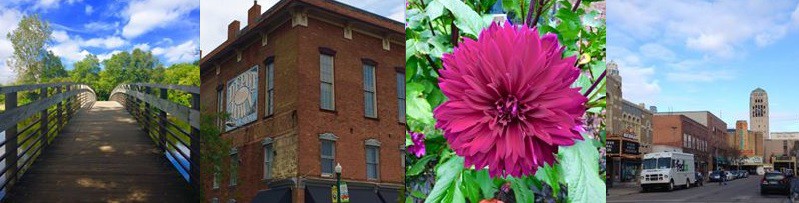
A couple of days ago, I was driving around my town. With a smile on my face, some words just spontaneously tumbled out of me. “I know you,” I said, and then I smiled some more.

I spoke this to Ann Arbor, the place I’ve called home for the last two and a half years. My car windows were down, and I took an enormous, intentional breath of spring air.  Then I put my arm out of the window to feel the breeze. I felt very alive.

The reality of spring called those words forth from me.
“I know you.”

I continued to enjoy the spring air, but the visual scene was most responsible for bringing those words into being. In Michigan, we have entered an aesthetically gorgeous time of year. The six month period from April to October brings continual changes in scenery.

Each week shifts as a variety of flowering trees and plants emerge, soon accompanied by the newborn leaves of trees which grow in gradual ways. After these leaves progressively paint our town bright green, they rustle in the wind for a few months and finally give us a swansong, bursting into a variety of colors as they shed their photosynthesis process and reveal the red, orange, and yellow colors hiding underneath it.

For this half of the year, every week is gorgeous, and every week is gorgeous differently.

This is the third spring I’ve experienced in Ann Arbor, and I’ve lived here long enough to know the order of this unfolding process of change. That’s why the words tumbled out of my mouth that day in my car.

“I know you.”

I know how one set of flowers and blooming trees emerge and seem to reign for mini-era of time, only to be replaced by another set of flowers and blooming trees. It’s a beautiful procession.

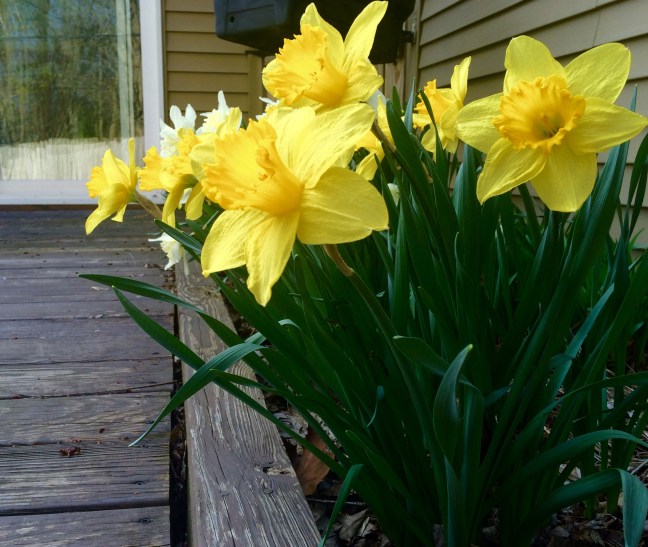
I know that the daffodils,

1

soon give way to the bradford pears,

2

which soon give way to the tulips,

3

which soon give way to the tulip magnolias,

4

which soon give way to the day lilies.

5

This process continues to unfold beautifully.

I love that we are in the midst of this procession right now, and it gave me an impromptu burst of joy when I spontaneously said, “I know you,” to Ann Arbor on that day.

There is a rich experience of belonging when we feel at home.

This is true
within places,
within relationships,
within ourselves.

We can feel at home in the presence of all of these.

When we do, I think we have some knowledge of the essence of what is before us, while also knowing and even expecting that it will experience change.

For instance,

I know the order of Ann Arbor’s flower procession,
but I am still surprised by its emerging beauty.

Likewise,

We know some of the essence of our children’s personalities,
but we are surprised with their growth year by year (and even daily).

We know our weekly work routine,
but we are surprised when we feel a sense of calling within it or beyond it.

We know our personal traumas and forms of grief,
but we are surprised when new life and forms of resurrection find us.

“I know you.”

May we feel at home.
And may our experiences there change us too.

Renee Roederer