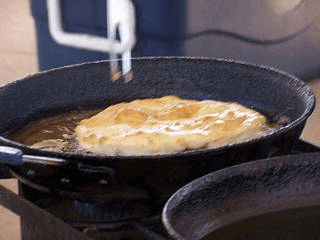
Cast-iron skillet with fry bread. Public domain image.
Inheritance by Tyree Daye
My mother will leave me her mother’s deep-black cast-iron skillet someday, I will fry okra in it, weigh my whole life on its black handle, lift it up to feel a people in my hand. I will cook dinner for my mother on her rusting, bleached stove with this oiled star. My mother made her body crooked all her life to afford this little wooden blue house. I want her green thumbs wound around a squash’s neck to be wound around my wrist telling me to stay longer. O what she grew with the dust dancing in blue hours. What will happen to her body left in the ground, to the bodies in the street, the uncles turned to ash on the fireplace mantles the cousins we’ve misplaced? How many people make up this wound? No one taught my mother how to bring us back to life, so no one taught me. O what we gather and O Lord bless what we pass on.
Every year, I like to make a pilgrimage of sorts. I get myself to a Jacob Collier concert, which is always an experience like none other. This is not an opportunity to be a mere spectator, by the way. If you are in the audience of a Jacob Collier concert, you are also a performer — an integral part of the experience.
Here are two things I typically share with others when I mention what this experience is like:
— Jacob Collier is a person of near unbelievable talent. He plays at least five instruments during a given concert and masterfully. And he improvises brilliantly, especially on the piano and the harmonizer, an instrument he himself invented, which allows him to sing one note and play keys to create harmonized versions of his own voice. Basically, he is singing chords with himself.
— Despite this near unbelievable talent on display, there is no Jacob Collier concert without the audience. He is all about collaboration, and he can craft a collective, interactive musical experience with the audience that feels powerful, playful, and sacred. He is remarkably skilled in being a moment-maker.
And here’s what I noticed in the concert I attended this year:
He always ends with us. He always ends with the community.
We were the finale to the concert. After the long set was over, he concluded by making us into an audience choir. He makes eye contact with certain sections of people, gets them singing a note, and then adds the others. He gestures up or down, and we know what to do with our voices. Now we are singing chords with ourselves. How many audiences end up being a choir and the conclusion to the concert?
There were encores, of course. And in this instance, too, he always found a way to end with us. He put us on display each time, and this was a collective experience. As a remarkably talented person, collaboration and transformation matter most to him.
Vignette 2:
This past Saturday, I was driving to the Midland Stroll for Epilepsy, one of the annual events at the Epilepsy Foundation of Michigan. I was just about to pull into the location, when the short conclusion of the Beatles’ album Abbey Road started playing. It’s just two minutes long and is called “The End.”
It’s a jam. But the final words are reflective,
“And in the end… the love you take… is equal to the love you make.”
I thought, “Here, too, the community is the end.” My colleagues do all sorts of detailed planning to make the Stroll happen, and individuals and team captains organize themselves, raise money, make t-shirts, or get themselves ready to volunteer. And… it’s all leading to the community experience. It’s all leading to being together, celebrating one another, and casting a vision where all belong, are included, and empowered to be advocates. It’s all leading there.
And a word like ‘end,’ brings this home. Yes, it can be a conclusion. But ‘the end’ can also mean the goal or the purpose.
And so,
The community is the end, and The end is community.
When I ride my bike, I take a particular pathway often where I am off the road and on a trail with grass on either side. This means that sometimes, I happen to startle a squirrel or chipmunk that was already in the grass.
And suddenly startled, these critters immediately begin to run, but… not away from me. They run precisely in my direction. Now I’m in a video game I’ve never wanted. Move over, Frogger. I am trying to dodge freaked out chipmunks.
I’ve never hit one, very thankfully.
But I’ve found myself reflecting on this. The flight response is a strong one. All mammals have it. And it’s strong enough that it can kick in without the wisdom of knowing precisely where and how we’re running. After all, it isn’t wise to run toward my wheels. But they’re in a particular response, and they will go where they will go.
And, of course, I think of humans too. We don’t always literally sprint away, but we have flight responses too. We can distract ourselves. We can overscroll on our phones. We can overwork. We can leave conversations. We can leave places. We can leave relationships.
And sometimes, we absolutely need to do these things. The flight response can be a good, instinctual response.
But we don’t want it to become maladaptive or so automatic that we run in the wrong direction. We just need to watch where we’re going.
Grace by Orlando Ricardo Menes We cannot buy it in bulk at Trader Joe’s, Swap it for gold, or hoard shares of Grace, Inc., To hedge against bad luck. We acquire it Without contract, promissory notes, or IOUs, Neither codicils nor fine print. We gather Grace safe from litigation or severance, And though we might breach the strictures of creed, It cannot be forfeited or suspended. Rather, Grace is asymmetric, parabolic, skewed to love, Immanent and absolute, but also unpredictable As quantum particles, both here and there, Both full and empty, so it might arrive Inopportunely and thus slip under hope, Upsetting the earnest prayer, teasing our faith, Like some rain bands, copious cumuli, That appear astray, unbidden, in stagnant skies To drench at last the drought-scourged earth
“If somebody asks me, ‘Ram Dass, are you happy?’ I stop and look inside. ‘Yes, I’m happy.’ ‘Ram Dass, are you sad’ ‘Yes, I’m sad.’ Answering those questions, I realize that all of those feelings are present. Imagine the richness of a moment in which everything is present: the pain of a broken heart, the joy of a new mother holding her baby, the exquisiteness of a rose in bloom, the grief of losing a loved one. This moment has all of that. It is just living truth.
“The saving grace is being able to witness suffering from the perspective of the soul. Another way to say it is that the saving grace is having faith. Living in the fullness of the moment with joy and suffering, witnessing it in all its perfection, our hearts still go out to those who are suffering.
“If we live in the moment, we are not in time. If you think, ‘I’m a retired person. I’ve retired from my role,’ you are looking back at your life. It’s retrospective; it’s life in the rearview mirror. If you’re young, you might be thinking, ‘I have my whole life ahead of me. This is what I’ll do later.’ That kind of thinking is called time binding. It causes us to focus on the past or the future and to worry about what comes next.
“Getting caught up in memories of the past or worrying about the future is a form of self-imposed suffering. Either retirement or youth can be seen as moving on, a time for something different, something new. Start fresh. It’s a new moment. Aging is not a culmination. Youth isn’t preparation for later. This isn’t the end of the line or the beginning. Now isn’t a time to look back or plan ahead. It’s time to just be present. The present is timeless. Being in the moment, just being here with what is, is ageless, eternal. ”
– Ram Dass, Polishing the Mirror: How to Live from Your Spiritual Heart
This week, I had the occasion to see a special art exhibit by Niki de Saint Phalle, a French-American sculptor, painter, filmmaker, and author. When I stepped into the exhibit, I saw one of her quotes on the wall. It says,
“I used to think there was a need to provoke… And then I understood that there is nothing more shocking than joy.”
I think the greatest shock of joy takes place when we move away from personalized hedonism and toward occasions to co-create joy in relationships, in community, and in systems that would prefer to keep some people marginalized and down. In those occasions — as in all times — every emotion is valid, including grief and anger. But when joy can emerge and be cultivated, it is truly shocking, isn’t it? It is truly provoking, isn’t it? It is truly transformative, isn’t it?
Earth from space, Public Domain image. (No collisions happening here; just one, very connected Earth)
I’m not sure if anything gives me more joy than when worlds collide — that is, when some of your connections in relationships build their own between each other.
This week, I’m spending time with multiple friends from multiple streams of life who now work together. They serve as consultants and coaches for city governments to help them be more effective with performance data management and special projects. Simply put, they are rocking what they do and having a huge impact.
One of my best friends from high school co-founded a business with one of her closest friends in her city. They recently hired their first employee, and that, too, is a close friend and chosen family member who I met in a totally different state in another stage of life. (I introduced them, so we colloquially call me “the HR Department”).
This is joy for me. Do you also take pleasure when your worlds collide?