I want to consider what it means to experience and cultivate a sense of continued connection with people who have died. With this in mind, I invite us into a place of imagination and wondering. How might we ponder our connections with those who have gone before us — those who have loved us into being?
What is that sacred in-between? That space right before death where powerful things seem to happen?
The truth is, I don’t know.
Is it a new reality coming into being? Is it simply (but still, amazingly!) the human brain giving a euphoric experience at the end of life? Is it a liminality between what has been and what will be? Is it an expansion of time — either in reality, or perhaps, in a beautiful illusion during a near-death state?
I don’t know. All I know is that I find it to be comforting.
I mean this: Sometimes, when people near death, they rally quite unexpectedly and receive a burst of strength that seems unexpected. Some appear to experience joy. Or in a last bit of consciousness in their bodies, some experience the presence of people who have died before them.
Before she died, my grandmother Ruby was unconscious and on a ventilator. After the ventilator was removed, she died pretty quickly. But right at the end, she suddenly opened up her eyes, looked up and smiled, and a couple tears dripped down her cheek.
I don’t know what that is, but I find that to be comforting.
I’ve also known of situations where people have spent whole days moving back and forth between conversation with people who are in the room and the next moment, announcing they could see someone from the earlier part of their life. It seemed that everyone was present at once.
I don’t know what that is, but I find that to be comforting.
In pondering this, I don’t mean to put a silver lining on death. I know these kinds of things can be hard to celebrate when loss is recent and grief is acute. But at the same time, it’s all such a mystery, and perhaps these kinds of moments can give some solace too.
Wouldn’t it be great if we could walk around in the world, and every time we see someone or pass someone, a little number would appear, telling us how many degrees of separation are between us? Then if we wanted to, we could try to figure out who we know in common?
That would be really fun. And I bet we’d be shocked at how many 2s and 3s there would be.
Three boards create a boardwalk in an open field. Public domain image.
When we were closing up a Zoom, a wise, sage elder who I love and respect said,
“Can I say something as we finish?”
She then quoted Belva Davis, the first Black woman to become a news anchor on the West Coast.
“Don’t be afraid of the distance between your dreams and reality.”
I sat with that quote, and I knew that multiple people on the screen were applying her words to situations in their lives. So today, I want to pass those words onto you if they resonate with anything in particular:
“Don’t be afraid of the distance between your dreams and reality.”
If part of how you measure your self-worth and your identity depends on your exhaustion, you will always struggle to rest. #workburnout#burnout#perfectionism
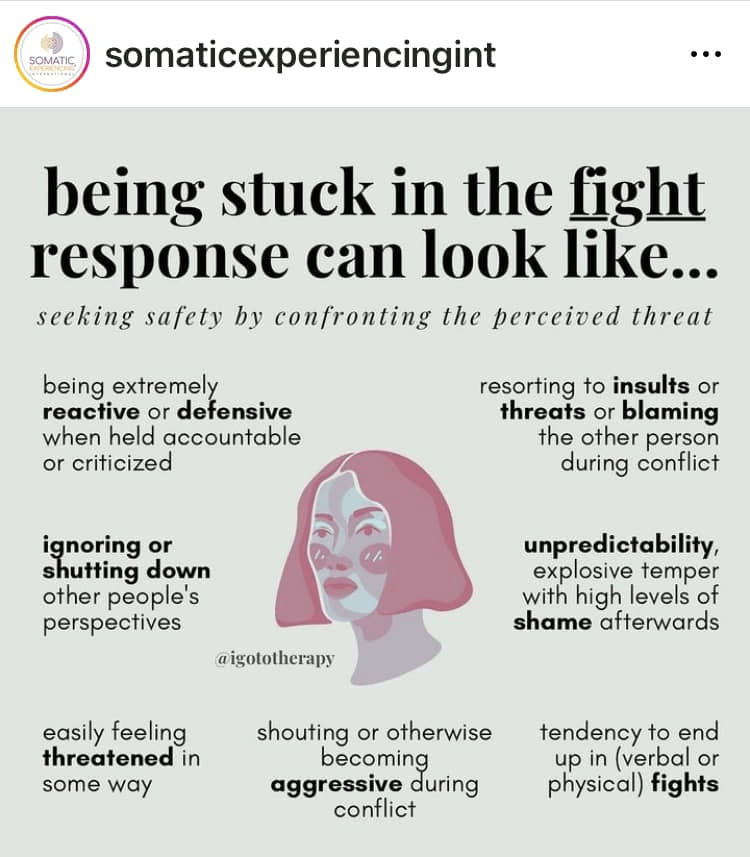
Image Description: This image shares the four primary nervous system responses to trauma — fight, flight, freeze, and fawn — as well as symptoms for each and ways they are commonly mislabeled. I am sharing the image text throughout the blog post below. I found this image on @SELSpace on Facebook.
As we’ve been moving through forms of upheaval, including a global pandemic, this is an important time to learn about trauma and the responses that our nervous systems often take in response. When we’re feeling overwhelmed, we can move into states of fight, flight, freeze, or fawn. We might also vacillate between a couple of these.
In addition to these becoming activated due to present circumstances,
— some people have endured past traumas as well, and these can become reactivated in our nervous systems in these ways,
and/or
— some people have lived with dysregulated nervous systems throughout much their lives, not necessarily remembering large, traumatic events in childhood, but rather, growing up in households that felt stressful and overwhelming in a generalized way. In these households, it was difficult to have needs cared for and nurtured, or caregivers may have also had dysregulated nervous systems, making it difficult to co-regulate alongside them.
In both of these instances, people may live with symptoms of PTSD or CPTSD (the C stands for complex and means that the traumatic events or environment was long-lasting).
In a moment, I’m going to list symptoms of the 4F pathways of trauma. You may recognize some of these in yourself or your loved ones. Please know that these don’t have to remain stuck or static in the body, and we don’t have to stay stuck or static in these patterns. There is help. Therapy certainly helps, and it’s okay to seek that help. In fact, it can be transformative. There are a variety of somatic therapies that help to heal our bodies and these patterns. (As just one example, I’m a big cheerleader for EMDR. Check it out.)
These are the 4Fs of trauma and PTSD. Which pathways tend to be primary for you? I am typing out the text of the image above.
Fight
Self-preservation at all costs
Explosive temper and outbursts
Aggressive, angry behavior
Controls others
Bully
Can’t ‘hear’ other points of view
A pronounced sense of entitlement
Demands perfection from others
Dictatorial tendencies
Typically mis-labelled as – Narcissist – Sociopath – Conduct disorder
Flight
Obsessive and/or compulsive behavior
Feelings of panic and anxiety
Rushing around
Over-worrying
Workaholic
Can’t sit still, can’t relax
Tries to micromanage situations and other people
Always ‘on the go;’ busy doing things
Wants things to be perfect
Over-achiever
Typically mis-labelled as – OCD – Bipolar – ADHD – Panic disorder – Mood Disorder
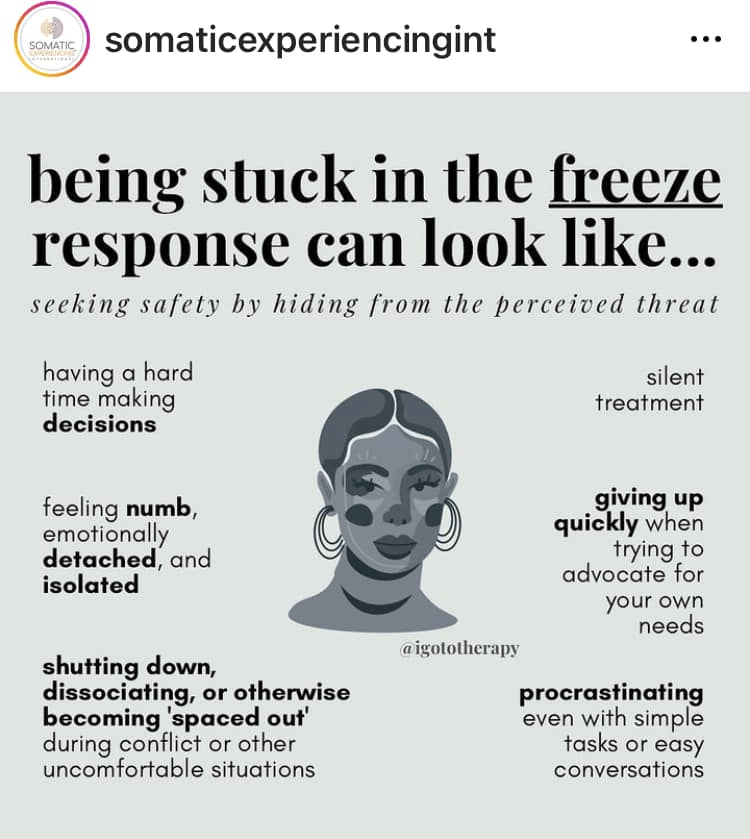
Freeze
Spacing out
Feeling unreal
Hibernating
Isolating self from the outside world
Couch potato
Dissociates
Brain Fog
Difficulties making decisions, acting on decisions
Achievement-phobic
Wants to hide from the world
Feels ‘dead,’ lifeless
Typically mis-labelled as – Clinical depression – Schizophrenia – ADD – OCD
Fawn
People pleasing
Scared to say what they really think
Talks about ‘the other’ instead of themselves
Flatters others (to avoid conflict)
‘Angel of mercy’
Over-caring
Sucker
Can’t stand up for the self, say ‘no’
Easily exploited by others
Hugely concerned with social standing and acceptance, ‘fitting in’
‘Yes’ man (or woman…)
Typically mis-labelled as – Codependent – ‘Victim’
Do you recognize these patterns in yourself or your loved ones? They are natural and do truly discharge traumatic energy. Our bodies have them because we need them at times. But we don’t want to become stuck in them. That causes larger problems for us. These patterns may spin out, causing us pain, and impacting our relationships.
But we can heal these patterns, and we can do the work of healing the systems that cause so much trauma in the first place. I love how the word ‘heal’ is both passive and active at once. We receive healing and cultivate it over time, and we can act as healers for a world with less trauma.
A tree with roots moving in a variety of directions. Public domain image.
I’ve written about this before, but I often think about this phase and organizing vision I learned from adrienne maree brown: Don’t live/serve/act/organize in a way that is a “mile wide and an inch deep.” Let your work and vision be “an inch wide and a mile deep.”
When we think about our sense of calling and purpose, we don’t have to do or be all things. (Also, we can’t). But if we go deep with one vision or a few interconnected visions, we can build communities with great depth.
And then if we take that further, we might also ponder this: If a community is formed and organized for one thing, they’ll also be organized for more things.
These days, in my role as Community Care Director for the Epilepsy Foundation of Michigan, I’m going deep with the epilepsy community in Michigan. If they can become more interconnected and organized around this aspect of their lives and its needs, won’t they also be organized for other things too? Ways of adding care when it comes to food, housing, and safety? Ways of adding encouragement around their relationships? Ways of making larger meaning in this era of time? Ways of addressing systemic inequalities? Ways of saying no to injustice? Ways of caring intentionally for one another’s multifaceted needs?
If a community is formed and organized for one thing, they’ll also be organized for more things.