A brown welcome mat with black writing. It reads, “Home,” and the ‘o’ is a red heart. It’s placed before a salmon colored door and is placed on top of a gray porch.Source: Kelly Lacy, Pexels, Public Domain.
I was recently listening to a Mumford & Sons’ song when one of their lyrics really caught my attention:
“… before I tumble homeward, homeward.”
I thought that was intriguing phrasing. It made me reflect on the times when I suddenly found myself in a homeward direction, perhaps when I wasn’t even expecting it. There are also times when I found myself feeling a sense of home, even though its process and arrival of getting there was messy.
Thank goodness these moments can happen.
I have had moments of return — to place, to family, to communities, to memory, to states of mind — that were sudden. I have had estrangements suddenly end. I have had reconnections with community open wide after this was previously closed. I have had moments when I realized I could reconnect with the feeling of a loved one’s presence after they died.
I have also had moments of tumbling home to uncharted places. I have moved across the country three times to live in four different states. I have weathered a pandemic from inside my house. I have been accompanied by friends and loved ones through daily living. I have come to feel at home in my body.
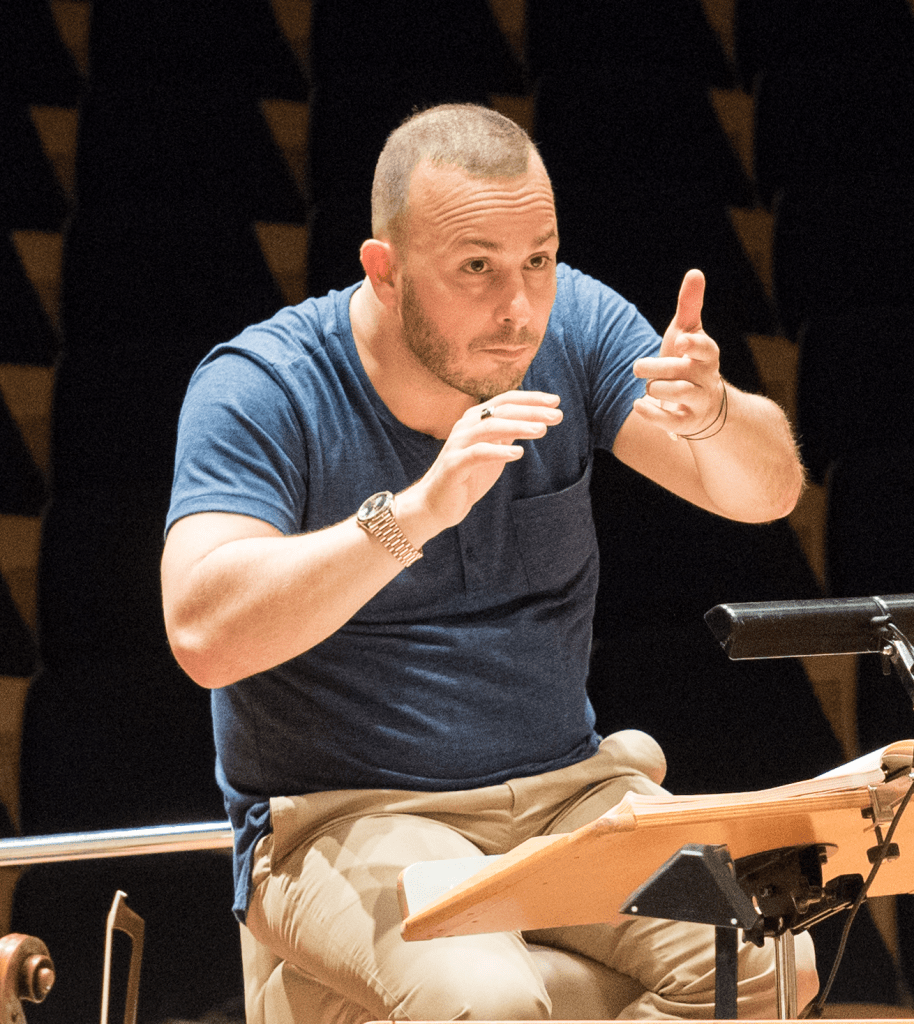
Last week, I watched one of the best conductors in the world in concert. Yannick Nézet-Séguin conducts more than six orchestras around the world. Most frequently, he works with the Metropolitan Opera, the Philadelphia Orchestra, and the Orchestre Métropolitain in Montreal. A year and a half ago, he and the Philadelphia Orchestra traveled to Ann Arbor to perform Brahms’ A German Requiem with the UMS Choral Union, the choir I sing with. It was a delight to work with him. Last week, he returned to town with the Chamber Orchestra of Europe. I bought tickets in the second row. I wanted to see how he does what he does so well.
For someone who has never done it in any formal way, I think about conducting often. I wish I had studied choral conducting while I was in music school, and these days I find myself wondering whether there might be avenues to learn without going back to school. I would welcome that.
I imagine it would be immensely gratifying to conduct. But deep down, I suppose I’m a bit like a football player who wants to learn ballet in order to be better at football. I’m a nonprofit leader and community curator who wants to learn conducting so I can be a better nonprofit leader and community curator.
It really is the best analogy.
When you’re conducting, you don’t face the audience. It’s not about you. You face the performers. You find ways to look in their direction and see them in their strengths. You make eye contact and invite them in. You try to maximize the ways different sounds and rhythms work together. Sometimes you aim for the best possible blend of voices. Sometimes you make sure a particular voice part has the spotlight.
And as much as you need to stay in touch with the performers — really listening — you also need to stay in touch with the music itself. You need to internalize what is central. The vision, shape, form, and execution. You need to embody it. You need to live it in those moments.
See how this is a helpful analogy for serving community well? And for being a good leader?
Last week’s concert was incredible. As I watched Yannick Nézet-Séguin conduct, I noticed so much. He was absolutely locked in, connected relationally to the ensemble. And he truly embodied the music. He had most of it memorized, and he moved like a dancer up there —so expressive. And yet, the attention always remained with the performers.
The experience was deeply relational, even intimate. When the concert was over and it was time to acknowledge the soloists, he didn’t simply gesture for them to stand. He went over to each one, hugged them, and bowed to them. His appreciation was evident, and he was present throughout the entire evening.
Here’s one of my main takeaways: This conductor, who was embodying the music and gesturing to bring people in, was also receiving from the ensemble the entire time. I noticed a great deal of trust between them. He was receiving their energy, too. He wasn’t just keeping time or marking beat patterns. He was gesturing expressively with the music and connecting deeply with the performers onstage.
And yet, he wasn’t the center. That relational posture allowed others to shine.
So how do we lead by receiving? By marveling at the strengths people show in our communities? By inviting them in?
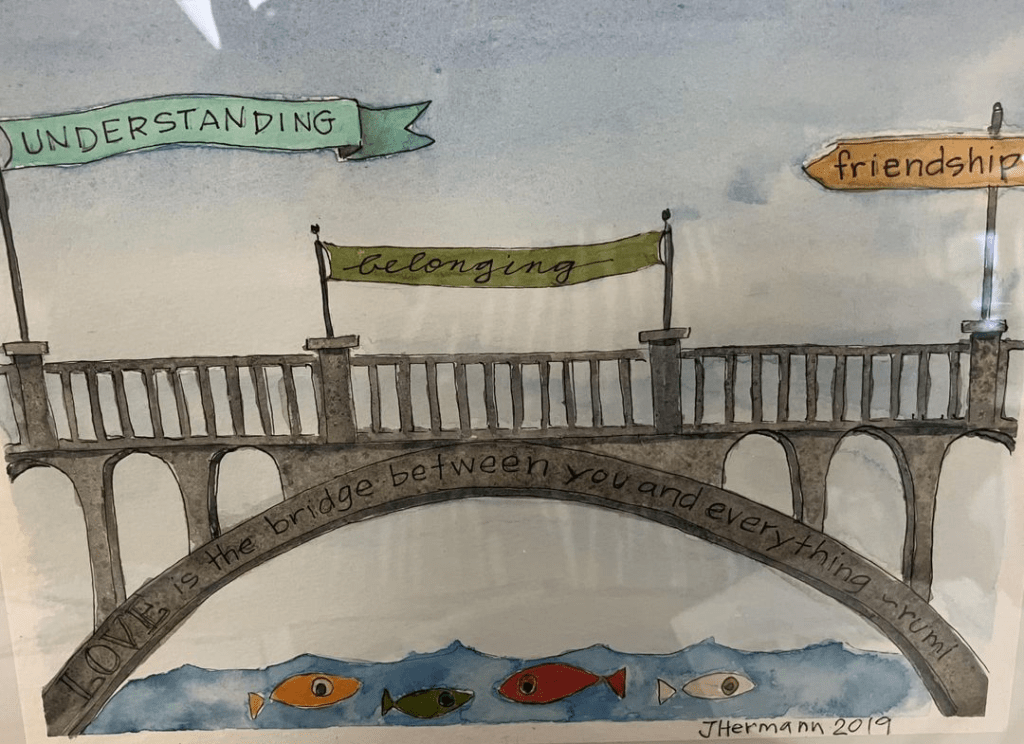
A framed painting at Parables. Four fish are swimming in a river. The red fish is moving in the opposite direction of the orange, green, and white fish. There is a bridge above the fish that reads, “Love is the bridge between you and everything” — Rumi. On the bridge, there are three flags that read, “Understanding,” “Belonging, and “Friendship.” The painting is signed, “J Herman, 2019.”
Once a month, I lead a congregational service called Parables, designed for the whole community but crafted especially for, with, and by people with disabilities and neurodivergence. At one of our services, we read the story of the Syrophoenician woman from the Gospel of Mark. Frankly, it’s one of the most powerful stories in the Bible, and it always invites me to reflect.
In the story, Jesus has left his familiar surroundings and travels to the region of Tyre, a Gentile area. While he’s there, trying to keep a low profile, a woman whose daughter is suffering approaches him. She’s bold. She asks Jesus to heal her daughter, but his response is remarkably out of character. He tells her, “It’s not fair to take the children’s food and throw it to the dogs.” It’s a shocking thing to hear from Jesus, especially considering how he consistently embraces those on the margins.
But the Syrophoenician woman doesn’t back down. She won’t let herself be defined by those words. Instead, she boldly responds, “Even the dogs under the table eat the children’s crumbs.” It’s a snarky, powerful reply. She claims her worth and her daughter’s worth—asserting that they too are a part of this healing and belonging. And this boldness is recognized. “For saying that, you may go,” Jesus says, and tells her that her daughter will be healed.
This story challenges us to think about how we claim our own worth, and the worth of those around us. It invites us to proclaim boldly that healing, dignity, and belonging are ours too, no matter what words or barriers might stand in our way.
Years ago, I attended the “Why Christian?” conference in Durham, North Carolina. One of the preachers, Rev. Gail Song Bantum, delivered a powerful sermon on this very story. After her sermon, we were invited to communion, and she urged us to claim the bread and cup with boldness. When we were handed the bread and told, “This is the body of Christ, given for you,” we were invited to respond, “Yes, it is!”—to assert that this gift, this grace, this belonging was really ours.
This was the spirit we carried into our time at Parables on Sunday. As we shared communion, our servers said, “You are a Child of God,” and each person was invited to respond boldly, “Yes, I am!” It was a simple but profound moment of claiming truth—about ourselves and about each other.
What would it look like for us to claim boldly? To declare that our identities are treasured? To insist that our neighbors, especially those who are often marginalized, belong fully? What possibilities might we see if we assert the truth of who we are, if we stand firm in the knowledge that we are cherished?
Today, I invite you to ponder what you want to claim boldly. Maybe it’s the truth of your worth. Maybe it’s the belief that life has more possibilities than you’ve imagined. Or maybe it’s the sacredness of your neighbor’s identity and the shared call to community.
An envelope, a fountain pen, and two wedding rings. Public domain.
Mother Teresa used to say, “If we have no peace, it is because we have forgotten we belong to one another.”
I certainly don’t need to remind anyone that we have many ways of forgetting that we belong to one another. At times, we neglect our shared belonging; at other times, we create barriers purposefully, excluding some people and labeling some people, marking them as ones who stand outside our community circle.
For this reason, perhaps we underestimate the power of an invitation and forget how transformative it can be. I’ve been thinking of this after hearing a meaningful story that I would like to pass along to you today. I extend my own invitation for you to listen. It is well worth the 8 minutes:
The Rev. Bill Golderer talks about the rhythms of invitation at Broad Street Ministry, where people regularly hold dinner parties, extending to everyone in their neighborhood and including people who are rarely invited to other community events. The story above talks about what happened when a couple decided to share their wedding day with the whole community at one of these spontaneous dinner parties and what it was like to be invited.
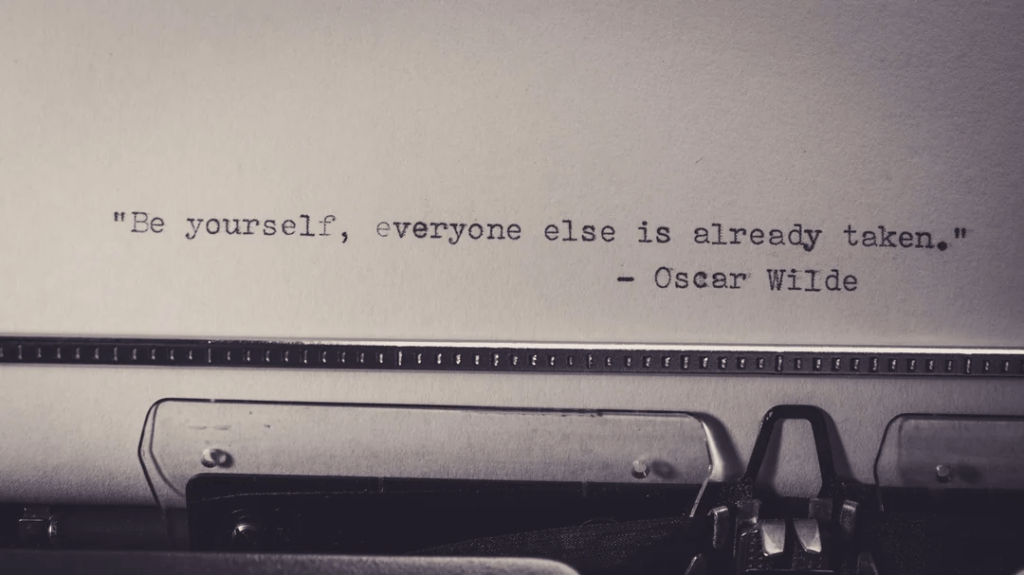
A typewriter with an Oscar Wilde quote: “Be yourself, everyone else is already taken.” Public domain image.
I want to begin this post with four powerful quotes.
Borrowing language from Thomas Merton, Richard Rohr — a Franciscan priest and wisdom teacher — writes often about what it means to give up our ego and “false self” in order to live as our “True Self.” In the midst of that reflection, he says:
“You (and every other created thing) begin with your unique divine DNA — an inner destiny, an absolute core that knows the truth about you, a true believer tucked away in the cellar of your being, an imago Dei that begs to be allowed, to be fulfilled, and to show itself.” — Daily Meditations, July 31, 2016
Author Paulo Coelho writes:
“Maybe the journey isn’t so much about becoming anything. Maybe it’s about unbecoming everything that isn’t really you, so you can be who you were meant to be in the first place.”
The story of the Chasidic master Zusya of Hanapoli is told in the Talmud:
“Once, the Hasidic Rabbi Zusya came to his followers with tears in his eyes. They asked him: ‘Zusya, what’s the matter?’
He told them of a vision: ‘I learned of the question the angels will one day ask me about my life.’
His followers were puzzled. ‘Zusya, you are pious. You are scholarly and humble. You have helped so many of us. What question could possibly terrify you?’
Zusya replied, ‘The angels will not ask me, “Why weren’t you Joshua, leading your people into the promised land?” They will ask me, “Zusya, why weren’t you Zusya?”’”
And author Marianne Williamson writes:
“Our deepest fear is not that we are inadequate. Our deepest fear is that we are powerful beyond measure… Who am I to be brilliant, gorgeous, talented, fabulous? Actually, who are you not to be? You are a child of God… As we let our own light shine, we unconsciously give other people permission to do the same.”
How do these quotes sit with you? Do they speak to certain parts of you — particular roles or identities that live near the root of who you are? Do they stir aspects of your True Self, the parts that “beg to be allowed, to be fulfilled, and to show themselves”?
I hope so.
This week, I found myself reflecting on Coelho’s idea of unbecoming. There have been times when I’ve tried to fit myself into roles that didn’t quite match me. For instance, my internal framework of what “a community organizer is” has sometimes been too narrow to include my actual strengths or to allow for my own limitations and needs. And it’s pretty difficult to do something well if the framework you’re using doesn’t make space for your best gifts — or for the grace, adaptation, and accommodations that your particular life requires.
I need to expand my sense of what these can be. But as I reflected on that, I realized I also need to attend to my own particularity — my gifts, my strengths, the at-the-core-of-myself callings. My deep-down, truest parts. The kinds of things illuminated by the quotes above.
True Self stuff. Deep Yes stuff.
So I sat down and asked myself, “What are the roles, archetypes, or identities that are central to me being… me?”
I wrote down five.
And simply naming them felt utterly invigorating. I don’t know if it was like the Captain Planet of myself coming together (1990s joke! You really should watch that goofy intro) but something powerful happened. I felt energized — and also physically settled — in a way that surprised me.
And none of these identities were new. Not one of them. I’ve known them for years. But naming them together felt like choosing them again. Reclaiming them again. These are the roles I can return to when I get off track (and I do). These are the ones I realign myself with… the ones rooted in a calling beyond myself… the ones that open space within me so I can make space for others.
So — you knew this was coming, right? — I’m going to invite you to do the same.
What are the roles, archetypes, and identities that are central to you being… you?
This morning, I’d like to share the Sunday Story from NPR’s Up First podcast. It aired yesterday morning, and this episode does a tremendous job lifting up the severe conditions that undocumented immigrants are facing in the United States, while also bringing home their humanity and casting a vision for a better future for them and our country. “This can bring us closer together if we let it,” one of the helpers says.
That being said, these needs are truly dire, and as immigrants and their children hide behind locked doors, this is a public health crisis with panic attacks, chest pain, isolation, and limited ability to access basic supplies.
We need to pay attention. If we dare to learn their languages, we need to love the people behind those languages. If we dare to enjoy their cuisines, we need to love the people behind those cultures. But of course, above all, if we ourselves want to step into our best humanity — simply because that is who we should be — we should love these people because they matter intrinsically and are our neighbors.













 Smuggling Grace