Image Description: Black background and the word ‘family’ in white letters; the l has a tree growing out of it. Public domain image.
What if you could be gathered together in one place with a version of yourself from every year of your life? Like, from baby to current age of adulthood?
What if every age of yourself was present toward all the others, gathered together like a family reunion of sorts? What would that be like?
-Would certain ages pair together for care?
-Would certain ages avoid each other?
-Would certain ages wander off somewhere and find some space to voice their stories, or maybe do some reconciliation work?
-Would certain ages impart wisdom to the other ages?
What might the current you want to say to your younger selves? What might your younger selves want to say to the current you? Truth be told, our younger selves are always present in some way, embedded into the rest of our lives. We can access the various parts of ourselves, and in a sense, even be in relationship with ourselves.
I wonder what would happen in this family reunion?
Look again at that dot. That’s here. That’s home. That’s us. On it everyone you love, everyone you know, everyone you ever heard of, every human being who ever was, lived out their lives. The aggregate of our joy and suffering, thousands of confident religions, ideologies, and economic doctrines, every hunter and forager, every hero and coward, every creator and destroyer of civilization, every king and peasant, every young couple in love, every mother and father, hopeful child, inventor and explorer, every teacher of morals, every corrupt politician, every “superstar,” every “supreme leader,” every saint and sinner in the history of our species lived there–on a mote of dust suspended in a sunbeam.
The Earth is a very small stage in a vast cosmic arena. Think of the rivers of blood spilled by all those generals and emperors so that, in glory and triumph, they could become the momentary masters of a fraction of a dot. Think of the endless cruelties visited by the inhabitants of one corner of this pixel on the scarcely distinguishable inhabitants of some other corner, how frequent their misunderstandings, how eager they are to kill one another, how fervent their hatreds.
Our posturings, our imagined self-importance, the delusion that we have some privileged position in the Universe, are challenged by this point of pale light. Our planet is a lonely speck in the great enveloping cosmic dark. In our obscurity, in all this vastness, there is no hint that help will come from elsewhere to save us from ourselves.
The Earth is the only world known so far to harbor life. There is nowhere else, at least in the near future, to which our species could migrate. Visit, yes. Settle, not yet. Like it or not, for the moment the Earth is where we make our stand.
It has been said that astronomy is a humbling and character-building experience. There is perhaps no better demonstration of the folly of human conceits than this distant image of our tiny world. To me, it underscores our responsibility to deal more kindly with one another, and to preserve and cherish the pale blue dot, the only home we’ve ever known.
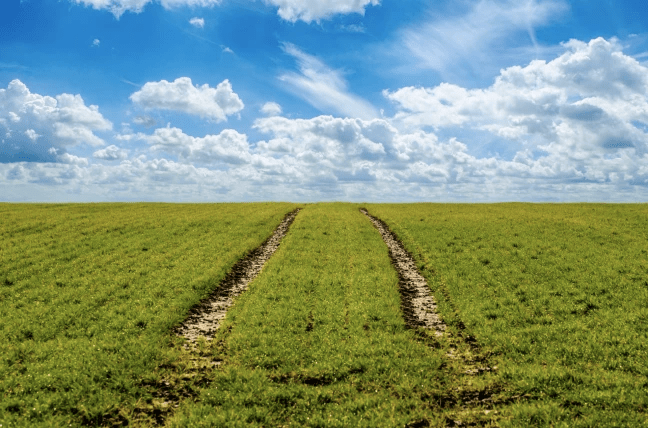
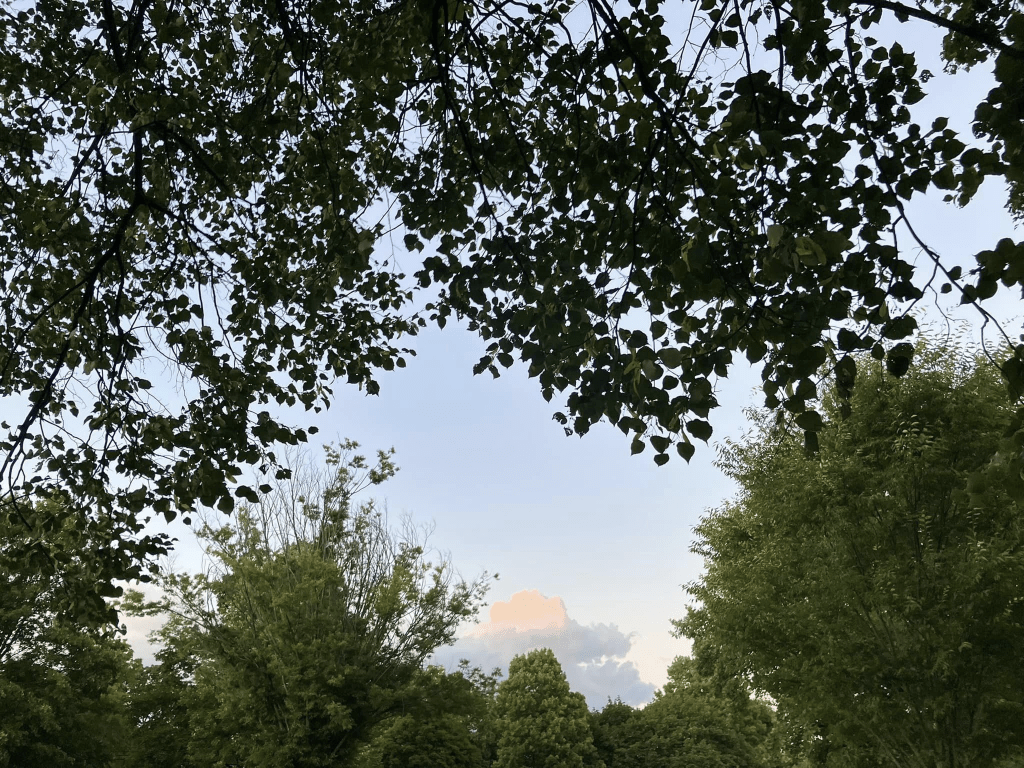
Image Description: Grass with tracks from a vehicle, exposing dirt. Above, is a blue sky with white, puffy clouds. Public domain image.
Zen Master and teacher, Thich Nhat Hanh, says,
Life is filled with suffering, but it is is also filled with many wonders, such as the blue sky, the sunshine, and the eyes of a baby. To suffer is not enough. We must also be in touch with the wonders of life. They are within us and all around us, everywhere, anytime.
This is the very first paragraph in his book, Being Peace.
He continues with these words,
If we are not happy, if we are not peaceful, we can’t share peace and happiness with others, even those we love, those who live under the same roof. If we are peaceful, if we are happy, we can smile and blossom like a flower, and everyone in our family, our entire society, will benefit from our peace. Do we need to make a special effort to enjoy the beauty of the blue sky? Do we have to practice to be able to enjoy it? No, we just enjoy it. Each second, each minute of our lives can be like this.
Do we have to make a special effort to enjoy the blue sky?
Truthfully, yes, sometimes. There are days when it may really be an effort. We may be struggling with ongoing feelings of sadness and anxiety. We may be grieving. We may be longing for a world that is more peaceful and just.
Sometimes, it probably does take a special effort — or at least, a special intention — to enjoy the blue sky. Or the sunshine. Or the eyes of a baby.
But we really can choose the intention to enjoy these too.
Thich Nhat Hanh does not teach people to put their heads in the sand. One of his primary teachings is that love is understanding — that if we want to love others and ourselves, we have to listen and understand one another’s suffering. This is so important.
And alongside that suffering, we can marvel at the joys and the beauty too. “Suffering is not enough,” he says. Joys and beauty can come alongside these pains.
Thich Nhat Hanh says, if we can enjoy and smile at these, we can embody peace — peace that will be made available to the suffering we and others carry.
So today, I put that wonderful intention in the world — That we might enjoy the sky also.
Image Description: The blue and white cover of the book, Being Peace. Under the title, it reads “Thich Nhat Hanh,” naming the author of the book. The cover also says, “Introduction by Jack Kornfield.” At the top right is a quote that reads, “Being Peace is distilled wisdom, the language simple and clear. This book is for everyone. — Fellowship Magazine.” There are also images of two leaves falling to the ground.
A Stress Relief/Trauma Life Hack*:
Sit and smile.
Meditation is calming for the body. When we get quiet, sit still, notice our breathing, and clear our thoughts — or often more accurately, notice our thoughts as they come and go — we ease our nervous systems. We activate the calming mechanisms of the parasympathetic nervous system, and our fight, flight, freeze, and fawn reactions slow down and fade for a while.
We can also practice smiling.
I’m certainly not a person who tells others, “You should smile!” (Women hear this all the time, and it’s irritating. We also know that people are feeling grief, anxiety, and stress). But when we sit and smile, breathing in and out, we can shift some of the feelings in our body.
Here’s what Zen Buddhist monk, Thich Nhat Hanh shares in his book, Being Peace:
“I would like to offer one short poem you can recite from time to time, while breathing and smiling.
“Breathing in, I calm my body. Breathing out, I smile. Dwelling in the present moment I know this is a wonderful moment.
” ‘Breathing in, I calm my body.’ This line is like drinking a glass of ice water-you feel the cold, the freshness, permeate your body. When I breathe in and recite this line, I actually feel the breathing calming my body, calming my mind.
” ‘Breathing out, I smile.’ You know the effect of a smile. A smile can relax hundreds of muscles in your face, and relax your nervous system. A smile makes you master of yourself. That is why the Buddhas and the bodhisattvas are always smiling. When you smile, you realize the wonder of the smile.
” ‘Dwelling in the present moment.’ While I sit here, I don’t think of somewhere else, of the future or the past. I sit here, and I know where I am. This is very important. We tend be alive in the future, not now. We say, ‘Wait until I finish school and get my Ph.D. degree, and then I will be really alive.’ When we have it, and it’s not easy to get, we say to ourselves, ‘I have to wait until I have a job in order to be really alive.’ And then after the job, a car. After the car, a house. We are not capable of being alive in the present moment. We tend to postpone being alive to the future, the distant future, we don’t know when. Now is not the moment to be alive. We may never be alive at all in our entire life. Therefore the technique, if we have to speak of a technique, is to be in the present moment, to be aware that we are here and now, and the only moment to be alive is the present moment.
” ‘I know this is a wonderful moment.’ This is the only moment that is real. To be here and now, and enjoy the present moment is our most wonderful task. ‘Calming, Smiling, Present moment, Wonderful moment.’ I hope you will try it.”
— Thich Nhat Hanh, Being Peace, pages 15-16
* I want to thank Shannon Dingle for a series of tweets she did in which she gave some valuable ‘trauma life hacks.’ I’m borrowing her phrase, so I want to give a nod to her work and her Twitter handle: @ShannonDingle
I probably don’t tell have to tell you that the body has a stress response. (I mean, just look at the last few years we’ve lived…) Stress causes adrenaline and cortisol, the tightening of muscles, and at times, the initiation of fight, flight, freeze, or fawn responses.
But we can also have a relaxation response. In the relaxation response, our activated sympathetic nervous system is calmed by the parasympathetic nervous system. What helps this? Intentional, deep breathing, stretching, meditation, mindfulness, touch, bilateral movement (walking is one), somatic processes like the body scan, cuddling, and generally slowing down — again — intentional, deep breathing (after all, this helps us slow down).
But here’s the thing:
The stress response is innate and automatic, and the relaxation response has to be learned. The body needs practice in order for this to happen naturally on its own.
All of these are worthy practice. Very worth our time.
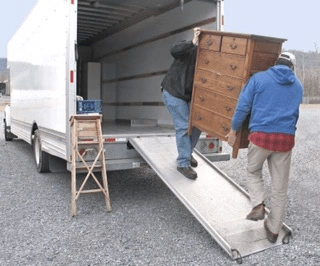
Image Description: Two people carrying a chest of drawers into a moving truck.
Over these last few years, have you had moments of becoming overwhelmed by the news cycle?
Yes, me too. Of course. Who hasn’t?
Behind the news cycle, there are real, raw, human stories of suffering. And so often, we feel helpless to prevent that suffering and powerless to change it.
It’s incredibly understandable to fall into those feelings. In such times, we need the solidarity of one another – that is,
. . . the sense that we are in each other’s view, that we encounter each other’s pain with empathy,
. . . the sense that we have each other’s commitment, that we are in each other’s corner for the long haul,
. . . the sense that we have each other’s action, that we covenant to act on behalf of one another, especially and most readily for those who are made vulnerable by barriers.
In some spiritual traditions, we hear language of bearing each other’s burdens. Lately, within that vision, I find myself encouraging people to shift each other’s burdens.
We can easily become incapacitated once we realize we cannot instantly fix the systems that are causing burdens. But our empathy, and most importantly, our committed action can change these systems and these burdens. Do not underestimate what these can do.
When we see pain for what it is, we add our validation, and it shifts burdens.
When we add our resources of money, time, or skills, it shifts burdens.
When we use our voices to name wrongs for what they are, it shifts burdens.
When we use our minds to create solutions, it shifts burdens.
When we honor the humanity of people who are being dehumanized, it shifts burdens.
When we take direct action and demand justice for the oppressed and vulnerable, it shifts burdens.
If we want to change the large-scale systems that cause harm, we have to disrupt and dismantle them. But alongside that commitment, we have to live and model our lives with a different rhythm – with different commitments and ways of relating to one another.
We practice solidarity.
And within that way of living, we share and lighten the loads that people are carrying. We assign energy and responsibility to where they really belong.
Image Description: A person is holding seeds in their hand and planting them in a row in the soil. Public domain image.
All of the things that sustain us and help us feel purposeful start initially as small actions,
— go to an event, only to meet someone who will become a life long friend, — introduce two people, only for them to initiate a major project together later, — have a conversation, only for it to shift the direction of your work, — step into that identity/role a little more, only to discover there’s a whole community waiting for you.
And so much more.
And if so much of this can happen unintentionally, what could be possible if we act on these kinds of things intentionally?
We can plant seeds today and in the near future that will surprise us with comfort, possibility, and purpose months and years down the line.