We are often in a position where a huge percentage of our time is structured. We may feel like we have little to no free time at all. This is detrimental to our mental and physical health. And it turns out it is not especially good for our relationships or our values, either. (For instance, one study found that when people experience “time famine,” they are much less likely to help other people.)
So how do we make this better? How do we increase our sense of time affluence? And how do we take advantage of time confetti — those free, unstructured moments that suddenly open up — to create time windfalls: moments of rest, downtime, relationship-building, and the things we most want to do, if only we felt like we had the time?
I was thinking recently about a hilarious quote from one of my mentors:
Decades ago, when he was just starting out in his career, he took a job where he was considered the “assistant.” The problem is that he was the assistant to too many people. Everyone constantly wanted his time, and he was pulled in every direction, unable to fulfill what was clearly impossible for one person to do.
One day, during a meeting, he became so frustrated and flustered that he blurted out,
“Well, why doesn’t someone just bring in a big tub of water right now, so I can prove once and for all that I can neither walk on it nor turn it into wine!”
That has stayed with me, and it still makes me laugh.
Here’s hoping that you’re centered and in one piece.
She writes about how diligent and hypervigilant many of us have had to become over the last decade, and especially over the last few years. We scroll through our phones, trying to understand crises unfolding around us and among us, hoping that knowledge might provide some sense of control. After all, how can we act? How can we shift? And how can we help bring about change if we don’t even know what is happening?
Some people are hypervigilant because threats and policies are directed at them personally. Others may be less directly vulnerable but still find themselves on edge, waiting for the next shoe to drop or scanning for the right moment to take action.
Then Solnit raises some important questions: If none of this were happening in our country, what would we be doing instead? What has been lost? And what might currently be getting lost because so much of our attention needs to be here?
What a tragic thing to consider.
At one point she writes, “…I miss where my attention might have gone.”
But she doesn’t leave us there.
In the very same essay, she reminds us that we can also be playing. And creating. And making art. And blasting music. And marveling at nature. And laughing with friends. And thoroughly savoring the taste of food and drink.
No doubt, our neighbors deserve dignity, protection, and solidarity from us. And at the same time, we all deserve opportunities to create and experience the things that make life lovely, connective, meaningful, and transformative. We benefit from one another when we do this.
So if the times were different, where would your attention be going? … Do you miss it?
A stack of newspapers, sitting on top of one another Public domain.
For at least eleven years, I feel like I have started many blog posts and sermons by talking about how overwhelming the news cycle is. At this point, that observation almost sounds trite. It risks becoming one of those phrases that gets repeated so often that it loses its impact, like “we’re living in unprecedented times” or “out of an abundance of caution” during the COVID era.
But the truth is that we are living in a unique moment in human history. At a moment’s notice, or with a simple glance at a phone, we have access to information about suffering, violence, disasters, and crises from all over the world. And I think two things are true at once:
On one hand, these stories can feel incredibly close. They can be overwhelming, especially when we encounter many of them at once. Until very recently in human history, people simply did not have access to this much information about what was happening across the globe.
On the other hand, these stories can also feel very far away, too. It is easy to become numb. It’s easy to forget, at least emotionally, that there are actual people behind these headlines. These people have names, faces, relationships, fears, hopes, and stories. Of course, we do not need to look halfway around the world to find suffering. We encounter it in our own neighborhoods, our own communities, our own families, and often in our own lives, too.
But I was thinking about all of this recently while hearing news reports about countries trading “strikes.” Yes, that is technically accurate language. It describes something that is happening. But are those the words that people would use if they were living through those strikes?
That phrase feels distant from the human realities on the ground. Nobody wakes up in the middle of the night thinking, “A strike occurred.” They wake up wondering where their child is. They wonder whether their home will still be standing in the morning. They wonder whether today is the day that ordinary life suddenly falls apart. They wonder whether the next loud sound means they should run.
Behind the language are people who are frightened, grieving, searching, hoping, enduring, and barely surviving. The news cycle does not always help us remember that.
So what do we do?
I think we remember what the language leaves out. We remember that people exist in the margins and in the rubble. And I think there is also enough suffering within our own communities and relationships to bring that close to us and allow us to feel it. We can remember the people behind the headlines elsewhere, too.
The truth is, we are more connected than we often realize — something that is also true in our globalized era. Their lives are not as distant from ours as they may seem. We can choose to act in ways that reach our neighbors here and people who live seemingly far away.
And we can stay connected to the values that matter most to us. These are unique times. But we are not as powerless as we sometimes think.
I recently encountered this poem by Andrea Gibson:
every time i ever said i want to die A difficult life is not less worth living than a gentle one. Joy is simply easier to carry than sorrow. And your heart could lift a city from how long you’ve spent holding what’s been nearly impossible to hold. This world needs those who know how to do that. Those who could find a tunnel that has no light at the end of it, and hold it up like a telescope to know the darkness also contains truths that could bring the light to its knees. Grief astronomer, adjust the lens, look close, tell us what you see.
Grief astronomer.
That title really grabbed me.
When we think of grief — and processing it — we often imagine an inward journey. But when we think of astronomy, we often imagine observations that move outward, exploring that which is vast.
Grief astronomer.
Are there times when our grief feels like… the cosmos?
Can we explore beyond our inner world, observing expanse that exists beyond grief? Connecting with people and resources beyond us?
If we adjust the lens — whatever that might need to be — does grief change shape? Do we see it differently?
Grief astronomer, adjust the lens, look close, tell us what you see.
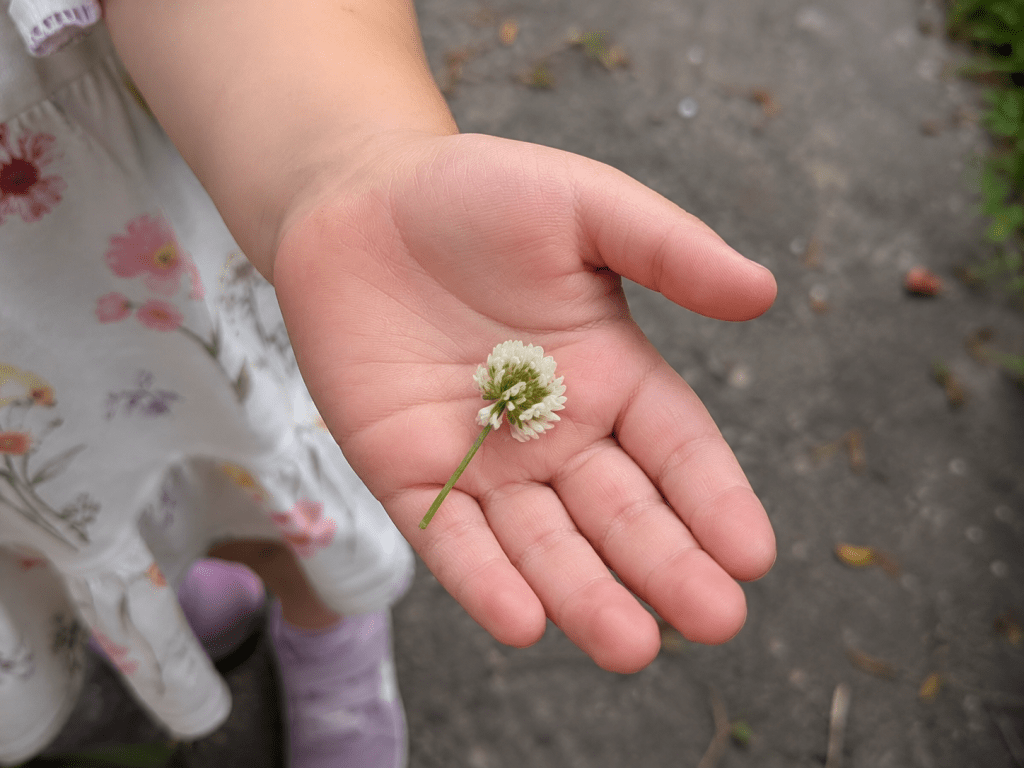
A child’s open hand holds a small white clover flower.Public domain.
Once a month, a wonderful therapist and I lead a program called Mindfulness Moments. Every time we come together, I’m reminded that we are able to be present and imaginative pretty much anytime we want.
Yes, some moments are easier than others. And many things pull us away from that way of being. But we can make space for it. We can be deliberate about it. We can choose it.
During our last gathering, she said something really simple, but it stayed with me: “As you take this next breath, do it with curiosity.”
I love that.
Like mindfulness itself, there are times when we are more curious than others. But we can practice curiosity intentionally as well.
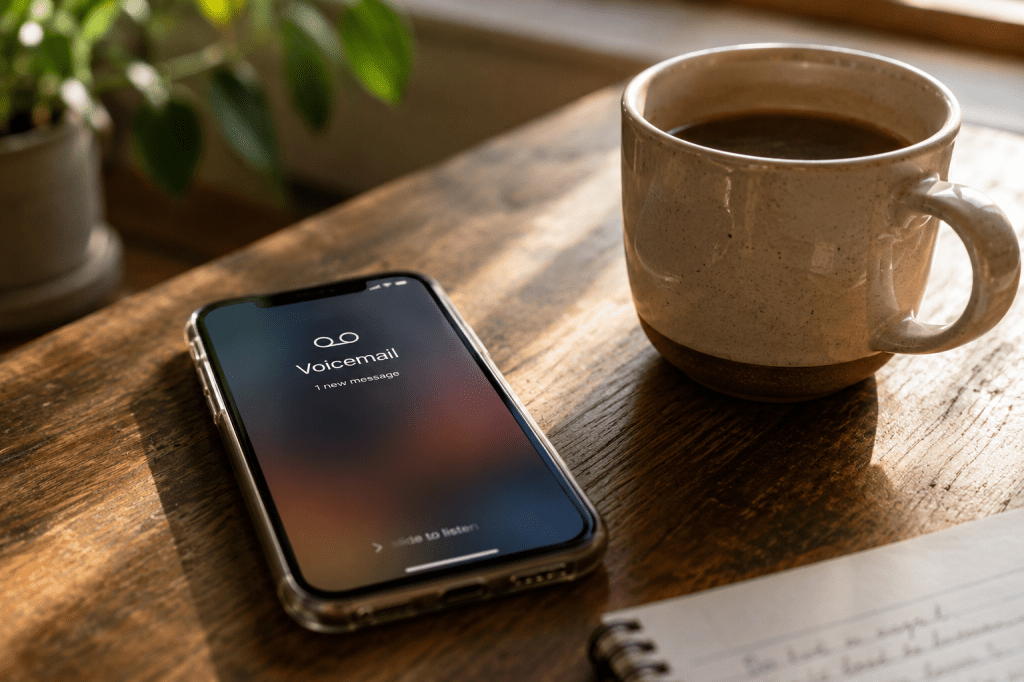
A smartphone and a coffee mug sit on a wooden table in warm sunlight. A notebook is partially visible in the corner. Public domain.
I opened the envelope with some trepidation, but soon discovered good news: I had passed all four of my ordination exams.
These exams involved a great deal of studying, along with long hours actually taking the tests. This was one of the last major milestones before I could seek an ordained position within the Presbyterian Church (USA). I was relieved and elated.
There were several people I wanted to tell, but the person I most wanted to call was David.
He had been my pastor growing up, and in my young adult years, I had been welcomed deeply into the life of his family as a chosen family member. He had also been steadfast in encouraging me as I moved toward ministry. I left him a voicemail sharing the good news.
Between that message and the call I received later, I was able to tell several close friends. I felt like a door was opening.
But then, a few hours later, I got the best call. David absolutely gushed with pride for me.
Of course, he was happy about the accomplishment and all that it represented. But what I remember from that day is much more than his words. I remember more than him saying he was proud of me.
I remember how over the top it was. And yet it was completely genuine.
Even then, I knew what a deliberate choice that was. David was aware of a lot of what I was carrying at that point in my life. Decades later, things are very different and have resolved beautifully, but at that time, there were significant tensions in my family. Eventually, I would even keep my own ordination service secret so that it would not be disrupted by those conflicts.
What I remember most is that David wanted to make absolutely sure that I knew someone loved me deeply, believed in me, and was proud of me.
Not long ago, I found myself thinking about that call again. It’s that deliberate choice that stays with me. It’s a choice to let people know that they matter. It’s a choice to celebrate them generously. It’s a choice to tell them that you value who they are and what they bring to the world.
It reminds me that whenever I can, I want to do it, too.
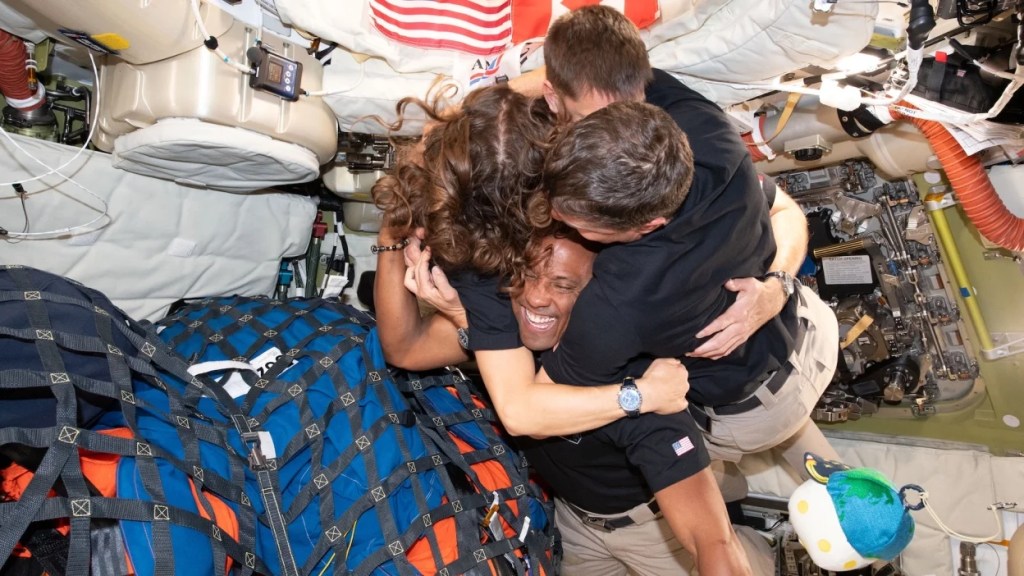
The crew of Artemis II, all hugging in zero gravity. NASA.
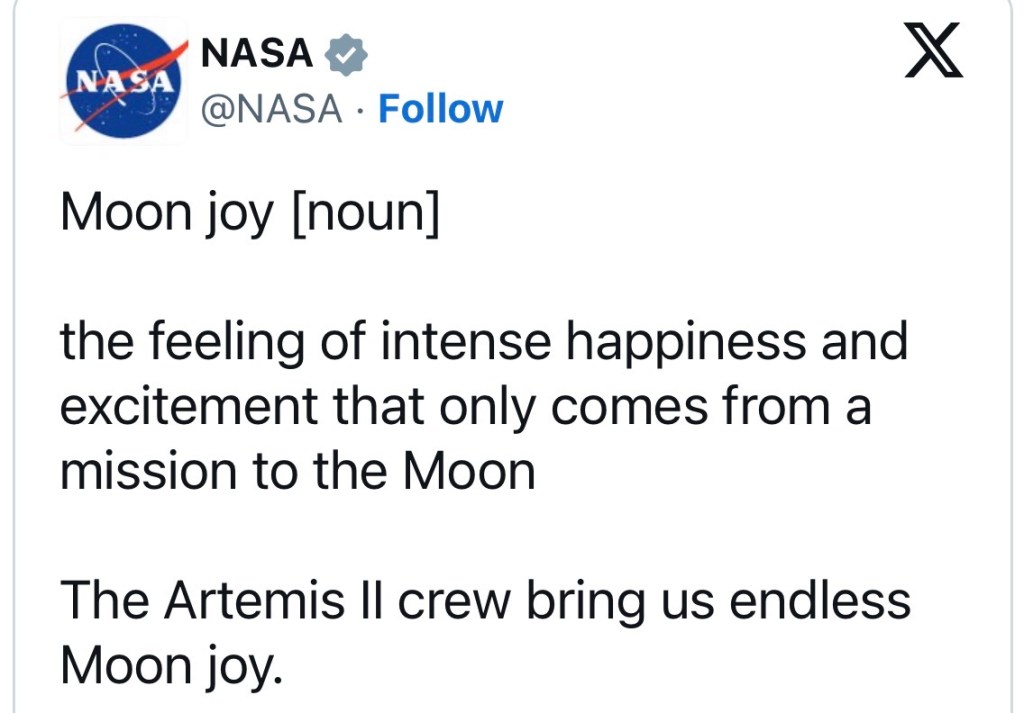
Text: A post on X from NASA: Moon joy [noun] the feeling of intense happiness and excitment that only comes from a mission to the Moon. The Artemis II crew bring us endless Moon joy.
IIs anything giving you joy right now? A little burst of glee?
By the way, it’s okay if that’s not your reality at the moment. Goodness knows, our collective reality contains many layers of struggle.
But what if it’s a tiny thing? It doesn’t have to be a swell of “to the Moon and back.” Maybe it’s “to that cup of coffee and back.” “To that phone call with a friend and back.” “To the adorable thing my grandchild said and back.” “To a delicious enchilada and back.”
Cultivating space for joy — or frankly, allowing it to surprise us — can be an act of resistance. And our joy can create space for others, too, compounding their own little delights.
So if you’ve got it, even something small, let it have its own gravity.