Image Description: A question mark written with white chalk on a black chalkboard.
Recently, someone asked me a great question:
“What’s something about you that is off brand? A trait about you that is against-type — one that doesn’t fit as obviously with the rest of who you are?”
I’ve been asking this question to myself and others, and I’ve discovered it’s also a fun question for groups. I love these unexpected answers.
Image Description: A car mirror with a reflection of trees, a blue sky, and white clouds.
Have you ever been with a child or adolescent who wants to be seen and observed?
“Watch this!” or “Watch me!” a young one might say as they play.
Or a teenager might just share all the things they’ve been up to lately — all the things they’ve been excited to try. The musical instrument they’re practicing, the new part-time job they’ve gotten, the team they’re on, or the play rehearsals they’re in at the moment.
When these moments happen, young people are connecting relationally with us. And we are also serving as mirrors for them to connect with their growing selves.
Though the formats or expressions may change, I don’t think adults grow out of this. We all need to connect relationally with others. We all need people to serve as mirrors so we can connect with our growing selves.
Image description: A pocket watch, surrounded by sand. It appears to be in motion, as if it’s being washed on the shore of a beach.
Trauma distorts a sense of time. This is true with personal trauma and collective trauma alike. As a more benign example, in the midst of this pandemic, how many of us have had trouble scaling an accurate sense of time? Experiences long-ago feel like they just happened, and experiences near in time can feel distant. I feel this sensation all the time, and I hear it from others too.
More challenging though, when we’re experiencing trauma on a deeper level in our bodies, we have moments in which the painful past feels re-lived and re-experienced in the present. On top of this, we likely project anxieties onto our imagined future too. These begin to feel real and present also. Past difficulties and future difficulties are converging inside us. Time is crashing within. This can feel very physical as it plays out in our bodies, and we may respond with fight, flight, freeze, or fawn reflexes.
But what if we could also hack this process a bit, reversing it and distorting time purposefully in our favor?
What if…
… we choose to recall the most supportive and affirming people, experiences, and chapters of our lives, remembering them and meditating on them in ways that allow us to feel their presence in our bodies? What if we make these present, and it impacts our physical sensations too?
… we choose to imagine a supportive and affirming future with beloved people, experiences, and next chapters at peace, with things likely working out (or with some bumps and resilience, turning out okay enough) and we encounter a future vision that energizes us in our bodies? What if we make these present, and it impacts our physical sensations too?
In this process, an affirming past and supportive future can also converge in the present, but now, we’re hacking this distortion intentionally.
A post from psychotherapy.central on Instagram. It’s a quote from Stephen Porges that reads, “Trauma compromises our ability to engage with others by replacing patterns of connection with patterns of protection.”
I find these words by Stephen Porges to be very wise and real:
“Trauma compromises our ability to engage with others by replacing patterns of connection with patterns of protection.”
When a person or community has experienced trauma, recent or long ago, the instincts for protection are valid.
-And-
This is one of the reasons that human connections are important in the healing of trauma. They restore something diminished. And they protect too.
Image Description: A bowl of tortellini soup with bread to the side. I wish I could share a photo of the actual soup I had, but alas, it turned out blurry.
I had the best soup for dinner last night. Like. Wow.
It was a tortellini soup, made by one of my favorite people. First of all, I don’t think I’ve ever had tortellini soup, so that was fun, but also, this was one of the best meals I’ve had in a good while.
And on top of that, something simple meant a lot to me too. As soon as I walked in the door, she said, “I know you like your food really hot, so I’ve kept it hot on the stove.” She would have kept it on the burner until I arrived anyway, but she had also been intentional about this little detail, just because she knows me. It feels good to be known.
One of the greatest gifts we can give each other — in large things and in small things — is particularity of care. Care that knows each other. Care that notices each other. Care that loves each other specifically.
Image Description: A brown welcome mat with black writing. It reads, “Home,” and the ‘o’ is a red heart. It’s placed before a salmon colored door and is placed on top of a gray porch.Source: Kelly Lacy, Pexels, Public Domain
I was recently listening to a Mumford & Sons’ song when one of their lyrics really caught my attention:
“… before I tumble homeward, homeward.”
I thought that was intriguing phrasing. It made me reflect on the times when I suddenly found myself in a homeward direction, perhaps when I wasn’t even expecting it. There are also times when I found myself feeling a sense of home, even though its process and arrival of getting there was messy.
Thank goodness these moments can happen.
I have had moments of return — to place, to family, to communities, to memory, to states of mind — that were sudden. I have had estrangements suddenly end. I have had reconnections with community open wide after this was previously closed. I have had moments when I realized I could reconnect with the feeling of a loved one’s presence after they died.
I have also had moments of tumbling home to uncharted places. I have moved across the country three times to live in four different states. I have weathered a pandemic from inside my house. I have been accompanied by friends and loved ones through daily living. I have come to feel at home in my body.
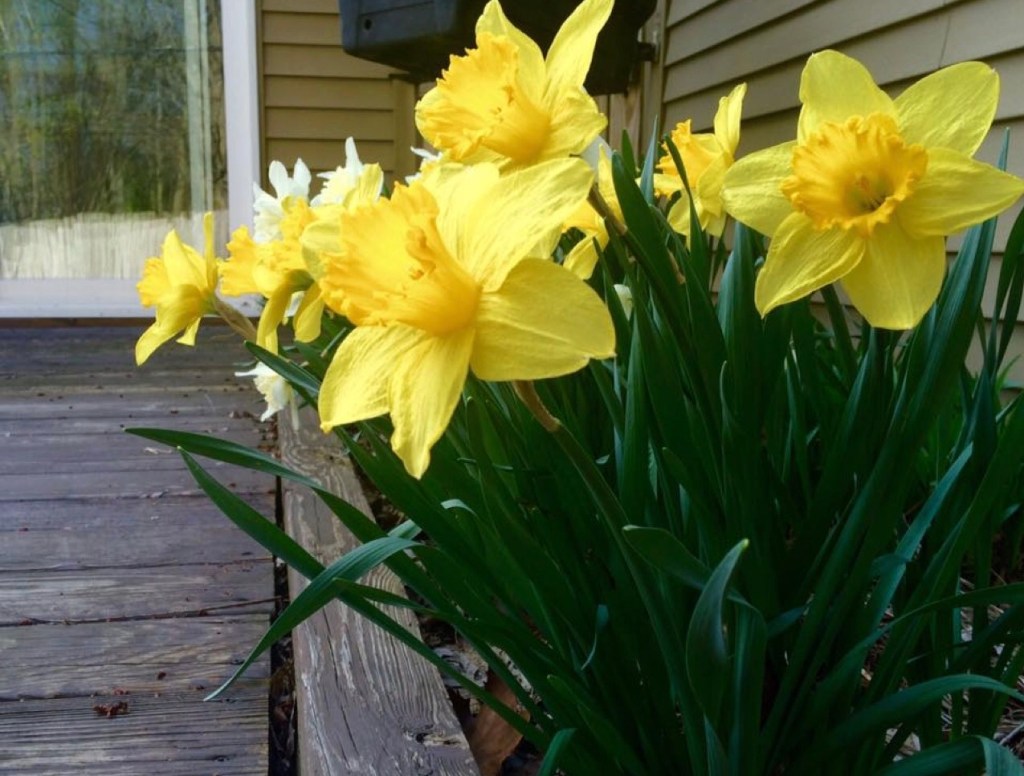
Image Description: Daffodils have emerged after a long winter.
Easter is a season — 50 days of new life.
Some of my readers likely celebrate Easter, while others do not. In any particular way resonates with you, may a season of new life find you. And here’s the theme that is sitting with me at the moment:
I want to live a larger narrative. I have some very specific things on my mind when I say that. These are large visions that resonate with my life and send me into particular callings in community.
I hope that you can also live into a larger narrative that marks your life, however it may take form.
This is what I mean: What is the larger narrative for you? — a vision more expansive than your fears, than your pain, than your abandonment, than your guilt, than your anger, than your regret, than your addictions, than your cynicism, than your anxiety, than your unease?
These feelings and experiences are valid and can be felt and processed, rather than pushed to the side.
But what larger narrative and vision energizes you and lights you up with sacred possibility?
Could we perhaps spend 50 days cultivating that? Dreaming that? Practicing that? Acting on that?
because we are all betrayers, taking silver and eating body and blood and asking (guilty) is it I and hearing him say yes it would be simple for us all to rush out and hang ourselves
but if we find grace to cry and wait after the voice of morning has crowed in our ears clearly enough to break our hearts he will be there to ask us each again do you love me
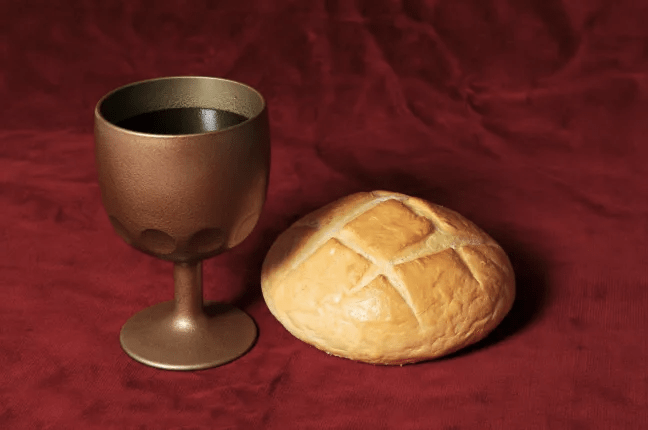
Image Description: A loaf of bread and a cup of wine. A red background.
This reflection was offered on April 14, 2022 at First Presbyterian Church in Saline, Michigan.
Having loved his own who were in the world, Jesus loved them to the end.
Jesus knows that the end of his life is coming. In a matter of hours, he will be unjustly arrested and condemned to die a painful death. As the end of his life draws closer, with each minute of heartbreak, Jesus also knows he will soon experience betrayal and abandonment by his most beloved disciples. It is a terrible burden to bear.
Having loved his own who were in the world, Jesus loved them to the end.
In his final moments, Jesus chooses to demonstrate love and righteousness, for he embodies the very love and righteousness that the disciples cannot fulfill. The King of Kings clothes himself in rags of servanthood and lowers himself to the ground. With love and righteousness, he washes the feet of the very ones who will walk toward his betrayal and then run away in fear.
Why does he choose to serve the ones who serve him betrayal?
Because love and righteousness are the end — the goal, the purpose, and the aim of his life.
Jesus loved his disciples to the end – that is, to his very last breath. Jesus loved his disciples to the end – that is, to the goal and purpose of who he was.
Jesus demonstrated love continually in the last hours of his life as he took bread, blessed it, and broke it with his disciples. He shared his last meal with them. He prayed for these disciples — each one — and he prayed for future disciples like you and me who would come to believe in him based on the words and witness of these disciples around the table with him.
Jesus loved these disciples. Jesus loved us. Jesus loved the world. He loved us all in these last moments, as he had loved us his entire life long.
Love so deep, enduring, and inclusive can come with challenges. Jesus loved so fully and radically that he threatened those in power, and the Roman state executed him. Love can be costly. . . Jesus chose to love anyway, and in doing so, he demonstrated the stronger power.
Jesus loved those he counted as friends, and he loved friends who would treat him like an enemy. Jesus Christ, God among us, loved humanity to the end – to his very last breath and the goal and purpose of his life.
We have all failed to live this kind of love fully. We struggle to love our friends and fellow disciples. We certainly fail to love our enemies and those who are scapegoated as the so-called “enemies.”
But Jesus gives us a commandment to love one another: “Love one another,” he says. “Just as I have loved you, you also should love one another. By this everyone will know that you are my disciples, if you have love for one another.”
Even if we do so imperfectly, can we dare to love one another to the end, to and through our very last breath?
Even if we do so imperfectly, can we dare to love one another to the end, to and through the very purpose and goal of Jesus’ life?
May God strengthen us as we sit at table with those we love. May God strengthen us as we sit at table with those who disagree with us. May God strengthen us as we ponder those who are vulnerable. May God strengthen us as we ponder those who betray the vulnerable.
And may we know that Jesus Christ loves us to the end.