Christmas exclaims that Time is an ever-expanding universe of arrival.
Christ has come, Christ is coming, Christ will come again.
Above and among, Beyond and beside, God stuns with sacred presence. Abstract and adnate, Boundless and bodied, God surprises with sudden reverence.
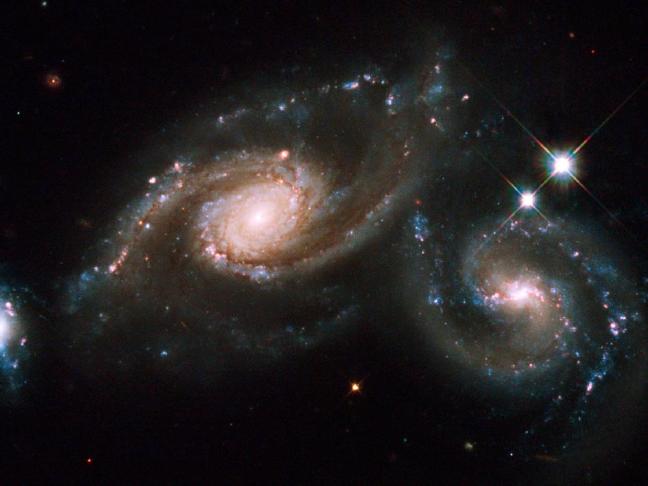
In this universe of Christmas, Time accelerates with increasing, expansive speed, and Time slows with easing, pensive stillness. Advent jumbles all eras of time together, Collapsing them into one another — colliding galaxies, continually merging.
Sacred past and sacred future converge, revealing a sacred present, A Holy, Sacred Now for
The One Who Was, Who Is, and Who Is to Come.
[2]
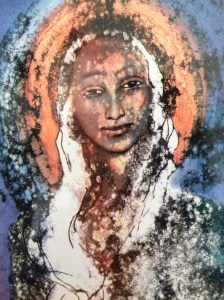
Mary was a universe of possibilities, God’s Mother, a cosmos of potentiality, “For in this rose contained was heaven and earth in little space, Res miranda. . .” [3] Res miranda! — A Wondrous Occurrence. . .
The Holy Spirit appears to reveal the sacred prospect, And Mary adds her YES, ushering in Emmanuel, God With Us.
Mary, Theotokos, bears God into the world. Res Miranda.
Mary, Theotokos, bears God’s child, Res Miranda! a galaxy of unending grace.
[4]
And. . . if Christmas is a swirling collision of Holy Time, making all things present, making all things new. . . Perhaps the Holy, Sacred Now is upon us, Perhaps the Holy Spirit is appearing among us, Right now, Right here, This very hour, summoning us to add our YES, so that we too might bear God into the world.
[1] This is an image of Spiral Galaxy ESO-137-001 as captured by the Hubble Space Telescope.
[2] This image was created by Deborah Koff Chapin and is part of her Soul Cards collection.
[3] This text is a portion of “There Is No Rose of Such Virtue,” a 15th century English Carol. Feel free to listen to the version that the King’s Singers perform:
[4] This is a NASA image of colliding galaxies.
[5] This image comes from wallpaper created by Fanpop.com. You can access the image here.
White ceramic elephant figurine on brown wooden table
When I was 9, I heard about a white elephant gift exchange for the first time. My friend’s Mom was having one. I no longer believed in Santa, but for about two weeks of my life, I sincerely believed my friend was about to receive a small, white elephant as a pet.
And because I was over there all the time, I was about to receive a small, white elephant as a pet.
I was so very excited.
I still enjoy white elephant gift exchanges, but this one had the cutest expectations.
Image Description: Four very real reindeer are eating grass. Public domain image.
This is one of my favorite questions to ask people:
What is something you learned incorrectly as a child but only realized well into your adulthood?
This is a fantastic question! It leads to stories that are very dear and often, quite hilarious. Some people talk about words they mispronounced for decades, only revealed, of course, when they blurted them aloud in a group setting. Others talk about illogical beliefs they internalized as kids which emerged unexpectedly in their minds years later (or were also voiced aloud!) These come as a total surprise because people hadn’t even thought about the topic, let alone questioned their young belief, until that very moment.
This American Life has an entire episode of stories like these. My favorite involves a moment when a college student approached other college students at a campus party and asked the question, “So… are unicorns just really rare, or did they go extinct?”
Hysterical. Totally embarrassing. But also so dear. I love it!
With all of this in mind, I will now admit that I have an embarrassment of riches of stories like these from my own life. And I will share one of them today.
My favorite personal story of this kind involves the nine year window when I didn’t believe in reindeer.
Yes, you heard that correctly.
Now I hope this doesn’t come as a total surprise or crush anyone’s dreams, but when I was eight years old, I learned the sad truth that Santa wasn’t real. (Are you okay? I hope so). In the moment of this revelation, I was pretty of devastated. I was also deeply concerned that I wouldn’t get presents anymore.
So in the midst of my sadness, I resigned myself to reality. So much so, in fact, that I just kind of… over-steered. I just assumed… that… reindeer weren’t real either.
I mean, come on… They fly! Flying reindeer? No way.
At least there was some sort of evidence of Santa’s existence. Gifts showed up annually, so there was something tangible to associate with him. Plus, I saw him in all the malls!
But once I knew the sad truth, how could I possibly believe in flying, antlered caribou? Reindeer quickly went the way of the unicorn. (Ahem… not extinct. Non-existent).
That is, until… I was 17 years old. That is, until… I was flipping through the channels and saw a nature documentary on my television set.
A British accented, David Attenbourough wannabe voiced commentary as creatures walked around in the snow, plunging their faces into the frigid stuff, attempting to nibble on frozen grasses. “The reindeer are in the tundra,” the David Attenbourough wannabe said in all his formal tones.
And I started laughing. Laughing! “The reindeer! In the tundra! Yeah…”
But then, my laughing stopped abruptly, and my mouth gaped open. As I sat alone in the living room of my childhood home, in my last year before legal adulthood, a recognition completely washed over me. It dawned on me — at age 17 — that reindeer are REAL.
I had indeed over-steered. The reindeer had been in the tundra this whole time.
Image Description: Tealight candles are it and lined up next to each other in an s-curve pattern.
I know a pastor who often says a particular phrase when he prays in worship:
“Help us to be a part of the very prayers we make.”
It’s a phrase I have taken on as well when I lead prayers. Prayer can mean many different things and take on many different forms. I suspect if we pray, most of us pray in many different formats, and we likely infuse that process with many forms of meaning.
But certainly, praying should call us to action.
We need to be a part of the very prayers we make.
So if you pray, what do you pray for these days? Or if you would use a different word than prayer, what do you hope for? Or long for? What need is grabbing your attention in this world, your community, your family?
Whatever it is, how might we take an action to be present to that very need? Or to address that very need?
How might this be important especially for neighbors who are so often out of view? – Those in prison, – Those going hungry, – Those experiencing homelessness, – Those in the throes of addiction, – Those who are immigrants, – Those who live in fear in the shadows, – Those who are sick without healthcare, – Those who are stigmatized because of mental illness, – Those who have lost jobs, – Those who are foreclosing on their houses, – Those who have received a challenging diagnosis, – Those who are harassed or bullied. . .
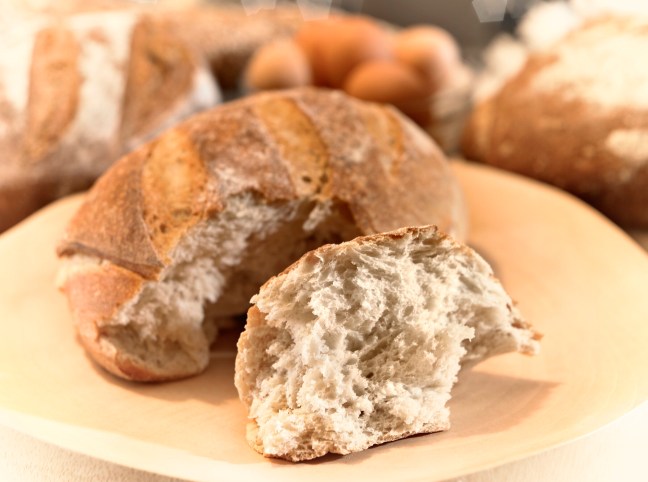
Image Description: A loaf of bread, with a large piece torn off.
I was walking toward a building near campus yesterday when a person waiting outside held the door open for me. The person was about to take in a big cart, but before moving it, it seemed easier to let me go through first. So the person held the door open for me as I approached it.
When I saw that this was about to happen, I immediately sped up my walking toward the door. I probably doubled my speed. Then the person said,
“Oh, no need to hurry!” This was spoken as a kind reminder that I wasn’t inconveniencing.
I thought about how frequently we worry about taking up space, or inconveniencing, even when we are given an authentic occasion to receive. Some of us have been socialized in this direction especially.
That’s when I thought of something that the poet Mary Oliver says: “Joy is not made to be a crumb.”
Likewise, I suppose,
The taking up of space — being noticed, being cared for — is not made to be hurried.
Dr. Ellen Langer, scholar and researcher on mindfulness, uses a particular phrase to describe the ways we become disconnected from the present moment. She says that so frequently, we live in a perpetual state of constant partial attention.
Constant partial attention. . . Isn’t that a perfect way to describe that kind of experience? So often, we move through our days simply going through the motions, rarely paying attention to what is right in front of us. Instead, our minds gravitate toward our to-do lists and the situations that make us most anxious. We get stuck mulling over the past or worrying about our imagined future. In the process, we miss the present moment.
And sadly, this means we lose some awareness of our surroundings, our inner life, our neighbors, and the deep stirrings within us.
Earth’s crammed with heaven, And every common bush afire with God, But only he who sees takes off his shoes; The rest sit round and pluck blackberries. [1]
Sometimes we experience the daily delights of what’s in front of us; other times, we’re more disconnected than we’d like to be.
The good news is that we can keep reorienting ourselves again and again.
Image Description: A black and white name tag sticker says, “Hello, my name is” with a blank space to write a name.
Recently, I had the opportunity to hear some folks encourage a particular person, and I noticed that something kept happening quite naturally. Instead of simply saying,
“We’re with you. . . We believe in you. . . We know you can do this. . .”
they also kept adding the person’s name:
“We’re with you, [Name]. . . We believe in you, [Name]. . . We know you can do this, [Name].”
Throughout all of this, I was reminded of how powerful names can be. In the context of expressing love, gratitude, or encouragement, names themselves can be words of deep affection.
After I had already been pondering this, in a different context, a friend said that she wanted to hear her name more. She felt like people hadn’t said her name as often lately, a name she shares with a relative she lost years ago.
Perhaps somewhere within us, we’re all longing to be addressed by name. This sacred process of speaking and hearing names comes from a place of being known and honored as the ones we are. We are seen and cared for in all our particularities.
When addressing others with love, gratitude, and encouragement, I’m going to start speaking names much more often and much more intentionally.

 [4]
[4] [5]
[5]