Years ago, I attended a Thanksgiving dinner with no mashed potatoes. Gasp! Clutch the pearls! No mashed potatoes. And I love mashed potatoes at Thanksgiving.
Now I’m sure if we went around the room, we could probably all name a favorite dish that we enjoy at Thanksgiving or some other holiday meal altogether — the kind of dish we cannot imagine that meal without. And I’m just curious what yours would be.
For me, it is mashed potatoes. I pile them high every single…
This image reads, “Coronavirus — 1 in 500 Americans have died of covid,” The Washington Post.
This is a heartbreaking statistic shared by The Washington Post, and I don’t think we’ve had many, if any, ways to honor this intense level of collective grief.
And in addition to this number, an even larger number of people have long term symptoms and disabling impacts.
The grief is deeply personal for those who have lost a loved one. And for all of us, it is broad, sweeping, and collective. This trauma is a part of our lives.
We can pause and remember people.
We can slow down.
We can reach out to loved ones.
We can cry.
We can express anger.
We can share words of kindness and tenderness with one another.
We are all impacted by this. Some people and families are upended by this. Let’s pause, remember, and honor them today.
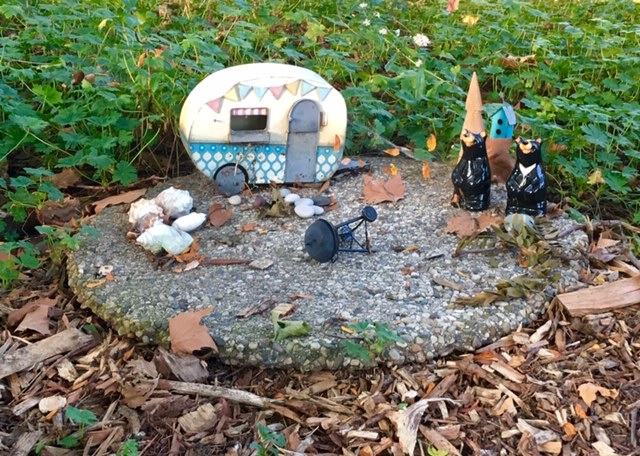
Image Description: A mini tableau camping scene with a camper, an overturned grill, and bears!
While driving in my car, I listened to an episode of the podcast Hidden Brain called You 2.0: Rebel With a Cause. The episode was about people who find themselves breaking rules that need to be broken. This includes people who live with a sense of openness. It allows for shifts in thinking and the cultivation of new possibilities in living and in problem solving. For a portion of the episode, they talked about the concept of Beginner’s Mind.
Beginner’s Mind, or Shoshin, comes from Zen Buddhism. The Zen monk and teacher Shunryu Suzuki says, “In the beginner’s mind there are many possibilities, but in the expert’s there are few.” When we approach life with a sense of newness, we can learn, grow, and view more possibilities.
Last night, I experienced this in a small but refreshing way. I stepped outside of the house and walked outside around the block, something I’ve done more times than I can count. But this time, I walked the block counter-clockwise instead of my typical clockwise. It wasn’t the first time I had done so, but I hadn’t walked in this direction in a very long time.
And I noticed so many different details in the neighborhood!
My favorite previously unnoticed detail was an adorable, mini tableau camping scene outside of a neighbor’s house.
There’s a lot to notice. We just need to begin again. There are a lot of possibilities.
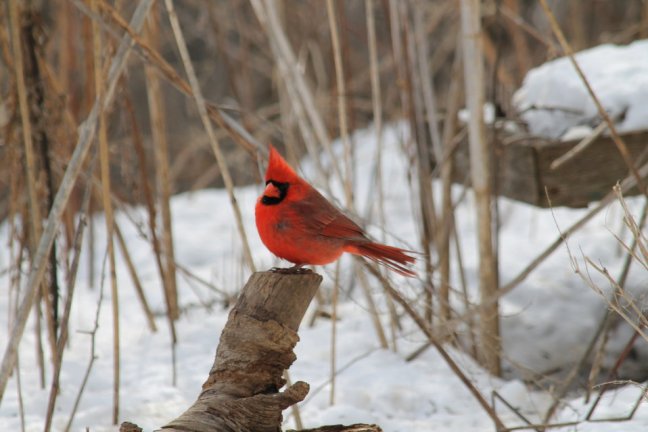
mage Description: A cardinal is perched on a stump with trees and snow in the background. Public Domain.
I wrote this piece a couple years ago, pre-pandemic. I’m remembering it fondly again.
Last week, I spent some time in the waiting room for a doctor’s visit… like a lot of time. Waiting. Usually, it doesn’t take this long — something my doctor also confirmed once he was able to see me.
For a while, I just sat in silence. I brought a book, but I think I just needed a bit of time to decompress and think of very little. The truth is, I had had a lot on my mind over the last few days. All of that was still there, of course, so I sat there while silence accompanied my still emerging thoughts. That and daytime television.
Then a man approached my side of the room, and he sat directly to my left. He had a walker. I soon realized the walker was for his wife who came immediately behind him. She moved to sit directly to my right, so before she sat, I asked,
“Would you like this seat?” wondering if they’d rather sit directly next to each other.
“Oh no, honey, this is just fine.”
Suddenly, I was sandwiched between Bob and Sue, two older adults, who were much better at accompanying me than the silence. For the next twenty minutes, I honestly felt wonderfully grandparented, as they delighted in talking with me. Bob told me his creative strategy to get telemarketers to stop calling. Sue told me that she knows one of my neighbors. They both shared why they keep choosing this medical clinic. They inquired about me. I felt so enjoyed, and I enjoyed them too.
At one point, while flipping through magazines, Sue saw a picture of a cardinal and said, “Aren’t they so pretty?”
“Yes, I love them,” I said, thinking about the ones who fly into my yard and how they’re my university mascot as well.
“You know, I’ve never seen a baby cardinal. I wonder what they look like.”
“I’ll look it up,” I said, pulling out my phone.
They chuckled at the marvel of it, that we could look that up on a phone. “These young people know how to do it,” Bob said. I smiled, enjoying being relationally young, though I’m just a couple years shy of forty.
“Oh, here it is. Look at that!” I said. It turns out that baby cardinals are pretty cute. We passed my phone around to see.
A few minutes later, a medical assistant spoke their names, and Bob and Sue were called to the back before I was. When they stood up to shuffle to their visit, I felt different.
There are many ways that kindness and delight can show up, surprisingly, even in times of stress. We just have to show up to it. Or sometimes… let it just find us.
*I changed the names of this wonderful couple. I will remember them by their real names for a long time.
I could make a parallel post to this week’s piece about having needs.
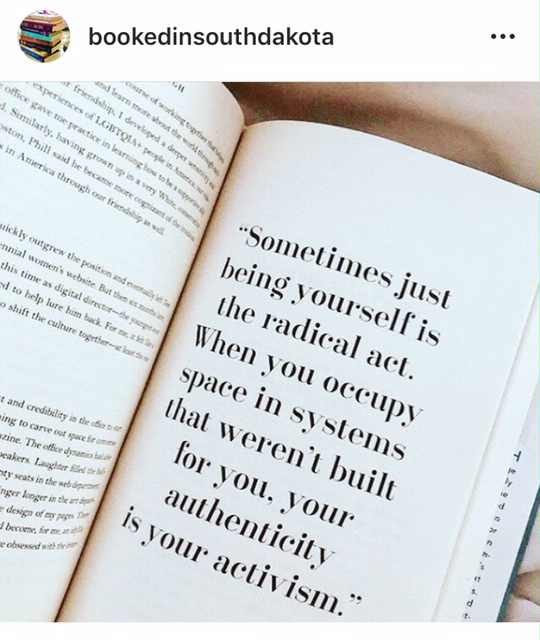
A great deal of cultural messaging says,
“Don’t speak up.”
“Keep that idea to yourself.” (or let me appropriate it…)
“Stay small.”
“Who are you to be in the room? Who are you to lead?”
These messages are sent especially to those with marginalized identities.
But shouldn’t we be suspicious? So frequently, aren’t the cultural forces and systems of greed, along with their benefactors, the loudest messengers in these directions?
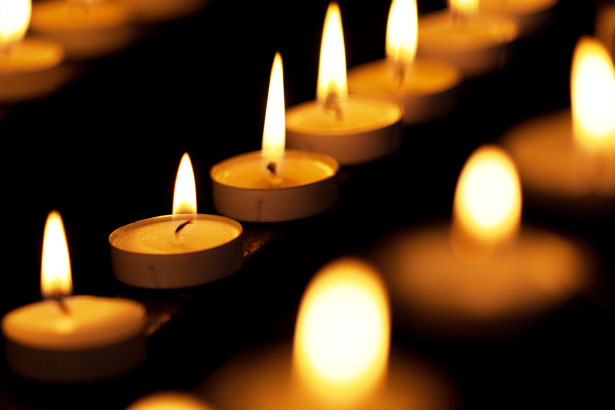
Image Description: Many tealight candles burning. Public domain image.
At one point this weekend, I was talking with someone who seems to think that people’s pandemic precautions have been overblown. He had gotten vaccinated, but he felt as though people have been overreacting about all of this over the last year and a half
Yet right now, we are losing a 9-11 amount of people nearly every single day to this illness. Of course, each of those people have names and are loved.
A few days ago, I saw someone pointing this out on Twitter. Each year on this date, we rightfully pause and remember those who died on September 11, 2001. But we don’t always have the ability, and sometimes, the willingness, to have collective morning for those who are dying daily. How do we wrap our minds around this much loss? It’s hard to do.
And so I pause to remember those who died 20 years ago and to remember those who are dying today.
But shouldn’t we be suspicious? So frequently, aren’t the cultural forces and systems of greed, along with their benefactors, the loudest messengers in these directions?
“Growing up with the message that ‘you’re not supposed to need other people’ is going to require a ton of shame to maintain — since it’s going against millions of years of human evolution in a species with a nervous system built exactly FOR: safety, connection, and relationship.”
Image from @notesfromyourtherapist on Instagram.
Image Description: The quote above is written on a sheet of white paper with black writing.
Public Domain Image. Image Description: Paper cut outs of people are standing in a line and holding hands. The image has different shades of orange with light shining through at the top.
We need care.
We all need nourishment, rest, play, connection, love, relaxation, personal growth, and the meeting of daily needs. These take time and intention.
These days, we hear a lot about self-care, but we need community-care too. I follow the lead here of BIPOC and disability justice activists who remind us that our relationships are intended to be interdependent, and that we can practice care toward one another, meeting each other’s needs with love, consent, respect, and empowerment.
When it comes to cultivating care for ourselves, both in our practices toward ourselves and in our making requests from others… some of us were socialized to feel as though care for ourselves is somehow selfish… that it is self-centered or that the prioritizing of time for our care somehow ‘takes’ from others.
Of course, when we seek to live toward an interdependent vision for our relationships, care for ourselves creates more vitality, resilience, and energy for our loved ones and the community as a whole. It aids more than ourselves alone.
But still, even if we know that, and even if we believe that, that old socialization can run deep.
So here’s a question I find myself thinking about…
When we cultivate care for ourselves, in our practices toward ourselves and in our asking for needs to be met by others,
what if we also thought about it as “selves-care”?
Does this framing help?
After all,
Don’t we find that we are meeting needs of our younger selves?
Don’t we find that we are creating more vitality for our future selves?
Doesn’t care do that for ourselves? Reach backward and forward?
Selves-Care: Loving and aiding our past and future selves. Loving and aiding our relationships and wider community. Is this helpful?
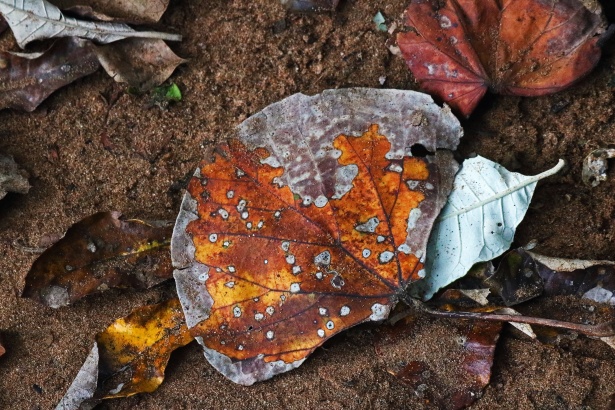
I looked up and watched several leaves float down from the sky. They were falling in real time from very tall trees.
“They’ve never been untethered before,” I thought with some sadness, because for some reason, I tend to anthropomorphize things. I watched them fall to the ground.
I kept walking and pondered how intertwined root systems existed underneath my feet, unseen as I walked along this pathway with trees on either side.
Sometimes, we’re more connected than we think we are.

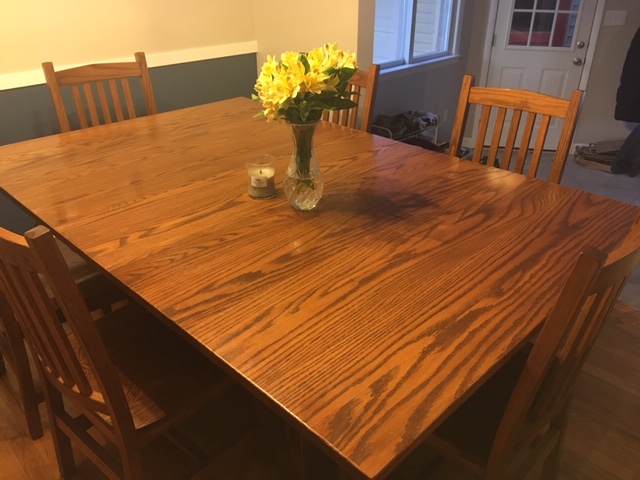 Image Description: A solid oak dining room table with chairs. A green candle and vase of yellow alstroemeria flowers are on the table.