Image Descripton: Six Black Lives Matter yard signs.
I was spending some time with people at a barbecue held by the Ann Arbor Friends Meeting. When I won the game of Get-To-Know-You Bingo — you know, that game where people attach people’s names to various details on the squares? — my prize was a Black Lives Matter sign for my yard.
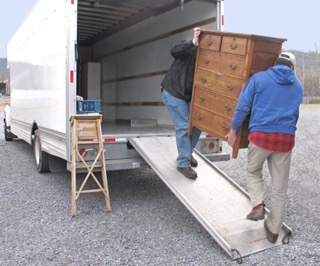
Image Description: Two people carrying a chest of drawers into a moving truck.
In these days we’re living, do you feel overwhelmed by the news cycle?
Yes, me too. Of course. Who doesn’t?
Behind the news cycle, there are real, raw, human stories of suffering. And so often, we feel helpless to prevent that suffering and powerless to change it.
It’s incredibly understandable to fall into those feelings. In such times, we need the solidarity of one another – that is,
. . . the sense that we are in each other’s view, that we encounter each other’s pain with empathy,
. . . the sense that we have each other’s commitment, that we are in each other’s corner for the long haul,
. . . the sense that we have each other’s action, that we covenant to act on behalf of one another, especially and most readily for the vulnerable.
In my Christian tradition, our scriptures speak to a calling of bearing each other’s burdens. Lately, within that calling, I find myself encouraging people to shift each other’s burdens.
We can easily become incapacitated once we realize we cannot instantly fix the systems that are causing burdens. But our empathy, and most importantly, our committed action can change these systems and these burdens. Do not underestimate what these can do.
When we see pain for what it is, we add our validation, and it shifts burdens.
When we add our resources of money, time, or skills, it shifts burdens.
When we use our voices to name wrongs for what they are, it shifts burdens.
When we use our minds to create solutions, it shifts burdens.
When we put our bodies in places that disrupt harm, it shifts burdens.
When we honor the humanity of people who are being dehumanized, it shifts burdens.
When we take direct action and demand justice for the oppressed and vulnerable, it shifts burdens.
If we want to change the large-scale systems that cause harm, we have to disrupt and dismantle them. But alongside that commitment, we have to live and model our lives with a different rhythm – with different commitments and ways of relating to one another.
We practice solidarity.
And within that way of living, we share and lighten the loads that people are carrying. We assign energy and responsibility to where they really belong.
Image Description: Words of the Torah in Hebrew text.
From my vantage point, looking at a screen as I sat at my dining room table, names emerged within the Zoom chat window. But I had not read them yet with my eyes.
Instead, gathered virtually with the Beth Israel Congregation in Ann Arbor, I listened to my dear friend and colleague, Rabbi Rob Dobrusin, pray in Hebrew. The sounds flowed meaningfully, though most of the words were unknown to me. Here and there, I would hear, Adonai, a name for God. In a language unknown to me, definitions, grammar, and syntax all fell away. Instead, I heard spoken, melodic sounds.
Then I began to hear our names.
In the midst of words I didn’t understand, I opened my eyes suddenly and looked up at the screen in recognition when the name of another colleague alerted me to understanding. This language of prayer was carrying names. Then I began to hear more names interspersed within these sounds. Then I heard the names of the people I had placed in that chat window.
I felt language itself lifting us up, knowing that our words are intentions, knowing that our melodic speaking is often filled with love for people.
Image Description: Pages from a book are folded to make the shape of a heart. A string of lights shines in the background.
For many people, 1 Corinthians 13 is a very familiar text. Some of us grew up hearing these words in church communities. Many others have heard these words at weddings.
Love is patient; love is kind; love is not envious or boastful or arrogant or rude. It does not insist on its own way; it is not irritable or resentful; it does not rejoice in wrongdoing, but rejoices in the truth. It bears all things, believes all things, hopes all things, endures all things. (1 Corinthians 13: 4-7, New Revised Standard Version)
These descriptors get translated as adjectives, but interestingly enough, in the original Greek language, these descriptor-words all have verb roots. We describe love by enacting love.
Here’s a verb-friendly translation of this text.
Love lives long-hearted in adversity. Love practices kindness. Love envies not. Love boasts not. Love swells-up not. Love does not act unbecomingly, does not seek the self, does not provoke to anger, does not calculate evil, does not rejoice upon the injustice, but rejoices together with the truth. It covers all things, entrusts all things, hopes all things, endures all things. Love never perishes.
Image Description: A butterfly on a plant with blue and black wings. Public domain image.
I was thinking about the butterfly effect this week, and specifically, I was wondering, is that really real?
Do you know which thing I’m talking about? Sometimes, it’s also called Chaos Theory. Ultimately, it’s a realization that very small actions can lead to very large effects, particularly as they create a series of changes in large systems. The butterfly effect gets its name due to Edward Lorenz. He demonstrated that the flapping wings of a butterfly in one part of the world could ultimately lead to a tornado weeks later somewhere else. Thankfully, this doesn’t happen all the time; otherwise, we’d have tornados and hurricanes everywhere. But the point is this: Tiny, minuscule changes can create complex results in large systems.
It’s pretty astounding, actually. It means that every thing — every action, every interaction — is affecting a whole, enormous host of other things.
In a tumultuous time, don’t underestimate how positive actions can lead to large scale results. Even tiny ones have an effect. Each and every day, what we do matters. What we do this very day matters.
So what kind of change is possible, not only when we act alone, but when we act together?
Image Description: Five post-it notes are placed in a stack, though offset so it looks like they are rotating (from back to front, pink, orange, yellow, and blue). A question mark is on the blue post-it note on top. Public domain image.
There are times when we find ourselves mulling over the very same themes in our thinking.
There are times when we feel weighed down by longstanding frustrations that rarely seem to shift.
There are times when it feels like things are stagnant or unmoving.
So. . . What if we ask a different question?
This is something that a friend of mine says often, and I really appreciate it.
What if we do that? What if we ask a new question? Could that open up new possibilities – creative pathways or new angles of relating?
Maybe that seems like a small thing, but it’s actually a large thing. Frameworks affect how we view situations, feel, and express hope.
So what if we try it? Might it open up something different?
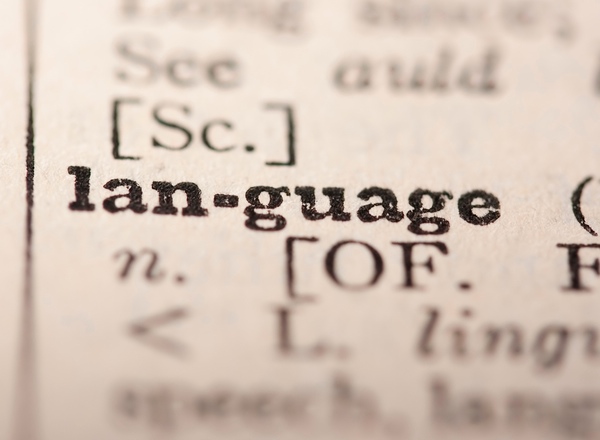
Image Description: The word ‘lan-guage’ as an entry in a dictionary. Public domain image.
One of the most transformative and empowering acts of care we can offer is an invitation to tell a story. When people can put their experiences into words, they connect meaningfully with others, and perhaps most significantly, they make meaning of their own lives. People remember who they are and become crafters of narratives that convey some of their most significant experiences.
Trauma researchers have written a great deal about this; healing often comes with the ability to share narratives and make meaning out of challenging experiences. We never want to inquire about trauma experiences in intrusive ways, but when people begin to open up, and we sense that they want to share, an invitation of, “Would you like to tell me more about that?” can be remarkably transformative.
Likewise, invitations to share stories of positive experiences can be just as transformative, especially when people are feeling down, sad, confused, or burned out. At the right time — and it is important for it to be at the right time — have you ever asked someone to share about their own resilience? Or about a moment when they felt joy? Or about a time when they felt really engaged and alive in what they are doing?
As they share, these positive memories of the past become present, physiologically speaking. These stories flow through people’s bodies as they tell them, and the act telling them changes how their bodies are feeling in that moment.
So yes, one of the most transformative and empowering acts of care we can offer is an invitation to tell a story.
Image Description: The words ‘Be brave,” are written in black cursive from within an uneven, circle-like shape of pink.Public domain image.
When people share similar sentiments across various community groups I’m in, I tend to give special notice to them. Multiple times last week, in different groups altogether, people voiced aloud,
“It’s so helpful to be able to name difficulties in this group without knowing you’re going to be (judged, dismissed, discounted, or told to ‘get over it’).”
I am thinking about this even more intentionally after hearing various versions of that sentiment.
This is one of the greatest gifts community can provide, particularly if the community culture feels safe enough or as someone said recently, like “a brave space.” Being brave, of course, doesn’t mean people need to be stoic or have it all together. In fact, brave spaces often invite the opposite.
It is extremely valuable when we can trust people to hold pain and difficulty just as it is in that particular moment. We don’t need to clean it up. We also don’t have to assume it’s static and immoveable.
In fact, sharing it changes its reality just a bit. We’re not alone, and we’re loved and accepted as it is and as we are.
Here’s another song I really love. Sometimes, people write music, poetry, or prose that can speak into a large variety of life directions. This song is like this, so may it encourage you in whatever direction you need.
“If you’re loved by someone, you’re never rejected. Decide what to be, and go be it.”
Head Full of Doubt/Road Full of Promise
There’s a darkness upon me that’s flooded in light In the fine print they tell me what’s wrong and what’s right And it comes in black and it comes in white And I’m frightened by those that don’t see it
When nothing is owed or deserved or expected And your life doesn’t change by the man that’s elected If you’re loved by someone, you’re never rejected Decide what to be and go be it
There was a dream and one day I could see it Like a bird in a cage I broke in and demanded that somebody free it And there was a kid with a head full of doubt So I’ll scream til I die and the last of those bad thoughts are finally out
There’s a darkness upon you that’s flooded in light And in the fine print they tell you what’s wrong and what’s right And it flies by day and it flies by night And I’m frightened by those that don’t see it
There was a dream and one day I could see it Like a bird in a cage I broke in and demanded that somebody free it And there was a kid with a head full of doubt So I’ll scream til I die and the last of those bad thoughts are finally out
There was a dream and one day I could see it Like a bird in a cage I broke in and demanded that somebody free it And there was a kid with a head full of doubt So I’ll scream til I die and the last of those bad thoughts are finally out
There’s a darkness upon me that’s flooded in light In the fine print they tell me what’s wrong and what’s right There’s a darkness upon me that’s flooded in light And I’m frightened by those that don’t see it