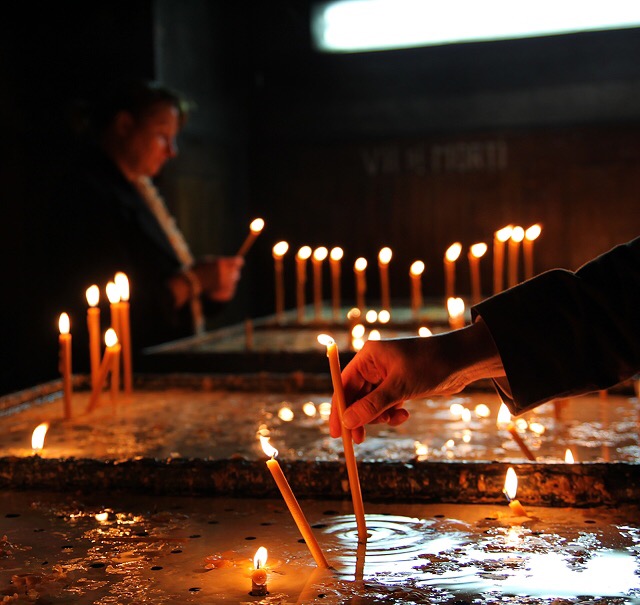
Image Description: People are placing long, white candles into shallow pools of water. There are holes to hold the candles.
Today’s piece is a repost from April 2017. I love this story.
These days, I pray to the God between us.
Not to a distant God far away off in the sky somewhere. Not to a mechanistic God, constantly making things happen with the push of a “save” or “smite” button, reminiscent of some old Far Side cartoon.
I pray to the God between us.
Beyond us, yes, but only in the sense of being greater than any one of us. That, and calling us to transformative realities beyond what we typically allow ourselves to imagine. Never far away.
Between us.
With us.
Among us.
A couple days ago, I found myself reflecting upon one of the most powerful experiences I ever had in a worship service. It was 10 years ago at Mo Ranch, a camp and conference center in Hunt, TX. I was there with a couple hundred college students at a conference aptly called College Connection.
That night, we were together around 9 PM. The beginnings of a warm summer were just beyond the door of the building, and the space was filled with hundreds of candles. Students sat on the floor in close proximity. Together, we sang a lot of beautiful choruses, music with rich meaning.
Midway through that time together, we began to sing a powerful song called “Prayers of the People.” Already, we could hear the tinkling of rain on the metal roof.
The song is by Ben Johnston-Krase. He was there with us, leading us on the piano as we sang it together. We sang these words, not necessarily about ourselves, but about humanity at large. . .
We are hungry, whoa, we are hungry, We are hungry, whoa, we are hungry, We are man, woman, we are children, whoa, we are hungry. . .
And that’s when it happened. We moved onto the main part of the chorus:
So let the rains go, let the healing river flow. Let justice roll like waters. Let the days begin when new life enters in, and let your kingdom come.
Right then, a deluge of water poured from the sky onto that tinny sounding roof. And not only that. It began to flood the space where we were sitting!
Thankfully, this was not from the roof above us, but it did come through the door onto the floor. Some of us got up quickly to move and cover electric cables, but other that, we just let it happen. As we continue to sing those words, we let that water flow right to the tables that held our candles.
The imagery and the synchronicity was not lost on us. We wanted justice to roll like waters, and in that moment, we even believed it possible.
So what happened that night? Did a far away God, off somewhere in the sky, push a “rain” button and mechanistically make that happen? Certainly, if there’s a God, we might say that God made the glories of rain. But if there’s a mechanistic process to everything that happens, I have to start worrying that there’s a cancer button, and a tomahawk missile button, and a school shooting button. I don’t believe that everything that happens is destined to happen.
But I pray to the God between us. Because when that glorious rain happened, I think God was between us, waking us up to the sacred moment as we recognized beauty and sensed a real calling to justice.
I think God is always between us, constantly inspiring us to act in transformative ways, sometimes beyond what we can easily imagine if we will notice what is around us and who is around us.
And without question, the God between us turns us toward one another, so we can marvel at the shared humanity around us.
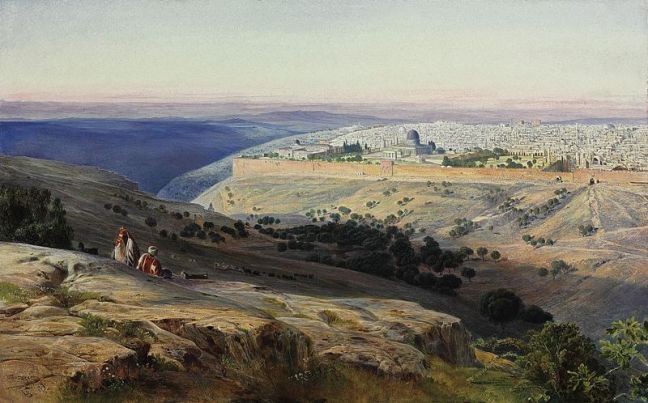
Image Description: Edwin Lear’s painting, Jerusalem from the Mount of Olives, Sunrise. Wikipedia Commons.
When Jesus walked up the Mount of Olives and sat down, his disciples followed him and joined him there. A crowd watched all of this happen.
Then, at the base of the mountain, that crowd listened to Jesus speak the Sermon on the Mount. The particular configuration of above and below likely allowed the Mount of Olives to serve as a natural amphitheater.
“Blessed are the poor in spirit, for theirs is the kingdom of heaven.
‘Blessed are those who mourn, for they will be comforted.
‘Blessed are the meek, for they will inherit the earth.
‘Blessed are those who hunger and thirst for righteousness, for they will be filled.
‘Blessed are the merciful, for they will receive mercy.
‘Blessed are the pure in heart, for they will see God.
‘Blessed are the peacemakers, for they will be called children of God.”
I didn’t notice this for a long time, and I thank Dietrich Bonhoeffer for this observation*: Jesus is putting his disciples on display before that crowd quite purposefully. He is speaking to them, about them, in front of that group of people.
These people right here are poor in spirit, mourners, and meek. They are invited to hunger and thirst for righteousness, practice mercy, live purely, and make peace. You, crowd at the base of this mountain, will see them be filled with the Kingdom of God, comfort, and the earth itself. (And you, the readers of this text, will see it as Matthew configures it.)
“Blessed are those who are persecuted for righteousness’ sake, for theirs is the kingdom of heaven.
‘Blessed are you when people revile you and persecute you and utter all kinds of evil against you falsely on my account. Rejoice and be glad, for your reward is great in heaven, for in the same way they persecuted the prophets who were before you.”
You will see them persecuted, reviled, and maligned with evil words and false testimony. At times, they will also fail and fall short. But make no mistake — they will be Prophets. When you practice love, justice, and the way of peace, power is threatened and unleashed. But the ways of love, justice, and peace have the final word. The Beatitudes are a prelude of an unfolding story.
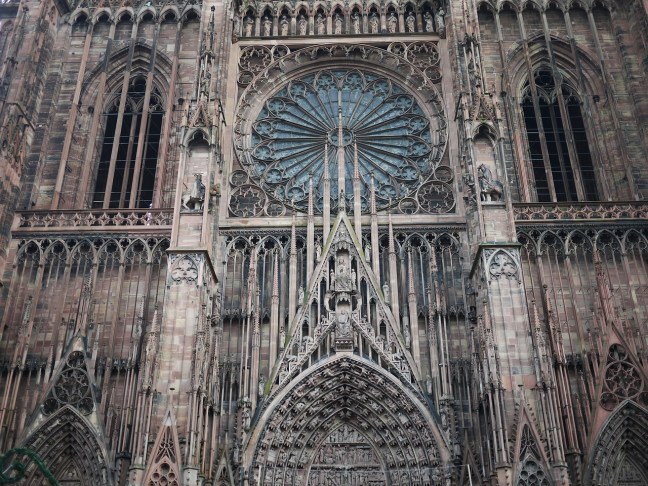
Image Description: The entrance to the Strasbourg Cathedral. It is gothic architecture with a round stained glass window. Public domain.
This sermon was preached at Northside Presbyterian Church in Ann Arbor, Michigan and was focused upon Isaiah 49:1-7. An audio recording is above and a written manuscript is below.
“It is too light a thing…” these words of prophesy say. Too small. If there’s anything that the people of Judah felt – the people of Judah from the Southern Kingdom of Israel – I’m sure it involved a day-to-day reality of feeling ‘too small.’ We’re distanced in time from the people who are addressed in this passage, distant in culture, distant in experience, so it’s hard to wrap our minds around the suffering these people were enduring. Too small: It would have been easy for the people of Judah to feel like the nobodies of their world.
This is connected to trauma. It’s connected to the utter upheaval of the year 587 BC. To us, that’s just a number, but to the people of Judah, that year was the watershed moment. It wasn’t the beginning of their conflict with the Babylonians, but 587 was the year that solidified Judah’s defeat. The Kingdom of Babylon was a force to be reckoned with, not only in Judah but in the entire region of the near-east. With Babylon on the prowl as an ever-expanding empire, the other kingdoms of that region were terrified, fearing that their own destruction was imminent.
And this brings us to a quick history lesson: In 597, ten years before the final defeat of Judah, Nebuchadnezzar II, the King of Babylon, led an army to Jerusalem and put the city under siege, cutting the people off from food and safe access in and outside the city. The Babylonians weakened the city to the point that they eventually broke through the walls, and when they did, they wreaked havoc on Jerusalem. They plundered the city and the temple, the most sacred place of worship and self-identity for the people of Judah, and they deported the King of Judah along with 10,000 others, prominent leaders in the government and the religious establishment. The people of Judah were left with a sweeping void of leadership. And as difficult as that was, it was only a taste, only the beginning of the end concerning the life that the people knew in Judah.
And then ten years later, in 587 BC – the watershed moment – Babylon left nothing untouched. For two years the Babylonians put Jerusalem under another siege, cutting the people off from the outside world, and in 587, they broke through the walls, destroyed the city for a second round – homes, fields, lives – and made captives of nearly all the survivors. But before they moved the captives of Judah into the foreign land of Babylon, the Babylonians gave them a searing, final, ghastly image to take with them. The Babylonian army burned the temple to the ground – made dust of it, destroying the most sacred place of these people – destroying the house where they believed their God dwelt with them. Can you imagine the sorrow of that moment? Can you imagine the fear? The confusion?
And so the people of Judah were taken to live in a foreign land – a place they had never lived with foreign customs, a different language, a worldview not their own, and ways of worshipping gods that weren’t their own. They were a disenfranchised, defeated, second-class group of captive exiles. And they were put into spiritual confusion too: Where was their God? Had God abandoned them? Is it any wonder that the people of Judah believed they were too small in their world? They had lost almost everything. Too small. Too small for this world to care. And perhaps, they wondered, too small for their God to care.
But God had something to say about that. In the Book of Isaiah, a prophet arrives with a Word for the people, a Word of Hope from their God, a Word of Identity. In effect, these prophetic words are flying in the face of all the heartache that the Judeans are witnessing in their lives. The words seem to say, “Don’t you know Whose you are? And since you belong to a God who loves, a God who saves, and a God who claims, don’t you know who you are called to be? Don’t you know Whose you are?” The words from our passage today seem to rise up out of the ashes, creating an alternative vision for the future of Judah, for the future of the Jewish people, and the future of all those who put their faith, trust, and hope in God.
Too small for this world? No. Through the words of the prophet, God has something to say about that self-understanding. In these words, God turns that self-understanding on its head. “Listen to me, O coastlands, pay attention, you peoples from far away! The Lord called me before I was born, while I was in my mother’s womb God named me. . . And God said to me, ‘You are my servant, Israel, in whom I will be glorified.’
Too small an identity? No. Here’s what’s too small: “And now the Lord says, who formed me in the womb to be his servant, to bring Jacob back to him, and that Israel might be gathered to him. . . God says, “It is too light a thing that you should be my servant to raise up the tribes of Jacob and to restore the survivors of Israel; I will give you as a light to the nations, that my salvation may reach to the end of the earth.” It is too light a thing – too small a thing – for you Judah, people of Israel, to gather up your own tribes and restore your survivors. That’s huge, but it’s too small. You are a light to the nations, that salvation may reach everywhere! Do you know Whose you are?
What a message. The prophet’s message seems to rise out of the ashes. Babylonian dust will not be the last word. And it wasn’t. Without God’s pledge of love toward the people of Judah, we wouldn’t even have a Hebrew Bible to hear these words this morning – to know about the heartache of exile and the eventual return to the homeland. Nearly 70 years later, people of Judah did leave Babylon and return to their homeland, and our identity is connected to theirs. Our faith is sustained upon their convictions. When they returned, they assembled the texts of the Hebrew Bible. Apart from their testimony, we would not be who we are. A disenfranchised, defeated, second-class group of captive exiles, empowered by God, articulated a faith that sustains people in every corner in our world. The Judeans returned to their homeland, something nearly unthinkable. And then people of Judah spoke hope to the entire world.
Sometimes it takes going to a different place to perceive home in a new way. Ten years ago, I took a meaningful trip to Germany. It was an incredible time, filled with gorgeous views, and interesting history. And while on that journey, we took an impromptu day-trip to France. We crossed the border between Germany and France and stayed one night in Strasbourg. There were many points of interest in Strasbourg – including a church where John Calvin, the influential theologian of the Presbyterian tradition, was pastor for three years, and we just unexpectedly stumbled upon it when we turned a corner on a Sunday morning. There was much to see, but without a doubt, the most awe-inspiring place we visited was the Strasbourg Cathedral. It’s really an understatement to say it’s awe inspiring. The Strasbourg Cathedral is a masterpiece of Gothic architecture. Construction for the building began in the 1100s. Now that’s old! And it was completed in the 1400s. For three hundred years, eight generations of people created a sacred monument which is more intricate than anything I’ve ever seen. Everywhere you look, there’s a carving here, a statue there, stained-glass windows towering everywhere. It’s as if everything has significance in this cathedral – all the details — and as I stood in awe of it, all the intricate parts seemed to point in a unified direction toward God, toward what’s most ultimate.
And I’m enough of a realist to know that when a city spends three hundred years building a cathedral, part of the reasoning behind it is to flex a muscle toward other cities. But that being said, the vision for this cathedral seemed to be large, and I would even say cosmic. The structure is built in the shape of a huge cross, and signs in the cathedral said that it was created to represent a ship to bring all of humanity to God. All humanity. There’s nothing ‘too small’ about that.
But even if this cathedral was built in part to flex a very large muscle, I have to say that as I looked around, I found myself in complete awe, reflecting upon how much faith it must have taken to build this structure, this cathedral for all of humanity. After all, only a strong faith in God’s presence would be worth this much time, and this much effort, and this much money. Perhaps the builders of the Strasbourg Cathedral felt connected to Whose they are.
And it must have taken so much faith in one another as well. It would have been difficult to put that much wealth, and time, and talent, and sweat into such an endeavor, only to know that you wouldn’t see it completed in your lifetime. Eight generations of lives, of individuals and communities, created this beautiful church. I wonder, did the innumerable people who contributed to this work feel that their part – no matter how small, no matter how detailed – was infinitely larger than themselves? I wonder, were they in any way aware that they were not too small for this world, that they were part of something larger than they could imagine? Today that Cathedral speaks to innumerable tourists who visit the city of Strasbourg. Nine hundred years later, a structure which was begun in a very different time period, acts as a witness, pointing toward God and community for the benefit of the entire world. Anything less would be too small.
And here we are together on an ordinary Sunday morning, but if our vision for this moment is mundane, we’re playing our faith too small. Much too small. Northside Presbyterian Church hasn’t experienced anything close to a Babylonian exile – though I’m sure if we reflected deeply enough, we might all discover that we’ve felt internally exiled in one form or another throughout our lives.
And we remember people in our community and beyond our community whose ancestors have experienced trauma and upheaval. During this holiday weekend in honor of Martin Luther King Jr., we remember African-American people along with their ancestors who have experienced slavery, Jim Crow, mass incarceration, and disenfranchisement. We remember refugees and migrants who are viewed with suspicion and treated as second-class people.
We are called to proclaim hope, and we are called to enact hope and justice in the face of these wrongs.
Though we’re grateful for this sanctuary where we worship, Northside Presbyterian Church isn’t housed in a masterpiece of Gothic architecture. But we would be missing something on this ordinary morning together if we forgot to remind ourselves in this moment of Whose we are. And we would be missing something if we forgot who we are, who we are in light of the amazing pledge and claim of God in our lives.
And so I turn the question to this church today– this holy, beloved community of God. Do you know Whose you are? Do you know how you’ve been claimed? Do you know who you’re called to be? Do you know that it would be too small a thing if we viewed ourselves as simple sanctuary dwellers this morning? No, it would be too small a thing for us to sit in these chairs and miss the mystery of God’s Spirit in one another. You are surrounded by a holy community – neighbors, and friends. And they contain worlds – yes, actual worlds within themselves. Have you ever thought about how every person is a community of worlds – how they represent people, and places, and memories, and experiences? Do you know that you represent people, and places, and memories, and experiences? Because of Whose you are, you bring all of that to this place. You bring all the worlds you carry within you – yes, to this moment.
And as we do it, we too are pointing to God’s presence. We bring our worlds – our people, and places, and memories, and experiences – and we share them with one another. It would be too small a thing for them to serve our own salvation and healing. Friends, let Northside Presbyterian Church be a community, a monument, and a nexus of relationships created for the wholeness also beyond this community, this building, and this nexus of relationships. May all our worlds serve this larger world. This expansive world. This beyond-our-world world.
Nothing you do is insignificant because of Whose you are. Nothing is insignificant.
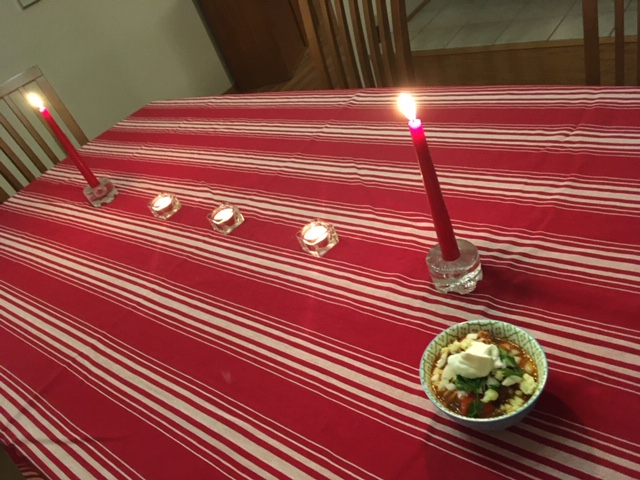
Image Description: Five candles and a bowl of chili are on top of a table, and the table has a tablecloth that is red with white stripes. All five candles are lined up across the table. The outer two candles are long and red. The inner three candles are tea light candles.
This week, I’m pondering the word metanoia, the ancient Greek word often translated as ‘repent.’ Among other things, it means a turn, an expansion of the mind, an opening of new possibilities.
My friends are initiating a new tradition in their household, and I love it. On Thursday nights, they are opening their home to the community, and together, we’re practicing hygge — a Danish tradition of keeping cozy, warm, and relaxed inside during the cold of winter.
And you betcha I went to the first one wearing pajamas.
I did so assuming that I would initiate a new trend for future hygge nights. And yes, that is true. Many of us will come jammified next week. (Winning!)
I was thinking about how important it is to have moments of calm and coziness. We’re all deserving of this, and we can create this for ourselves, our families, and the expansive chosen family we find in our community.
This is important for moments of change and transformation, both personal or communal. We need moments of restoration. Our relationships need this. Our bodies need this.
Very specifically, our nervous systems need this.
Particularly in times of stress, trauma, or upheaval, our nervous systems need calm. Within that calm, we can respond rather than react. We can feel internally that we have choices. We can move in new directions — metanoia — with less anxiety.
I’m so grateful that my friends are doing this weekly through April. I plan to be there a lot.
And… am I writing this post right now in a lovely nook in the house, sitting on a couch under cozy blankets, sipping coffee, enjoying the scent of a burning candle, and wearing pajamas?
Image Description: Four people are standing together side by side. Each is wearing a number: 8-0-0-0. They’re all lifting their hands, and curving them to make a rounded circle. Public Domain image.
This week, I’m pondering the word metanoia, the ancient Greek word often translated as ‘repent.’ Among other things, it means a turn, an expansion of the mind, an opening of new possibilities.
Yesterday, I had another lovely conversation over coffee (connection changes things; so does coffee!). This conversation was with a very wise young adult who is in her last semester of undergrad.
We were talking about how people these days are living quite frequently with big questions and fears of societal upheaval, and that young adults often feel the brunt of these questions and fears very closely and particularly. Questions swirl within people about the climate crisis (in the midst of this, some young adults are questioning whether or not to have children) our economic system, and the future of democracy.
These questions and fears can begin to feel very casual in their frequency, so much so, that we forget how much stress they are adding to our lives. I like to call this experience Casual Existential Threat Thinking.
And when we think of metanoia,
How do we make a turn?
How do we expand our thinking?
How do we cultivate new possibilities?
There are many answers to these questions, of course, but I’ll offer something from our conversation yesterday.
In my time with my friend, I shared a statistic that I find myself thinking about every once and a while. I’ve written about it here before, and I find it to be hopeful.
On average, each person on the planet consistently impacts 8,000 people every day.
This number comes from a book entitled, Connected: The Surprising Power of Social Networks and How they Shape Our Lives.The authors, Nicholas Christakis and James Fowler, explore the power of connection and social embeddedness. As they did sociological research, they discovered that people consistently impact and are impacted by their friend’s-friend’s-friends. Often this is invisible to us, but these three circles of contact have influence for our wellness, relationships, and decisions.
So how did they come up with the number 8,000?
Christakis and Fowler have discovered that on average, each person knows twenty people well enough to invite them to a dinner party. If those friends then know twenty people to the same degree, and then those friends know twenty people to the same degree, we are talking about 20 x 20 x 20 = 8,000 people.
And moving beyond the individual, this indicates that small groups of people can have an enormous positive impact on larger society.
Metanoia — transformation — has big impact even if it starts small.
Image Description: A latte in a cup on top of a brown plate on top of a brown table. The foam in the cup is shaped like a flower.
This week, I’m pondering the word metanoia, the ancient Greek word often translated as ‘repent.’ Among other things, it means a turn, an expansion of the mind, an opening of new possibilities.
There are times when life seems to rhyme.
Two Saturdays ago, I gathered with people at Sweetwaters Coffee and Tea in Ypsilanti, Michigan. We pushed tables together in the back of the space, and we sat there together, sipping coffee, eating scones, and sharing in conversation. We had just passed into a new year, so we explored the topic of newness and the ways that is developing in our lives.
This is the same coffee shop, the same tables, and the same conversation topic that launched the Michigan Nones and Dones community in January of 2016.
Now we were here four years later with the same community vision, doing it all over again. One of our participants had been in both conversations. The others were new.
These are the questions we asked together in conversation:
— What newness do you seek? What newness seems to be seeking you?
These are questions of metanoia — transformation and possibility.
And so I offer those questions to you as well:
What newness do you seek? What newness seems to be seeking you?
What is goodness is growing in your heart and mind?
What is summoning you toward wholeness?
What calling is emerging?
This week, I’m pondering the word metanoia, the ancient Greek word often translated as ‘repent.’ Among other things, it means a turn, an expansion of the mind, an opening of new possibilities.
I was in the zone at work yesterday, and it felt really tremendous.
In my role at the Epilepsy Foundation of Michigan, I am tasked with addressing isolation and expanding connection between people. I care deeply about this, and it’s very meaningful for me to work in this direction.
Isolation is sadly a frequent difficulty for people in the epilepsy community. Social stigma is strong, and at times, there is secrecy around the illness. Many people in our community are also unable to drive, and that places additional challenges for social connection. Individuals and families sometimes have this internal feeling of being ‘the only one’ they know going through this, simply because they don’t have others with epilepsy in their immediate circle. (Or they might not know that they do. Epilepsy is remarkably prevalent. 1 in 26 people will have this condition at some point in their lives. That’s a lot of people!)
Yesterday, I found myself having a number of personal conversations with people over the phone, and more than once, I had the occasion to introduce people to each other, knowing that their experiences are similar. And each time there were occasions to connect, I saw change happen.
This is personal conviction that drives me: Connection changes everything.
This is true in our epilepsy community, but this is true… in all situations. I’m convinced of this. Human connection changes every situation.
It doesn’t fix every situation.
But it always changes it.
And I believe, most frequently, it changes things for the better. Want to transform a situation, a need, or an area for growth? Connect.
Image Description: The front entrance to Canterbury House, a blue building with white trim.
“Maybe repentance gets a bad rap,” my friend and colleague Matthew said. He’s the Chaplain at Canterbury House, the Episcopal Campus Ministry at the University of Michigan. We were having a discussion about this with a group of students during Compline, a candlelight service at the end of the evening.
We tend to associate the word “repent!” with fire and brimstone preachers, so it might not be our favorite. But it’s actually a lovely invitation. The Greek root word is metanoia. Meta gives a nod to change; we might think of words like metamorphosis and metabolism. Noia is associated with the mind.
Metanoia… repent… a change of mind…
Meta literally means ‘after’ or ‘beyond’ — we we might think of expansion… the mind expanding beyond… recognizing new possibilities.
And sometimes this word metanoia has been used with the imagery of literally turning around. This might be a dramatic 180. Or it might just be a simple turn, stopping still, without yet taking a step. We look in a new direction or a previous direction with bigger expansion, insight, and possibility. Sometimes, it might just involve looking over our shoulder to see that there are other pathways.
So where are we called to go? What is expanding for us? What might reveal new possibilities? Which directions are healthy and flourishing for us? How can we transform, grow, and change? Dramatically or gradually?
Image Description: Water with circular ripples. Public domain.
This sermon was preached at Northside Presbyterian Church in Ann Arbor, Michigan and was focused upon the story told in Matthew 3:1-13. An audio recording is above and a written manuscript is below.
I’d also like to dedicate this sermon to Blake and Ethan Grunden, toddler twins in my Family of Choice who were baptized today. Noozle loves you!
Author Frederick Buechner has written a quote that I so appreciate and enjoy. It comes from his book Whistling in the Dark, and I have read this quote a number of times at very special occasions in the lives of people that I love. And it’s this:
“In the entire history of the universe, let alone in your own history, there has never been another day just like today, and there will never be another just like it again. Today is the point to which all your yesterdays have been leading since the hour of your birth. It is the point from which all your tomorrows will proceed until the hour of your death. If you were aware of how precious today is, you could hardly live through it. Unless you are aware of how precious it is, you can hardly be said to be living at all.”
Isn’t that an incredible quote and a beautiful invitation? I first heard that quote read to me at my ordination service, and it’s a quote I bring into almost every wedding I officiate.
I found myself thinking about it again when I considered this passage this week — this story, this pivotal moment of Jesus coming to John in the wilderness to be baptized. It seems as though this moment set the stage for much to come. And yet there were many moments before it, countless moments unknown to us, which led to this baptism. And there were powerful and pivotal moments that moved from it.
This baptism seems to be an occasion where past and future come together in one present moment. John discovers his calling more deeply, and Jesus discovers more of his. He has what we might call an epiphany, a transformative experience. It makes me wonder if he might have returned to it in his mind and heart again and again. This experience seemed to lay a foundation.
And so the story begins with these words: “Jesus came from Galilee to John in the Jordan.” Jesus came from the place where he had grown up, the context of all those preceding moments, to meet John who was doing something revolutionary at the Jordan River, a place so important to the larger history and identity of their people.
Jesus comes with this request to be baptized, and John, who has been doing all this baptizing suddenly seems a be a bit flummoxed. “I need to be baptized by you, and do you come to me?” He seems stunned at this.
But Jesus puts himself in the place and position to receive.
And I find this to be beautiful. So often in our own culture, we hold independence to be some high value — some way of existing on our own, maybe even over and against others. And yet, we have this vision of Jesus, who will soon be called Son of God, who reveals what it means to receive. The Word made flesh, God with us… Jesus reveals that God exists continually in relationship, and God calls us into an interdependent vision.
Jesus is baptized, and it’s as if everything opens up. He comes up from the water. He sees this vision: The heavens are opened to him, and he sees the Spirit of God descending like a dove, alighting on him. And suddenly, there is a voice from heaven. Was it audible and collective, or was it internal? — either way so deeply true to the moment… “This is my Son, the Beloved, with whom I am well pleased.”
The Spirit is present.
Jesus is named as Son. God, creator of that water, has a voice that resounds beyond and within.
This is a foundational moment — a pivotal moment for Jesus who will go forward from this place with this Belovedness, proclaiming it upon others, including those who have been pushed out of community and into the margins of society.
And this vision opens up so much for us. God — Creator, Son, Spirit — is in relationship, and this God calls us into relationships. God names us as Beloved too and sends us forward with an interdependent vision for living, called to be people who receive, inviting love from others, and to be people who give, inviting the receiving of others.
Perhaps this story can become a pivotal moment for us too.
We have all stepped into this sanctuary, this time of community and relationship today, carrying a host of previous moments into this room. Some took place long ago and formed who we are, what we care about, and what sort of questions swirl within us. These moments are so integral to who we are. We also bring moments from the last week — concerns about things in our personal lives and relationships, pain and fear about potential war in Iran and Iraq, and the enormous needs in Puerto Rico after earthquakes this week. We also bring concerns about what 2020 will reveal, both personally and collectively.
We also know that this moment we’re living will inform other moments. This experience and invitation to know God in relationship impacts how we live our days — how we will live this week, how we will live this year, and how we will live for years to come.
Maybe this story and this moment can become pivotal for us too.
When I share that wonderful Frederick Buecnher quote with couples during their wedding ceremony, I always follow it by saying that Frederick Buecnher was not talking about the most memorable moments and events of our lives. He was talking about every day, and in fact, sometimes this quote is simply called “Today.”
So I want to speak it again and invite us to hear it, knowing that this present moment and these deep convictions about who God is in relationship can inform what comes next in our lives. So hear this quote one more time about a today as simple and mundane as this one:
“In the entire history of the universe, let alone in your own history, there has never been another day just like today, and there will never be another just like it again. Today is the point to which all your yesterdays have been leading since the hour of your birth. It is the point from which all your tomorrows will proceed until the hour of your death. If you were aware of how precious today is, you could hardly live through it. Unless you are aware of how precious it is, you can hardly be said to be living at all.”
So hear this again, on this particular today:
You are Beloved.
We are Beloved.
By God, By one another, By this world in which we live.
We are included in the Belovedness that Jesus experienced in this moment and throughout his life, both beyond him and internal to him.
We are called on this today — this mundane day — to proclaim Belovedness beyond this place. We are called to go forward among those who are fearful, lonely, or marginalized and be people who carry a God of Relationship forward. We are called to enter relationships ourselves, receiving from them and giving within them, building a culture of interdependence where we all belong and where we all give embodiment and community to a word like Beloved.
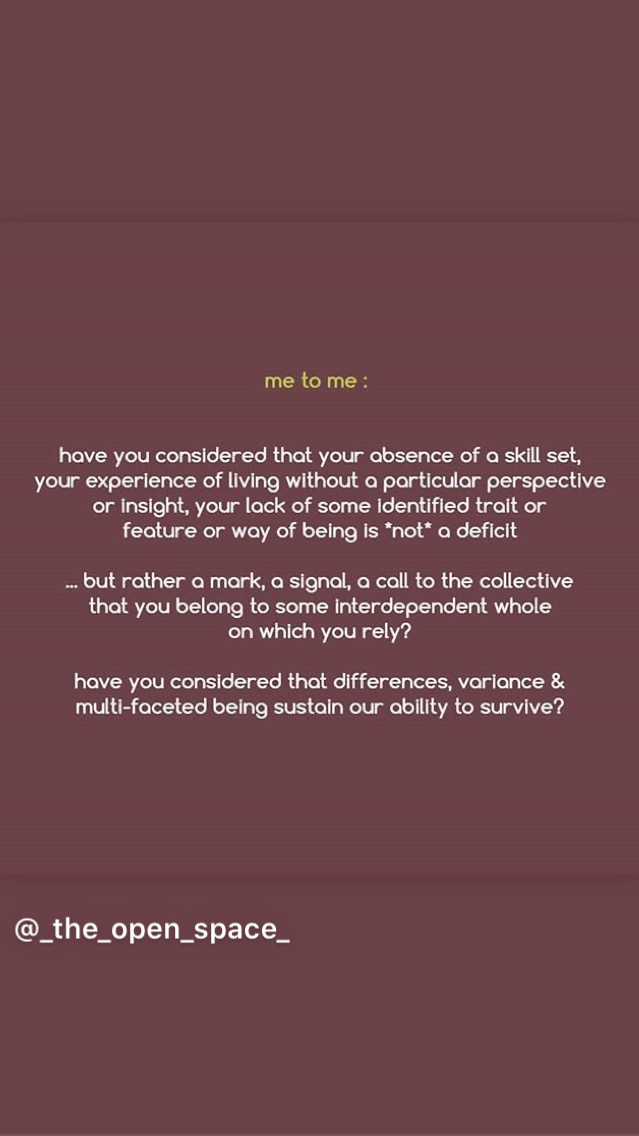
Today, I’d like to share a quote and an image from @the_open_space_ — an account I so appreciate on Instagram. What do these question call to mind for you when we think about need, difference, calling, belonging, and community?
The image reads…
me to me:
have you considered that your absence of a skill set, your experience of living without a particular perspective or insight, your lack of some identified trait or feature or way of being is *not* a deficit
— but rather a mark, a signal, a call to the collective that you belong to some interdependent whole on which you rely?
have you considered that differences, variance & multi-faceted being sustain our ability to survive?