A person holding a pen, about to fill out an envelope.
I think it’s rare for us to receive personal letters and cards in the mail outside of holidays, but early this week, I got two in one day! One was from a long-time friend who regularly writes like this, and she always gives me joy. The other was a kind affirmation from a colleague I appreciate and admire. It was such a wonderful surprise.
My point in sharing this is that if you have something meaningful to share with someone — a story, an affirmation, an invitation, a kind word, a joke, a vulnerability, or a memory — do it. I don’t think we ever regret that connection.
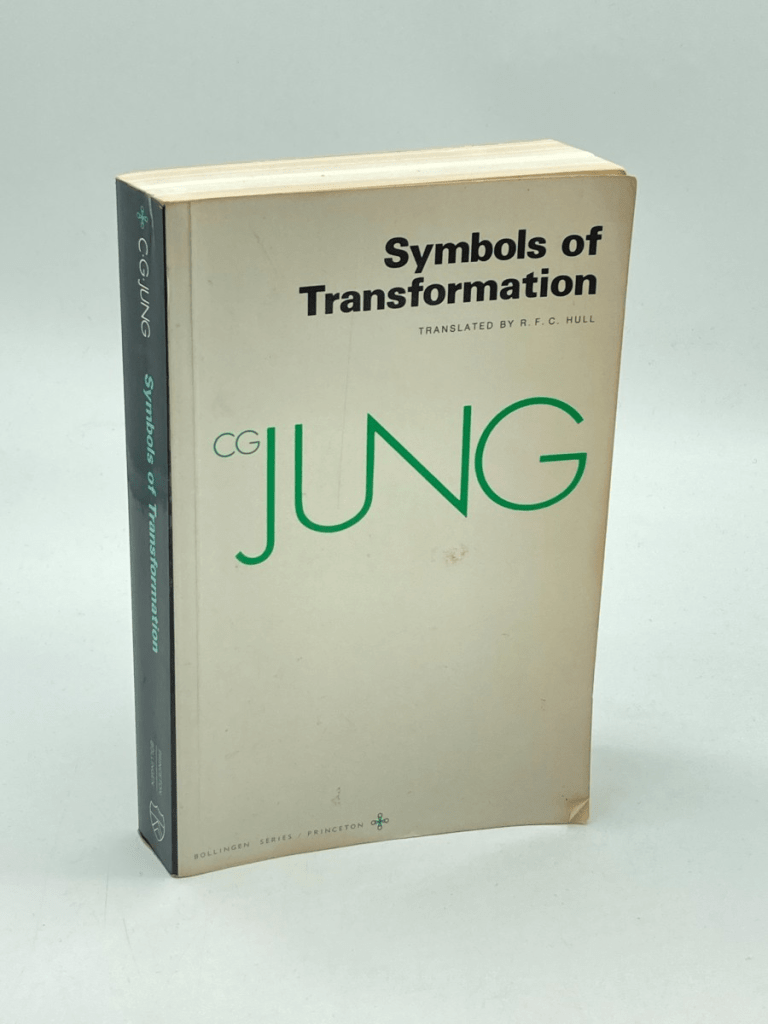
Carl Jung, the Swiss psychiatrist who founded analytical psychology, wrote a great deal about archetypes and the symbolic life of the psyche. He was interested in sacrifice as something transformative, not merely destructive. And linguistically, “sacrifice” and “sacred” share the same Latin root, sacer.
I’m not an expert in Jung, so what follows is riffing rather than representing him directly. But I’m intrigued by the connection.
So often, we think of sacrifice as depletion. This is especially true when we think about our bodies and how much time and energy we give. If sacrifice is our aim, we might imagine it as self-negating. We give until we are exhausted.
But how different would it be, and how different would it feel, if we thought about sacrifice through the lens of offering something sacred?
Rather than living through depletion or exhaustion, we might think of our giving as an act that honors what is sacred, in ourselves and in others. We might remember that what we are offering is not the erasure of ourselves, but something that carries ultimate value. Something grounded. Something intentional. Something that also fills us.
And perhaps what is sacred flows through us rather than being manufactured entirely by us. We are not required to do it all or be it all on our own.
That feels like a different framing to me. And I appreciate that.
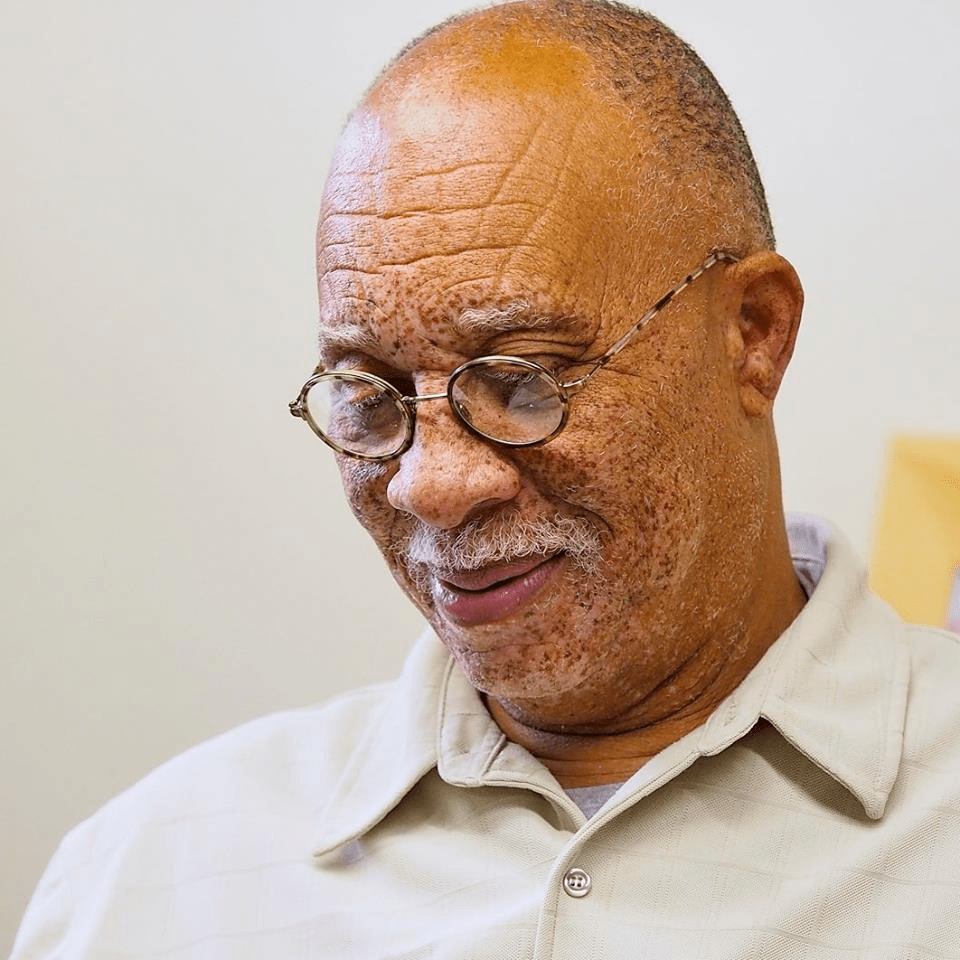
That’s what Dwight L. Wilson, one of my mentors, recently shared in an interview about the books he has written. I highly recommend the entire interview. It’s filled with wisdom. He said this is a phrase he first heard many years ago from Elizabeth Watson, one of his own mentors.
That sentence really struck me.
We all carry places of woundedness. We have received harm from relationships and systems. And we have also wounded others. We have harmed our relationships and created pain for communities and even the environment through our participation in systems.
We can all heal. Notice that this word is both passive and active. Healing is something we can receive and something we can offer. It is an internal process and a relational one.
If we spend all our time trying to be good, we will keep our wounded histories in the shadows. We will do all we can to avoid them or suppress them. When we live this way, we miss opportunities to heal ourselves and to be reconciled with people, communities, and land. We keep places of pain in our rearview mirror, yet they remain active in ways that are not always conscious.
As Richard Rohr says,
“We either transform our pain or we transmit it.”
As Margaret Foley says,
“We reenact what we have not resolved.”
So yes, as Dwight L. Wilson and Elizabeth Watson remind us,
When one of my friends was 18 years old, he traveled to Chicago for a service trip. He and other young people stayed with host families who were receiving services from the organization they had come to serve alongside.
The family he stayed with struggled deeply with poverty, and they were regularly neglected by their housing complex. Their home often had mice and roaches. In the midst of these challenges, they were deeply hospitable to the young people who stayed with them, and over a few days, meaningful friendships began to form.
One morning, my friend noticed a particular clock in the kitchen. Underneath it, the family had written the words, “Nebraska Time.” When he asked about it, they explained that it marked the time in Nebraska. Of course, Chicago and Nebraska are both in the Central Time Zone, so this analog clock was no different from any other clock they might see that day in the city.
But it carried so much meaning.
This family had contacts in Nebraska. People they loved. A place where they believed they could get a new start. It was their dream to move there and begin again.
Every day, they saw that label, and with it in front of them, they dreamed. Did they ever get there? I don’t know. My friend doesn’t know either. But the Nebraska Time clock had a powerful effect on their lives in the present moment. It didn’t only give them hope or a vision for the future. That imagined future seemed to reach back and shape their present, as well. It helped them hold onto hope in their current circumstances and continue building partnerships and friendships that aligned with their goals.
I wonder, do you have anything like that?
An idea or vision you hold for your future — or something that represents your deepest hopes or values so clearly that it is shaping how you live right now?
Yesterday, I wrote about my experience rushing back to my house — so mindless — ironically, in order to lead a virtual program called “Mindfulness Moments.”
But then, once I sat down and actually started, my co-leader, a gifted therapist, started leading us in a visualization exercise. She spoke beautiful words about connection, and we began to visualize people, places, and pets that matter to us.
During this time, my mind especially landed on places, and I sat there quietly, visualizing images of places I’ve been throughout the U.S. and the world. These are places of great beauty and places where I met people I love.
This was such a simple experience. Sit down. Remember. Imagine. Observe. Have gratitude.
And we have access to our imagination all the time. We can tap into this any time we want.
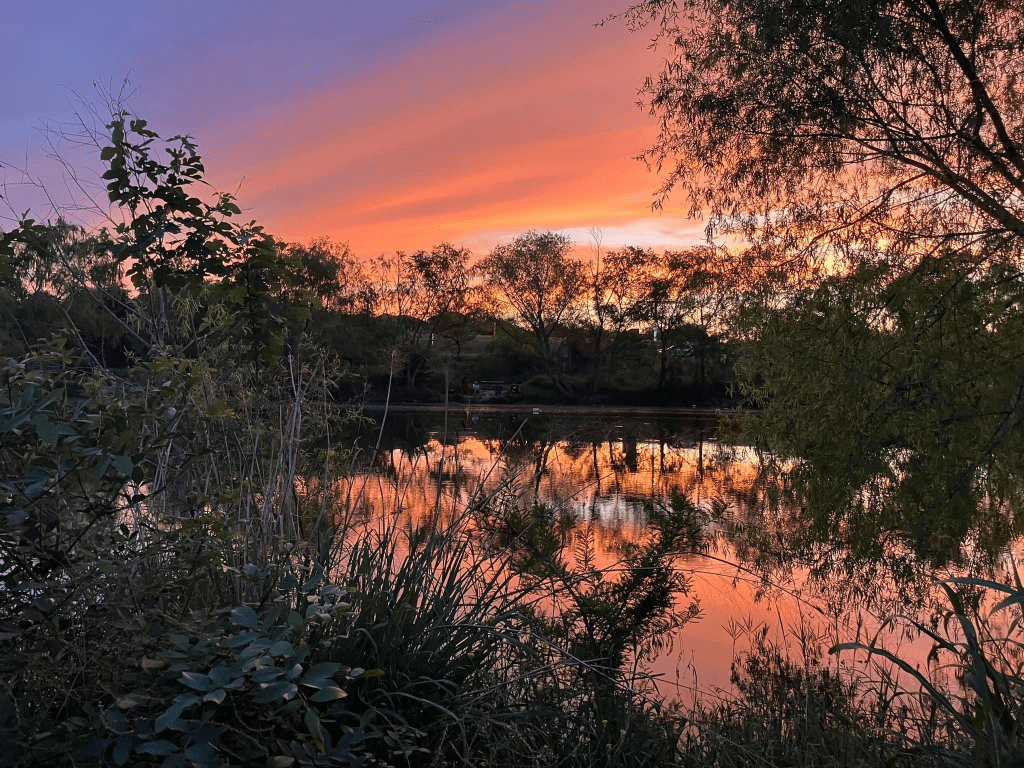
After turning out of a parking lot, I ended up behind a car with a bumper sticker that said,
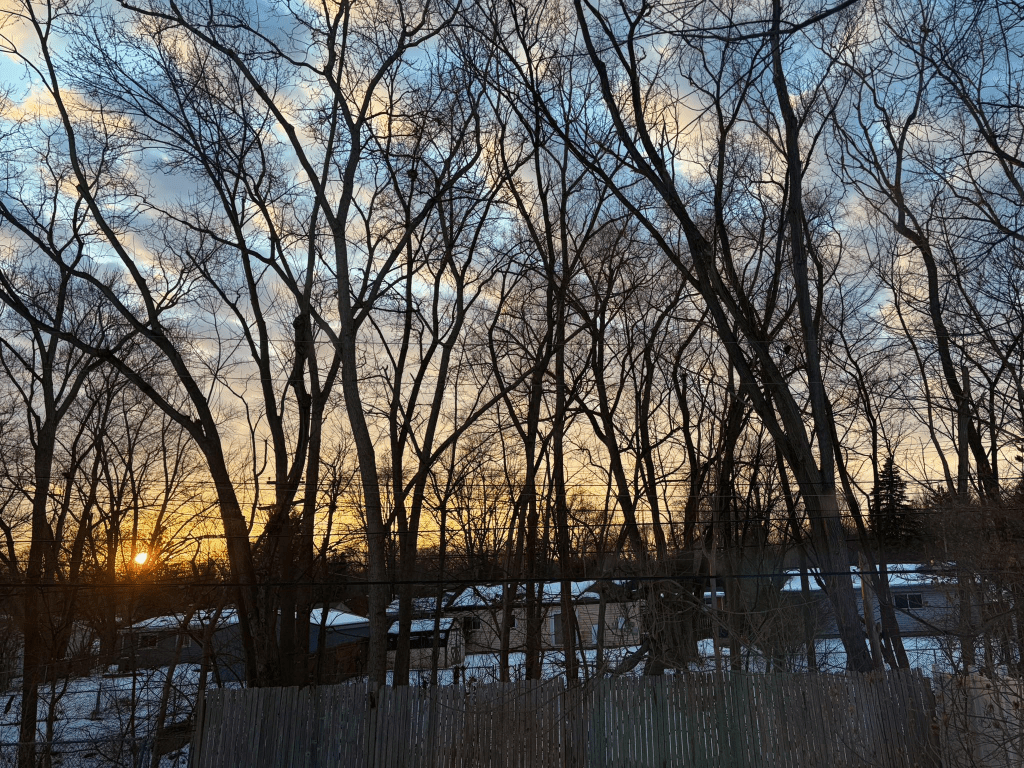
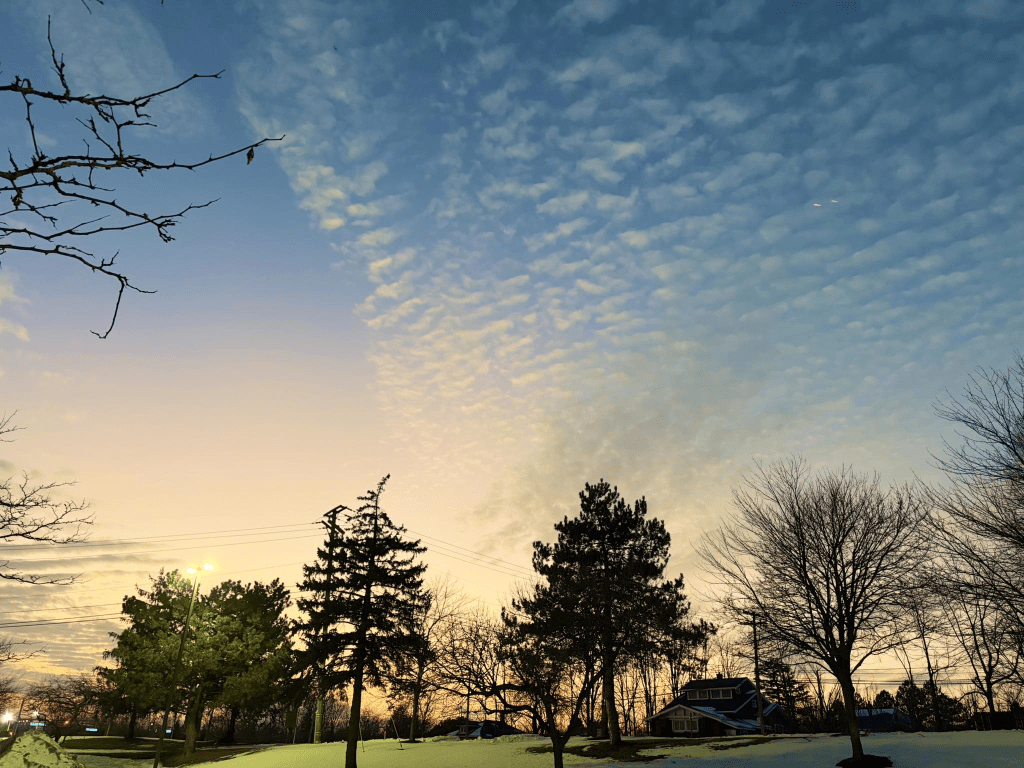
“Watch more sunsets.”
I laughed, given the context. I was rushing home after running errands and was doing what I could to make it home on time. I did, but just barely, and at stoplights, I was eating a piece of pizza in my car. Here’s the irony: I was trying to get home quickly to start a monthly Zoom offering I co-lead called “Mindfulness Moments.”
A therapist and I provide space for people to slow down and practice mindfulness and reflection together. I was doing everything but that. The bumper sticker woke me up to that.
Yes, definitely slow down. Yes, definitely be more mindful. Yes, definitely watch more sunsets.
I thought Bad Bunny’s Super Bowl Halftime Show was joyful and brilliant.
If you haven’t seen it yet, his performance closed with a litany of blessings for America, as people carried flags from every nation in North and South America. “God bless America,” he started, and then he named every one of these countries, closing as he held a football that said, “We are America.”
In the background, a banner read, “The only thing more powerful than hate is love.”
Bad Bunny expanded the “we.” People from all of these countries have lived in the United States and contributed to it. But what I loved most is that he cast a vision to expand how we define the word America. This was joyfully subversive.
And I wonder, in a variety of contexts, how do we need to expand the “we”?
When I share this with people, they’re usually pretty surprised. I realize I’m not the typical age for this. I’m no spring chicken, but I’m still at least twenty years shy of when most people have a surgery like this.
My cataract developed as a result of a different surgery. When I was a young adult, I had a detached retina. That was actually quite serious, and I needed surgery to repair it. Sometimes that type of surgery leads to the formation of a cataract. That’s what happened to me. Mine was first spotted when I was 30 and grew slowly over the years.
Well, now it’s gone. Bye!
A surgeon removed the lens I was born with and replaced it with an artificial one. I am now a card-carrying member of that club. Literally. They gave me a card. A whole bionic woman, though you can’t tell. I can’t even tell.
Cataract surgery has become remarkably routine, and it’s been that way for decades. (Although cataract surgery was invented in 800 B.C.E., wow.) For most of human history, though, it wasn’t widely practiced, and certainly not with artificial lenses. It’s easy to forget what a medical miracle this really is. Most humans simply lived with terrible eyesight.
And that leads me to a very different thought, though I think you’ll see the throughline.
One of the funniest lines in the Bible comes from the Song of Songs, where the writer praises his beloved by saying, “Your teeth are like a flock of goats, and not a one is missing!” This phrase shows up several times in that book. Why a flock of goats? And also, why is it such a big deal to have all your teeth?
Oh! Because it actually was a big deal to have all your teeth. Most ancient people didn’t. I had never really thought about that before. (Though still, why a flock of goats?)
Anyway, I’m grateful for our eyes and our teeth, including the artificial ones. (P.S. I still have all my teeth. What a flock of goats!)