I remember the first time I ever stepped inside a Trader Joe’s. I was with some friends in Milwaukee, and they stopped to pick up a few food staples.
Right away, I knew this store was different. Almost every item had the Trader Joe’s label, and the Hawaiian-shirt-clad staff genuinely seemed eager to check our groceries and place them efficiently into brown paper bags.
While we were in the store, Gloria Estefan’s “1, 2, 3” started playing loudly through the speakers, adding energy to the room. My friend then leaned over and said, “What if everyone in this store – every single person right now – just started dancing to this?” Then he demonstrated a dorky dance move, shifting to the beat. It was silly, and I laughed hard.
For the rest of our time in the store, I enjoyed imagining this ridiculous scenario. People came into the store that day thinking they would simply push a cart and check items off of a grocery list, but little did they know. . . this very day they would become co-stars in Trader Joe’s: The Musical!
It was enjoyable to imagine.
Back then, Trader Joe’s was a complete novelty to me. Now it is my most frequent grocery destination. I love it, and I would be so sad if we ever moved to a town that doesn’t have one.
I hadn’t thought of this memory in for a long time, but it popped in my head a few days ago while I was in the Ann Arbor store. That’s because a number of fun connections emerged while I was the one simply pushing a cart and checking items off a grocery list.
When I got to the produce section, a toddler sat in the front of his own cart and boldly introduced himself to me. “HIIIIIII!” he exclaimed with joyful abandon. I said the same to him and waved with a smile.
Lest I think I was completely special, however, this toddler continued to exclaim, “HIIIIIII!”to every single person he encountered. Every single one. I think it annoyed his Mom a little bit, and if I was much closer to him in proximity, I would probably feel that way too. But instead, I got to keep smiling, because no matter what aisle I was in, I heard this kid greeting everyone. His voice faded with distance, but I could still hear it – a continuous, little kid refrain.
Not much later, I heard another continuous refrain. Brice, one of the staff members, was asking every single customer who came through his checkout lane, “So what was the most exciting thing that happened in your day?” The question was intentionally the same each time, but I bet he heard lots of different kinds of stories.
And then, as if the universe already knew I was recalling that memory from Milwaukee, I stood in Brice’s lane myself, probably three people away from hearing the question directed at me. And I kid you not, the man directly in front of me who was waiting there too, started dancing. He started bouncing back and forth dorkily (maybe mindlessly but definitely to the beat of the music) and it was wonderful.
We human beings are connected, and these connections can literally find us anywhere in large and small ways. Even in a neighborhood grocery store.
So we might as well seek them out and join the dorky dance.
Yesterday, a Youtube video of Prince’s 2007 Super Bowl performance made a resurgence as people passed it around social media and remembered his great life and presence. AndI cannot get enough of this video.
I cannot get enough of it as a moment.
What I mean is that some elements of the experience happened apart from anyone’s decision or control. Namely, lots and lots of rain. But Prince and his team also embraced those elements to synergize a moment of creativity, connection, and electrifying energy. At Super Bowl XLI, Prince sang ‘Purple Rain’ in an absolute downpour. It was magical.
Along with sections of the performance itself, the video above includes interviews with Half Time Show designers and managers. They agree this performance was truly a remarkable moment. In their own words, they share what made them so impressed:
Prince embraced a situation of potential inconvenience,
and completely transformed it.
Prince demonstrated confidence on the stage,
and performed music written by others.
Prince rolled with a great deal of spontaneity,
and launched it into the world as if this is exactly what should happen.
It all leads to the finale. As Prince wraps up “The Best of You” by Foo Fighters, he flashes this foreshadowing look across his face that something special is about to happen. And then it does. Fireworks explode, and standing in the downpour, Prince captivates the stage even more as he starts to sing, “Purple Rain.” The crowd goes wild.
Then he pulls the crowd into the creation of the experience too. They sing along with him, and suddenly, everyone is participating in this strange yet magical moment. They are drenched but connected with wonderful energy.
It’s beautiful.
There’s an ancient Greek word for moments like these: Kairos.
Kairos is a type of time. It’s different than our common conception of time, which more clearly matches the Greek word chronos – time which marks things linearly i.e. one event leading naturally to the next, as the past leads to the present, etc.
But Kairos is a form of time which marks a significant moment.
Some might even call it a holy moment.
Kairos is not measured by length in seconds, minutes, days, or years.
It isn’t about length or anything linear at all.
It’s about an experience.
Kairos an opportune moment where everything comes together.
It isn’t a measurement, but a recognition,
a realization that a moment is to be embraced and savored. Kairos is a moment to be fully alive.
In those moments, what can else can we do but take it all in and say thank you?
That’s what one of the interviewees says in the video: “When he did do ‘Purple Rain,’ that was one of those times where things just work magically, and there’s nothing you can do but say, ‘Thank you.'”
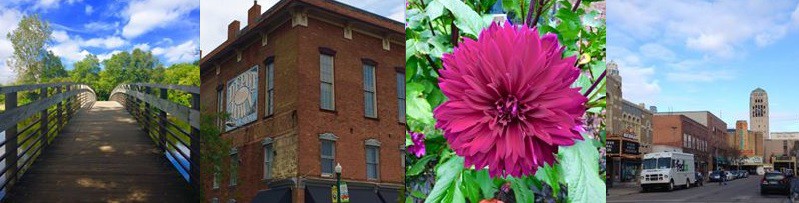
A couple of days ago, I was driving around my town. With a smile on my face, some words just spontaneously tumbled out of me. “I know you,” I said, and then I smiled some more.
I spoke this to Ann Arbor, the place I’ve called home for the last two and a half years. My car windows were down, and I took an enormous, intentional breath of spring air. Then I put my arm out of the window to feel the breeze. I felt very alive.
The reality of spring called those words forth from me.
“I know you.”
I continued to enjoy the spring air, but the visual scene was most responsible for bringing those words into being. In Michigan, we have entered an aesthetically gorgeous time of year. The six month period from April to October brings continual changes in scenery.
Each week shifts as a variety of flowering trees and plants emerge, soon accompanied by the newborn leaves of trees which grow in gradual ways. After these leaves progressively paint our town bright green, they rustle in the wind for a few months and finally give us a swansong, bursting into a variety of colors as they shed their photosynthesis process and reveal the red, orange, and yellow colors hiding underneath it.
For this half of the year, every week is gorgeous, and every week is gorgeous differently.
This is the third spring I’ve experienced in Ann Arbor, and I’ve lived here long enough to know the order of this unfolding process of change. That’s why the words tumbled out of my mouth that day in my car.
“I know you.”
I know how one set of flowers and blooming trees emerge and seem to reign for mini-era of time, only to be replaced by another set of flowers and blooming trees. It’s a beautiful procession.
I know that the daffodils,
soon give way to the bradford pears,
which soon give way to the tulips,
which soon give way to the tulip magnolias,
which soon give way to the day lilies.
This process continues to unfold beautifully.
I love that we are in the midst of this procession right now, and it gave me an impromptu burst of joy when I spontaneously said, “I know you,” to Ann Arbor on that day.
There is a rich experience of belonging when we feel at home.
This is true
within places,
within relationships,
within ourselves.
We can feel at home in the presence of all of these.
When we do, I think we have some knowledge of the essence of what is before us, while also knowing and even expecting that it will experience change.
For instance,
I know the order of Ann Arbor’s flower procession,
but I am still surprised by its emerging beauty.
Likewise,
We know some of the essence of our children’s personalities,
but we are surprised with their growth year by year (and even daily).
We know our weekly work routine,
but we are surprised when we feel a sense of calling within it or beyond it.
We know our personal traumas and forms of grief,
but we are surprised when new life and forms of resurrection find us.
“I know you.”
May we feel at home.
And may our experiences there change us too.
This sermon was preached at St. Andrew’s Presbyterian Church in Dearborn Heights, Michigan and was focused upon the story that is told in Acts 11:1-18. The audio recording is above and a written manuscript is below.
As the church was growing, strange things were happening. . .
Now, very distanced in time from these events, we hear that “the Gentiles had accepted the Word of God,” and we view that as something to be celebrated. But in the life early church, there were questions about this. In the life early church, this was a crisis.
It was uncharted territory. At the very least, it was quite unexpected, and the leaders in Jerusalem had some serious questions about these new developments. So when Peter went up to Jerusalem, they criticized him with a question of challenge: “Why did you go to uncircumcised men and eat with them?”
I wonder how Peter felt in that moment.
I wonder if he was anxious.
I wonder if he feared that he would be ostracized for sharing his story.
Or I wonder if he viewed this as a moment of opportunity.
Perhaps emboldened, Peter was grateful to have the opportunity to testify to an experience that had changed his life. I wonder if he could have possibly anticipated the large-scale ways his story would change others.
Because this story Peter would tell –
His story,
Cornelius’ story,
A Gentile family’s story, and ultimately,
The story of the Holy Spirit – It would change the entire life of the church itself.
I wonder if Peter could have possibly anticipated that.
The question of challenge comes. “Why did you go to uncircumcised men and eat with them?”
Whatever Peter felt in that moment, we know that he testified to his experience. I notice that he didn’t get defensive. He didn’t engage these leaders in a debate. Peter told a story. He told a transformative story of the Holy Spirit.
Now I want to acknowledge an aspect of this story right at the beginning. Parts of it are bizarre, at least to our ears and imaginations. It begins with a vision that is rather odd.
Peter had been staying in the home of Simon the Tanner, and at a particular moment on an ordinary day, the extraordinary happened. Peter went to the roof of Simon’s house to pray, and while he was up there, he received a vision. Suddenly, a great sheet was lowered down from heaven, and he saw all sorts of animals – beasts of prey, reptiles, and birds of the air. These animals were so different from one another, but they all had one thing in common. They were all considered ritually unclean for eating. The dietary laws of Leviticus forbade the people of God from eating any of these.
So that was certainly an odd sight to see. . . a sheet from heaven containing all of these animals. . .
But the command must have seemed even more strange and troubling, because it certainly didn’t make any sense. Peter heard a voice which said, “Get up, Peter; kill and eat.”
In response, Peter gave the answer that certainly seemed most right. “By no means, Lord; for nothing profane or unclean has ever entered my mouth.”
Then he heard the response from the heavenly voice which must have seemed most puzzling of all. “What God has made clean, you must not call unclean.”
This happened three times.
“Get up, Peter; kill and eat.”
“By no means, Lord; for nothing profane or unclean has ever entered my mouth.”
“What God has made clean, you must not call unclean.”
What God has made clean, you must not call unclean.
How confusing. . . After all, it was God who had declared these animals to be ritually unclean in the law itself, right?
I wonder if Peter stood on that rooftop puzzled. Though he didn’t have all the answers, it became clear that he needed to follow the Spirit’s leading because something extraordinary was clearly unfolding.
Right that moment, three men arrived at the house where they were staying. They were emissaries from Cornelius, a Gentile who lived in Caesarea. Cornelius had had a vision too. He had seen an angel standing in his house saying, “Send to Joppa and bring Simon, who is called Peter; he will give you a message by which your entire household will be saved.”
At that moment with these emissaries at the door, Peter had a challenging decision to make. It was controversial to enter the household of Gentiles and receive hospitality from them. It was considered ritually unclean by the scriptures themselves to eat food that was forbidden by the law, the very food that would certainly be served to them. It was quite the faux pas to go with these uncircumcised men and eat with them.
But the Spirit had spoken. What God has made clean, you must not call unclean. What a challenging situation. . . I’m sure Peter’s mind was spinning. What is the right thing to do? He had to follow the call of the Spirit. He had to trust that he was being welcomed in this household – one that was also beloved by God. Peter had to wonder if God was welcoming the Gentiles into God’s own household.
So Peter took the risk. He and some of his close associates went along with these emissaries and entered the household of Cornelius. When they arrived, they learned about the vision that Cornelius had experienced, and Peter began to share the good news – the message of Jesus’ life, death, and resurrection.
So let’s hear Peter’s testimony in his own words. This is what he spoke to the leaders at Jerusalem. Peter said, “As I began to speak, the Holy Spirit fell upon them just as it had upon us at the beginning. And I remembered the word of the Lord, how he had said, ‘John baptized with water, but you will be baptized with the Holy Spirit.’”
The leaders of the church in Jerusalem began with a challenging question: “Why did you go to uncircumcised men and eat with them?” Now Peter has a challenging question of his own. He says, “If then God gave them the same gift that God gave us when we believed in the Lord Jesus Christ, who was I that I could hinder God?”
If God gave them the same gift, who was I that I could hinder God?
Peter stood before them and told a transformative story. But it was not simply his own story. This was the story of God’s action. This was the story of God’s claim upon the lives of people who were considered to be outsiders. These Gentiles did not obey the laws of the covenant.
This is challenging, isn’t it?
Peter told a story about
God’s love,
God’s acceptance, and
God’s welcome.
It changed him.
And it would change the entire church.
This is how we know that this story changed the life of the entire church:
Luke, the author of the Acts of the Apostles, doesn’t tell this story once. In this book of scripture, he tells the story three times. It was that pivotal.
In chapter 10, Luke narrates the story first, sharing all that happened with this strange vision and unexpected encounter between Jews and Gentiles. Then Luke allows the story to be told again. This time, in chapter 11, Peter is the narrator as he stands before the leaders in Jerusalem. Finally, the story is told a third time in Acts chapter 15, when the leaders of the church make a radical decision. It seems very radical and unexpected, but they are following the Spirit’s leading toward a great welcome.
Part of the miracle of this story is that the leaders in Jerusalem listen to Peter. Most importantly, they listen to the Holy Spirit, and their lives are changed forever. They take this story seriously. Our passage ends by saying, “When they heard this, they were silenced.” But eventually, they could keep their silence no longer, because they praised God, saying, “Then God has given even to the Gentiles the repentance that leads to life.”
They wondered in awe. . . And then. . .
They had to take a risk.
Acts 15 tells the story of one of the most radical, unexpected turns the church would ever take. As a result of Peter’s story, the apostles and other leaders gather together in Jerusalem for a council, and they recognize that the Gentiles have been welcomed into this family of God. And then, they make a decision not to require the Gentiles to follow the Jewish law.
In other words, the Gentiles did not first have to become Jews before they could become believers. They were accepted as themselves, new believers in Christ, fully grafted into the Body of Christ, even though they did not keep the same practices as the Jewish believers.
This was a radical, unexpected shift, and it was the leading of the Holy Spirit.
What God has made clean, you must not call unclean.
We know that this story changed the life of the entire church. This is not only true because Luke chooses to tell this story three times in the Acts of the Apostles. We know that this story changed the life of the entire church because we’re sitting here. We’re a part of the Body of Christ. You. . . and me. . . and believers all across this world. . . fully engrafted into the Body of Christ. The earliest followers of Jesus did not anticipate this.
So we, fully accepted, faulty though we are, yet fully loved – we have been welcomed in.
And. . isn’t the church of today called to follow the Holy Spirit and be just as inclusive in its welcome?
May we be encouraged by this story.
May we be challenged by this story.
May we, in some places in ourselves, be silenced,
as the Jewish leaders were so many years ago.
And then, following their leading, may we praise God with wonder and awe,
seeing the presence of the Holy Spirit in the lives of people we don’t necessarily expect.
May we add our voices, saying, “God has even given them the repentance that leads to life.”
May we be encouraged.
May we be challenged.
May we be changed. “Who are we that we could hinder God?”
May we take those risks.
Amen.
[2] I contributed a segment on the Pulpit Fiction Podcast this week about this passage. It is the “Voice in the Wilderness” segment toward the beginning of the podast. You can listen to it here.
I recently encountered this image on Facebook. It’s described as “The Weight of Grief,” and it is a very evocative piece of art by Celeste Roberge. Upon seeing the image, I was instantly moved by this work.
This art is moving as it creates an instant, visceral recognition of truth.
Yes, grief feels like this.
Yes, it feels this heavy.
Yes, it is unbelievably challenging to pull ourselves up and stand straight.
When I saw this image, it brought me to certain memories and recognitions. It connected me to feelings of grief that I have carried, and it reminded me of friends who are grieving right now.
Some are grieving recent losses,
Some a grieving losses that happened years ago, and
Some are grieving multiple losses at once.
This is all a reminder that we need to be gentle with ourselves and one another when we are carrying the weight of grief. It is an enormously heavy load of emotions, pain, and physical changes in our bodies.
And in the midst of grief, we need connection. There are certain moments when solitude and privacy may be desired, but most of all, we need connection. We need the presence of others.
We need to know that we are seen in our grief, and we need to know that even though our lives are changing, we are loved as the person we have always been.
Do we know people who are in the midst of grief?
Are we grieving right now?
How can we reach out and connect with one another so that no one is bearing this weight alone?
Ricardo Semler, CEO and majority owner of Semco Partners, is known for implementing creative reforms in the areas of workplace culture and education. He also has an intriguing personal practice:
For years, Ricardo Semler has declared Mondays and Thursdays to be his “Terminal Days.”
These two days of the week are dedicated to prioritizing what he would be doing if he were to learn that he has a terminal diagnosis. The decision to label 28.5% of the week “Terminal Days” might seem rather grim to many of us. In fact, he says that his wife does not like the term. But without question, his personal commitment to this practice has been life-giving.
He says, “On Mondays and Thursdays, I learn how to die. I call them my terminal days. . . one day I could be sitting in front of a doctor who looks at my exams and says, ‘Ricardo, things don’t look very good. You have six months or a year to live.’ And you start thinking about what you would do with this time. And you say, ‘I’m going to spend more time with the kids. I’m going to visit these places. I’m going to go up and down mountains and places, and I’m going to do the things I didn’t do when I had the time.
“But of course, we know these are very bittersweet memories we’re going to have. It’s going to be very difficult to do. You spend a good part of the time crying, probably. So I said, I’m going to do something else. Every Monday and Thursday, I’m going to use my terminal days. And I will do, during those days, whatever it is I was going to do if I received that piece of news.”
One of the things I admire about Ricardo Semler, which you will notice also if you watch the TED Talk above, is that he has spent his life working to reform systems – including the workplace culture of his own company – so that others have the freedom to prioritize their lives in similar ways.
We don’t all have the privilege or opportunity to step away from work two additional days each week, and we can’t all afford to travel the globe. But all of this makes me wonder, what can we do? What is in the realm of possibility, and which choices are ours to make?
Most importantly,
What do we want our lives to mean?
What do we want to prioritize?
What can we do with our time, so that we’re prioritizing these things now, rather than waiting for some event to wake us up to them?
It may seem rather grim to label particular weekdays “Terminal Days.” But it is wise to know that our days do authentically have an end. So to what end (i.e. purpose) will we live?
There’s a particular podcast that I enjoy listening to each week, and I would like to recommend it to you. It has a fun title and tagline. Introducing. . .
. . . The Pulpit Fiction Podcast – a lectionary podcast for “Preachers, Seekers, and Bible Geeks!” Each week, the Revs. Eric Fistler and Robb McCoy create an hour-long podcast to explore the four scriptures presented for Sunday worship in the Revised Common Lectionary. They do this with depth, humor, and imagination. It’s a great podcast to download and enjoy. I often listen to it while driving or taking walks, and it always stirs my thinking as I prepare sermons and write for this site.
This week, I have the privilege of being a contributor on the show. Eric and Robb invite a guest each week to provide the “Voice in the Wilderness” segment. I provided commentary on Acts 11:1-18, a narrative passage which has powerful implications for the ways we consider inclusion in the church. Feel free to check it out here.
This is a simple thought, but I think it’s beautiful and true to our experience of life.
The verb ‘heal’ is both active and passive.
At times, we say,
“Heal,” i.e. “be healed.”
At other times, we say,
“Heal,” i.e. “act as a healer.”
Healing is –
Something we receive,
Something we take in,
Something we allow to sit with us,
Something we invite inside, and it makes a home with us.
Healing is –
Something we cultivate,
Something we enact alongside others,
Something we breathe into the world,
Something we work at, like kneading dough.
Frederick Buechner says that our calling is found in “the place where your deep gladness and the world’s deep hunger meet.” [2]
It makes me wonder. . .
What needs are present in our own lives?
How can we receive healing?
What needs are present in the world?
How can we work as healers?
And. . .
. . . Are there any intersections where those could come together as a calling?
This sermon was preached at St. Andrew’s Presbyterian Church in Dearborn Heights, Michigan and was focused upon the story that is told in John 21:1-19, 24-25. The audio recording is above and a written manuscript is below.
I love the final stories of the Gospel according to John.
I really do. I love how this Gospel ends. It’s intriguing, giving us interesting images and conversations with Jesus on the beach — one who is known to us and recognizable, and yet, one who is also mysterious, beyond us, unrecognizable – one who calls us to follow him and venture into unchartered waters of discipleship.
I love that this passage closes in a rather open ended way. We don’t know what will happen next, and yet, the Gospel closes with us knowing exactly what will happen ultimately, though we can’t even come close to summing it up:
Jesus is going to keep meeting us, feeding us, walking with us, and calling us to follow. Jesus is going to do more things in and through the lives of countless disciples – Peter, John, the disciple whom Jesus loves; disciples all around the world, us too – healing, shepherding, teaching, reconciling. . . I suppose if we could write down all the things that Jesus has done and is about to do among us, the whole world could not contain the books that would be written.
But the stories are still being written all the time. Jesus’ story with us is an ongoing, unfolding narrative. The Risen Christ is shepherding us into shepherding others with love and care, with redemptive stories that are still being written. You and me and countless others. . . we are narratives of reconciliation that are still being written. . .
For all of these reasons, I love how this Gospel ends. These final stories are interesting, and they’ve intrigued scholars for a long time too. The Bible wasn’t written with ready-made chapters and verses. The church added those many years after all these books were written. But this final chapter of this Gospel, chapter 21, has been especially puzzling for students and scholars of the Bible over the centuries. And one of the main reasons for this is that we don’t know who wrote it!
As you know, authors have specific writing styles. For instance, it’s not hard to tell the difference between William Shakespeare and Michael Crichton. If we sat down and read their works, we wouldn’t even have to know who authored them in order to tell that Romeo and Juliet is not quite the same as Jurassic Park (though there is a certain level of tragedy to them both). We wouldn’t even have to know who wrote them to say, “Yep. There are different authors here!”
Something similar is going on with chapter 21, the last chapter of this Gospel. For the first twenty chapters, we get a particular writing style, and then, William Shakespeare becomes Michael Crichton! Well, okay, okay. . . it’s not that dramatic and different. But the style of writing in the original language suddenly changes, and scholars feel confident that a different author or set of authors has taken the reins in this storytelling adventure. Chapter 21 with its concluding stories of resurrection, fish, and conversation is an epilogue. The chapter is a holy epilogue, a conclusion to what has come before it and an opening toward ways of imagining what might come next. That’s what epilogues do, and that’s part of what’s happening here.
Now the metaphor between William Shakespeare and Michael Crichton eventually breaks down because we certainly don’t have a situation of dinosaurs pairing themselves into warring factions of Capulets and Montagues. Shakespeare and Crichton don’t only have two different writing styles. In their case, we’re talking about two completely different stories!
This holy epilogue is not like that. There might be a difference in the authorship and writing style, but the story is a deliberate continuation of what has come before it. In fact, I find myself amazed at the ways that this concluding chapter circles back to include images and allusions to the beginning of Jesus’ narrative with his disciples. I’m amazed at how beautifully it weaves themes and symbols together from many stories that unfolded among the first community of people who followed Jesus.
There are many stories within this epilogue that are connected to other stories, and each one of them could be the focus for a sermon. (Don’t worry, I won’t preach them all! But let’s touch upon them).
After experiencing the emotional whiplash of Jesus’ arrest, trial, crucifixion, death, and sudden resurrection into new life, the disciples were in the midst of figuring it all out. It’s hard to imagine what that must have felt like. So Peter decides to go back to the basics. He and many of first disciples were common fishermen before they started following Jesus. So they get back to the basics and go fishing. They can’t catch a single fish until the mysterious Jesus on the beach tells them to cast their nets differently.
Do you remember another time that Jesus did that? Do you remember that when Jesus first called Peter, James, and John as disciples, they were in a boat, fishing? They couldn’t catch a single fish until Jesus told them to try one more time in deeper water, and then their nets could hardly pull in all the fish. In that first encounter with Jesus, Peter, for once in his life, was speechless. And Jesus said some words that would mark the course of his life: “Follow me. From now on you will be catching people.” Do you remember that?
Peter wanted to get back to the basics of fishing, but instead, he got an opportunity to get back to the basics of his life-calling. After they caught all that fish, another disciple recognized the mysterious stranger on the beach as Jesus, and I love what happens next. I think it’s hilarious. The story says that Peter “put on clothes, for he was naked, and jumped into the sea!” What a funny image! Peter is so stunned at it all that he puts his clothes on only to plunge overboard and get them all wet.
Funny. But beyond humorous images, several foundational stories weave their way through this epilogue. Jesus feeds them the fish and bread on the beach. . . remember how he once took a simple meal of fish and bread and multiplied it to feed 5000 people? Remember how he took bread and cup among his disciples and said, “Eat and drink. This is my body and my life-blood given for you?” Remember that?
And then, there’s a connection to a heavy story. Do you remember how Peter betrayed Jesus by denying him three times, right when Jesus was on the verge of condemnation and death? Do you remember how gut-wrenching that denial was? I wonder if Peter feared that he had ruined that relationship with Jesus. I wonder if he feared that he may have marred his own call to the point that it was no longer available for him.
After the miraculous catch and a holy meal on the beach, Jesus does what he so often does. Jesus engages in a ministry of reconciliation. Peter denied Jesus three times, and now, three times Jesus restores Peter with a foundational question. “Peter, do you love me? Do you love me, Peter? Peter, do you love me?” “Then feed my lambs.” Jesus reconciles Peter for a life of reconciliation, for a life of shepherding people through Jesus’ love.
So this is our epilogue, the holy epilogue with stories of the past, retold again in new ways to launch us into the future. .
I’ve already told you many times in this sermon that I love this epilogue. I do. But do you know what I might love the most about it? Most scholars believe that this epilogue was written by a person or a set or people who represented a community– a community that had immersed itself in the stories and theological language of the Gospel of John. And the words of this community close the Gospel of John by telling us that the story is still being told, and that if we could possibly write down all the stories of Jesus’ presence and ministry among us, the whole world could not contain the volumes that would exist! That’s probably what I love most.
Jesus asks, “Do you love me?”
“Then feed my lambs.”
“Get out there and love with a Love that rewrites the world’s story! Be my story! Be a ministry of reconciliation in this world.”
Friends, do you know that we’re an epilogue community too? Do you know that Jesus is still writing stories of ministry and reconciliation among us? Jesus’ story with us is just one of those volumes, but we’re really in that library! We’ve seen it. We’ve heard it. You have personal stories of being reconciled to God in amazing ways.
This is a place where God writes our story and says, “I call others to myself.”
This is a place where God says, “Come, bring your story. Tell us of the great love and great pains you’ve experienced in your life. Come and experience healing and love here right here, and be in ministry with us.”
All of these stories are a part of God’s narrative for us.
And there may be unchartered waters for us too, stories that are still being written in our uncompleted volume. I wonder where they could take us. . .
Let’s give great praise to the author and finisher of our faith. Jesus is the author of so many stories that the world cannot contain them. Let’s live that praise as a reconciling, story-filled church.
I am about to say something obvious, yet for some reason, I have never thought about this before. Perhaps it is new to you also. I find it to be wild, beautiful, intriguing, and inspiring. Here it is:
We have never once — not even one time! —
charted a path that has been taken previously.
Nope, never. Not even one time!
In the history of our lives,
In the history of humanity,
In the history of the earth as we know it, and
In the history of our solar system,
We have never repeated the same rotational pathway. Not even once.
We have never resided in the exact same physical space we inhabited
two minutes ago,
two years ago,
two millennia ago, or
two zillion millennia ago.
Why?
Our universe is expanding.
The earth is not traveling the exact same path,
year by year, around a static sun.
We are charting new pathways on April 12, 2016,
which are entirely different
from the pathways of movement and physical space
we forged collectively on April 12, 2015.
BECAUSE
The sun is not standing still.
It has never done so.
It is shooting forward
(as if we could know in the cosmos which way is forward?)
through the Galaxy,
in an ever-expanding universe!
So tell me again. . .
. . .why do we think our lives cannot change and adapt?
. . .why do we think we have to stay in the same rut?
. . .why do we think “But we’ve always done it that way!” is an accurate or appropriate argument?
Perhaps, grounded to this very earth,
with our eyes to the skies, and
with our feet firmly planted,
we might just accept that our personal universe
Can
EXPAND
Too.